Page 311 of 514
4-12 Driving safety
4Cargo loads
N00629700318
Cargo load precautionsTo determine the cargo load capacity for your vehicle, subtract
the weight of all vehicle occupants from the vehicle capacity
weight. For added information, if needed, refer to “Step for
Determining Correct Load Limit” on page 4-10.
DO NOT USE the Gross Vehicle Weight Rating and Gross
Axle Weight Rating numbers listed on the safety certification
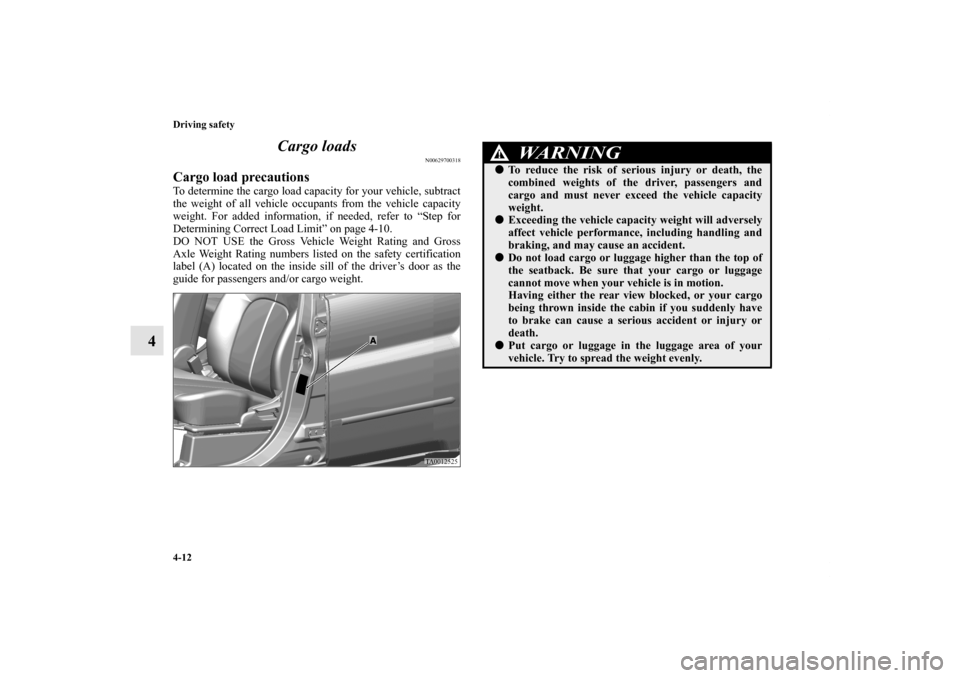
label (A) located on the inside sill of the driver’s door as the
guide for passengers and/or cargo weight.
WA R N I N G
!�To reduce the risk of serious injury or death, the
combined weights of the driver, passengers and
cargo and must never exceed the vehicle capacity
weight.�Exceeding the vehicle capacity weight will adversely
affect vehicle performance, including handling and
braking, and may cause an accident.�Do not load cargo or luggage higher than the top of
the seatback. Be sure that your cargo or luggage
cannot move when your vehicle is in motion.
Having either the rear view blocked, or your cargo
being thrown inside the cabin if you suddenly have
to brake can cause a serious accident or injury or
death.�Put cargo or luggage in the luggage area of your
vehicle. Try to spread the weight evenly.
BK0102600US.book 12 ページ 2009年3月30日 月曜日 午後2時2分
Page 313 of 514
4-14 Driving safety
4
NOTE�Before using an automatic car wash, check with the atten-
dant to determine if the roof carrier should be removed.
�Be sure that adequate clearance is maintained for raising
the sunroof (if so equipped) and/or the liftgate when
installing a roof carrier.
Crossbars
(if so equipped)
N00630500013
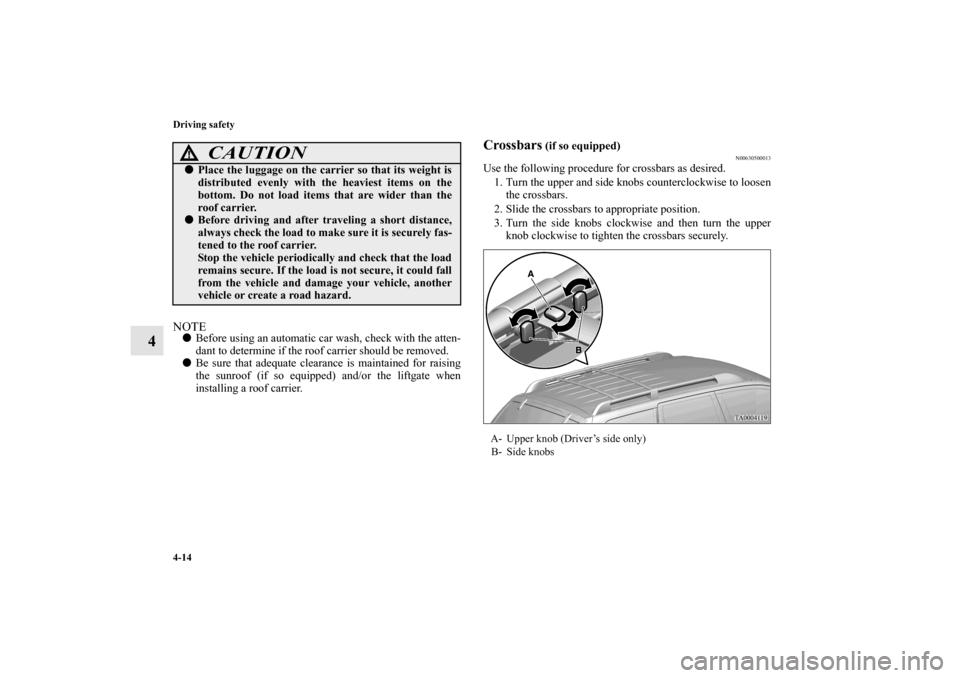
Use the following procedure for crossbars as desired.
1. Turn the upper and side knobs counterclockwise to loosen
the crossbars.
2. Slide the crossbars to appropriate position.
3. Turn the side knobs clockwise and then turn the upper
knob clockwise to tighten the crossbars securely.
CAUTION
!�Place the luggage on the carrier so that its weight is
distributed evenly with the heaviest items on the
bottom. Do not load items that are wider than the
roof carrier.�Before driving and after traveling a short distance,
always check the load to make sure it is securely fas-
tened to the roof carrier.
Stop the vehicle periodically and check that the load
remains secure. If the load is not secure, it could fall
from the vehicle and damage your vehicle, another
vehicle or create a road hazard.
A- Upper knob (Driver’s side only)
B- Side knobs
BK0102600US.book 14 ページ 2009年3月30日 月曜日 午後2時2分
Page 319 of 514

4-20 Driving safety
4
When towing at high altitudes, engine coolant and automatic
transaxle fluid will overheat at a lower temperature than at nor-
mal altitudes.
If you turn your engine off immediately after towing at high
altitude on steep uphill grades, your vehicle may show signs
similar to overheating. To avoid this, let the engine run while
parked (preferably on level ground) with the automatic tran-
saxle in “P” (PARK) position for a few minutes before turning
the engine off.
�If the needle in the engine coolant temperature gauge
approaches the overheating zone, refer to “Engine over-
heating” on page 6-5.
�If the automatic transaxle fluid temperature warning light
illuminates, refer to “Automatic transaxle fluid tempera-
ture warning light” on page 3-43.Driving on hillsReduce speed and shift to a lower gear before you start down a
long or steep downgrade. If you don’t shift down, over using
the brakes can cause reduced brake efficiency.
You can tow in “D” (DRIVE) position. You may want to shift
the transaxle to 3rd gear or a lower gear, under heavy loads or
hilly conditions.
ParkingAlways place chocks or blocks under both the vehicle and
trailer wheels when parking. Apply the parking brake firmly.
Move the selector lever to the “P” (PARK) position. Avoid
parking on a hill with a trailer, but if it cannot be avoided, do so
only after performing the following:
1. Apply the brakes and keep them applied.
2. Have someone place chocks or blocks under both the
vehicle and trailer wheels.
3. When the chocks or blocks are in place, release your
brakes slowly until the chocks or blocks absorb the load.
4. Apply the parking brake firmly.
5. Move the selector lever to the “P” (PARK) position and
turn off the engine.
When restarting out after parking on a hill:
1. Make sure the selector lever is in the “P” (PARK) posi-
tion, and start the engine. Be sure to keep the brake pedal
depressed.
2. Move the selector lever to the 2nd gear, 1st gear or “R”
(REVERSE) position.
3. Release the parking brake and brake pedal and slowly pull
or back away from the chocks or blocks. Stop and apply
your brakes.
4. Have someone retrieve the chocks or blocks.
BK0102600US.book 20 ページ 2009年3月30日 月曜日 午後2時2分
Page 326 of 514
Comfort controls
5-7
5
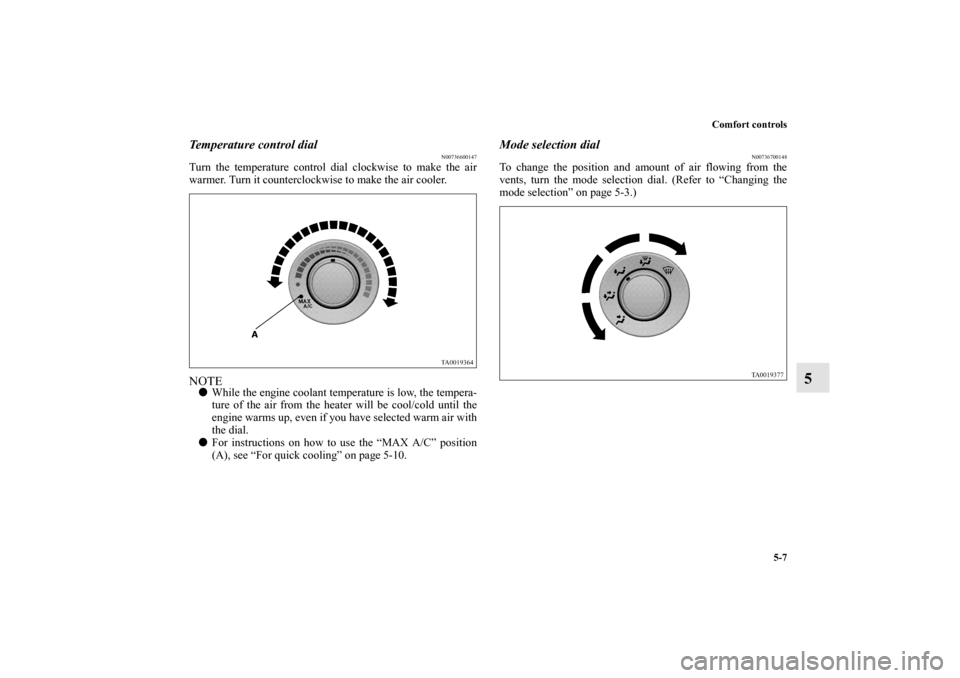
Temperature control dial
N00736600147
Turn the temperature control dial clockwise to make the air
warmer. Turn it counterclockwise to make the air cooler. NOTE�While the engine coolant temperature is low, the tempera-
ture of the air from the heater will be cool/cold until the
engine warms up, even if you have selected warm air with
the dial.
�For instructions on how to use the “MAX A/C” position
(A), see “For quick cooling” on page 5-10.
Mode selection dial
N00736700148
To change the position and amount of air flowing from the
vents, turn the mode selection dial. (Refer to “Changing the
mode selection” on page 5-3.)
BK0102600US.book 7 ページ 2009年3月30日 月曜日 午後2時2分
Page 329 of 514
5-10 Comfort controls
5
Operating the air conditioning system
N00731100176
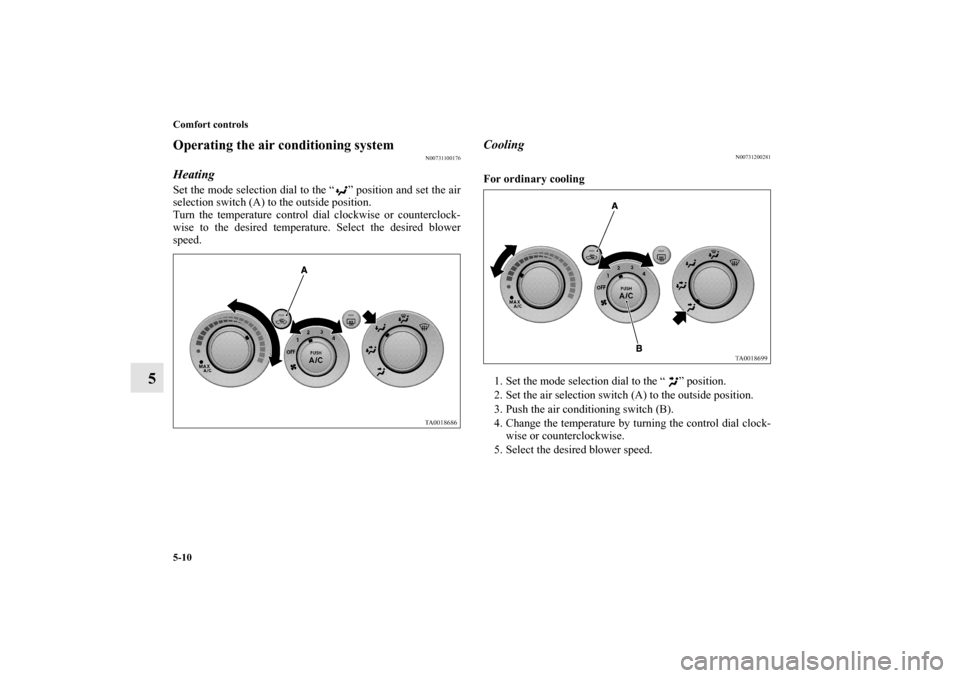
Heating Set the mode selection dial to the “ ” position and set the air
selection switch (A) to the outside position.
Turn the temperature control dial clockwise or counterclock-
wise to the desired temperature. Select the desired blower
speed.
Cooling
N00731200281
For ordinary cooling
1. Set the mode selection dial to the “ ” position.
2. Set the air selection switch (A) to the outside position.
3. Push the air conditioning switch (B).
4. Change the temperature by turning the control dial clock-
wise or counterclockwise.
5. Select the desired blower speed.
BK0102600US.book 10 ページ 2009年3月30日 月曜日 午後2時2分
Page 335 of 514
5-16 Comfort controls
5
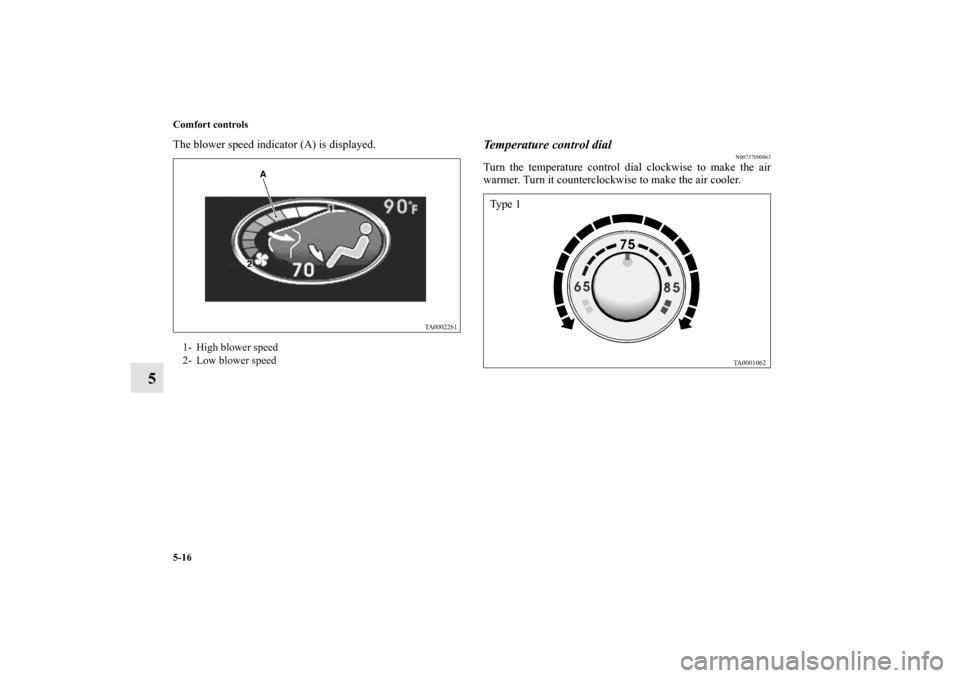
The blower speed indicator (A) is displayed.
Temperature control dial
N00737000063
Turn the temperature control dial clockwise to make the air
warmer. Turn it counterclockwise to make the air cooler.
1- High blower speed
2- Low blower speed
Ty p e 1
BK0102600US.book 16 ページ 2009年3月30日 月曜日 午後2時2分
Page 345 of 514
5-26 Comfort controls
5
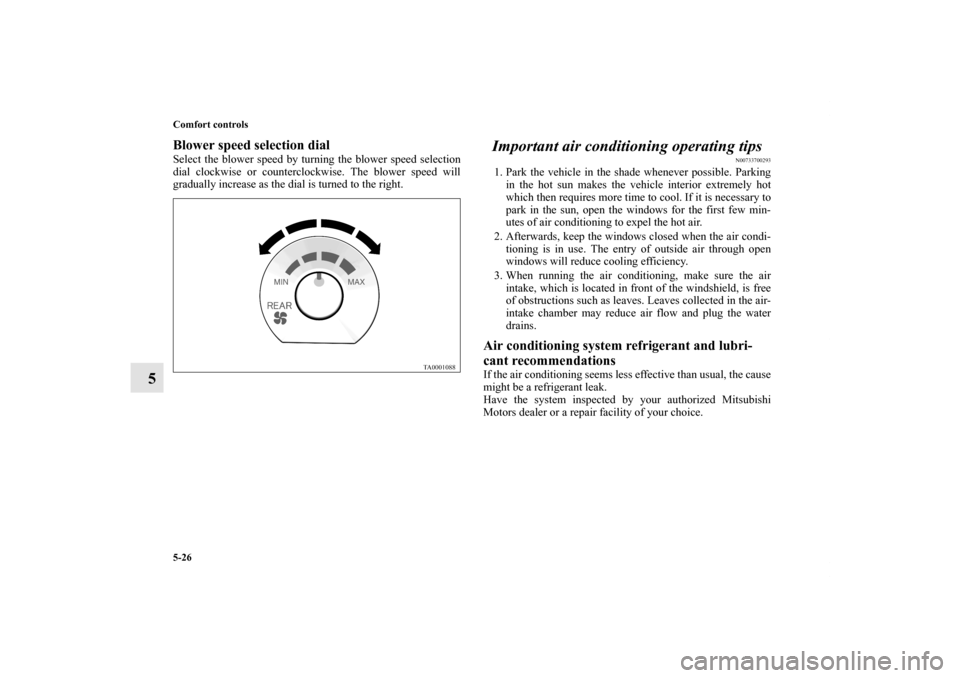
Blower speed selection dialSelect the blower speed by turning the blower speed selection
dial clockwise or counterclockwise. The blower speed will
gradually increase as the dial is turned to the right.
Important air conditioning operating tips
N00733700293
1. Park the vehicle in the shade whenever possible. Parking
in the hot sun makes the vehicle interior extremely hot
which then requires more time to cool. If it is necessary to
park in the sun, open the windows for the first few min-
utes of air conditioning to expel the hot air.
2. Afterwards, keep the windows closed when the air condi-
tioning is in use. The entry of outside air through open
windows will reduce cooling efficiency.
3. When running the air conditioning, make sure the air
intake, which is located in front of the windshield, is free
of obstructions such as leaves. Leaves collected in the air-
intake chamber may reduce air flow and plug the water
drains. Air conditioning system refrigerant and lubri-
cant recommendations If the air conditioning seems less effective than usual, the cause
might be a refrigerant leak.
Have the system inspected by your authorized Mitsubishi
Motors dealer or a repair facility of your choice.
BK0102600US.book 26 ページ 2009年3月30日 月曜日 午後2時2分
Page 350 of 514
Comfort controls
5-31
5
To adjust the volume
N00712000293
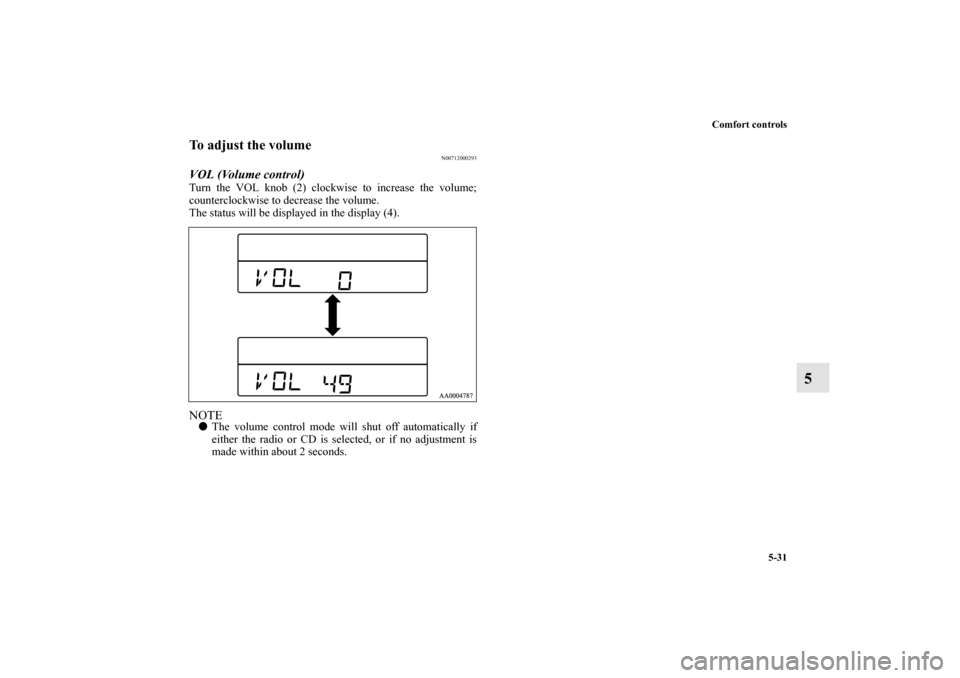
VOL (Volume control) Turn the VOL knob (2) clockwise to increase the volume;
counterclockwise to decrease the volume.
The status will be displayed in the display (4).NOTE�The volume control mode will shut off automatically if
either the radio or CD is selected, or if no adjustment is
made within about 2 seconds.
BK0102600US.book 31 ページ 2009年3月30日 月曜日 午後2時2分