2010 KIA Sportage tow
[x] Cancel search: towPage 13 of 371
Knowing your vehicle
43
1
2
3
4
5
6
7
8
9
Operational distance may vary
depending upon the area the trans-
mitter is used in. For example, if the
vehicle is parked near police sta-
tions, government and public offices,
broadcasting stations, military instal-
lations, airports, or transmitting tow-
ers, etc.
This device complies with
Industry Canada Standard RSS-
210.Operation is subject to the fol-
lowing two conditions:
1. This device may not cause inter- ference, and
2. This device must accept any inter- ference, including interference that
may cause undesired operation of
the device.
Battery replacement
Transmitter uses a 3 volt lithium bat-
tery which will normally last for sev-
eral years. When replacement is nec-
essary, use the following procedure.
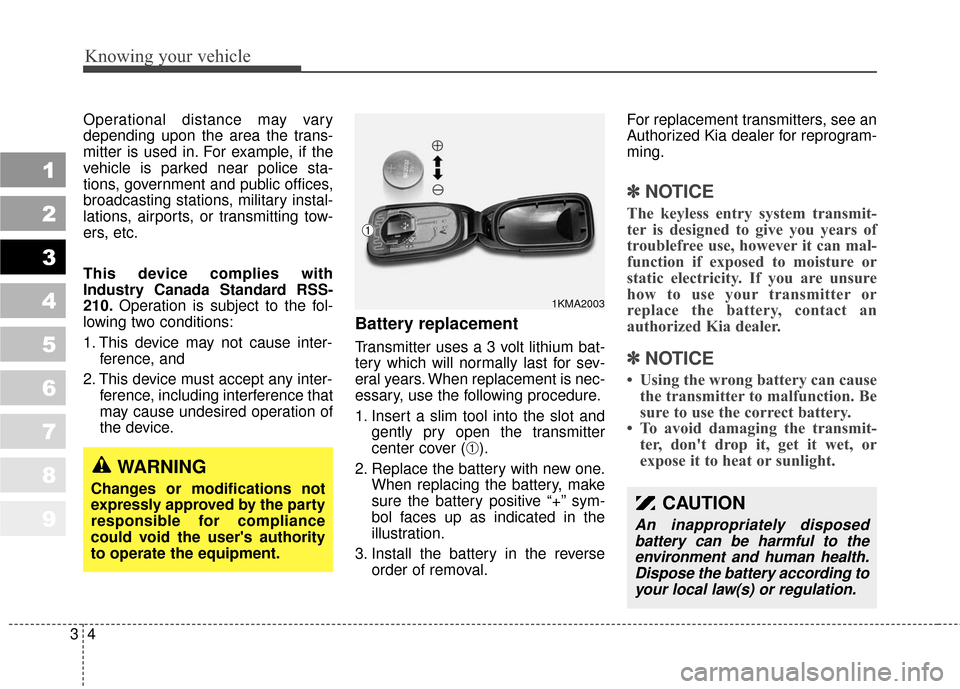
1. Insert a slim tool into the slot andgently pry open the transmitter
center cover (
➀).
2. Replace the battery with new one. When replacing the battery, make
sure the battery positive “+” sym-
bol faces up as indicated in the
illustration.
3. Install the battery in the reverse order of removal. For replacement transmitters, see an
Authorized Kia dealer for reprogram-
ming.
✽ ✽
NOTICE
The keyless entry system transmit-
ter is designed to give you years of
troublefree use, however it can mal-
function if exposed to moisture or
static electricity. If you are unsure
how to use your transmitter or
replace the battery, contact an
authorized Kia dealer.
✽ ✽NOTICE
• Using the wrong battery can cause
the transmitter to malfunction. Be
sure to use the correct battery.
• To avoid damaging the transmit- ter, don't drop it, get it wet, or
expose it to heat or sunlight.
1KMA2003
➀
WARNING
Changes or modifications not
expressly approved by the party
responsible for compliance
could void the user's authority
to operate the equipment.
CAUTION
An inappropriately disposed
battery can be harmful to theenvironment and human health.Dispose the battery according toyour local law(s) or regulation.
Page 17 of 371
Knowing your vehicle
83
1
2
3
4
5
6
7
8
9
4. If all of the digits have been inputsuccessfully, you have to start the
engine within 30 seconds. If you
attempt to start the engine after 30
seconds, the engine will not start
and you will have to input your
password again.
After performing the limp home pro-
cedure, you have to see an autho-
rized Kia dealer immediately to
inspect and repair your ignition key
or immobilizer system.
✽ ✽ NOTICE
If you cannot start your engine in
spite of limp home procedure, have
your vehicle towed by an authorized
Kia dealer for inspection and neces-
sary repairs.
✽ ✽NOTICE
The transponder in your ignition
key is an important part of the
immobilizer system. It is designed to
give years of troublefree service,
however you should avoid exposure
to moisture, static electricity and
rough handling. Immobilizer sys-
tem malfunction could occur.
✽ ✽NOTICE
Do not change, alter or adjust the
immobilizer system because it could
cause the immobilizer system to
malfunction and should only be ser-
viced by an authorized Kia dealer.
Malfunctions caused by improper
alterations, adjustments or modifi-
cations to the immobilizer system
are not covered by your vehicle
manufacturer warranty.
This device complies with
Industry Canada Standard RSS-
210. Operation is subject to the fol-
lowing two conditions:
1. This device may not cause inter- ference, and
2. This device must accept any inter- ference, including interference that
may cause undesired operation of
the device.
WARNING
Changes or modifications not
expressly approved by the party
responsible for compliance
could void the user's authority
to operate the equipment.
Page 18 of 371
39
Knowing your vehicle
1
2
3
4
5
6
7
8
9
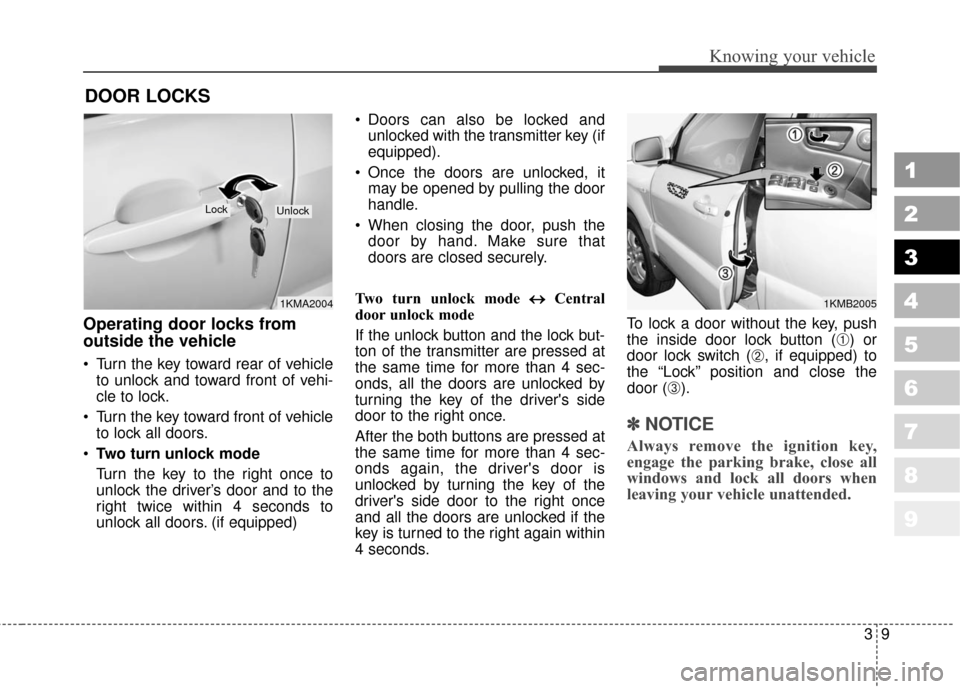
Operating door locks from
outside the vehicle
Turn the key toward rear of vehicleto unlock and toward front of vehi-
cle to lock.
Turn the key toward front of vehicle to lock all doors.
Two turn unlock mode
Turn the key to the right once to
unlock the driver’s door and to the
right twice within 4 seconds to
unlock all doors. (if equipped) Doors can also be locked and
unlocked with the transmitter key (if
equipped).
Once the doors are unlocked, it may be opened by pulling the door
handle.
When closing the door, push the door by hand. Make sure that
doors are closed securely.
Two turn unlock mode ↔ ↔
Central
door unlock mode
If the unlock button and the lock but-
ton of the transmitter are pressed at
the same time for more than 4 sec-
onds, all the doors are unlocked by
turning the key of the driver's side
door to the right once.
After the both buttons are pressed at
the same time for more than 4 sec-
onds again, the driver's door is
unlocked by turning the key of the
driver's side door to the right once
and all the doors are unlocked if the
key is turned to the right again within
4 seconds. To lock a door without the key, push
the inside door lock button (
➀) or
door lock switch (
➁, if equipped) to
the “Lock” position and close the
door (
➂).
✽ ✽ NOTICE
Always remove the ignition key,
engage the parking brake, close all
windows and lock all doors when
leaving your vehicle unattended.
DOOR LOCKS
1KMA2004
LockUnlock
1KMB2005
Page 31 of 371
Knowing your vehicle
22
3
1
2
3
4
5
6
7
8
9
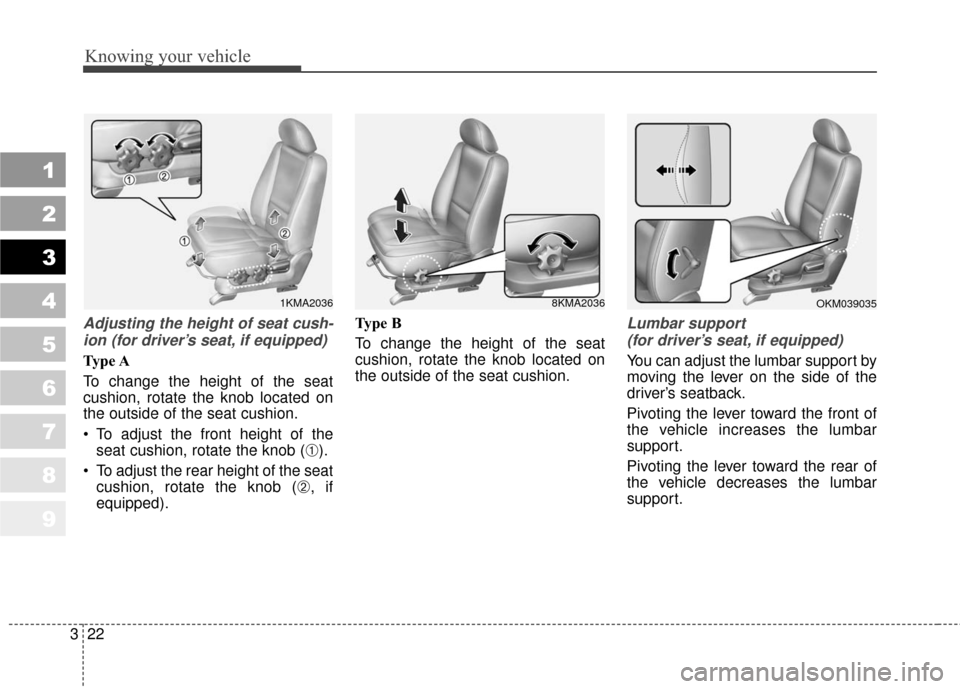
Adjusting the height of seat cush-
ion (for driver’s seat, if equipped)
Type A
To change the height of the seat
cushion, rotate the knob located on
the outside of the seat cushion.
To adjust the front height of the seat cushion, rotate the knob (
➀).
To adjust the rear height of the seat cushion, rotate the knob (
➁, if
equipped). Type B
To change the height of the seat
cushion, rotate the knob located on
the outside of the seat cushion.
Lumbar support
(for driver’s seat, if equipped)
You can adjust the lumbar support by
moving the lever on the side of the
driver’s seatback.
Pivoting the lever toward the front of
the vehicle increases the lumbar
support.
Pivoting the lever toward the rear of
the vehicle decreases the lumbar
support.
8KMA2036OKM0390351KMA2036
Page 52 of 371
343
Knowing your vehicle
1
2
3
4
5
6
7
8
9
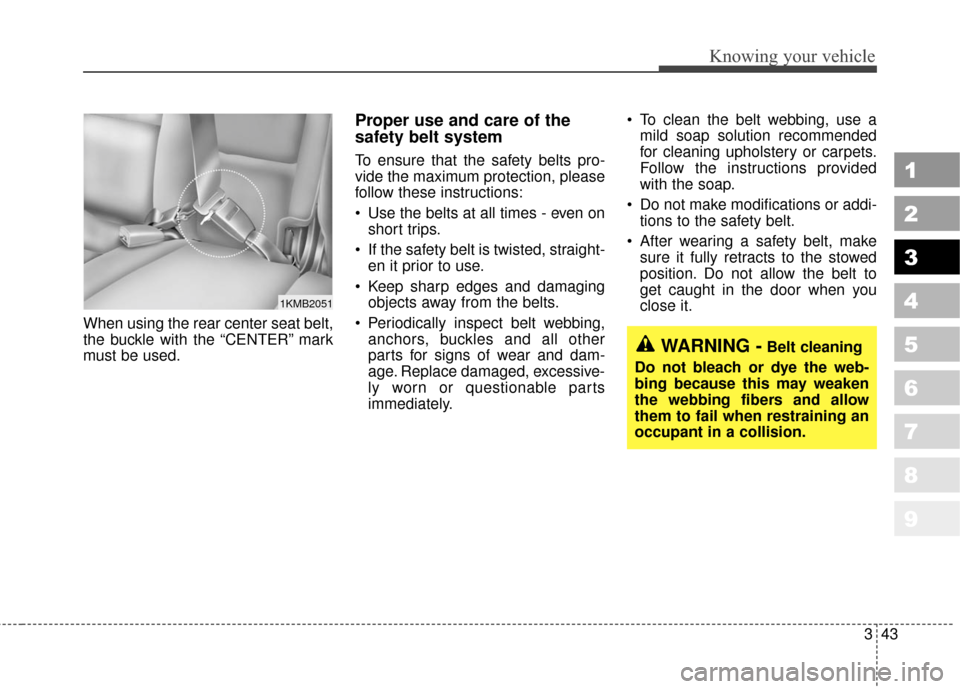
When using the rear center seat belt,
the buckle with the “CENTER” mark
must be used.
Proper use and care of the
safety belt system
To ensure that the safety belts pro-
vide the maximum protection, please
follow these instructions:
Use the belts at all times - even onshort trips.
If the safety belt is twisted, straight- en it prior to use.
Keep sharp edges and damaging objects away from the belts.
Periodically inspect belt webbing, anchors, buckles and all other
parts for signs of wear and dam-
age. Replace damaged, excessive-
ly worn or questionable parts
immediately. To clean the belt webbing, use a
mild soap solution recommended
for cleaning upholstery or carpets.
Follow the instructions provided
with the soap.
Do not make modifications or addi- tions to the safety belt.
After wearing a safety belt, make sure it fully retracts to the stowed
position. Do not allow the belt to
get caught in the door when you
close it.
WARNING -Belt cleaning
Do not bleach or dye the web-
bing because this may weaken
the webbing fibers and allow
them to fail when restraining an
occupant in a collision.
1KMB2051
Page 60 of 371
351
Knowing your vehicle
1
2
3
4
5
6
7
8
9
7. Double check that the retractor isin the “Auto Lock” mode by
attempting to pull more of the safe-
ty belt out of the retractor. If you
cannot, the retractor is in the “Auto
Lock” mode.
To remove the child restraint, press
the release button on the buckle and
then pull the lap/shoulder belt out of
the restraint and allow the safety belt
to retract fully.
When the safety belt is allowed to
retract to its fully stowed position,
the retractor will automatically
switch from the “Auto Lock” mode
to the emergency lock mode for
normal adult usage.
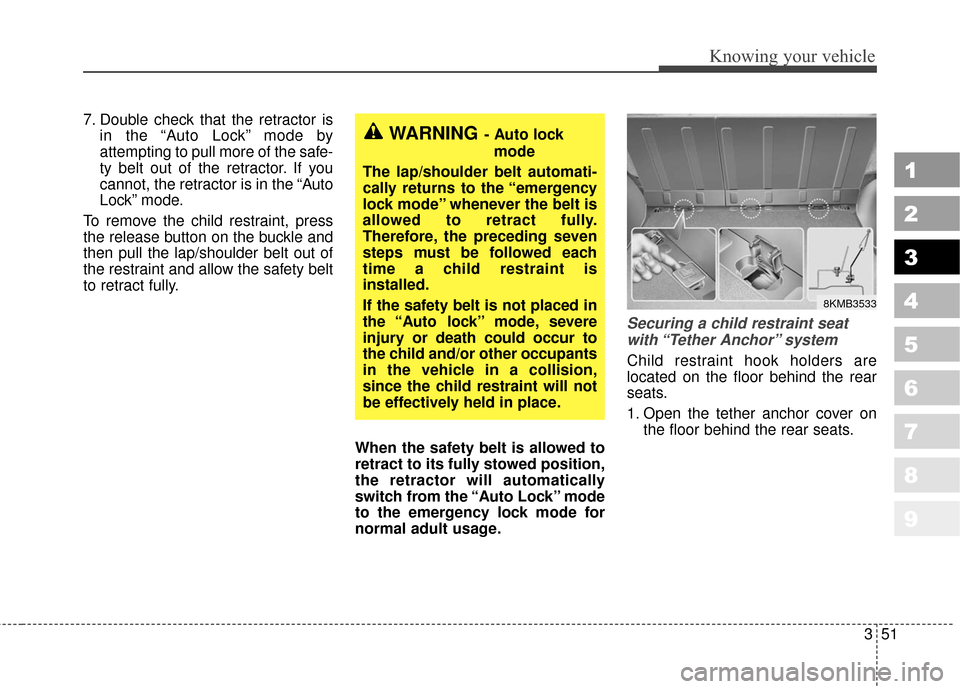
Securing a child restraint seatwith “Tether Anchor” system
Child restraint hook holders are
located on the floor behind the rear
seats.
1. Open the tether anchor cover on the floor behind the rear seats.
WARNING- Auto lock
mode
The lap/shoulder belt automati-
cally returns to the “emergency
lock mode” whenever the belt is
allowed to retract fully.
Therefore, the preceding seven
steps must be followed each
time a child restraint is
installed.
If the safety belt is not placed in
the “Auto lock” mode, severe
injury or death could occur to
the child and/or other occupants
in the vehicle in a collision,
since the child restraint will not
be effectively held in place.
8KMB3533
Page 67 of 371

Knowing your vehicle
58
3
1
2
3
4
5
6
7
8
9
The SRS uses a collection of sen-
sors to gather information about the
driver’s and front passenger’s seat
position, the driver’s and front pas-
senger’s safety belt usage and
impact severity.
The driver's and front passenger's
seat position sensors, which are
installed on the seat track let the
airbag control module know where
the seats are positioned. Similarly,
the safety belt usage sensors mea-
sure if the driver and front passen-
ger’s safety belts are fastened. These
sensors provide the ability to control
the SRS deployment based on how
close the driver’s seat is to the steer-
ing wheel, how close the passen-
ger’s seat is to the instrument panel,
whether or not the safety belts are
fastened, and the severity of the
impact.(Continued)
If your vehicle has been sub-
jected to flood conditions (e.g.
soaked carpeting/standing
water on the floor of the vehi-
cle, etc.) or if your vehicle has
become flood damaged in any
way, do not attempt to start
the vehicle or put the key in
the ignition. Have the vehicle
towed to an authorized Kia
dealer for inspection and nec-
essary repairs.
Disregarding this precaution
may cause an unexpected
airbag deployment, which
could result in serious per-
sonal injury or death.(Continued)
If occupants are not wearingsafety belts or correctly seat-
ed, they cannot be fully pro-
tected, and thus face a greater
risk of serious injury or death.
Driver’s and front passenger’s airbag are designed to inflate
only in certain frontal colli-
sion, and side and curtain
airbags are designed to inflate
in certain side impacts.
Frontal airbags are not
designed to provide protec-
tion in side impacts, rear
impacts, rollovers, or less
severe frontal collisions. They
will not provide protection
from later impacts in a multi-
impact collision.
(Continued)
Page 71 of 371
Knowing your vehicle
62
3
1
2
3
4
5
6
7
8
9
Main components of occupant
classification system
A detection device located within
the front passenger seat track.
Electronic system to determine whether passenger air bag sys-
tems (both front and side) should
be activated or deactivated.
A warning light located on the instrument panel which illuminates
the words PASSENGER AIR BAG
“OFF” indicating the front passen-
ger air bag system is deactivated.
The instrument panel air bag warn- ing light is interconnected with the
occupant classification system. Always be sure that you and all vehi-
cle occupants are seated and
restrained properly (sitting upright
with the seat in an upright position,
centered on the seat cushion, with
the person’s legs comfortably
extended, feet on the floor, and wear-
ing the safety belt properly) for the
most effective protection by the air
bag and the safety belt.
The OCS (Occupant Classification
System) may not function properly
if the passenger takes actions
which can defeat the detection sys-
tem. These include:
(1) Failing to sit in an upright posi- tion.
(2) Leaning against the door or cen- ter console.
(3) Sitting towards the sides or the front of the seat.
(4) Putting legs on the dashboard or resting them on other locations
which reduce the passenger
weight on the front seat.
(5) Improperly wearing the safety
belt.
(6) Reclining the seat back. The PASSENGER AIR BAG “OFF”
indicator illuminates after the igni-
tion key is turned to the “ON” posi-
tion or after the engine is started. If
the front passenger’s seat is occu-
pied by very small person, the
PASSENGER AIR BAG “OFF” indi-
cator will remain illuminated. If the
front passenger’s seat is occupied
by a person of adult size, the PAS-
SENGER AIR BAG “OFF” indicator
will turn off after 4 seconds.
If the front passenger's seat is unoccupied, the PASSENGER AIR
BAG “OFF” indicator will turn on,
and the front passenger's airbag
will not deploy in frontal crashes.
If the PASSENGER AIR BAG “OFF” indicator illuminates, the
front passenger’s airbag will not
deploy in frontal crashes.
If the front passenger’s seat is occupied by a person of adult size,
the PASSENGER AIR BAG “OFF”
indicator is not illuminated and the
front passenger’s airbag will deploy
in frontal crashes.