2010 KIA Sportage lock
[x] Cancel search: lockPage 328 of 371

719
Maintenance
1
2
3
4
5
6
7
8
9
ENGINE COOLING SYSTEM
The high-pressure cooling system
has a reservoir filled with year-round
antifreeze coolant. The reservoir is
filled at the factory.
Check the antifreeze protection and
coolant level at least once a year, at
the beginning of the winter season,
and before traveling to a colder cli-
mate.Checking the coolant level
WARNING- Removingradiator cap
Never attempt to remove the radiator cap while the engine
is operating or hot. Doing so
might lead to cooling system
and engine damage and could
result in serious personal
injury from escaping hot
coolant or steam.
Turn the engine off and wait until it cools down. Use
extreme care when removing
the radiator cap. Wrap a thick
towel around it, and turn it
counterclockwise slowly to
the first stop. Step back while
the pressure is released from
the cooling system. When you
are sure all the pressure has
been released, press down on
the cap, using a thick towel,
and continue turning counter-
clockwise to remove it.
(Continued)
(Continued)
Even if the engine is not oper-ating, do not remove the radi-
ator cap or the drain plug
while the engine and radiator
are hot. Hot coolant and steam
may still blow out under pres-
sure, causing serious injury.
Page 337 of 371
Maintenance
28
7
1
2
3
4
5
6
7
8
9
LUBRICANTS AND FLUIDS
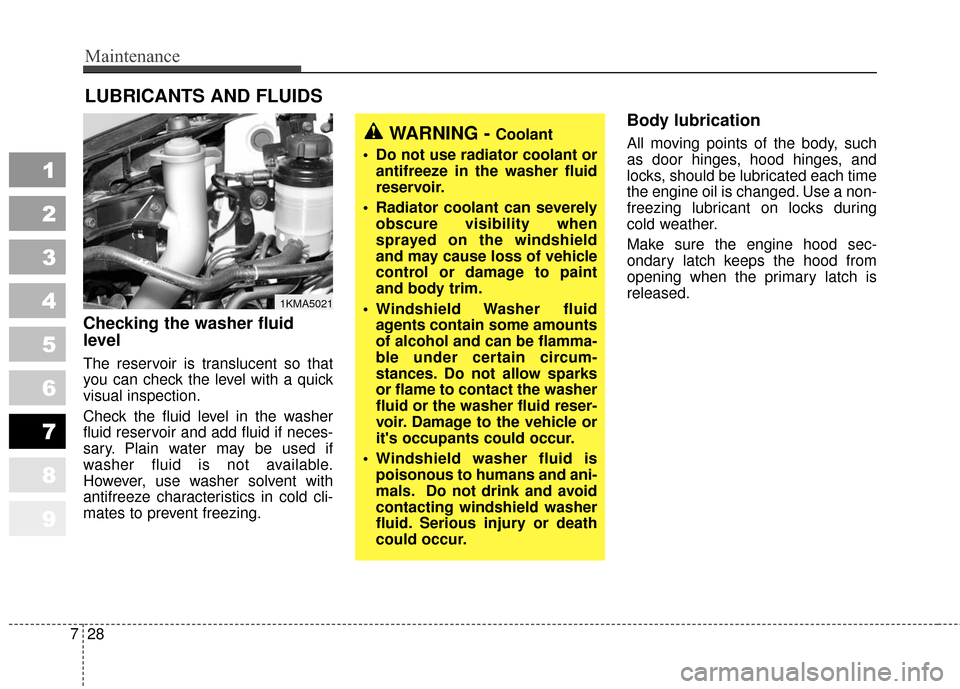
Checking the washer fluid
level
The reservoir is translucent so that
you can check the level with a quick
visual inspection.
Check the fluid level in the washer
fluid reservoir and add fluid if neces-
sary. Plain water may be used if
washer fluid is not available.
However, use washer solvent with
antifreeze characteristics in cold cli-
mates to prevent freezing.
Body lubrication
All moving points of the body, such
as door hinges, hood hinges, and
locks, should be lubricated each time
the engine oil is changed. Use a non-
freezing lubricant on locks during
cold weather.
Make sure the engine hood sec-
ondary latch keeps the hood from
opening when the primary latch is
released.
1KMA5021
WARNING - Coolant
Do not use radiator coolant or antifreeze in the washer fluid
reservoir.
Radiator coolant can severely obscure visibility when
sprayed on the windshield
and may cause loss of vehicle
control or damage to paint
and body trim.
Windshield Washer fluid agents contain some amounts
of alcohol and can be flamma-
ble under certain circum-
stances. Do not allow sparks
or flame to contact the washer
fluid or the washer fluid reser-
voir. Damage to the vehicle or
it's occupants could occur.
Windshield washer fluid is poisonous to humans and ani-
mals. Do not drink and avoid
contacting windshield washer
fluid. Serious injury or death
could occur.
Page 341 of 371
Maintenance
32
7
1
2
3
4
5
6
7
8
9
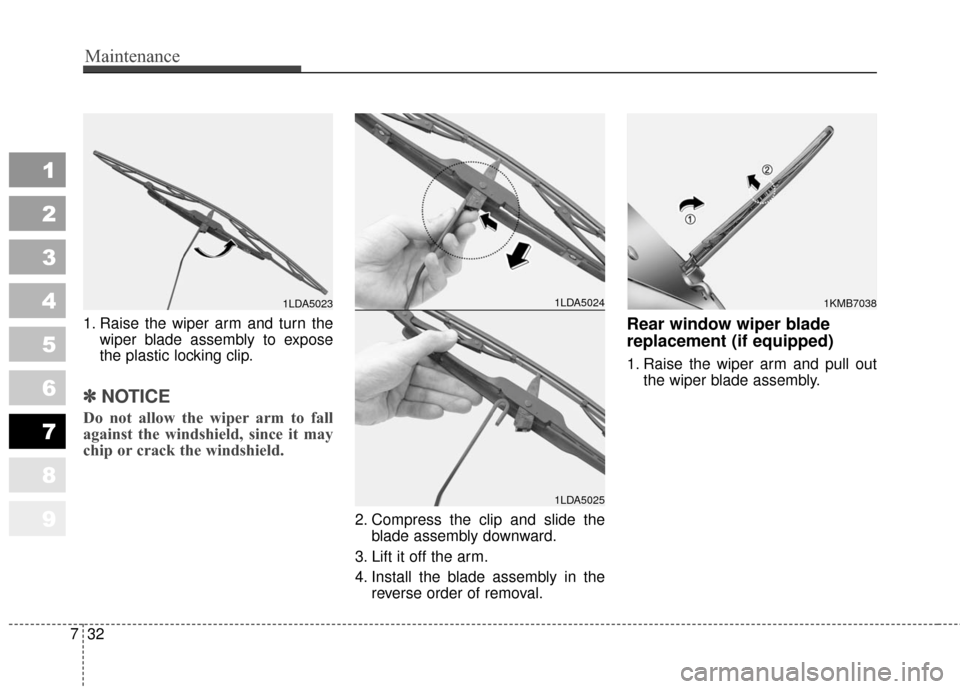
1. Raise the wiper arm and turn the
wiper blade assembly to expose
the plastic locking clip.
✽ ✽NOTICE
Do not allow the wiper arm to fall
against the windshield, since it may
chip or crack the windshield.
2. Compress the clip and slide the
blade assembly downward.
3. Lift it off the arm.
4. Install the blade assembly in the reverse order of removal.
Rear window wiper blade
replacement (if equipped)
1. Raise the wiper arm and pull outthe wiper blade assembly.
1LDA50231LDA5024
1LDA5025
1KMB7038
Page 343 of 371
Maintenance
34
7
1
2
3
4
5
6
7
8
9
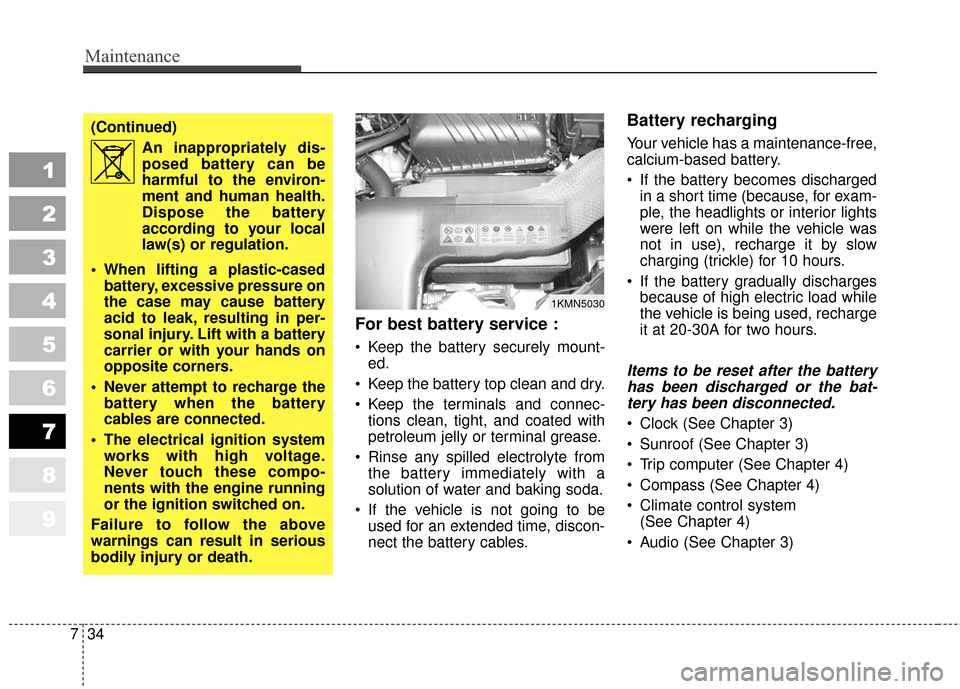
For best battery service :
Keep the battery securely mount-
ed.
Keep the battery top clean and dry.
Keep the terminals and connec- tions clean, tight, and coated with
petroleum jelly or terminal grease.
Rinse any spilled electrolyte from the battery immediately with a
solution of water and baking soda.
If the vehicle is not going to be used for an extended time, discon-
nect the battery cables.
Battery recharging
Your vehicle has a maintenance-free,
calcium-based battery.
If the battery becomes dischargedin a short time (because, for exam-
ple, the headlights or interior lights
were left on while the vehicle was
not in use), recharge it by slow
charging (trickle) for 10 hours.
If the battery gradually discharges because of high electric load while
the vehicle is being used, recharge
it at 20-30A for two hours.
Items to be reset after the batteryhas been discharged or the bat-tery has been disconnected.
Clock (See Chapter 3)
Sunroof (See Chapter 3)
Trip computer (See Chapter 4)
Compass (See Chapter 4)
Climate control system (See Chapter 4)
Audio (See Chapter 3)
1KMN5030
(Continued) An inappropriately dis-
posed battery can be
harmful to the environ-
ment and human health.
Dispose the battery
according to your local
law(s) or regulation.
When lifting a plastic-cased battery, excessive pressure on
the case may cause battery
acid to leak, resulting in per-
sonal injury. Lift with a battery
carrier or with your hands on
opposite corners.
Never attempt to recharge the battery when the battery
cables are connected.
The electrical ignition system works with high voltage.
Never touch these compo-
nents with the engine running
or the ignition switched on.
Failure to follow the above
warnings can result in serious
bodily injury or death.
Page 349 of 371
Maintenance
40
7
1
2
3
4
5
6
7
8
9
Wheel alignment and tire
balance
The wheels on your vehicle were
aligned and balanced carefully at the
factory to give you the longest tire life
and best overall performance.
In most cases, you will not need to
have your wheels aligned again.
However, if you notice unusual tire
wear or your vehicle pulling one way
or the other, the alignment may need
to be reset.
If you notice your vehicle vibrating
when driving on a smooth road, your
wheels may need to be rebalanced.
✽ ✽
NOTICE
Improper wheel weights can dam-
age your vehicle's aluminum wheels.
Use only approved wheel weights.
WARNING - Replacing
tires
Driving on worn-out tires is very hazardous and will reduce
braking effectiveness, steering
accuracy, and traction.
Your vehicle is equipped with tires designed to provide for
safe ride and handling capabil-
ity. Do not use a size and type
of tire and wheel that is differ-
ent from the one that is origi-
nally installed on your vehicle.
It can affect the safety and per-
formance of your vehicle,
which could lead to handling
failure or rollover and serious
injury. When replacing the tires,
be sure to equip all four tires
with the tire and wheel of the
same size, type, tread, brand
and load-carrying capacity. If
you nevertheless decide to
equip your vehicle with any
tire/wheel combination not rec-
ommended by Kia for off road
driving, you should not use
these tires for highway driving.
(Continued)(Continued)
The use of any other tire sizeor type may seriously affect
ride, handling, ground clear-
ance, stopping distance, body
to tire clearance, snow tire
clearance, and speedometer
reliability.
It is best to replace all four tires at the same time. If that is
not possible, or necessary,
then replace the two front or
two rear tires as a pair.
Replacing just one tire can
seriously affect your vehicle’s
handling.
The ABS works by comparing the speed of the wheels. Tire
size can affect wheel speed.
When replacing tires, all 4
tires must use the same size
originally supplied with the
vehicle. Using tires of a differ-
ent size can cause the ABS
(Anti-lock Brake System) and
ESC (Electronic Stability
Control) (if equipped) to work
irregularly.
Page 369 of 371

Index
29
1
2
3
4
5
6
7
8
9
Air cleaner. . . . . . . . . . . . . . . . . . . . . . . . . . . . . . . . . . 7-29\
Airbags-supplemental restraint system . . . . . . . . . . 3-55
Audio system . . . . . . . . . . . . . . . . . . . . . . . . . . . . . . . 3-105
Automatic climate control system. . . . . . . . . . . . . . . 4-71
Automatic transaxle . . . . . . . . . . . . . . . . . . . . . . 4-6, 7-25
Battery . . . . . . . . . . . . . . . . . . . . . . . . . . . . . . . . . . . . \
. 7-33
Before driving . . . . . . . . . . . . . . . . . . . . . . . . . . . . . . . . 5-5
Brake system . . . . . . . . . . . . . . . . . . . . . . . . . . . . . . . . 4-18
Brakes and clutch . . . . . . . . . . . . . . . . . . . . . . . . . . . . 7-22
Climate control air filter . . . . . . . . . . . . . . . . . . . . . . 7-30
Compass . . . . . . . . . . . . . . . . . . . . . . . . . . . . . . . . . . . 4-\
51
Cruise control system. . . . . . . . . . . . . . . . . . . . . . . . . 4-26
Defroster . . . . . . . . . . . . . . . . . . . . . . . . . . . . . . . . . . . 4-\
61
Door locks . . . . . . . . . . . . . . . . . . . . . . . . . . . . . . . . . . . 3-\
9
Electrical circuit protection . . . . . . . . . . . . . . . . . . . . . 6-7
Electronic stability control . . . . . . . . . . . . . . . . . . . . 4-30
Emergency starting . . . . . . . . . . . . . . . . . . . . . . . . . . . 6-4Emission control system . . . . . . . . . . . . . . . . . . . . . . . 5-3
Engine compartment . . . . . . . . . . . . . . . . . . . . . . . . . 7-15
Engine cooling system . . . . . . . . . . . . . . . . . . . . . . . . 7-19
Engine oil and oil filter . . . . . . . . . . . . . . . . . . . . . . . 7-17
Explanation of scheduled maintenance items . . . . . . 7-8
Exterior care . . . . . . . . . . . . . . . . . . . . . . . . . . . . . . . . 7-50
Four wheel drive (4WD) . . . . . . . . . . . . . . . . . . . . . . 4-12
Fuel filler lid . . . . . . . . . . . . . . . . . . . . . . . . . . . . . . . . 3-81
Fuel requirements . . . . . . . . . . . . . . . . . . . . . . . . . . . . 5-2
Gauges . . . . . . . . . . . . . . . . . . . . . . . . . . . . . . . . . . . . \
. 4-34
Hazard warning flasher . . . . . . . . . . . . . . . . . . . . . . . 4-62
Homelink® wireless control system . . . . . . . . . . . . . 5-45
Hood. . . . . . . . . . . . . . . . . . . . . . . . . . . . . . . . . . \
. . . . . 3-80
How to use this manual . . . . . . . . . . . . . . . . . . . . . . . . 1-2
If you have a flat tire . . . . . . . . . . . . . . . . . . . . . . . . . 6-19
Ignition switch . . . . . . . . . . . . . . . . . . . . . . . . . . . . . . . 4-2
Immobilizer system . . . . . . . . . . . . . . . . . . . . . . . . . . . 3-6
In case of an emergency while driving . . . . . . . . . . . . 6-2
Instrument cluster . . . . . . . . . . . . . . . . . . . . . . . . . . . 4-33
A
B
C
D
E
G
F
H
I