Page 343 of 522

NOTE:To improve the vehicle’s traction when driving
with snow chains, or when starting off in deep snow,
sand, or gravel, it may be desirable to switch to the
“Partial Off” mode by momentarily pressing the “ESC
Off” button. Once the situation requiring “Partial Off”
mode is overcome, turn ESC back on by momentarily
pressing the “ESC Off” button. This may be done while
the vehicle is in motion.
Full Off — Four-Wheel Drive Vehicles in 4WD High
and 4WD Low Range
The “Full Off” mode is intended for off-highway and
off-road use when ESC stability features could inhibit
vehicle maneuverability due to trail conditions.
The “ESC Off” button is located in the lower switch bank
below the climate control panel. To enter “Full Off”
mode, press and hold the “ESC Off” button for five
seconds while the vehicle is stopped with the engine
running. After five seconds, the “ESC Off Indicator Light” will illuminate and an “ESC OFF” message will
appear in the odometer. Press and release the trip odom-
eter button located on the instrument cluster to turn off
this message.
In this mode, ESC and TCS are turned off (except for the
“limited slip” feature described in the TCS section) until
the vehicle reaches a speed of 40 mph (64 km/k). At
speeds over 40 mph (64 km/k), the system automatically
switches to “Partial Off” mode, described above. When
the vehicle speed returns to less than 35 mph (56 km/h),
the ESC system will return to “Full Off” mode. The “ESP
Off Indicator Light” is always illuminated when ESC is
off. To turn ESC on again, momentarily press the “ESC
Off” button. This will restore the normal “ESC On” mode
of operation.
342 STARTING AND OPERATING
Page 368 of 522
3. Lots of snow or ice around the wheels or wheel
housings.
4. Using tire chains on the vehicle.
5. Using wheels/tires not equipped with TPMS sensors.
Vehicles with Full-Size Spare
1. The matching full-size spare wheel and tire assembly
has a tire pressure monitoring sensor that can be moni-
tored by the TPMS.
2. If you install the full-size spare in place of a road tire
that has a pressure below the low-pressure warning limit,
a chime will sound and the “TPMS Telltale Light” will
turn on upon the next ignition key cycle.
3. Driving the vehicle for up to 20 minutes above 15 mph
(25 km/h) will turn off the “TPMS Telltale Light,” as long
as no tire pressure is below the low-pressure warning
limit in any of the four active road tires.Vehicles with Compact Spare
1. The compact spare tire does not have a tire pressure
monitoring sensor. Therefore, the TPMS will not monitor
the pressure in the compact spare tire.
2. If you install the compact spare tire in place of a road
tire that has a pressure below the low-pressure warning
limit, a chime will sound and the “TPMS Telltale Light”
will turn on upon the next ignition key cycle.
3. After driving the vehicle for up to 20 minutes above
15 mph (25 km/h), the “TPMS Telltale Light” will flash
on and off for 75 seconds and then remain on solid.
4. For each subsequent ignition key cycle, a chime will
sound and the “TPMS Telltale Light” will flash on and off
for 75 seconds and then remain on solid.
5. Once you repair or replace the original road tire and
reinstall it on the vehicle in place of the compact spare,
the TPMS will update automatically and the “TPMS
5
STARTING AND OPERATING 367
Page 371 of 522
Check TPMS Warning
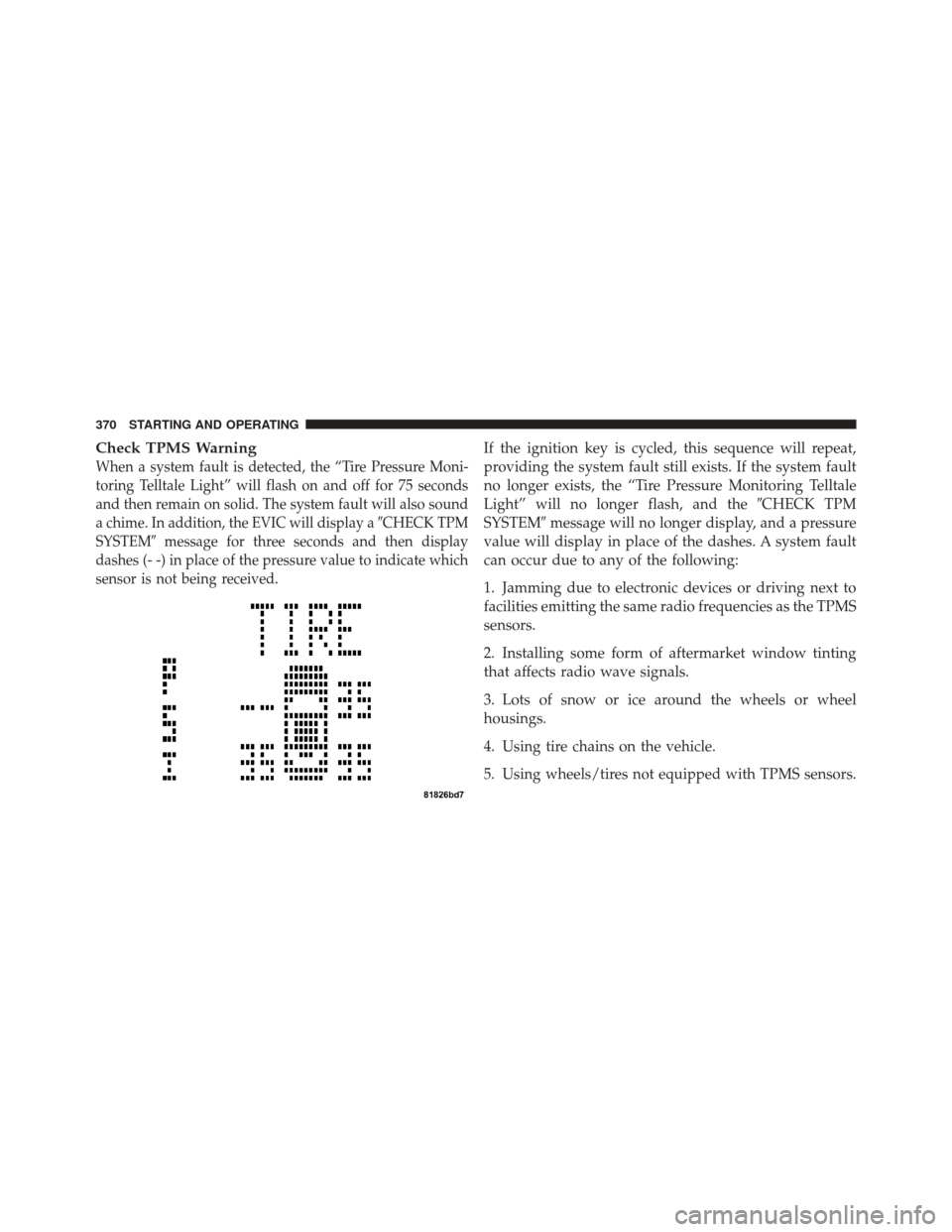
When a system fault is detected, the “Tire Pressure Moni-
toring Telltale Light” will flash on and off for 75 seconds
and then remain on solid. The system fault will also sound
a chime. In addition, the EVIC will display a�CHECK TPM
SYSTEM� message for three seconds and then display
dashes (- -) in place of the pressure value to indicate which
sensor is not being received.
If the ignition key is cycled, this sequence will repeat,
providing the system fault still exists. If the system fault
no longer exists, the “Tire Pressure Monitoring Telltale
Light” will no longer flash, and the �CHECK TPM
SYSTEM� message will no longer display, and a pressure
value will display in place of the dashes. A system fault
can occur due to any of the following:
1. Jamming due to electronic devices or driving next to
facilities emitting the same radio frequencies as the TPMS
sensors.
2. Installing some form of aftermarket window tinting
that affects radio wave signals.
3. Lots of snow or ice around the wheels or wheel
housings.
4. Using tire chains on the vehicle.
5. Using wheels/tires not equipped with TPMS sensors.
370 STARTING AND OPERATING
Page 517 of 522

Sentry Key (Immobilizer)................... 14
Sentry Key Programming ................... 16
Sentry Key Replacement ................... 15
Service Assistance ....................... 491
Service Contract ......................... 493
Service Engine Soon Light
(Malfunction Indicator) .................... 210
Service Manuals ........................ 495
Setting the Clock ................ 237,251,254,263
Settings, Personal ........................ 231
Shift Lock Manual Override ................ 303
Shifting Automatic Transmission ................. 305
Transfer Case ................. 309,312,315,318
Shoulder Belts ........................... 42
Side View Mirror Adjustment ................ 95
Side Window Demisters (Defrosters) .......... 292
Signals, Turn ................. 88,152,211,462,464
Sky Slider Power Roof .................183,446Snow Chains (Tire Chains)
................. 360
Spare Tire .......................... 355,406
Spark Plugs ............................ 466
Specifications Fuel (Gasoline) ........................ 466
Oil .............................. 425,466
Speed Control (Cruise Control) .............. 160
Speedometer ........................... 211
Starting ............................. 26,299
Cold Weather ......................... 300
Emergency (Jump Starting) ............... 412
Engine Block Heater .................... 301
Engine Fails to Start .................... 300
Remote .............................. 26
Starting and Operating .................... 299
Starting Procedures ...................... 299
Steering Power ........................... 325,327
Tilt Column .......................... 159
516 INDEX