Page 259 of 407

the brake of the appropriate wheel to assist in counter-
acting the over/under steer condition. Engine power
may also be reduced to help the vehicle maintain the
desired path.
ESP uses sensors in the vehicle to determine the vehicle
path intended by the driver and compares it to the actual
path of the vehicle. When the actual path does not match
the intended path, ESP applies the brake of the appropri-
ate wheel to assist in counteracting the oversteer or
understeer condition.
•Oversteer - when the vehicle is turning more than
appropriate for the steering wheel position.
•Understeer - when the vehicle is turning less than
appropriate for the steering wheel position.
The “ESP/TCS Indicator Light” in the instrument cluster
will start to flash as soon as the tires lose traction and the
ESP system becomes active. The “ESP/TCS Indicator Light” also flashes when TCS is active. If the “ESP/TCS
Indicator Light” begins to flash during acceleration, ease
up on the accelerator and apply as little throttle as
possible. Be sure to adapt your speed and driving to the
prevailing road conditions.
WARNING!
The Electronic Stability Program (ESP) cannot pre-
vent the natural laws of physics from acting on the
vehicle, nor can it increase the traction afforded by
prevailing road conditions. ESP cannot prevent acci-
dents, including those resulting from excessive speed
in turns, driving on very slippery surfaces, or hydro-
planing. Only a safe, attentive, and skillful driver can
prevent accidents. The capabilities of an ESP-
equipped vehicle must never be exploited in a reck-
less or dangerous manner which could jeopardize the
user’s safety or the safety of others.
258 STARTING AND OPERATING
Page 274 of 407

Safety
WARNING!
•Improperly inflated tires are dangerous and can
cause accidents.
•Under inflation increases tire flexing and can
result in over-heating and tire failure.
•Over inflation reduces a tire’s ability to cushion
shock. Objects on the road and chuck holes can
cause damage that results in tire failure.
•Unequal tire pressures can cause steering prob-
lems. You could lose control of your vehicle.
•Overinflated or under inflated tires can affect
vehicle handling and can fail suddenly, resulting
in loss of vehicle control.
•Unequal tire pressures from one side of the ve-
hicle to the other can cause the vehicle to drift to
the right or left.
Economy
Improper inflation pressures can cause uneven wear
patterns to develop across the tire tread. These abnormal
wear patterns will reduce tread life resulting in a need for
earlier tire replacement. Under inflation also increases
tire rolling resistance and results in higher fuel
consumption.
Ride Comfort and Vehicle Stability
Proper tire inflation contributes to a comfortable ride.
Over inflation produces a jarring and uncomfortable ride.
Both under inflation and over inflation affect the stability
of the vehicle and can produce a feeling of sluggish
response or over responsiveness in the steering.
Unequal tire pressures can cause erratic and unpredict-
able steering response.
Unequal tire pressure from side to side may cause the
vehicle to drift left or right.5
STARTING AND OPERATING 273
Page 279 of 407
WARNING!
•Do not use a tire, wheel size or rating other than
that specified for your vehicle. Some combinations
of unapproved tires and wheels may change sus-
pension dimensions and performance characteris-
tics, resulting in changes to steering, handling, and
braking of your vehicle. This can cause unpredict-
able handling and stress to steering and suspen-
sion components. You could lose control and have
an accident resulting in serious injury or death.
Use only the tire and wheel sizes with load ratings
approved for your vehicle.
•Never use a tire with a smaller load index or
capacity, other than what was originally equipped
on your vehicle. Using a tire with a smaller load
index could result in tire overloading and failure.
You could lose control and have an accident.(Continued)
WARNING! (Continued)
•Failure to equip your vehicle with tires having
adequate speed capability can result in sudden tire
failure and loss of vehicle control.
CAUTION!
Replacing original tires with tires of a different size
may result in false speedometer and odometer read-
ings.
TIRE ROTATION RECOMMENDATIONS
Do not rotate the tires as the wider rear tires will not fit
on the front of the vehicle.
278 STARTING AND OPERATING
Page 292 of 407
Weight-Distributing Hitch
A weight-distributing system works by applying lever-
age through spring (load) bars. They are typically used
for heavier loads, to distribute trailer tongue weight to
the tow vehicle’s front axle and the trailer axle(s). When
used in accordance with the manufacturers’ directions, it
provides for a more level ride, offering more consistent
steering and brake control thereby enhancing towing
safety. The addition of a friction/hydraulic sway control
also dampens sway caused by traffic and crosswinds and
contributes positively to tow vehicle and trailer stability.
Trailer sway control and a weight distributing (load
equalizing) hitch are recommended for heavier Tongue
Weights (TW) and may be required depending on Vehicle
and Trailer configuration/loading to comply with gross
axle weight rating (GAWR) requirements.WARNING!
•An improperly adjusted weight-distributing hitch
system may reduce handling, stability, braking
performance, and could result in an accident.
•Weight-distributing hitch systems may not be
compatible with Surge Brake Couplers. Consult
with your hitch and trailer manufacturer or a
reputable Recreational Vehicle dealer for addi-
tional information.
5
STARTING AND OPERATING 291
Page 296 of 407

Towing Requirements
To promote proper break-in of your new vehicle drive-
train components the following guidelines are recom-
mended:
CAUTION!
•Do not tow a trailer at all during the first 500 miles
(805 km) the new vehicle is driven. The engine,
axle or other parts could be damaged.
•Then, during the first 500 miles (805 km) that a
trailer is towed, do not drive over 50 mph
(80 km/h) and do not make starts at full throttle.
This helps the engine and other parts of the
vehicle wear in at the heavier loads.
WARNING!
Improper towing can lead to an injury accident.
Follow these guidelines to make your trailer towing
as safe as possible:
•Make certain that the load is secured in the trailer
and will not shift during travel. When trailering
cargo that is not fully secured, dynamic load shifts
can occur that may be difficult for the driver to
control. You could lose control of your vehicle and
have an accident.
•When hauling cargo or towing a trailer, do not
overload your vehicle or trailer. Overloading can
cause a loss of control, poor performance or dam-
age to brakes, axle, engine, transmission, steering,
suspension, chassis structure or tires.(Continued)
5
STARTING AND OPERATING 295
Page 314 of 407
ENGINE COMPARTMENT – 6.1L
1 — Engine Coolant Reservoir7 — Engine Oil Dipstick
2 — Power Distribution Center 8 — Power Steering Fluid Reservoir
3 — Brake Fluid Reservoir 9 — Engine Oil Fill
4 — Integrated Power Module 10 — Coolant Pressure Cap
5 — Battery 11 — Air Cleaner Filter
6 — Washer Fluid Reservoir7
MAINTAINING YOUR VEHICLE 313
Page 319 of 407

Besides those maintenance items specified in the fixed
maintenance schedule, there are other components which
may require servicing or replacement in the future.
CAUTION!
•Failure to properly maintain your vehicle or per-
form repairs and service when necessary could
result in more costly repairs, damage to other
components or negatively impact vehicle perfor-
mance. Immediately have potential malfunctions
examined by an authorized Chrysler Group LLC
dealership or qualified repair center.(Continued)
CAUTION! (Continued)
•Your vehicle has been built with improved fluids
that protect the performance and durability of
your vehicle and also allow extended maintenance
intervals. Do not use chemical flushes in these
components as the chemicals can damage your
engine, transmission, power steering or air condi-
tioning. Such damage is not covered by the New
Vehicle Limited Warranty. If a flush is needed
because of component malfunction, use only the
specified fluid for the flushing procedure.
Engine Oil
Checking Oil Level
To assure proper engine lubrication, the engine oil must
be maintained at the correct level. Check the oil level at
regular intervals, such as every fuel stop. The best time to
318 MAINTAINING YOUR VEHICLE
Page 342 of 407
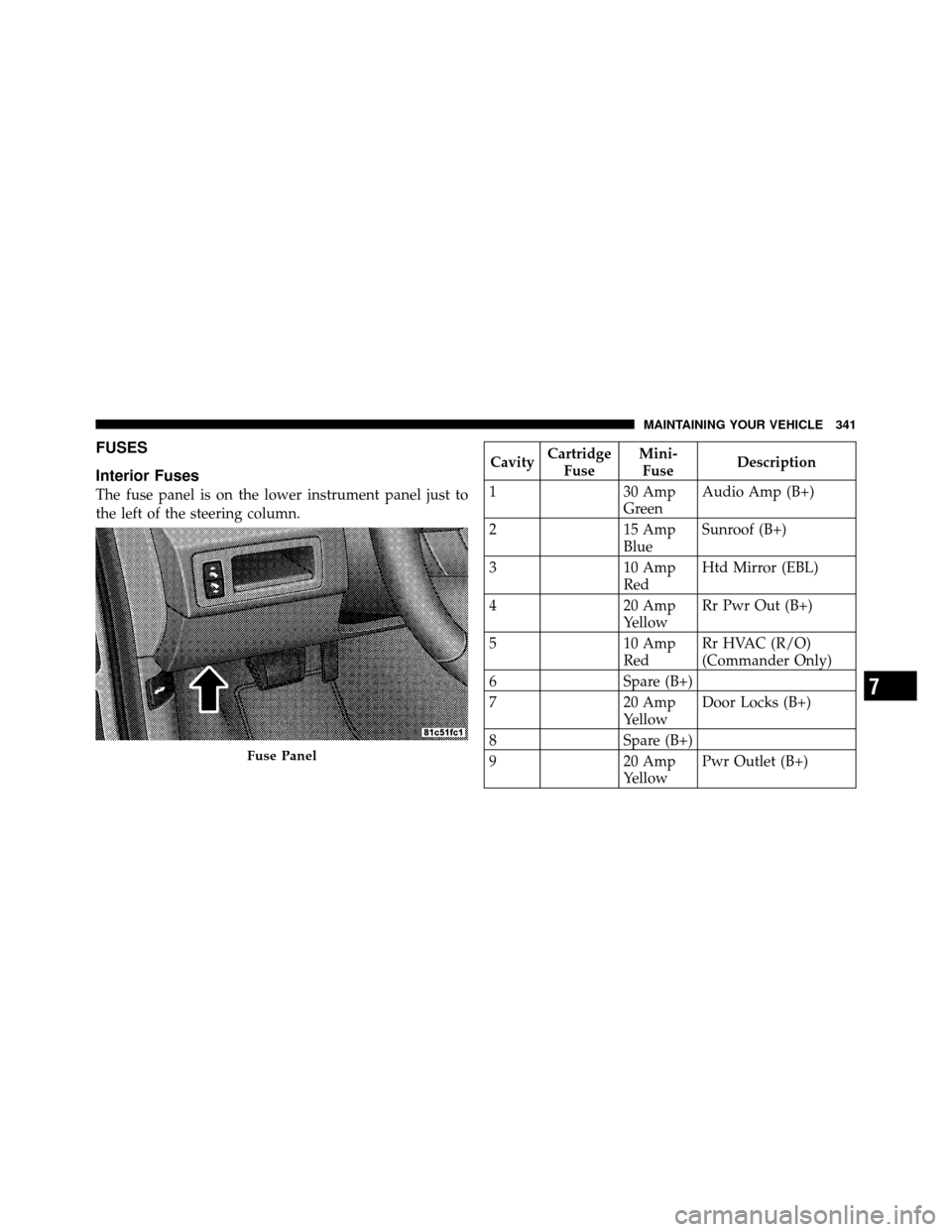
FUSES
Interior Fuses
The fuse panel is on the lower instrument panel just to
the left of the steering column.
CavityCartridge
Fuse Mini-
Fuse Description
1 30 Amp
GreenAudio Amp (B+)
2 15 Amp
BlueSunroof (B+)
3 10 Amp
RedHtd Mirror (EBL)
4 20 Amp
YellowRr Pwr Out (B+)
5 10 Amp
RedRr HVAC (R/O)
(Commander Only)
6 Spare (B+)
7 20 Amp
YellowDoor Locks (B+)
8 Spare (B+)
9 20 Amp
YellowPwr Outlet (B+)
Fuse Panel
7
MAINTAINING YOUR VEHICLE 341