Page 236 of 407
STARTING AND OPERATING
CONTENTS
�Starting Procedures .................... 238
▫ Normal Starting ..................... 238
▫ Extreme Cold Weather
(Below �20°F Or �29°C)............... 239
▫ If Engine Fails To Start ................ 239
▫ After Starting ....................... 240
� Automatic Transmission ................. 240
▫ Key Ignition Park Interlock ............. 241
▫ Brake/Transmission Shift Interlock System . . 241 ▫
Brake/Transmission Interlock Manual
Override .......................... 241
▫ Five–Speed Automatic Transmission ....... 242
▫ Gear Ranges ........................ 243
▫ Rocking The Vehicle .................. 244
� AutoStick� .......................... 245
▫ Operation ......................... 246
▫ General Information .................. 247
� Power Steering ....................... 248
5
Page 237 of 407

▫Power Steering Fluid Check ............. 249
� Parking Brake ........................ 250
� Anti-Lock Brake System ................. 252
� Electronic Brake Control System ........... 255
▫ Anti-Lock Brake System (ABS) ........... 255
▫ Traction Control System (TCS) ........... 255
▫ Brake Assist System (BAS) .............. 256
▫ Electronic Roll Mitigation (ERM) ......... 257
▫ Electronic Stability Program (ESP) ........ 257
▫ Trailer Sway Control (TSC) ............. 260
▫ ESP/BAS Warning Light And ESP/TCS
Indicator Light ...................... 260
� Tire Safety Information ................. 262 ▫
Tire Markings ....................... 262
▫ Tire Identification Number (TIN) ......... 266
▫ Tire Terminology And Definitions ......... 267
▫ Tire Loading And Tire Pressure .......... 268
� Tires — General Information ............. 272
▫ Run Flat Tires ....................... 272
▫ Tire Pressure ....................... 272
▫ Tire Inflation Pressures ................ 274
▫ Tire Pressures For High Speed Operation . . . 275
▫ Radial-Ply Tires ..................... 275
▫ Tire Spinning ....................... 276
▫ Tread Wear Indicators ................. 276
▫ Life Of Tire ........................ 277
236 STARTING AND OPERATING
Page 241 of 407

If the engine fails to start after you have followed the
“Normal Starting” or “Extreme Cold Weather” proce-
dures, it may be flooded. To clear any excess fuel, push
the accelerator pedal all the way to the floor and hold it.
Then, turn the ignition switch to the START position and
release it as soon as the starter engages. The starter motor
will disengage automatically in 10 seconds. Once this
occurs, release the accelerator pedal, turn the ignition
switch to the LOCK position, wait 10 to 15 seconds, then
repeat the “Normal Starting” procedure.
CAUTION!
To prevent damage to the starter, wait 10 to 15 sec-
onds before trying again.
After Starting
The idle speed is controlled automatically and it will
decrease as the engine warms up.
AUTOMATIC TRANSMISSION
CAUTION!
Damage to the transmission may occur if the follow-
ing precautions are not observed:
•Shift into PARK only after the vehicle has come to
a complete stop.
•Shift into or out of REVERSE only after the
vehicle has come to a complete stop and the engine
is at idle speed.
•Do not shift from REVERSE, PARK, or NEUTRAL
into any forward gear when the engine is above
idle speed.
•Before shifting into any gear, make sure your foot
is firmly on the brake pedal.
240 STARTING AND OPERATING
Page 242 of 407
WARNING!
It is dangerous to move the shift lever out of PARK or
NEUTRAL if the engine speed is higher than idle
speed. If your foot is not firmly on the brake pedal,
the vehicle could accelerate quickly forward or in
reverse. You could lose control of the vehicle and hit
someone or something. Only shift into gear when the
engine is idling normally and when your foot is
firmly on the brake pedal.
Key Ignition Park Interlock
This vehicle is equipped with a Key Ignition Park Inter-
lock which requires the shift lever to be placed in PARK
prior to rotating the ignition switch to the LOCK posi-
tion. The key fob can only be removed from the ignition
switch when the ignition switch is in the LOCK position
and once removed the shift lever is locked in PARK.
Brake/Transmission Shift Interlock System
This vehicle is equipped with a Brake Transmission Shift
Interlock System (BTSI) that holds the shift lever in the
PARK position when the ignition switch is in the LOCK
position. To move the shift lever out of the PARK
position, the ignition switch must be turned to either the
ON or START position (engine running or not) and the
brake pedal must be pressed.
Brake/Transmission Interlock Manual Override
Your vehicle may be equipped with a shift lock manual
override. The manual override may be used in the event
that the shift lever should fail to move from PARK with
the ignition switch in the ON position and the brake
pedal pressed. To operate the shift lock manual override,
perform the following steps:
1. Turn the ignition switch to the ON position, but do not
start the engine.
2. Firmly set the parking brake.5
STARTING AND OPERATING 241
Page 243 of 407
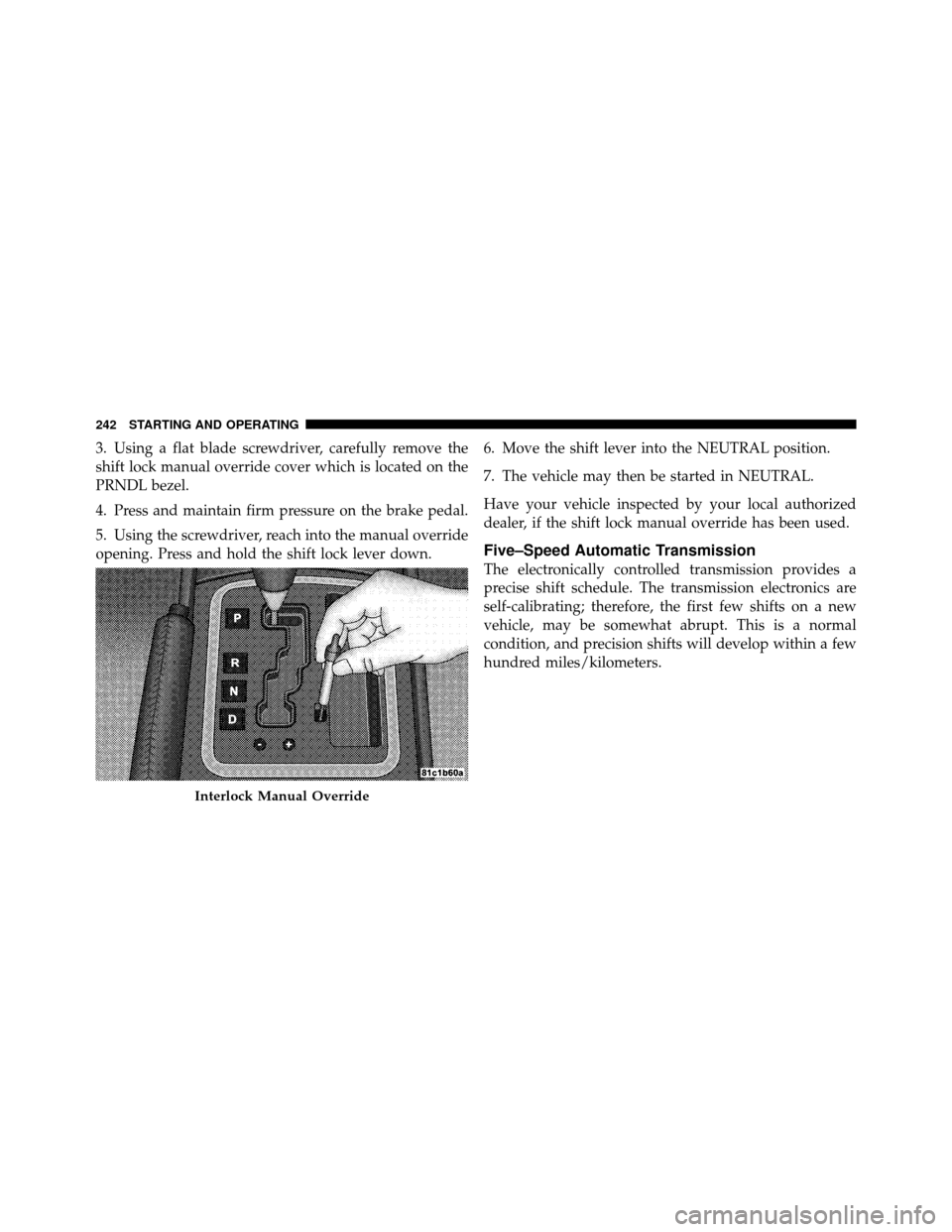
3. Using a flat blade screwdriver, carefully remove the
shift lock manual override cover which is located on the
PRNDL bezel.
4. Press and maintain firm pressure on the brake pedal.
5. Using the screwdriver, reach into the manual override
opening. Press and hold the shift lock lever down.6. Move the shift lever into the NEUTRAL position.
7. The vehicle may then be started in NEUTRAL.
Have your vehicle inspected by your local authorized
dealer, if the shift lock manual override has been used.
Five–Speed Automatic Transmission
The electronically controlled transmission provides a
precise shift schedule. The transmission electronics are
self-calibrating; therefore, the first few shifts on a new
vehicle, may be somewhat abrupt. This is a normal
condition, and precision shifts will develop within a few
hundred miles/kilometers.
Interlock Manual Override
242 STARTING AND OPERATING
Page 244 of 407
WARNING!
It is dangerous to move the shift lever out of PARK or
NEUTRAL if the engine speed is higher than idle
speed. If your foot is not firmly on the brake pedal,
the vehicle could accelerate quickly forward or in
reverse. You could lose control of the vehicle and hit
someone or something. Only shift into gear when the
engine is idling normally and when your foot is
firmly on the brake pedal.
Gear Ranges
NOTE:After selecting any gear range, wait a moment to
allow the selected gear to engage before accelerating.
This is especially important when the engine is cold. If
there is a need to restart the engine, be sure to turn the
ignition switch to the LOCK position before restarting. Transmission gear engagement may be delayed after
restarting the engine if the ignition switch is not turned to
the LOCK position first.
PARK
This range supplements the parking brake by locking the
transmission. The engine can be started in this range.
Never use PARK while the vehicle is in motion. Apply
the parking brake when leaving the vehicle in this range.
Always apply the parking brake first, then place the shift
lever into the PARK position.
5
STARTING AND OPERATING 243
Page 245 of 407
WARNING!
Unintended movement of a vehicle could injure
those in and near the vehicle. As with all vehicles,
you should never exit a vehicle while the engine is
running. Before exiting a vehicle, you should apply
the park brake, shift the transmission into PARK,
and remove the key fob from the ignition switch.
Once the key fob is removed from the ignition
switch, the shift lever is locked in the PARK position,
securing the vehicle against unwanted movement.
Furthermore, you should never leave children unat-
tended inside a vehicle.
REVERSE
This range is for moving the vehicle backward. Use only
after the vehicle has come to a complete stop.
NEUTRAL
This range is used when vehicle is standing for pro-
longed periods with engine running. Engine may be
started in this range. Set the parking brake if you must
leave the vehicle.
DRIVE
This range should only be selected when the vehicle is at
a complete stop and the brakes are firmly applied. The
transmission automatically upshifts through fifth gear.
The DRIVE position provides optimum driving charac-
teristics under all normal operating conditions. For addi-
tional shifting information, refer to “AutoStick�”in
“Starting and Operating” for further information.
Rocking the Vehicle
If the vehicle becomes stuck in snow, sand, or mud, it can
often be moved by a rocking motion. Move the shift lever
between DRIVE and REVERSE, while applying slight
pressure to the accelerator.
244 STARTING AND OPERATING
Page 246 of 407
NOTE:The Electronic Stability Program (ESP) and
Traction Control (if equipped) should be turned OFF
before attempting to rock the vehicle. Refer to “Electronic
Brake Control System” in “Starting and Operating” for
further information.
The least amount of accelerator pedal pressure to main-
tain the rocking motion without spinning the wheels or
racing the engine is most effective. Racing the engine or
spinning the wheels, due to the frustration of not freeing
the vehicle, may lead to transmission overheating and
failure. Allow the engine to idle with the shift lever in
NEUTRAL for at least one minute after every five
rocking-motion cycles. This will minimize overheating
and reduce the risk of transmission failure during pro-
longed efforts to free a stuck vehicle.CAUTION!
When “rocking” a stuck vehicle by moving between
DRIVE and REVERSE, do not spin the wheels faster
than 15 mph (24 km/h), or drivetrain damage may
result.
AUTOSTICK�
AutoStick� is a driver-interactive transmission that offers
manual gear shifting capability to provide the driver
with more control. AutoStick� allows the driver to in-
crease engine braking ability, control upshift and down-
shift points, and enhance the driving experience. This
system can also provide the driver with more control
during passing, city driving, mountain driving, trailer
towing, and many other situations.
5
STARTING AND OPERATING 245