Page 2462 of 3039
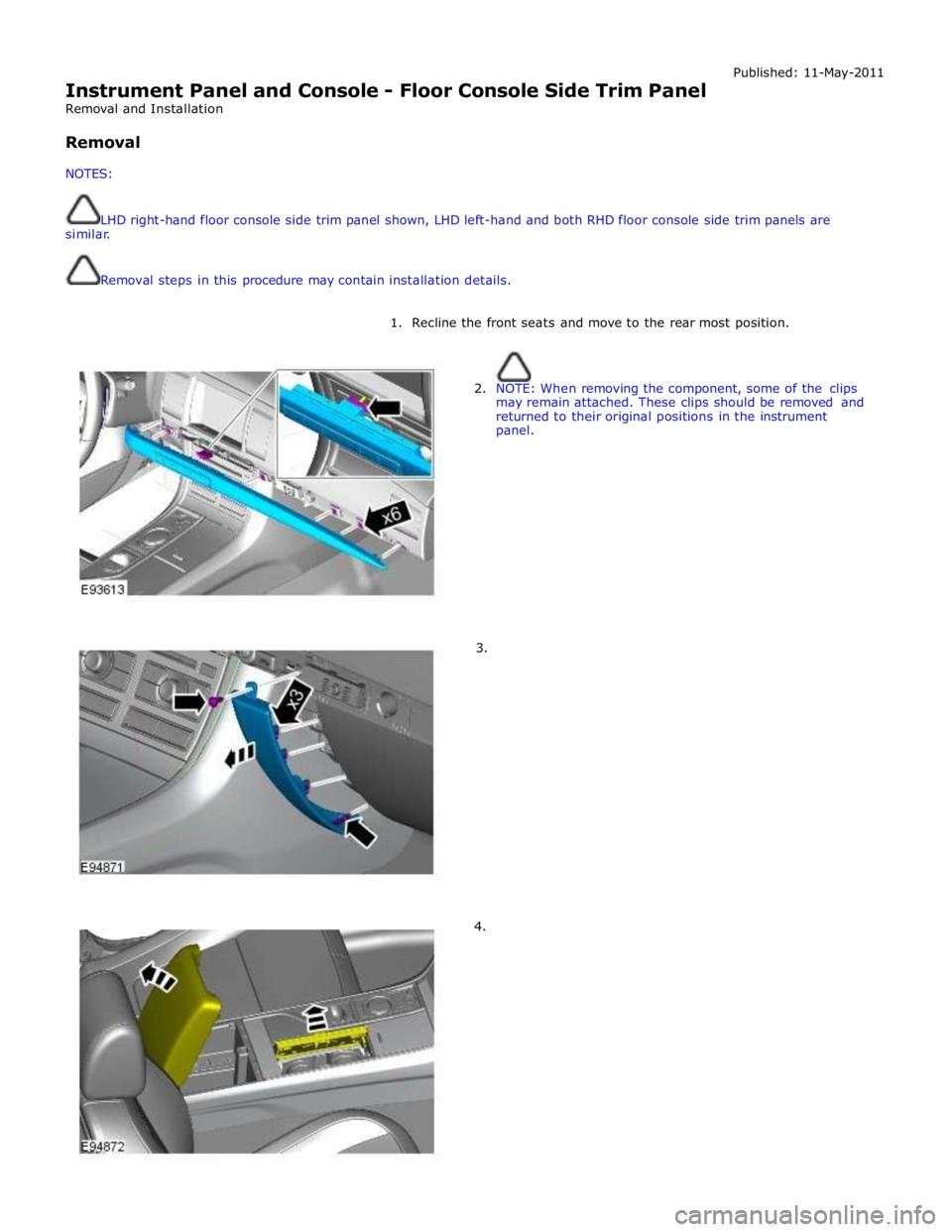
Instrument Panel and Console - Floor Console Side Trim Panel
Removal and Installation
Removal
NOTES: Published: 11-May-2011
LHD right-hand floor console side trim panel shown, LHD left-hand and both RHD floor console side trim panels are
similar.
Removal steps in this procedure may contain installation details.
1. Recline the front seats and move to the rear most position.
2. NOTE: When removing the component, some of the clips
may remain attached. These clips should be removed and
returned to their original positions in the instrument
panel.
3.
4.
Page 2593 of 3039

Safety Belt System - Safety Belt System - Overview
Description and Operation
Authoring Template
OVERVIEW Published: 11-May-2011
A three point safety belt is fitted to all seating positions. Each safety belt retractor incorporates an emergency locking feature.
The emergency locking retractor incorporates 2 mechanical inertia devices. One inertia device activates if the safety belt is
subjected to a sharp pull. The second inertia device activates if the vehicle is subject to a sudden deceleration or is on a
severe incline.
North American Specification (NAS) safety belt retractors also include an automatic locking feature. The Automatic Locking
Retractor (ALR) is fitted to all passenger seating positions and allows the safety belt to be tensioned to aid the safe fitment
of child or booster seats. For additional information, refer to the Owners Handbook.
NAS vehicles are also fitted with a belt tension sensor on the front passenger seat. The belt tension sensor is incorporated
into the seat belt lower anchorage and is attached to the seat frame by an M10 Torx head bolt. The belt tension sensor forms
part of the SRS (supplemental restraint system) occupancy detection and classification feature.
The center rear safety belt features a mini-buckle lower anchorage. The mini-buckle is disengaged by inserting a suitable tool
into the small aperture on the front face of the housing.
To aid the fitment of child seats, 3 tethers are located on the rear parcel shelf. Each tether is attached to the parcel shelf with
an M10 Torx head bolt.
A safety belt warning indicator is located in the instrument cluster to remind front seat passengers to fasten their safety belts.
The warning indicator will illuminate if the safety belt of an occupied front seat is not fastened.
Refer to: Instrument Cluster (413-01, Description and Operation).
Page 2620 of 3039
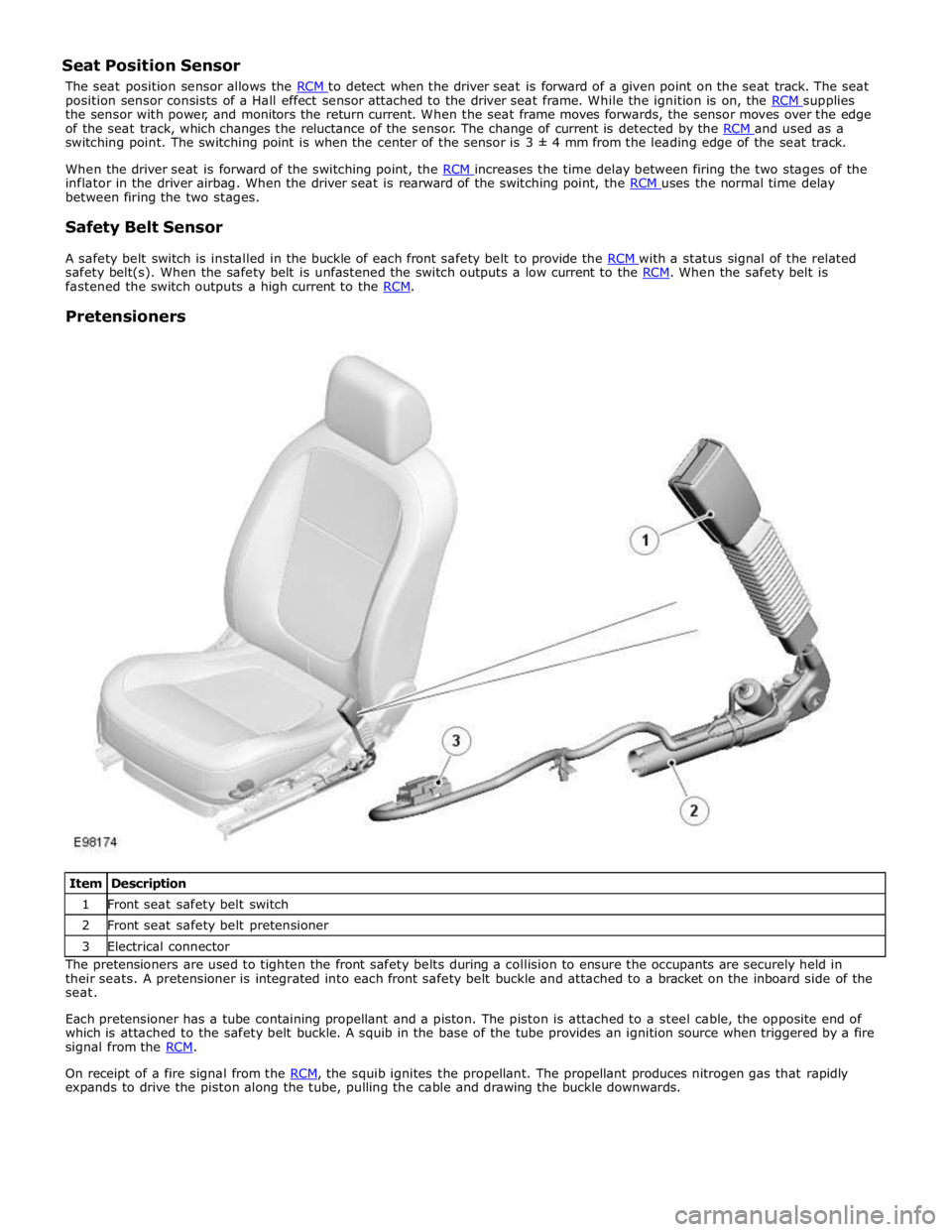
position sensor consists of a Hall effect sensor attached to the driver seat frame. While the ignition is on, the RCM supplies the sensor with power, and monitors the return current. When the seat frame moves forwards, the sensor moves over the edge
of the seat track, which changes the reluctance of the sensor. The change of current is detected by the RCM and used as a switching point. The switching point is when the center of the sensor is 3 ± 4 mm from the leading edge of the seat track.
When the driver seat is forward of the switching point, the RCM increases the time delay between firing the two stages of the inflator in the driver airbag. When the driver seat is rearward of the switching point, the RCM uses the normal time delay between firing the two stages.
Safety Belt Sensor
A safety belt switch is installed in the buckle of each front safety belt to provide the RCM with a status signal of the related safety belt(s). When the safety belt is unfastened the switch outputs a low current to the RCM. When the safety belt is fastened the switch outputs a high current to the RCM.
Pretensioners
Item Description 1 Front seat safety belt switch 2 Front seat safety belt pretensioner 3 Electrical connector The pretensioners are used to tighten the front safety belts during a collision to ensure the occupants are securely held in
their seats. A pretensioner is integrated into each front safety belt buckle and attached to a bracket on the inboard side of the
seat.
Each pretensioner has a tube containing propellant and a piston. The piston is attached to a steel cable, the opposite end of
which is attached to the safety belt buckle. A squib in the base of the tube provides an ignition source when triggered by a fire
signal from the RCM.
On receipt of a fire signal from the RCM, the squib ignites the propellant. The propellant produces nitrogen gas that rapidly expands to drive the piston along the tube, pulling the cable and drawing the buckle downwards.
Page 2798 of 3039
Actuation, Removal and Installation).
12. Remove the left-hand and right-hand front seats.
For additional information, refer to: Front Seat (501-10 Seating, Removal and Installation).
13. Remove the heater core and evaporator core housing.
For additional information, refer to: Heater Core and Evaporator Core Housing (412-01 Climate Control, Removal and Installation).
14. Remove the front safety belt retractor.
For additional information, refer to: Front Safety Belt Retractor (501-20A Safety Belt System, Removal and Installation).
15. Remove the B-pillar side impact sensor.
For additional information, refer to: B-Pillar Side Impact Sensor (501-20B Supplemental Restraint System, Removal and Installation).
16. Remove the left-hand and right-hand front floor covering.
17. Remove the rear floor covering.
18. If the left-hand front side member and suspension top mount assembly
is to be repaired, remove the left-hand rear foot well duct.
19. If the right-hand front side member and suspension top mount assembly
is to be repaired, remove the right-hand rear foot well duct.
20. If the drivers side front side member and suspension top mount is being
repaired, remove the pedal box.
21. Release and position the insulating material at the inner bulkhead to
one side.
22. Release and position the inner bulkhead and floor panel wiring harness
to one side.
23. Drain the fuel tank.
For additional information, refer to: Fuel Tank Draining (310-00 Fuel System - General Information, General Procedures).
24. If the left-hand front side member and suspension top mount assembly
is to be repaired, remove the left-hand under shield.
25. If the right-hand front side member and suspension top mount assembly
is to be repaired, remove the right-hand under shield.
26. If the left-hand front side member and suspension top mount assembly
is to be repaired, remove the fuel supply and return pipes.
27. For diesel engine vehicles only, if the left-hand front side member and
suspension top mount assembly is to be repaired, remove the fuel
cooler.
28. If the right-hand front side member and suspension top mount assembly
is to be repaired, release and position the underfloor wiring harness to
Page 2828 of 3039
Published: 11-May-2011
Roof Sheet Metal Repairs - Roof Panel Vehicles With: Sliding Roof Opening
Panel
Removal and Installation
Removal
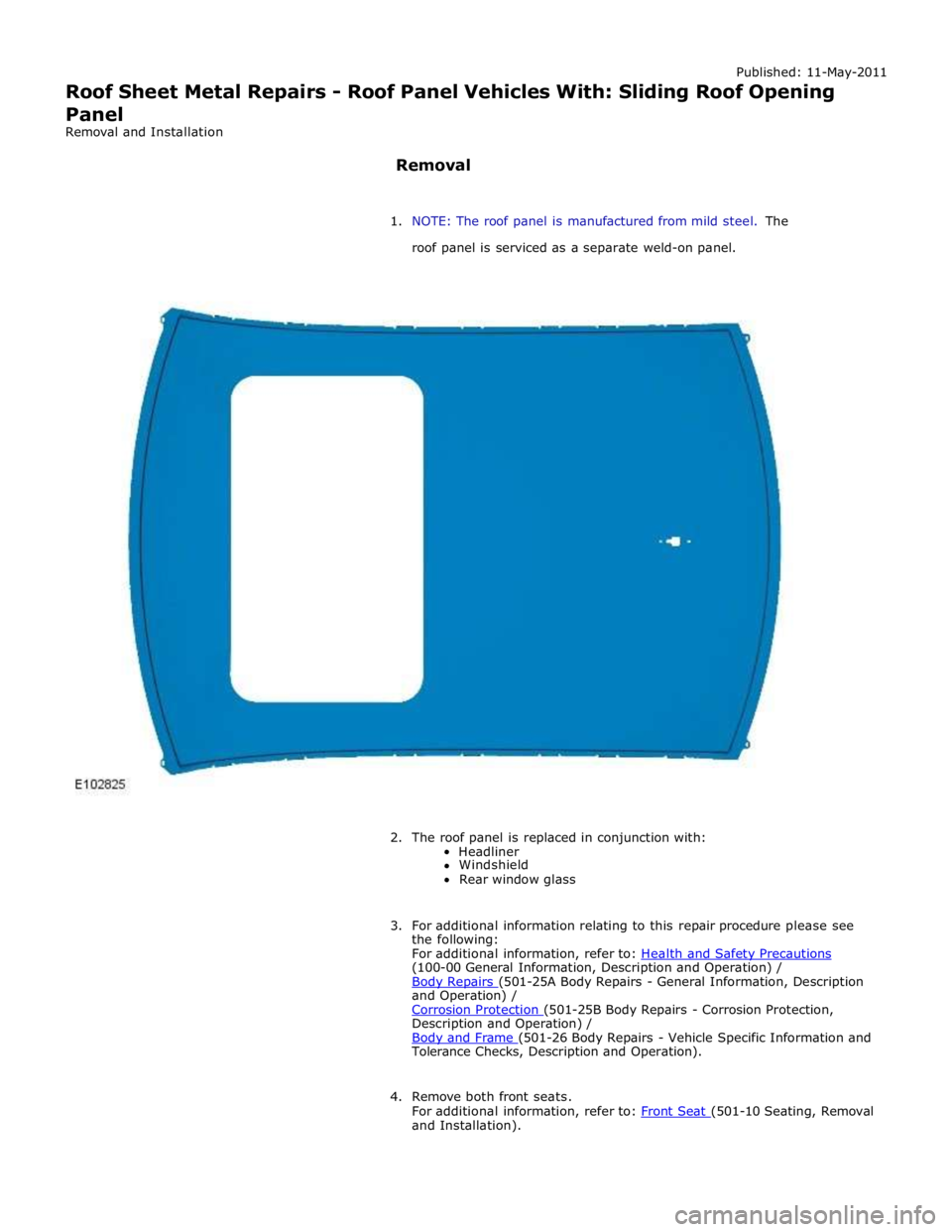
1. NOTE: The roof panel is manufactured from mild steel. The
roof panel is serviced as a separate weld-on panel.
2. The roof panel is replaced in conjunction with:
Headliner
Windshield
Rear window glass
3. For additional information relating to this repair procedure please see
the following:
For additional information, refer to: Health and Safety Precautions (100-00 General Information, Description and Operation) /
Body Repairs (501-25A Body Repairs - General Information, Description and Operation) /
Corrosion Protection (501-25B Body Repairs - Corrosion Protection, Description and Operation) /
Body and Frame (501-26 Body Repairs - Vehicle Specific Information and Tolerance Checks, Description and Operation).
4. Remove both front seats.
For additional information, refer to: Front Seat (501-10 Seating, Removal and Installation).
Page 2835 of 3039
Published: 11-May-2011
Roof Sheet Metal Repairs - Roof Panel Vehicles Without: Sliding Roof Opening
Panel
Removal and Installation
Removal
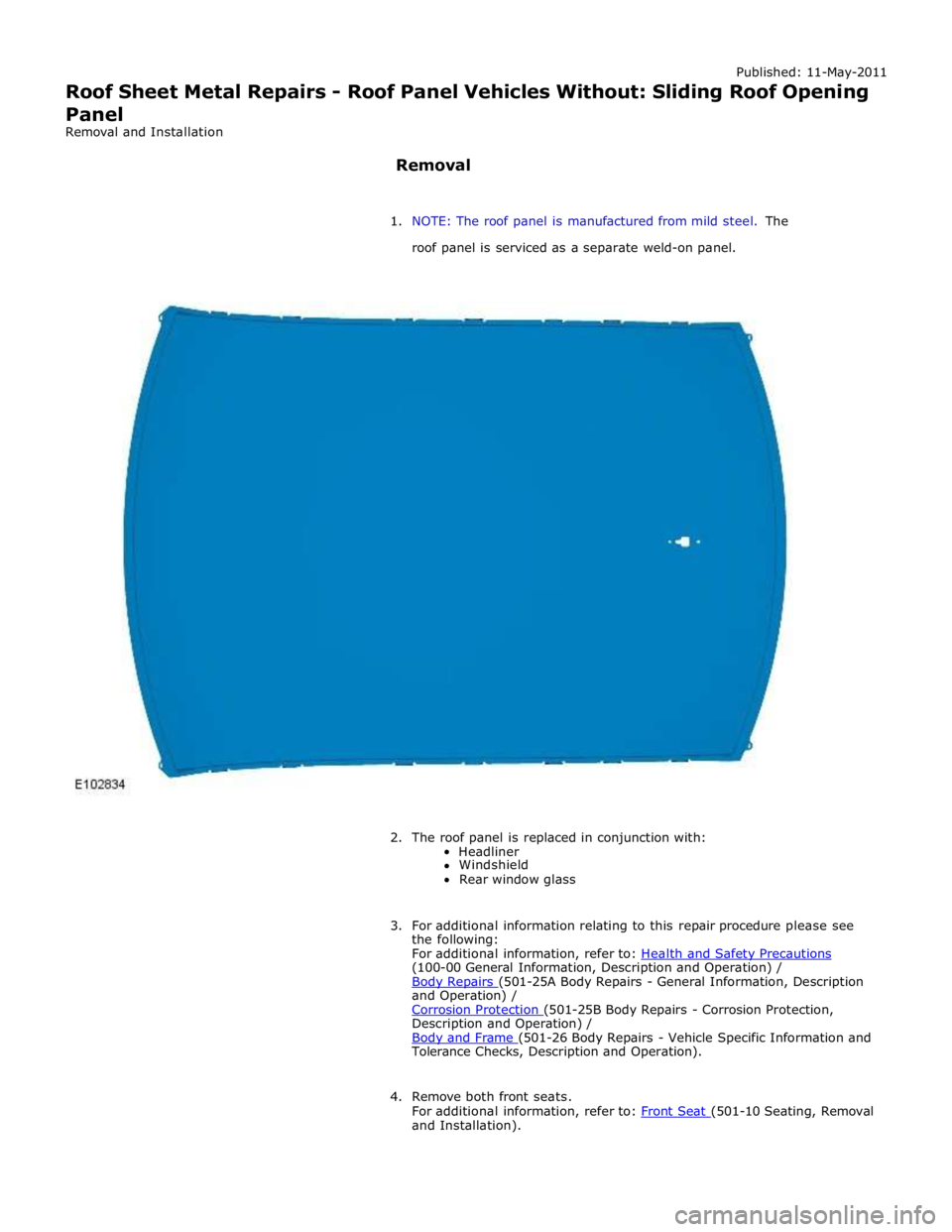
1. NOTE: The roof panel is manufactured from mild steel. The
roof panel is serviced as a separate weld-on panel.
2. The roof panel is replaced in conjunction with:
Headliner
Windshield
Rear window glass
3. For additional information relating to this repair procedure please see
the following:
For additional information, refer to: Health and Safety Precautions (100-00 General Information, Description and Operation) /
Body Repairs (501-25A Body Repairs - General Information, Description and Operation) /
Corrosion Protection (501-25B Body Repairs - Corrosion Protection, Description and Operation) /
Body and Frame (501-26 Body Repairs - Vehicle Specific Information and Tolerance Checks, Description and Operation).
4. Remove both front seats.
For additional information, refer to: Front Seat (501-10 Seating, Removal and Installation).
Page 2993 of 3039
5. Disconnect the generator electrical connectors.
6. Disconnect the battery positive cable and position it to one side.
7. Remove the rear subframe and rear suspension, as an assembly.
For additional information, refer to: Rear Subframe - V6 3.0L Petrol (502-00 Uni-Body, Subframe and Mounting System, Removal and
Installation).
8. Remove the fuel tank filler pipe.
For additional information, refer to: Fuel Tank Filler Pipe (310-01B,
Removal and Installation).
9. Release the left-hand and right-hand luggage floor wiring harnesses and
position them to one side.
10. Make sure that the rear seats are covered to prevent any damage during
this repair procedure.
11. NOTE: If undamaged, the left-hand and right-hand rear bumper
retaining brackets should be reinstalled.
Remove the left-hand and right-hand rear bumper retaining brackets.