Page 1237 of 3039
Raise and support the vehicle.
10.
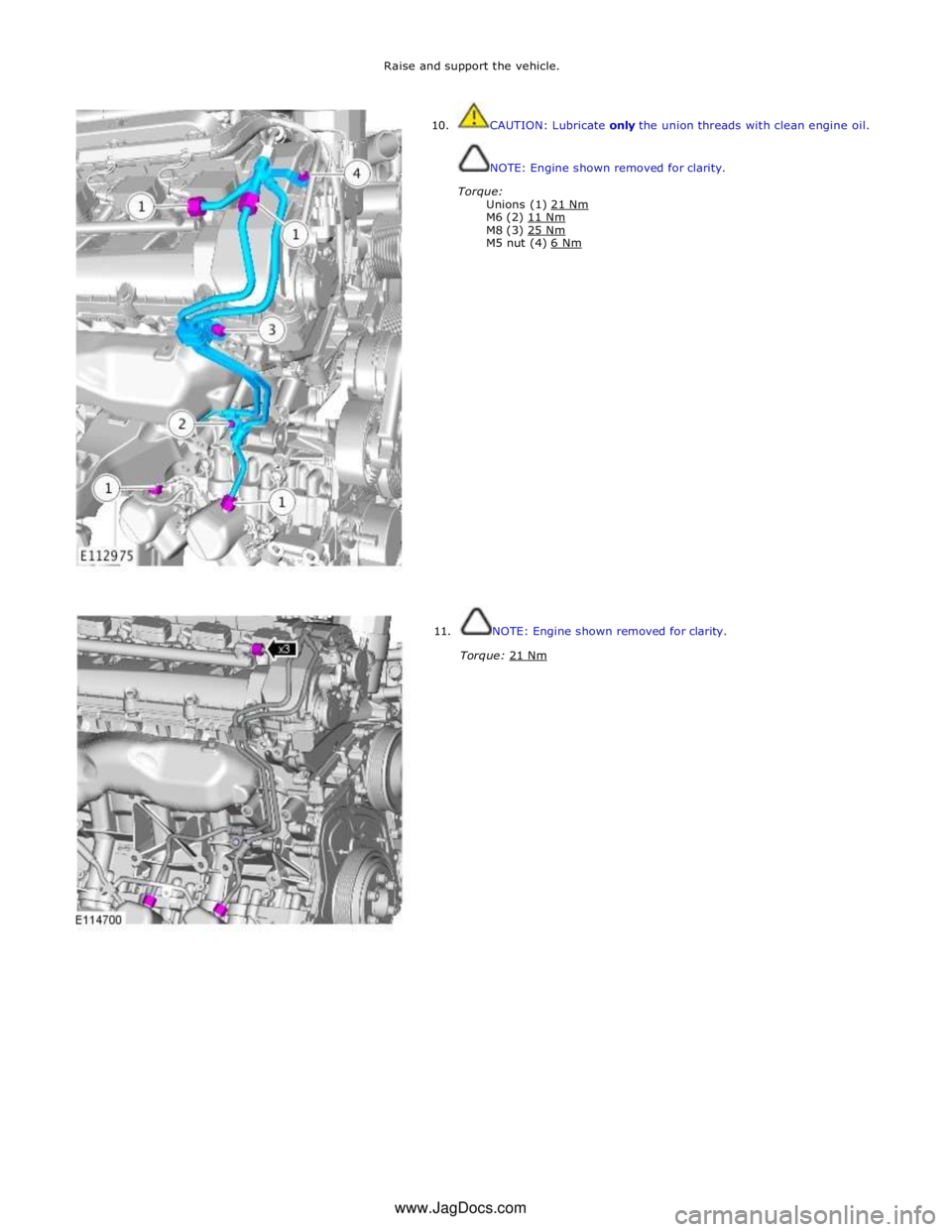
11. CAUTION: Lubricate only the union threads with clean engine oil.
NOTE: Engine shown removed for clarity.
Torque: Unions (1) 21 Nm M6 (2) 11 Nm M8 (3) 25 Nm M5 nut (4) 6 Nm
NOTE: Engine shown removed for clarity.
Torque: 21 Nm www.JagDocs.com
Page 1240 of 3039
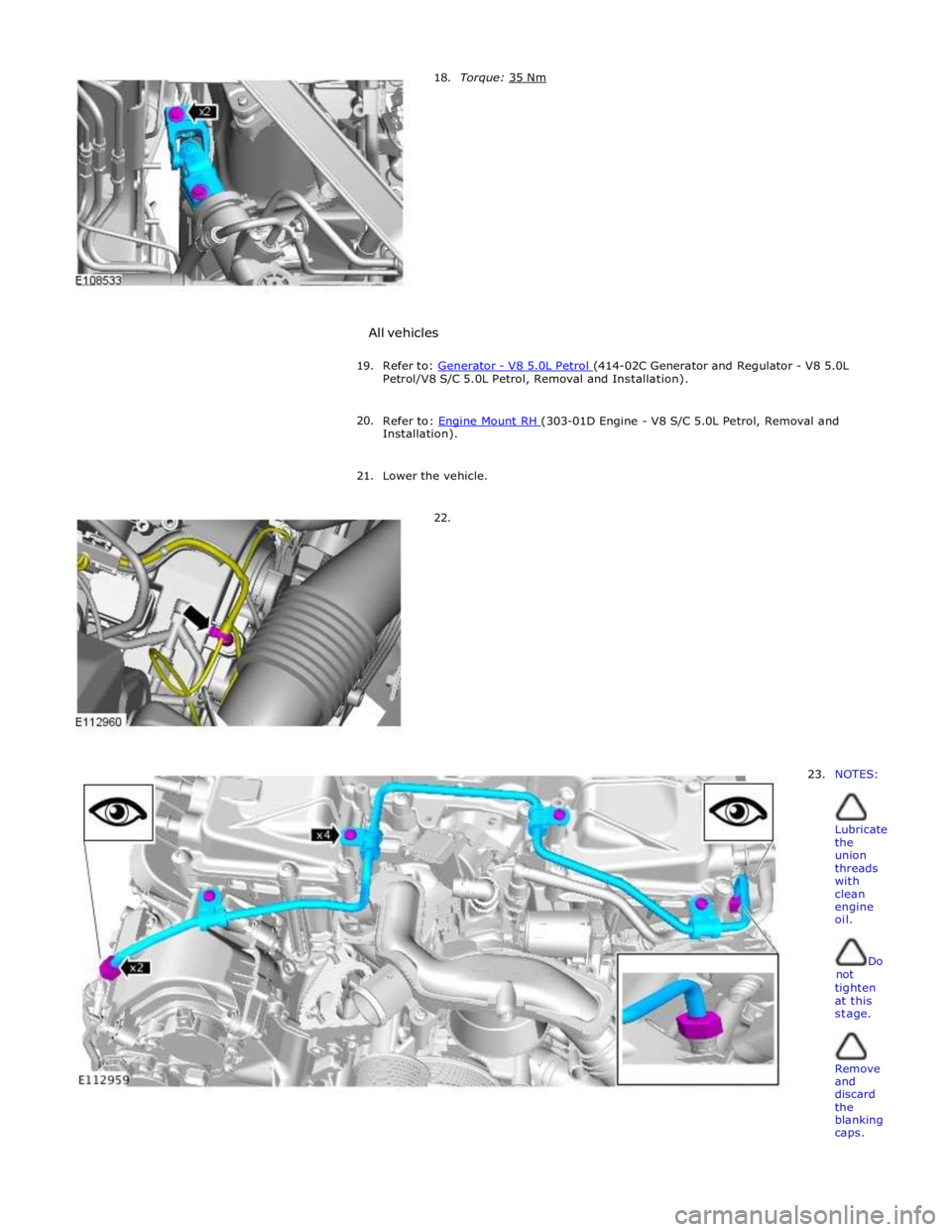
18. Torque: 35 Nm
All vehicles
19. Refer to: Generator - V8 5.0L Petrol (414-02C Generator and Regulator - V8 5.0L Petrol/V8 S/C 5.0L Petrol, Removal and Installation).
20. Refer to: Engine Mount RH (303-01D Engine - V8 S/C 5.0L Petrol, Removal and Installation).
21. Lower the vehicle.
22.
23.
NOTES:
Lubricate
the
union
threads
with
clean
engine
oil.
Do
not tighten
at this
stage.
Remove
and
discard
the
blanking
caps.
Page 1262 of 3039
When the ECM receives a crank request, it energizes the starter relay in the EJB (engine junction box). The energized starter relay supplies 12 V power (fed via the 250 A megafuse in the BJB (battery junction box)) to energize the pull-in coil of the
starter solenoid. Once activated, the pull-in coil engages the solenoid plunger, which engages the pinion with the ring gear.
The plunger then closes the solenoid circuit, feeding power from the 400 A megafuse in the BJB to the starter motor.
Page 1264 of 3039
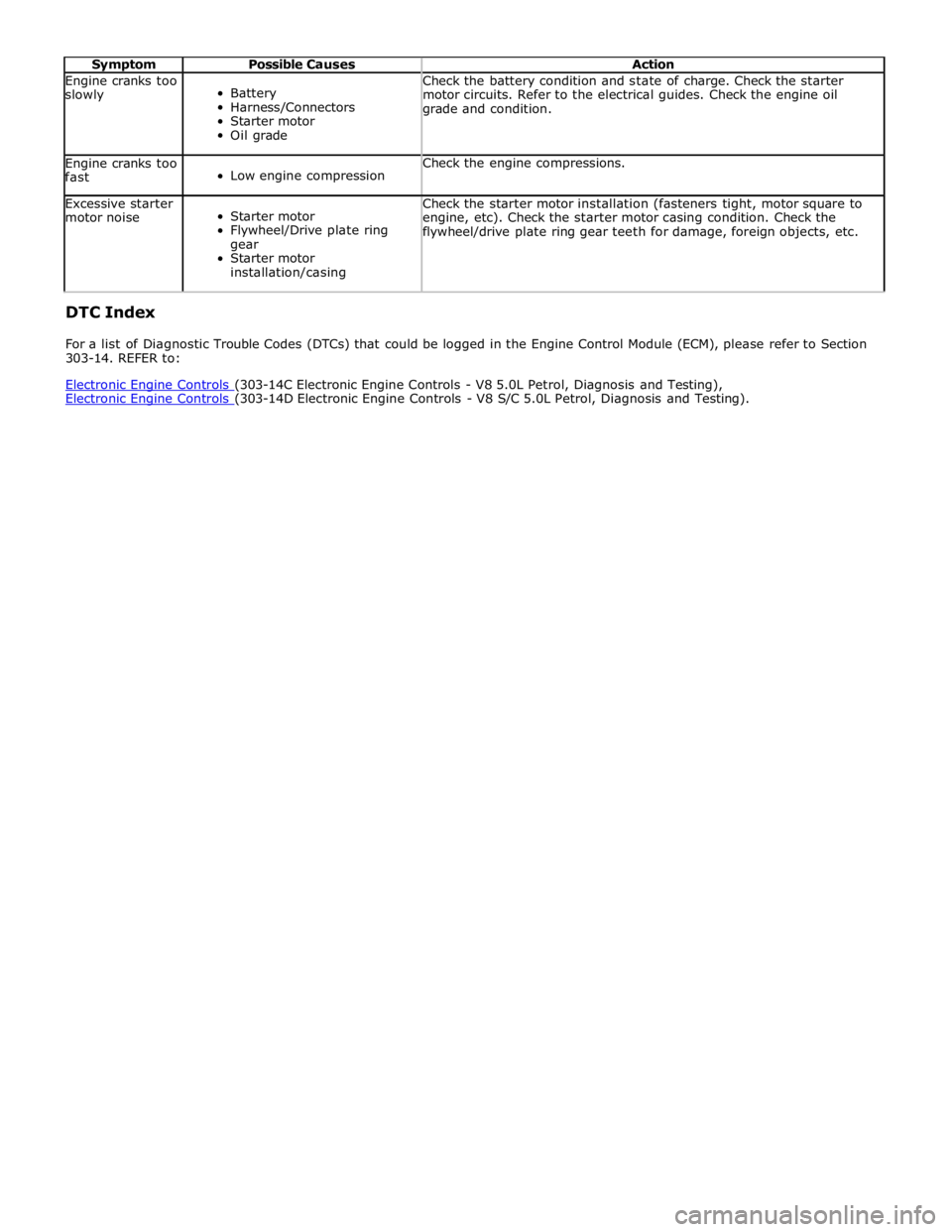
Symptom Possible Causes Action Engine cranks too
slowly
Battery
Harness/Connectors
Starter motor
Oil grade Check the battery condition and state of charge. Check the starter
motor circuits. Refer to the electrical guides. Check the engine oil
grade and condition. Engine cranks too
fast
Low engine compression Check the engine compressions. Excessive starter
motor noise
Starter motor
Flywheel/Drive plate ring
gear
Starter motor
installation/casing Check the starter motor installation (fasteners tight, motor square to
engine, etc). Check the starter motor casing condition. Check the
flywheel/drive plate ring gear teeth for damage, foreign objects, etc. DTC Index
For a list of Diagnostic Trouble Codes (DTCs) that could be logged in the Engine Control Module (ECM), please refer to Section
303-14. REFER to:
Electronic Engine Controls (303-14C Electronic Engine Controls - V8 5.0L Petrol, Diagnosis and Testing), Electronic Engine Controls (303-14D Electronic Engine Controls - V8 S/C 5.0L Petrol, Diagnosis and Testing).
Page 1271 of 3039
Published: 11-May-2011
Engine Ignition - V8 5.0L Petrol/V8 S/C 5.0L Petrol - Engine Ignition - Component Location
Description and Operation
NOTE: RHD (right-hand drive) naturally aspirated installation shown; other installations similar.
COMPONENT LOCATION
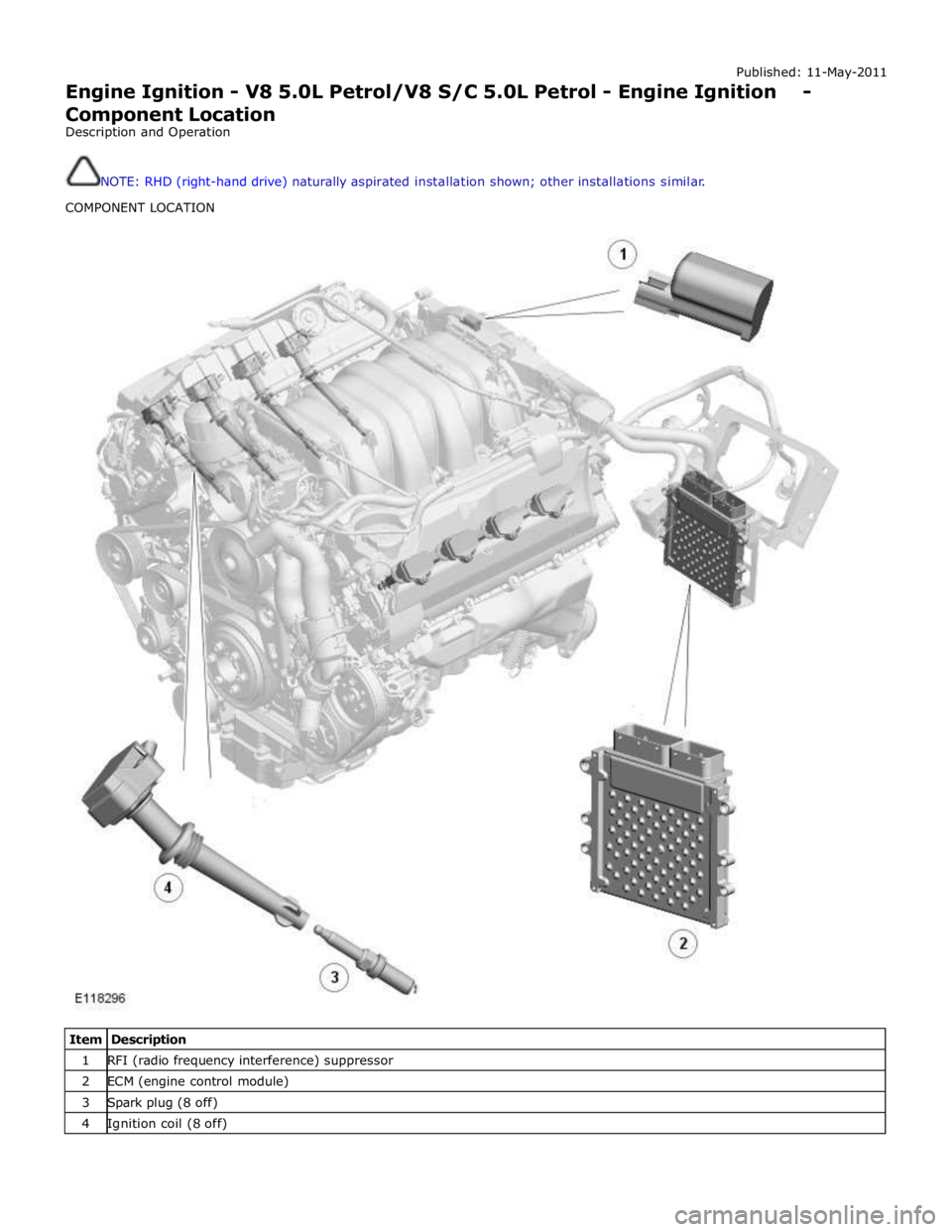
Item Description 1 RFI (radio frequency interference) suppressor 2 ECM (engine control module) 3 Spark plug (8 off) 4 Ignition coil (8 off)
Page 1272 of 3039
Published: 11-May-2011
Engine Ignition - V8 5.0L Petrol/V8 S/C 5.0L Petrol - Engine Ignition - Overview
Description and Operation
OVERVIEW
The engine ignition system is a coil-on-plug, single spark system controlled by the ECM (engine control module). An iridium
tipped spark plug is installed in each combustion chamber, between the inlet and exhaust valves, and an ignition coil is
installed on each spark plug. A RFI (radio frequency interference) suppressor is connected to the power feed to the ignition
coils.
Page 1273 of 3039
Published: 11-May-2011
Engine Ignition - V8 5.0L Petrol/V8 S/C 5.0L Petrol - Engine Ignition - System Operation and Component Description
Description and Operation
Control Diagram
NOTE: A = Hardwired
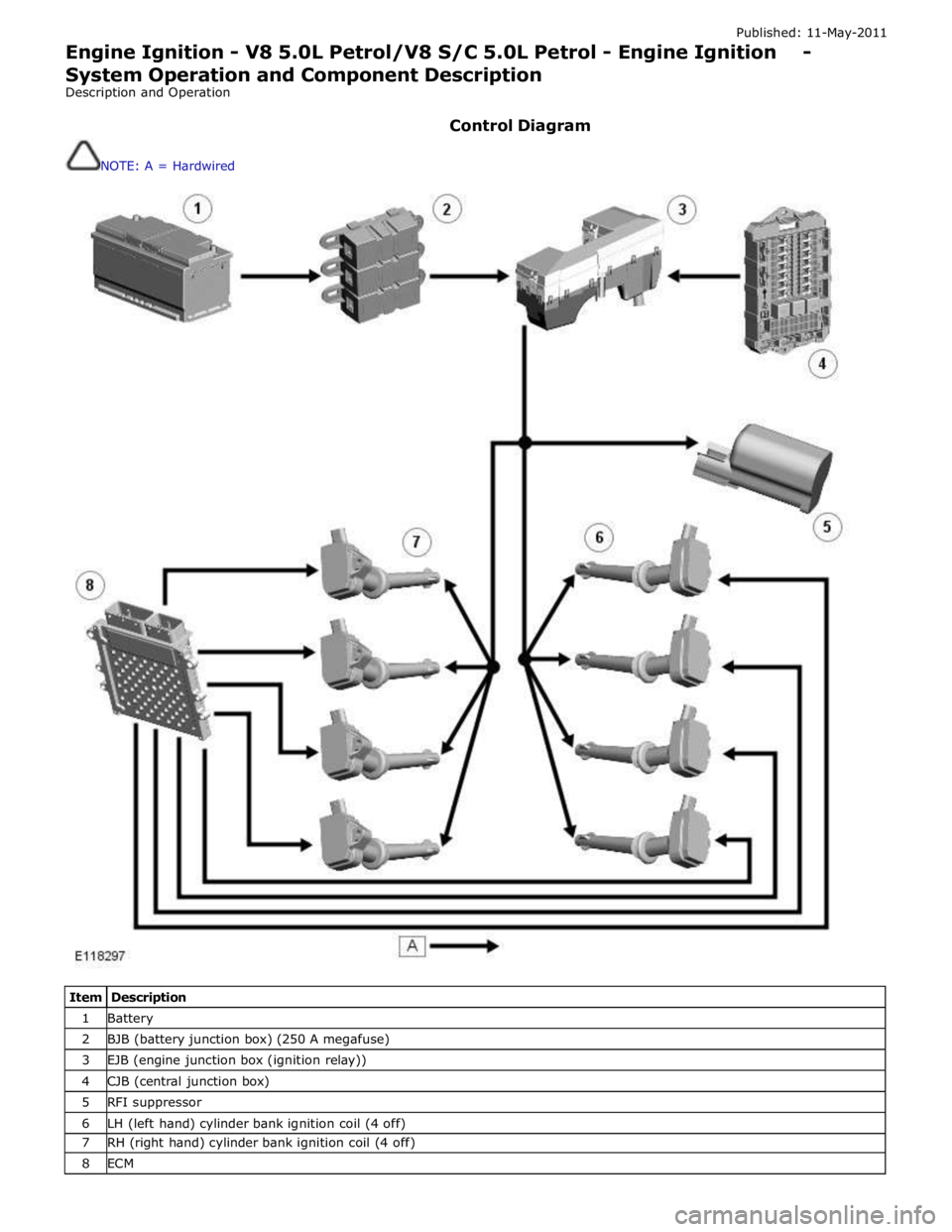
Item Description 1 Battery 2 BJB (battery junction box) (250 A megafuse) 3 EJB (engine junction box (ignition relay)) 4 CJB (central junction box) 5 RFI suppressor 6 LH (left hand) cylinder bank ignition coil (4 off) 7 RH (right hand) cylinder bank ignition coil (4 off) 8 ECM
Page 1274 of 3039
GENERAL System Operation
The ignition coils are supplied with electrical power from the battery via a 250 A megafuse in the BJB (battery junction box)
and the ignition relay in the EJB (engine junction box). The control signal for the ignition relay is supplied by the CJB (central
junction box).
The ECM (engine control module) sends a separate signal to each ignition coil to trigger the power stage switching. The ECM calculates the dwell time from the battery voltage and engine speed, to ensure a constant energy level is produced in the
secondary coil each time the power stage is switched. This ensures sufficient spark energy is available without excessive
primary current flow, which avoids overheating and damage to the ignition coils.
The ECM calculates the ignition timing for individual cylinders from: Engine speed
Camshaft position
Engine load
Engine temperature
The knock control function
The shift control function
The idle speed control function.
IGNITION COILS Component Description
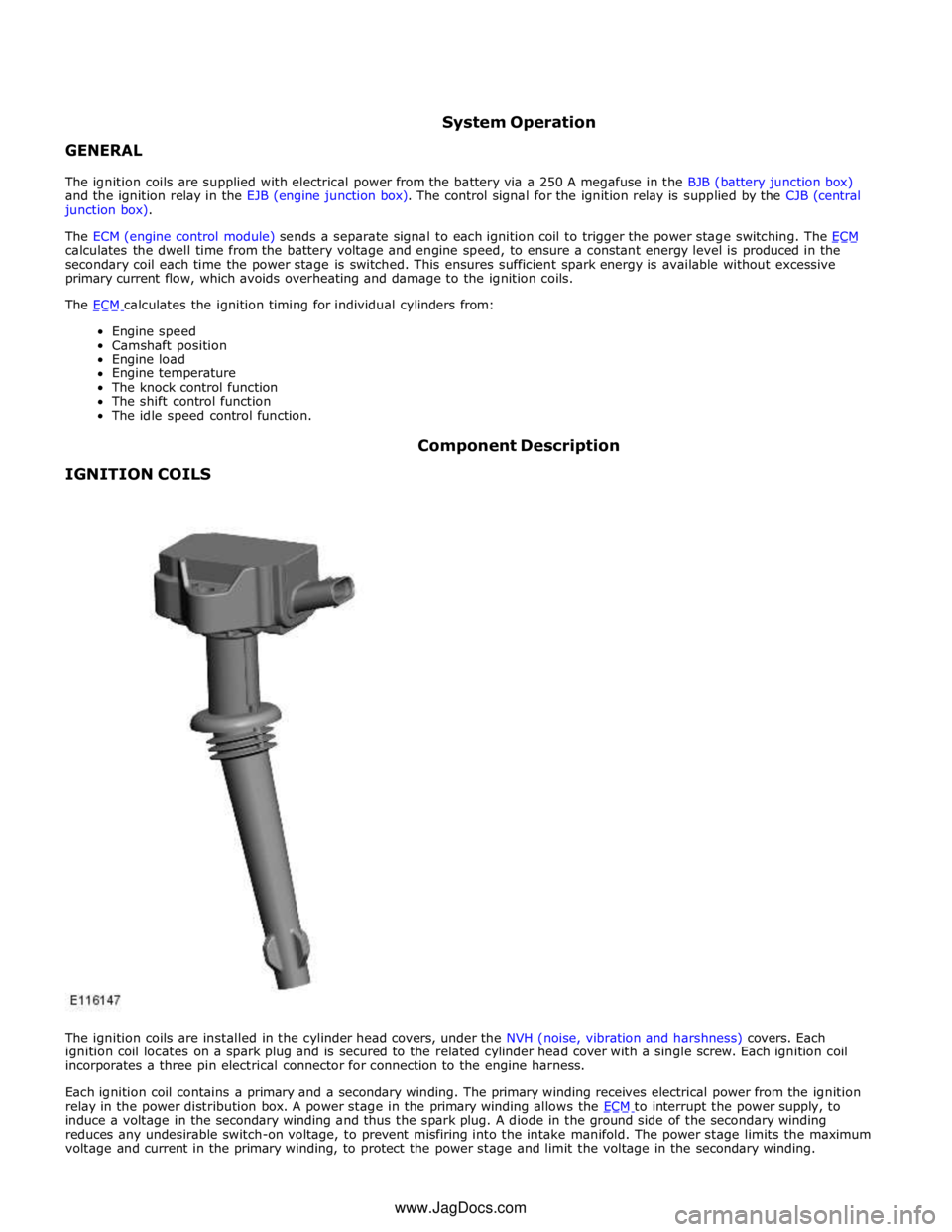
The ignition coils are installed in the cylinder head covers, under the NVH (noise, vibration and harshness) covers. Each
ignition coil locates on a spark plug and is secured to the related cylinder head cover with a single screw. Each ignition coil
incorporates a three pin electrical connector for connection to the engine harness.
Each ignition coil contains a primary and a secondary winding. The primary winding receives electrical power from the ignition
relay in the power distribution box. A power stage in the primary winding allows the ECM to interrupt the power supply, to induce a voltage in the secondary winding and thus the spark plug. A diode in the ground side of the secondary winding
reduces any undesirable switch-on voltage, to prevent misfiring into the intake manifold. The power stage limits the maximum
voltage and current in the primary winding, to protect the power stage and limit the voltage in the secondary winding. www.JagDocs.com