Page 405 of 441
�´�´
Although this seems like a simple
procedure, you should take several
precautions.
Open the hood, and check the
physical condition of the battery.
In very cold weather, check the
condition of the electrolyte. If it
seems slushy or f rozen, do not try
jump starting until it thaws.
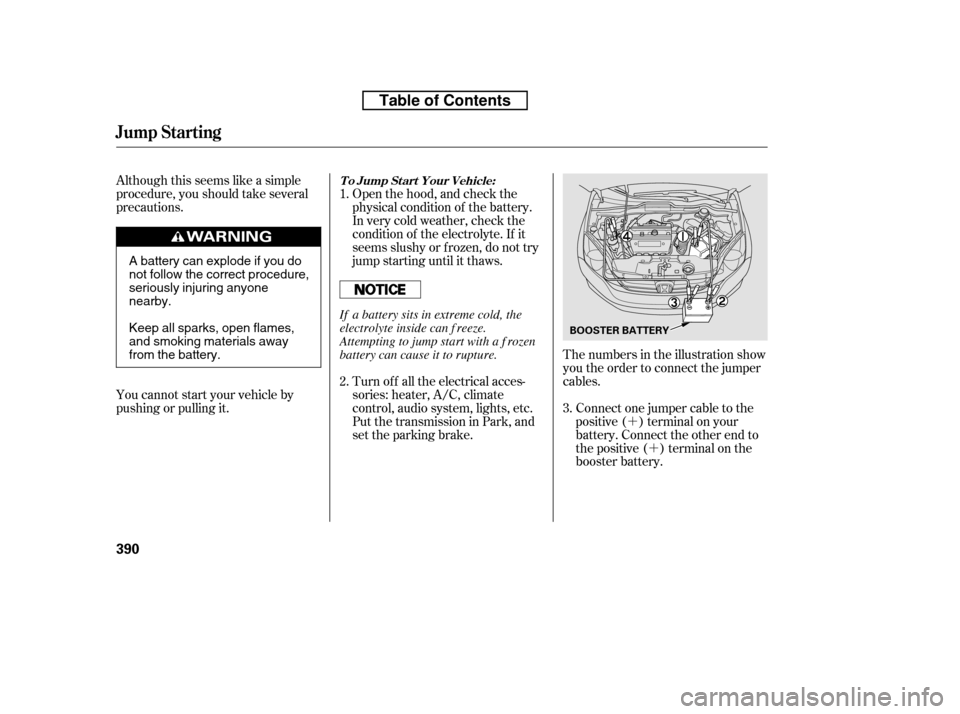
Connect one jumper cable to the
positive ( ) terminal on your
battery. Connect the other end to
the positive ( ) terminal on the
booster battery.
The numbers in the illustration show
you the order to connect the jumper
cables.
You cannot start your vehicle by
pushing or pulling it. Put the transmission in Park, and
set the parking brake.
Turn of f all the electrical acces-
sories: heater, A/C, climate
control, audio system, lights, etc.
1. 2.
3.
To Jump Start Your Vehicle:
Jump Starting
390
BOOSTER BATTERY
A battery can explode if you do
not follow the correct procedure,
seriously injuring anyonenearby.
Keep all sparks, open flames,
and smoking materials away
from the battery.If a battery sits in extreme cold, the
electrolyte inside can f reeze.
Attempting to jump start with a f rozen
battery can cause it to rupture.
Table of Contents
Page 407 of 441
If the vehicle overheats, you should
take immediate action. The only
indication may be the temperature
gauge climbing to or above the red
mark. Or you may see steam or
spray coming f rom under the hood.
The reading of the vehicle’s
temperature gauge should stay in
the midrange. If it climbs to the red
mark, you should determine the
reason (hot day, driving up a steep
hill, etc.).
If you do not see steam or spray,
leave the engine running, and
watch the temperature gauge. If
the high heat is due to overloading,
the engine should start to cool
down almost immediately. If it
does, wait until the temperature
gauge reading comes down to the
midpoint, then continue driving.
If the temperature gauge reading
stays at the red mark, turn of f the
engine.
If you see steam and/or spray
coming f rom under the hood, turn
of f the engine. Wait until you see
no more signs of steam or spray,
then open the hood.
Saf ely pull to the side of the road.
Put the transmission in Park, and
set the parking brake. Turn of f all
the accessories, and turn on the
hazard warning lights.
1. 2. 3. 4.
If theEngineOverheats
392
Steam and spray from an
overheated engine can
seriously scald you.
Do not open the hood if steam
is coming out.
Driving with the temperature gauge
reading at the red mark can cause
serious damage to the engine.
Table of Contents
Page 409 of 441

Let the vehicle sit f or a minute.
Open the hood, and check the oil
level (see page ). An engine
very low on oil can lose pressure
during cornering and other driving
maneuvers.
If necessary, add oil to bring the
level back to the full mark on the
dipstick (see page ).
Saf ely pull of f the road, and shut
of f the engine. Turn on the hazard
warning lights.
Start the engine, and watch the oil
pressure indicator. If it does not go
out within 10 seconds, turn of f the
engine. There is a mechanical
problem that needs to be repaired
bef ore you can continue driving
(see on page
).
This indicator should never come on
when the engine is running. If it
starts flashing or stays on, the oil
pressure has dropped very low or
lost pressure. Serious engine
damage is possible, and you should
take immediate action.
If the charging system indicator
comes on brightly when the engine
is running, the battery is not being
charged.
Immediately turn of f all electrical
accessories. Try not to use other
electrically operated controls such as
the power windows. Keep the engine
running; starting the engine will
discharge the battery rapidly.
Go to a service station or garage
where you can get technical
assistance.
1. 2. 4.
3.
349
403 298
Emergency T owing
L ow Oil Pressure
Indicator
Charging System
Indicator
L ow Oil Pressure Indicator, Charging System Indicator
394
Running the engine with low oil
pressure can cause serious mechanical
damage almost immediately. Turn of f
the engine as soon as you can saf ely get
the vehicle stopped.
Table of Contents
Page 412 of 441
The interior f use box is located
under the dashboard on the driver’s
side. The f use label is attached
under the steering column.The under-hood f use box is on the
driver’s side. To open it, push the
tabs as shown.
The vehicle’s f uses are contained in
threefuseboxes.
The auxiliary f use box is located
next to the interior f use box.
To open the f use box lid, pull the tab
in the direction as shown in the
illustration.
Fuses
T aking Care of t he Unexpect ed
397
TAB
INTERIOR
UNDER-HOOD
FUSE LABEL TAB
FUSELID
FUSES INTERIOR (Auxiliary)
Table of Contents
Page 440 of 441
If NHTSA receives similar com-
plaints, it may open an investigation,
and if it f inds that a saf ety def ect
exists in a group of vehicles, it may
order a recall and remedy campaign.
However, NHTSA cannot become
involved in individual problems
between you, your dealer, or
American Honda Motor Co., Inc.
If you believe that your vehicle has a
def ect which could cause a crash or
could cause injury or death, you
should immediately inf orm the
National Highway Traf f ic Saf ety
Administration (NHTSA) in addition
to notifying American Honda Motor
Co., Inc.
To contact NHTSA, you may call the
VehicleSafetyHotlinetoll-freeat1-888-327-4236
(TTY: 1-800-424-9153); go to
; or write to:
Administrator, NHTSA, 1200 New
Jersey Avenue, SE., Washington, DC20590.
You can also obtain other
inf ormation about motor vehicle
safety from .
Reporting Saf ety Def ects (U.S. Vehicles)
424
http://www.saf ercar.gov
http://www.saf ercar.gov
Table of Contents