Page 350 of 441

If you tow more than 8 hours in one
day, you should repeat the above
procedure at least every 8 hours
(when you stop f or f uel, etc.)Only remove the fuse after you have
perf ormed the transmission shif ting
procedure, and the key is in the
ACCESSORY (I) position. Store the
f use in an obvious location (center
tray, coin pockets, etc) as a reminder
to re-install the fuse before drivingthe vehicle.
When towing your vehicle f or long
periods, remove the 7.5 A Accessory
Radio f use to reduce drain on battery.
This f use is located in the interior
f use box and is shown as number 34
below.
If you tow a CR-V behind a
motorhome, the transmission fluid
must be changed every 2 years or
30,000 miles (48,000 km), whichever
comes f irst.
Ext ended T owing
Towing Your Vehicle Behind a Motorhome
Driving
335
INTERIOR FUSE BOXACCESSORY RADIO FUSE
The steering system can be damaged if
the steering wheel is locked. Leave the
ignition switch in the ACCESSORY (I)
position, and make sure the steering
wheel turns f reely bef ore you begin
towing.
Failure to f ollow the recommended
instructions exactly will result in severe
automatic transmission damage. If you
cannot shif t the transmission or start
the engine, your vehicle must be
transported on a f lat-bed truck or
trailer. Severe transmission damage will occur
if the vehicle is shif ted f rom reverse to
neutral and then towed with the drive
wheels on the ground.
Table of Contents
Page 352 of 441

Before you leave the pavement, be
sure to do all scheduled maintenance
and service, and inspect your vehicle
f or any problems. Pay special
attention to the condition of the tires,
and check the tire pressures.
After you return to the pavement,
caref ully inspect your vehicle to
make sure there is no damage that
could make driving it unsaf e.
Recheck the condition of the tires
and the tire pressures.
The route presents limits (too steep
or bumpy roads). You have limits
(driving skill and comf ort). And your
vehicle has limits (traction, stability,
and power).
Driving of f -highway can be
hazardous if you f ail to recognize
limits and take the proper
precautions.Forbettertractiononallsurfaces,
accelerate slowly and gradually build
up speed. If you try to start too fast
on wet soil, mud, snow, or ice, you
might not have enough traction to
get underway, and you may dig
yourself a hole. Starting with the
shif t lever in second (2) gear will
help you have a smoother start on
snow or ice.
Keep in mind that you will usually
need more time and distance to
brake to a stop on unpaved surf aces.
Avoid hard braking. Do not ‘‘pump’’
the brakes; let the anti-lock braking
system pump them f or you.
Debris in the road can damage your
suspension or other components.
Because your vehicle has a high
center of gravity, driving over a large
obstacle, or allowing a wheel to drop
into a deep hole can cause your
vehicle to tip or roll over.
If you can’t clearly see all conditions
or obstacles on a slope, walk the
slope bef ore you drive on it. If you
have any doubt whether or not you
can saf ely drive on the slope, don’t
do it. Find another route.
If you are driving up a hill and f ind
that you cannot continue,
. Your vehicle could roll
over. Slowly back down the hill,
f ollowing the same route you took up
the hill.
do not try to
turn around
Check Out Your Vehicle
Remember A ccelerating and Braking A voiding Obstacles
Driving on Slopes
Of f -Highway Driving Guidelines
Driving
337
Table of Contents
Page 368 of 441
Do not add any rust inhibitors or
other additives to your vehicle’s
cooling system. They may not be
compatible with the coolant or
engine components.Pour coolant into the reserve tank.
Fill it half way between the MAX
and MIN marks. Put the cap back
on the reserve tank.
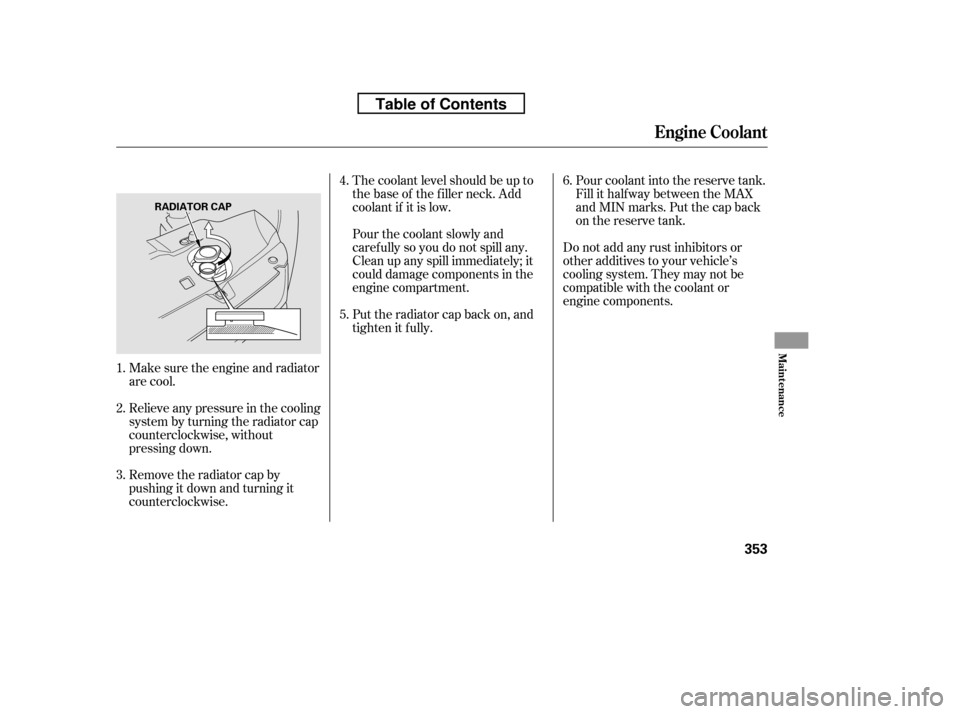
Make sure the engine and radiator
are cool. The coolant level should be up to
the base of the f iller neck. Add
coolant if it is low.
Pourthecoolantslowlyand
caref ully so you do not spill any.
Clean up any spill immediately; it
could damage components in the
engine compartment.
Put the radiator cap back on, and
tighten it fully.
Relieve any pressure in the cooling
system by turning the radiator cap
counterclockwise, without
pressing down.
Remove the radiator cap by
pushingitdownandturningit
counterclockwise.
3. 4.
2.
1. 5.6.
Engine Coolant
Maint enance
353
RADIATOR CAP
Table of Contents
Page 373 of 441
Check the level on the side of the
reservoir when the engine is cold.
The f luid should be between the
UPPER LEVEL and LOWER LEVEL.
If not, add power steering f luid to the
UPPER LEVEL.
Pour the f luid slowly and caref ully so
you do not spill any. Clean up any
spills immediately; it could damage
components in the engine
compartment.Always use Honda Power Steering
Fluid. You may use another power
steering f luid as an emergency
replacement, but have the power
steering system f lushed and ref illed
with Honda PSF as soon as possible.
A low power steering f luid level can
indicate a leak in the system. Check
the f luid level f requently, and have
the system inspected as soon as
possible.
Power Steering Fluid
358
LOWER LEVEL
UPPER LEVEL
T urning the steering wheel to f ull lef t
or right lock and holding it there can
damage the power steering pump.
Table of Contents
Page 376 of 441
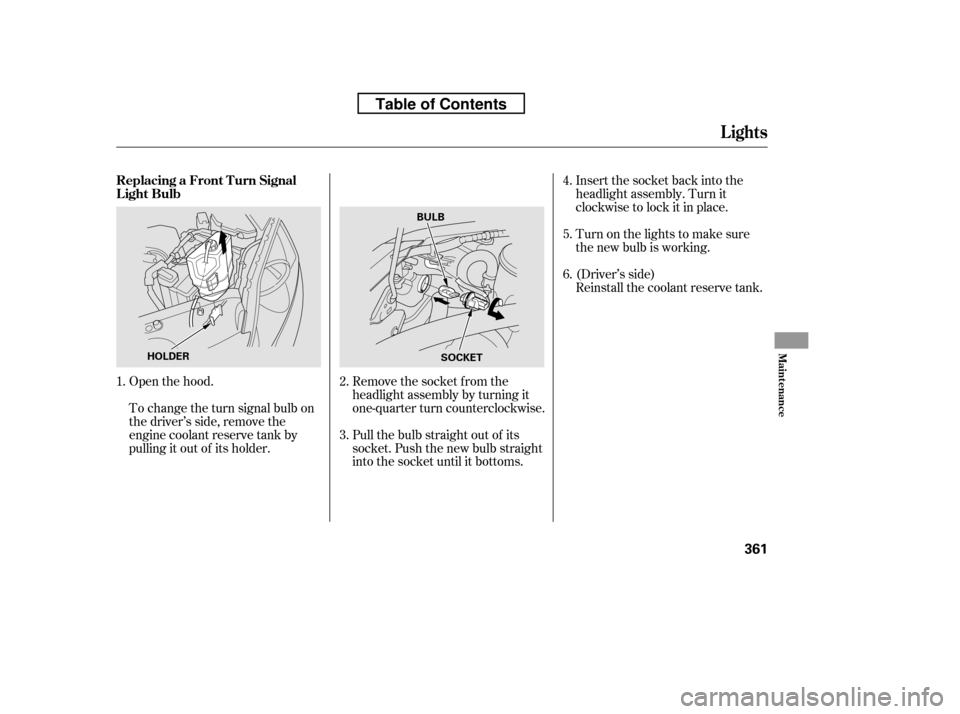
Insert the socket back into the
headlight assembly. Turn it
clockwise to lock it in place.
Turn on the lights to make sure
the new bulb is working.
(Driver’s side)
Reinstall the coolant reserve tank.
Open the hood.
To change the turn signal bulb on
the driver’s side, remove the
engine coolant reserve tank by
pulling it out of its holder. Remove the socket from the
headlight assembly by turning it
one-quarter turn counterclockwise.
Pull the bulb straight out of its
socket. Push the new bulb straight
into the socket until it bottoms.
1.
2. 3.4.5. 6.
Lights
Replacing a Front T urn Signal
Light Bulb
Maint enance
361
HOLDER
BULB
SOCKET
Table of Contents
Page 377 of 441
Insert the socket back into the
headlight assembly. Turn it
clockwise to lock it in place.
Turn on the lights to make sure
the new bulb is working.
Reinstall the f use box in place
securely.
(Driver’s side)
Open the hood.
To change the parking light/f ront
side marker on the driver’s side,
removethefuseboxfromitsstay
by pulling out. Remove the socket from the
headlight assembly by turning it
one-quarter turn counterclockwise.
Pull the bulb straight out of its
socket. Push the new bulb straight
into the socket until it bottoms.
1.
2. 3.4.5. 6.
Lights
Replacing a Parking L ight/Front
Side Marker L ight Bulb
362
FUSE BOX
On the passenger’s sideBULB
SOCKET
Table of Contents
Page 378 of 441
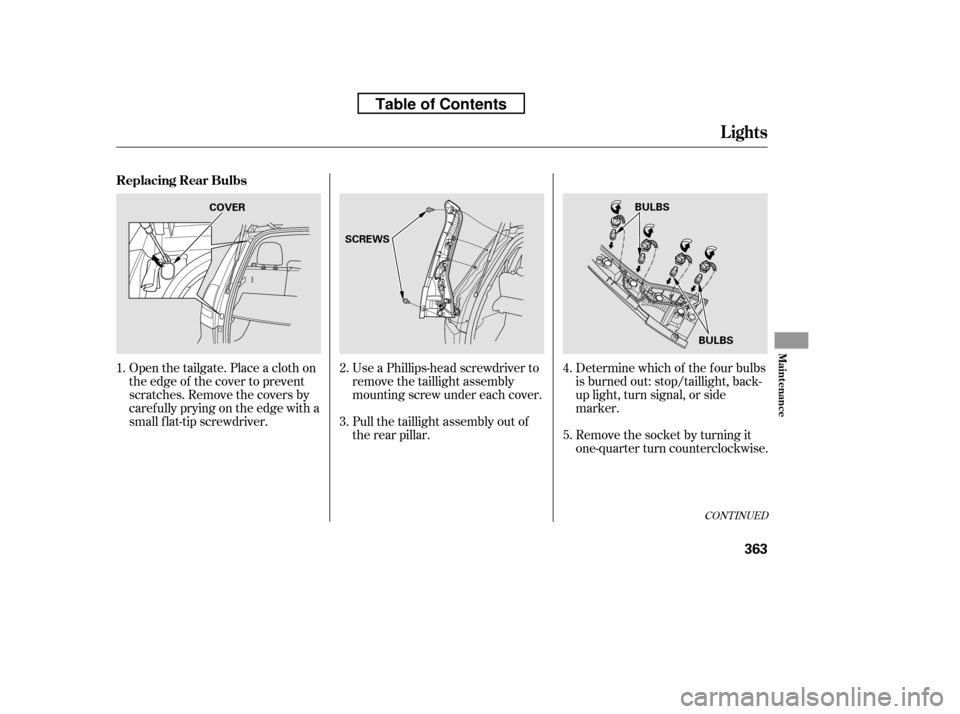
Determine which of the f our bulbs
is burned out: stop/taillight, back-
up light, turn signal, or side
marker.
Remove the socket by turning it
one-quarter turn counterclockwise.
Use a Phillips-head screwdriver to
remove the taillight assembly
mounting screw under each cover.
Pull the taillight assembly out of
the rear pillar.
Open the tailgate. Place a cloth on
the edge of the cover to prevent
scratches. Remove the covers by
caref ully prying on the edge with a
small f lat-tip screwdriver.
2. 3. 4. 5.
1.
CONT INUED
Replacing Rear Bulbs
Lights
Maint enance
363
BULBS
COVER
SCREWS
BULBS
Table of Contents
Page 379 of 441
Reinstall the socket into the light
assembly by turning it clockwise
until it locks.
Align the clips on the taillight
assembly with the holes in the
body, then push the taillight
assembly into place. Tighten the
two mounting screws securely and
reinstall the covers.
Pull the bulb straight out of its
socket. Push the new bulb straight
into the socket until it bottoms.
Turn on the lights to make sure
the new bulb is working.
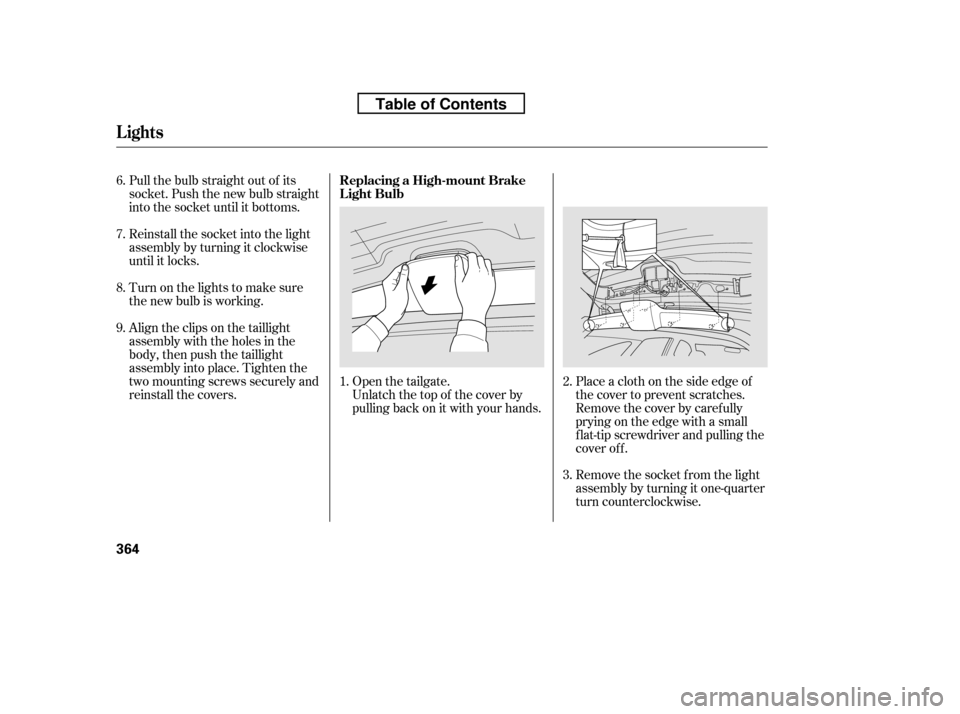
Open the tailgate. Place a cloth on the side edge ofthe cover to prevent scratches.
Remove the cover by caref ully
prying on the edge with a small
f lat-tip screwdriver and pulling the
cover off.
Unlatch the top of the cover by
pulling back on it with your hands.
Remove the socket f rom the light
assembly by turning it one-quarter
turn counterclockwise.
1.
2.
6. 7.8. 9.
3.
Replacing a High-mount Brake
Light Bulb
Lights
364
Table of Contents