Page 82 of 120

Fuses and Circuit Breakers
The wiring circuits in the vehicle are protected from
short circuits by a combination of fuses, circuit breakers
and fusible thermal links. This greatly reduces the
chance of fires caused by electrical problems.
Be sure you replace a bad fuse with a new one of the
identical size and rating.
If you ever have a problem on the road and do not
have a spare fuse, you can borrow one that has the
same amperage. Just pick some feature of the vehicle
that you can get along without, like the radio or cigarette
lighter, and use its fuse, if it is the correct amperage.
Replace it as soon as you can.
The vehicle also has a special fuse in the battery box
for the 300-volt batteries. If this fuse has failed and
needs to be replaced, the vehicle will be disabled and
you will need to have the vehicle repaired by your
dealer/retailer. Do not attempt to self-service this fuse.
Underhood Fuse Block
Hybrid Auxiliary Underhood Fuse Block
The hybrid underhood fuse block is located in the
engine compartment near the front of the vehicle. Lift
the cover for access to the fuse/relay block. SeeEngine
Compartment Overview
on page 6‑4for more
information on its location. For more information on the
main underhood fuse block, see “Underhood Fuse
Block” in the owner manual.
6-26
Page 88 of 120

TPMS Sensor Matching Process
Each TPMS sensor has a unique identification code.
Any time you rotate your vehicle's tires or replace one
or more of the TPMS sensors, the identification codes
will need to be matched to the new tire/wheel position.
The sensors are matched to the tire/wheel positions in
the following order: driver side front tire, passenger
side front tire, passenger side rear tire, and driver side
rear tire using a TPMS diagnostic tool. See your
dealer/retailer for service.
The TPMS sensors can also be matched to each
tire/wheel position by increasing or decreasing the
tire's air pressure. If increasing the tire's air pressure,
do not exceed the maximum inflation pressure indicated
on the tire's sidewall.
To decrease air-pressure out of a tire you can use the
pointed end of the valve cap, a pencil-style air pressure
gage, or a key.
You have two minutes to match the first tire/wheel
position, and five minutes overall to match all four
tire/wheel positions. If it takes longer than two minutes,
to match the first tire and wheel, or more than
five minutes to match all four tire and wheel positions
the matching process stops and you need to start over.The TPMS sensor matching process is outlined below:
1. Set the parking brake.
2. Turn the ignition switch to ON/RUN with the engine off.
3. Press
QandKon the Remote Keyless Entry
(RKE) transmitter at the same time for
approximately five seconds. The horn sounds
twice to signal the receiver is in relearn mode and
TIRE LEARNING ACTIVE message displays on
the DIC screen.
4. Start with the driver side front tire.
5. Remove the valve cap from the valve cap stem. Activate the TPMS sensor by increasing or
decreasing the tire's air pressure for five seconds,
or until a horn chirp sounds. The horn chirp, which
may take up to 30 seconds to sound, confirms that
the sensor identification code has been matched to
this tire and wheel position.
6. Proceed to the passenger side front tire, and repeat the procedure in Step 5.
7. Proceed to the passenger side rear tire, and repeat the procedure in Step 5.
6-32
Page 91 of 120
If a tire goes flat, avoid further tire and wheel damage
by driving slowly to a level place and stopping.
Then do this:1. Turn on the hazard warning flashers.
2. Park your vehicle. Set the parking brake firmly and put the shift lever in PARK (P).
3. Turn off the engine.
4. Inspect the flat tire.
If the tire has been separated from the wheel or has
damaged sidewalls or large tears that allow rapid air
loss, call a tire repair facility. See “Roadside Assistance
Program” in the Index of the owner manual.
If the flat tire is due to a slow leak caused by a nail or
other similar road hazard, the tire inflator kit may be
used to repair the damaged tire temporarily. The kit
uses a liquid tire sealant to seal small punctures in the
tread area of the tire.
After repairing a tire with the tire inflator kit, take your
vehicle to an authorized retailer to have the tire
inspected and repaired as soon as possible. The tire
sealant is a temporary repair only. See Tire Sealant
and Compressor Kit (Without Selector Switch)
on
page 6‑35or Tire Sealant and Compressor Kit
(With Selector Switch) on page 6‑45.
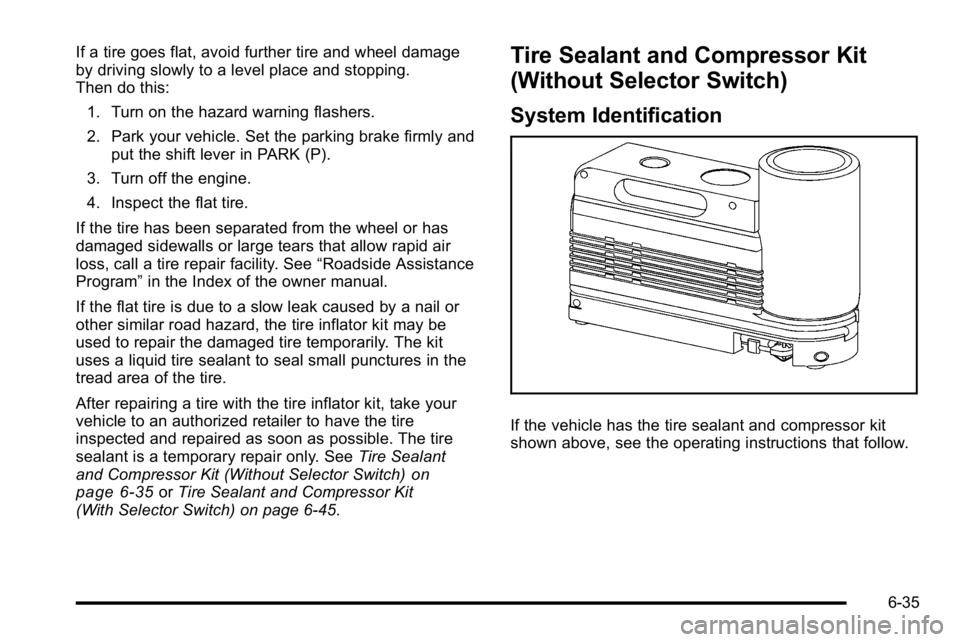
Tire Sealant and Compressor Kit
(Without Selector Switch)
System Identification
If the vehicle has the tire sealant and compressor kit
shown above, see the operating instructions that follow.
6-35
Page 92 of 120
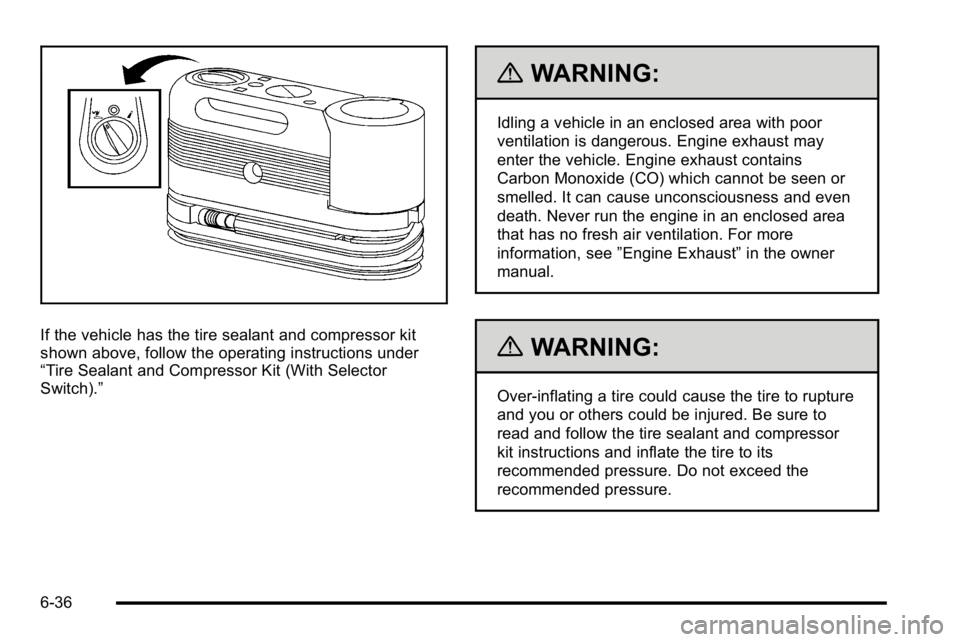
If the vehicle has the tire sealant and compressor kit
shown above, follow the operating instructions under
“Tire Sealant and Compressor Kit (With Selector
Switch).”
{WARNING:
Idling a vehicle in an enclosed area with poor
ventilation is dangerous. Engine exhaust may
enter the vehicle. Engine exhaust contains
Carbon Monoxide (CO) which cannot be seen or
smelled. It can cause unconsciousness and even
death. Never run the engine in an enclosed area
that has no fresh air ventilation. For more
information, see”Engine Exhaust” in the owner
manual.
{WARNING:
Over-inflating a tire could cause the tire to rupture
and you or others could be injured. Be sure to
read and follow the tire sealant and compressor
kit instructions and inflate the tire to its
recommended pressure. Do not exceed the
recommended pressure.
6-36
Page 102 of 120
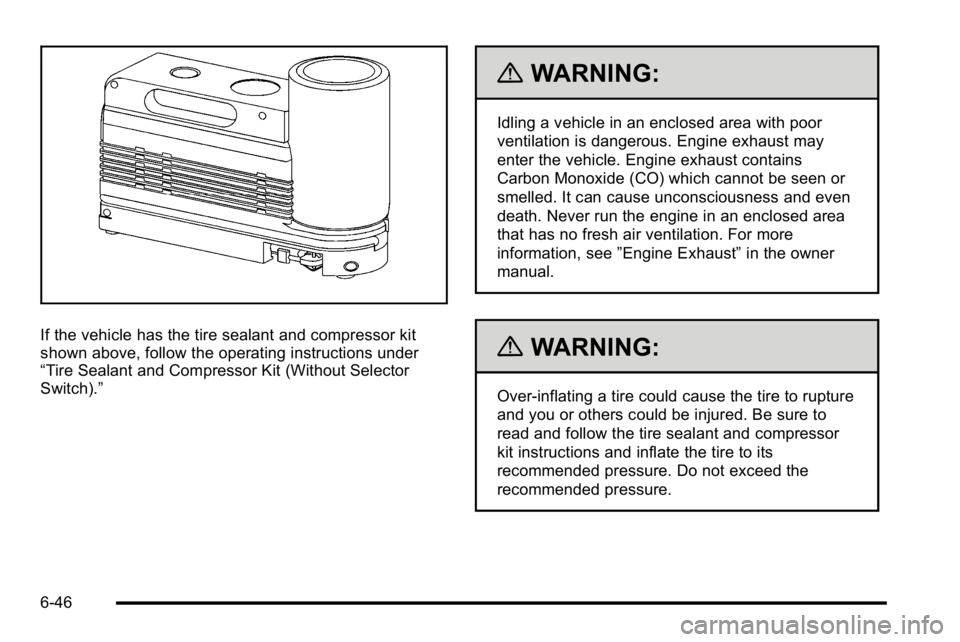
If the vehicle has the tire sealant and compressor kit
shown above, follow the operating instructions under
“Tire Sealant and Compressor Kit (Without Selector
Switch).”
{WARNING:
Idling a vehicle in an enclosed area with poor
ventilation is dangerous. Engine exhaust may
enter the vehicle. Engine exhaust contains
Carbon Monoxide (CO) which cannot be seen or
smelled. It can cause unconsciousness and even
death. Never run the engine in an enclosed area
that has no fresh air ventilation. For more
information, see”Engine Exhaust” in the owner
manual.
{WARNING:
Over-inflating a tire could cause the tire to rupture
and you or others could be injured. Be sure to
read and follow the tire sealant and compressor
kit instructions and inflate the tire to its
recommended pressure. Do not exceed the
recommended pressure.
6-46
Page 113 of 120
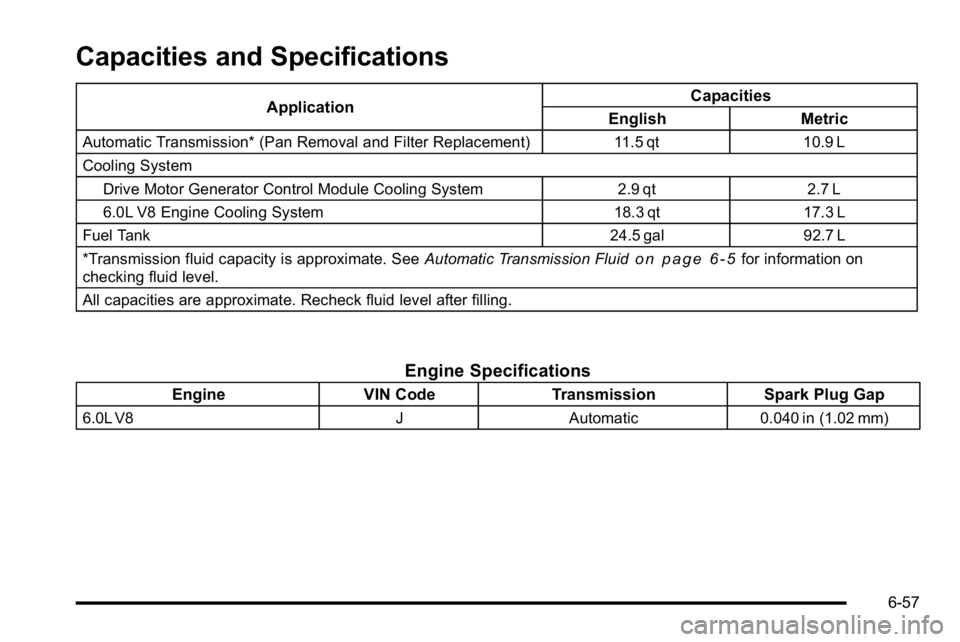
Capacities and Specifications
ApplicationCapacities
English Metric
Automatic Transmission* (Pan Removal and Filter Replacement) 11.5 qt10.9 L
Cooling System Drive Motor Generator Control Module Cooling System 2.9 qt2.7 L
6.0L V8 Engine Cooling System 18.3 qt17.3 L
Fuel Tank 24.5 gal92.7 L
*Transmission fluid capacity is approximate. See Automatic Transmission Fluid
on page 6‑5for information on
checking fluid level.
All capacities are approximate. Recheck fluid level after filling.
Engine Specifications
Engine VIN CodeTransmission Spark Plug Gap
6.0L V8 JAutomatic 0.040 in (1.02 mm)
6-57
Page 115 of 120
Section 7 Maintenance Schedule
Maintenance Schedule. . . . . . . . . . . . . . . . . . . . . . . . . . . . 7-2
At Least Once a Year . . . . . . . . . . . . . . . . . . . . . . . . . . . 7-2
Recommended Fluids and Lubricants . . . . . . . . . . . 7-2
Engine Drive Belt Routing . . . . . . . . . . . . . . . . . . . . . . . 7-2
7-1
Page 116 of 120
Maintenance Schedule
At Least Once a Year
Tire Sealant and Compressor Kit
Check the sealant expiration date printed on the
instruction label of the Tire Sealant and Compressor Kit
at least once a year. See your dealer/retailer for a
replacement canister.
Recommended Fluids and
Lubricants
Fluids identified below are specific to the hybrid vehicle
and can be obtained from your dealer/retailer. See the
owner manual for the other fluids and lubricants
recommended for the vehicle.Usage Fluid/Lubricant
Drive Motor/Generator
Control Module
(DMCM) Cooling
System Always use the pre-mixed
50/50 mixture of de‐ionized water
and DEX-COOL®(silicate-free)
coolant available at your dealer/
retailer. See Drive Motor/Generator
Control Module (DMCM) Cooling
System on page 6‑9.
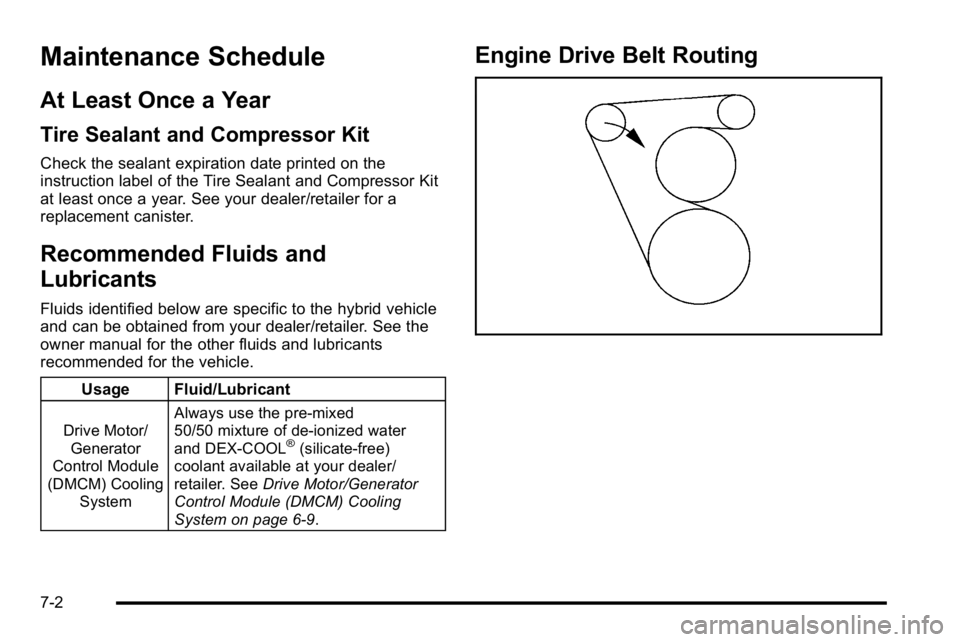
Engine Drive Belt Routing
7-2