Page 310 of 448
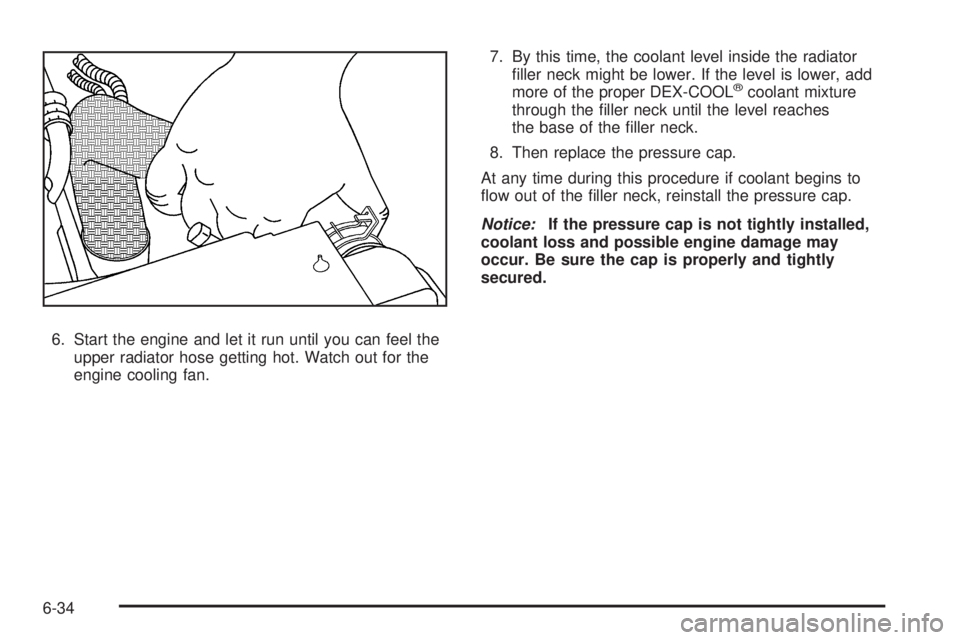
6. Start the engine and let it run until you can feel the
upper radiator hose getting hot. Watch out for the
engine cooling fan.7. By this time, the coolant level inside the radiator
filler neck might be lower. If the level is lower, add
more of the proper DEX-COOL
®coolant mixture
through the filler neck until the level reaches
the base of the filler neck.
8. Then replace the pressure cap.
At any time during this procedure if coolant begins to
flow out of the filler neck, reinstall the pressure cap.
Notice:If the pressure cap is not tightly installed,
coolant loss and possible engine damage may
occur. Be sure the cap is properly and tightly
secured.
6-34
Page 332 of 448
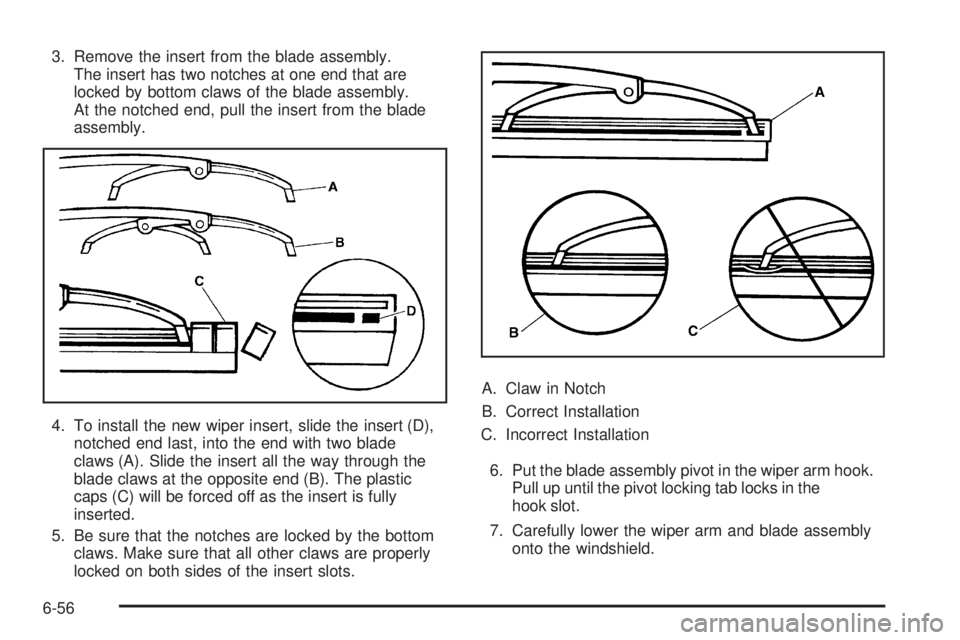
3. Remove the insert from the blade assembly.
The insert has two notches at one end that are
locked by bottom claws of the blade assembly.
At the notched end, pull the insert from the blade
assembly.
4. To install the new wiper insert, slide the insert (D),
notched end last, into the end with two blade
claws (A). Slide the insert all the way through the
blade claws at the opposite end (B). The plastic
caps (C) will be forced off as the insert is fully
inserted.
5. Be sure that the notches are locked by the bottom
claws. Make sure that all other claws are properly
locked on both sides of the insert slots.A. Claw in Notch
B. Correct Installation
C. Incorrect Installation
6. Put the blade assembly pivot in the wiper arm hook.
Pull up until the pivot locking tab locks in the
hook slot.
7. Carefully lower the wiper arm and blade assembly
onto the windshield.
6-56
Page 342 of 448

Set the cold inflation pressure to the maximum inflation
pressure shown on the tire sidewall, or 35 psi (241 kPa),
whichever is lower. See the example following. When you
end this high-speed driving, return the tires to the cold
tire inflation pressure shown on the Tire and Loading
Information label. SeeLoading the Vehicle on page 5-33
andInation - Tire Pressure on page 6-64.
Example:
You will find the maximum load and inflation pressure
molded on the tire’s sidewall, in small letters, near the
rim flange. It will read something like this: Maximum load
690 kg (1521 lbs) 300 kPa (44 psi) Max. Press.
For this example, you would set the inflation pressure
for high-speed driving at 35 psi (241 kPa).
Tire Pressure Monitor System
The Tire Pressure Monitor System (TPMS) uses radio
and sensor technology to check tire pressure levels.
The TPMS sensors monitor the air pressure in your
vehicle’s tires and transmit tire pressure readings to a
receiver located in the vehicle.
Each tire, including the spare (if provided), should be
checked monthly when cold and inflated to the inflation
pressure recommended by the vehicle manufacturer
on the vehicle placard or tire inflation pressure label.
(If your vehicle has tires of a different size than the sizeindicated on the vehicle placard or tire inflation pressure
label, you should determine the proper tire inflation
pressure for those tires.)
As an added safety feature, your vehicle has been
equipped with a tire pressure monitoring system (TPMS)
that illuminates a low tire pressure telltale when one
or more of your tires is significantly under-inflated.
Accordingly, when the low tire pressure telltale
illuminates, you should stop and check your tires
as soon as possible, and inflate them to the proper
pressure. Driving on a significantly under-inflated
tire causes the tire to overheat and can lead to tire
failure. Under-inflation also reduces fuel efficiency and
tire tread life, and may affect the vehicle’s handling
and stopping ability.
Please note that the TPMS is not a substitute for proper
tire maintenance, and it is the driver’s responsibility to
maintain correct tire pressure, even if under-inflation
has not reached the level to trigger illumination of
the TPMS low tire pressure telltale.
Your vehicle has also been equipped with a TPMS
malfunction indicator to indicate when the system
is not operating properly. The TPMS malfunction
indicator is combined with the low tire pressure telltale.
When the system detects a malfunction, the telltale will
flash for approximately one minute and then remain
continuously illuminated. This sequence will continue
upon subsequent vehicle start-ups as long as the
malfunction exists.
6-66
Page 350 of 448
GM recommends replacing tires in sets of four. This is
because uniform tread depth on all tires will help keep
your vehicle performing most like it did when the tires
were new. Replacing less than a full set of tires can affect
the braking and handling performance of your vehicle.
SeeTire Inspection and Rotation on page 6-71for
information on proper tire rotation.
{WARNING:
Mixing tires could cause you to lose control of
your vehicle while driving. If you mix tires of
different sizes, brands, or types (radial and
bias-belted tires) the vehicle may not handle
properly, and you could have a crash. Using tires
of different sizes, brands, or types may also cause
damage to your vehicle. Be sure to use the correct
size, brand, and type of tires on all wheels.
Your vehicle may have a compact spare tire and
wheel assembly. It is all right to drive with your
vehicle’s compact spare tire temporarily. It was
developed for use on your vehicle. SeeSpare Tire
on page 6-101.
{WARNING:
If you use bias-ply tires on the vehicle,
the wheel rim flanges could develop cracks
after many miles of driving. A tire and/or
wheel could fail suddenly, causing a crash.
Use only radial-ply tires with the wheels on
the vehicle.
If you must replace your vehicle’s tires with those that do
not have a TPC Spec number, make sure they are the
same size, load range, speed rating, and construction
type (radial and bias-belted tires) as your vehicle’s
original tires.
Vehicles that have a tire pressure monitoring system
could give an inaccurate low-pressure warning if
non-TPC Spec rated tires are installed on your vehicle.
Non-TPC Spec rated tires may give a low-pressure
warning that is higher or lower than the proper warning
level you would get with TPC Spec rated tires. SeeTire
Pressure Monitor System on page 6-66.
Your vehicle’s original equipment tires are listed on
the Tire and Loading Information Label. SeeLoading the
Vehicle on page 5-33, for more information about the
Tire and Loading Information Label and its location
on your vehicle.
6-74
Page 358 of 448
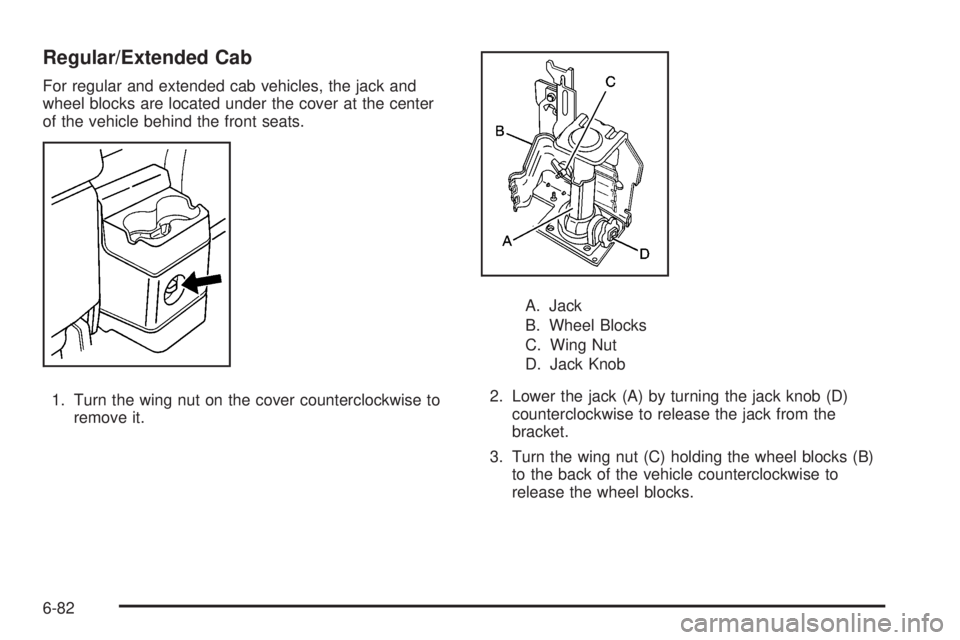
Regular/Extended Cab
For regular and extended cab vehicles, the jack and
wheel blocks are located under the cover at the center
of the vehicle behind the front seats.
1. Turn the wing nut on the cover counterclockwise to
remove it.A. Jack
B. Wheel Blocks
C. Wing Nut
D. Jack Knob
2. Lower the jack (A) by turning the jack knob (D)
counterclockwise to release the jack from the
bracket.
3. Turn the wing nut (C) holding the wheel blocks (B)
to the back of the vehicle counterclockwise to
release the wheel blocks.
6-82
Page 359 of 448
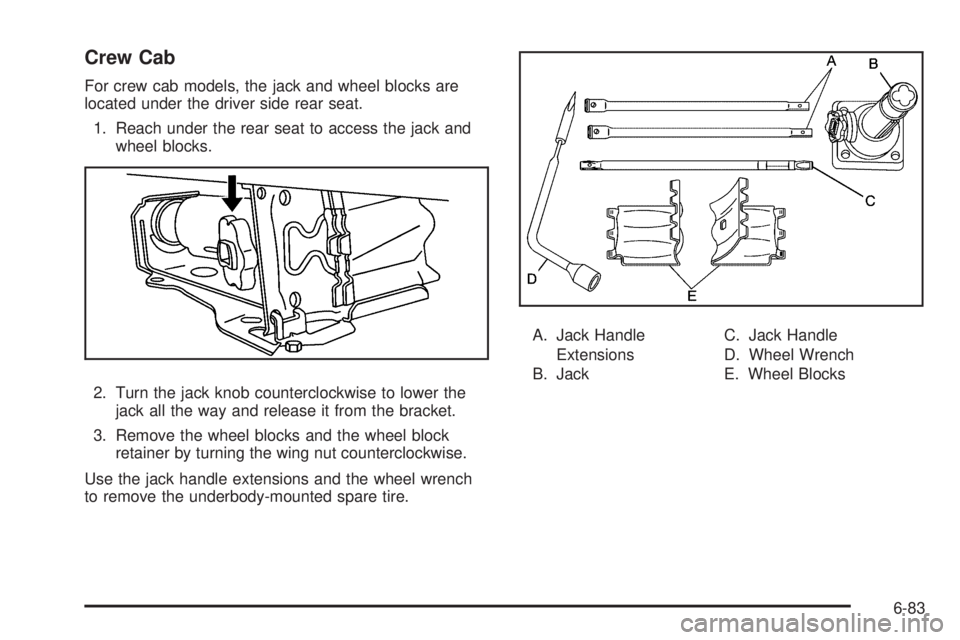
Crew Cab
For crew cab models, the jack and wheel blocks are
located under the driver side rear seat.
1. Reach under the rear seat to access the jack and
wheel blocks.
2. Turn the jack knob counterclockwise to lower the
jack all the way and release it from the bracket.
3. Remove the wheel blocks and the wheel block
retainer by turning the wing nut counterclockwise.
Use the jack handle extensions and the wheel wrench
to remove the underbody-mounted spare tire.A. Jack Handle
Extensions
B. JackC. Jack Handle
D. Wheel Wrench
E. Wheel Blocks
6-83
Page 361 of 448
3. Turn the wheel wrench (D) counterclockwise to
lower the spare tire to the ground. Continue to
turn the wheel wrench until the spare tire can be
pulled out from under the vehicle.
If the spare tire does not lower to the ground,
the secondary latch is engaged causing the tire
not to lower. SeeSecondary Latch System
on page 6-93.
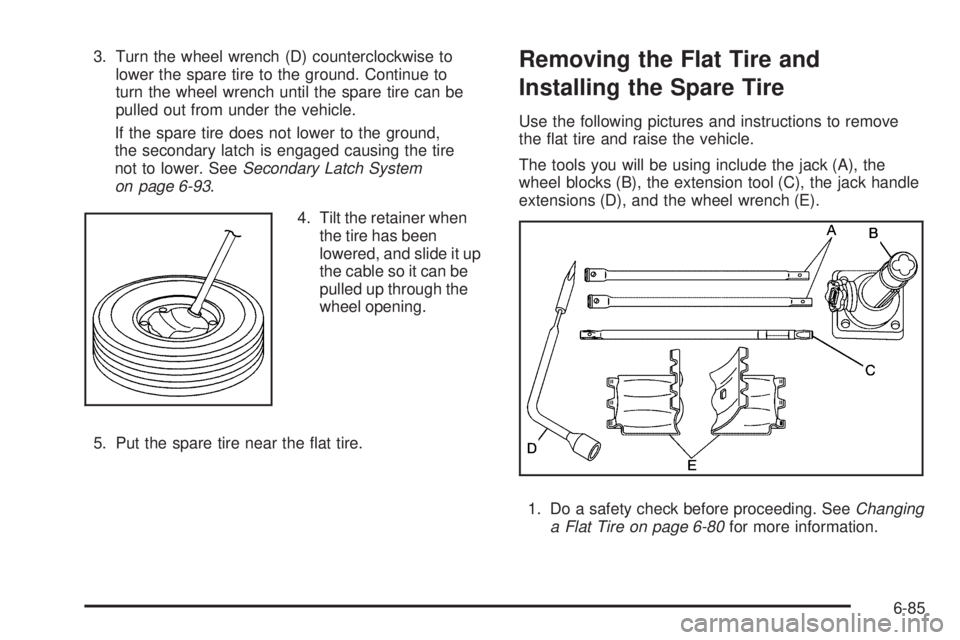
4. Tilt the retainer when
the tire has been
lowered, and slide it up
the cable so it can be
pulled up through the
wheel opening.
5. Put the spare tire near the flat tire.Removing the Flat Tire and
Installing the Spare Tire
Use the following pictures and instructions to remove
the flat tire and raise the vehicle.
The tools you will be using include the jack (A), the
wheel blocks (B), the extension tool (C), the jack handle
extensions (D), and the wheel wrench (E).
1. Do a safety check before proceeding. SeeChanging
a Flat Tire on page 6-80for more information.
6-85
Page 367 of 448
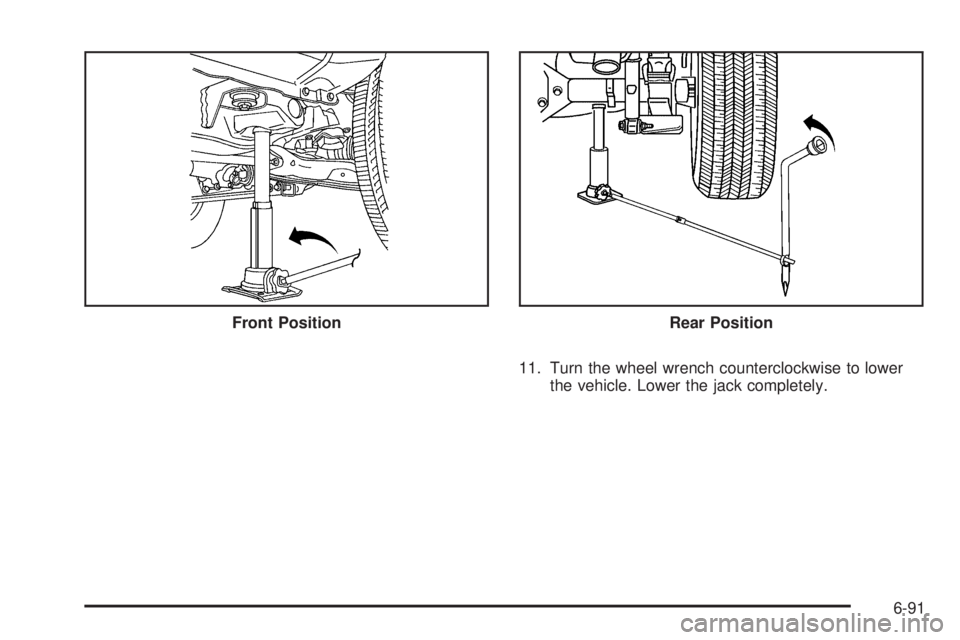
11. Turn the wheel wrench counterclockwise to lower
the vehicle. Lower the jack completely. Front Position
Rear Position
6-91