Page 77 of 448
For crew cab models, there are exposed metal lower
anchors for each rear outboard seating position, located
where the seatback meets the back of the seat
cushion.
For extended cab models with rear seats, there are
exposed metal lower anchors for each rear seating
position, attached to the back wall, near the seat
cushion.
To assist you in locating the lower anchors, place your
hand in a palm-up position and reach up between
the seat cushion and the seatback.To assist you in locating
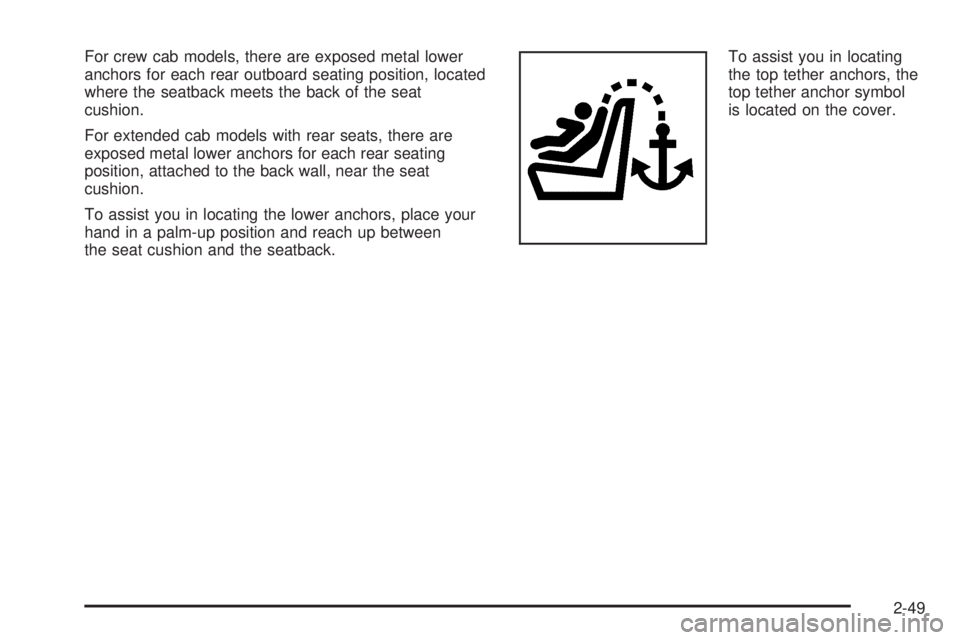
the top tether anchors, the
top tether anchor symbol
is located on the cover.
2-49
Page 83 of 448
3. Attach and tighten the lower attachments to the
lower anchors. If the child restraint does not have
lower attachments or the desired seating position
does not have lower anchors, secure the child
restraint with the top tether and the safety belts.
Refer to your child restraint manufacturer
instructions and the instructions in this manual.
3.1. Find the lower anchors for the desired
seating position.
3.2. Attach and tighten the lower attachments on
the child restraint to the lower anchors.
4. Tighten the top tether.
5. Push and pull the child restraint in different
directions to be sure it is secure.Extended Cab — Rear Seat
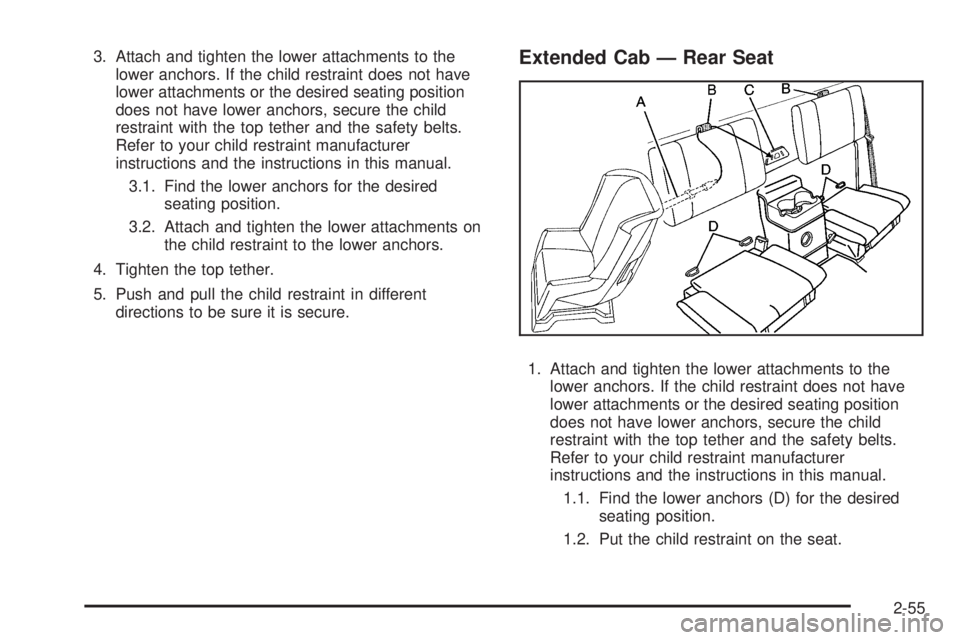
1. Attach and tighten the lower attachments to the
lower anchors. If the child restraint does not have
lower attachments or the desired seating position
does not have lower anchors, secure the child
restraint with the top tether and the safety belts.
Refer to your child restraint manufacturer
instructions and the instructions in this manual.
1.1. Find the lower anchors (D) for the desired
seating position.
1.2. Put the child restraint on the seat.
2-55
Page 84 of 448
1.3. Attach the lower attachments on the child
restraint to the lower anchors (D) in the
vehicle. The child restraint instructions will
show you how.
2. If the child restraint manufacturer recommends that
the top tether be attached, attach and tighten the top
tether to the top tether anchor (C). Refer to the child
restraint instructions and the following steps:
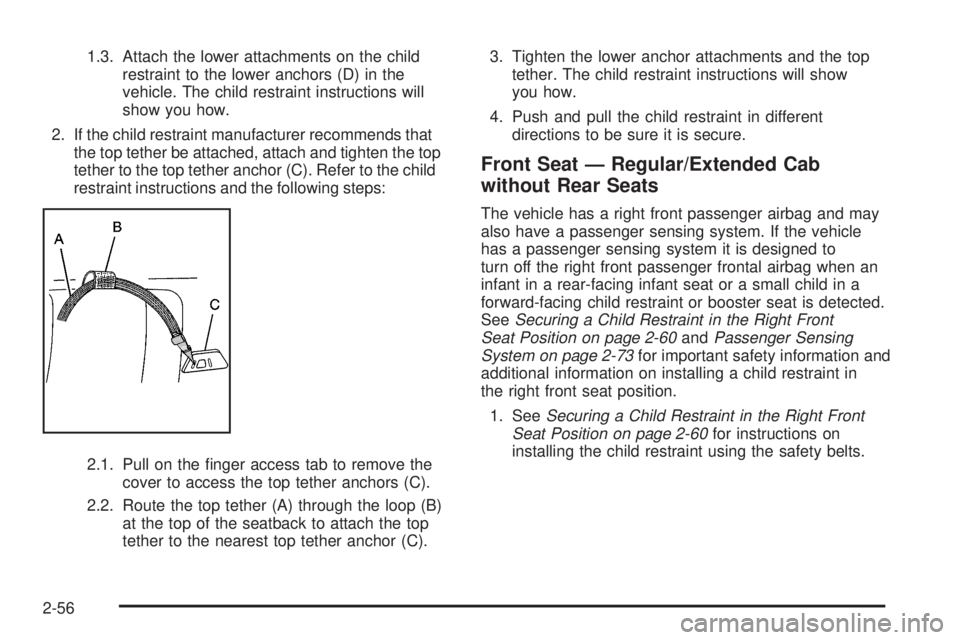
2.1. Pull on the finger access tab to remove the
cover to access the top tether anchors (C).
2.2. Route the top tether (A) through the loop (B)
at the top of the seatback to attach the top
tether to the nearest top tether anchor (C).3. Tighten the lower anchor attachments and the top
tether. The child restraint instructions will show
you how.
4. Push and pull the child restraint in different
directions to be sure it is secure.
Front Seat — Regular/Extended Cab
without Rear Seats
The vehicle has a right front passenger airbag and may
also have a passenger sensing system. If the vehicle
has a passenger sensing system it is designed to
turn off the right front passenger frontal airbag when an
infant in a rear-facing infant seat or a small child in a
forward-facing child restraint or booster seat is detected.
SeeSecuring a Child Restraint in the Right Front
Seat Position on page 2-60andPassenger Sensing
System on page 2-73for important safety information and
additional information on installing a child restraint in
the right front seat position.
1. SeeSecuring a Child Restraint in the Right Front
Seat Position on page 2-60for instructions on
installing the child restraint using the safety belts.
2-56
Page 86 of 448
Securing a Child Restraint in a Rear
Seat Position
When securing a child restraint in a rear seating
position, study the instructions that came with your child
restraint to make sure it is compatible with this vehicle.
If your child restraint has the LATCH system, see
Lower Anchors and Tethers for Children (LATCH)
on page 2-46for how to install your child restraint
using LATCH. If you secure a child restraint using a
safety belt and it uses a top tether, seeLower Anchors
and Tethers for Children (LATCH) on page 2-46for
top tether anchor locations.
Do not secure a child restraint in a position without a
top tether anchor if a national or local law requires that
the top tether be anchored, or if the instructions that
come with the child restraint say that the top strap must
be anchored.
In Canada, the law requires that forward-facing child
restraints have a top tether, and that the tether be
attached.
If your child restraint does not have the LATCH system,
you will be using the safety belt to secure the child
restraint in this position. Be sure to follow the instructions
that came with the child restraint. Secure the child in the
child restraint when and as the instructions say.If you need to install more than one child restraint in the
rear seat, be sure to readWhere to Put the Restraint
on page 2-44.
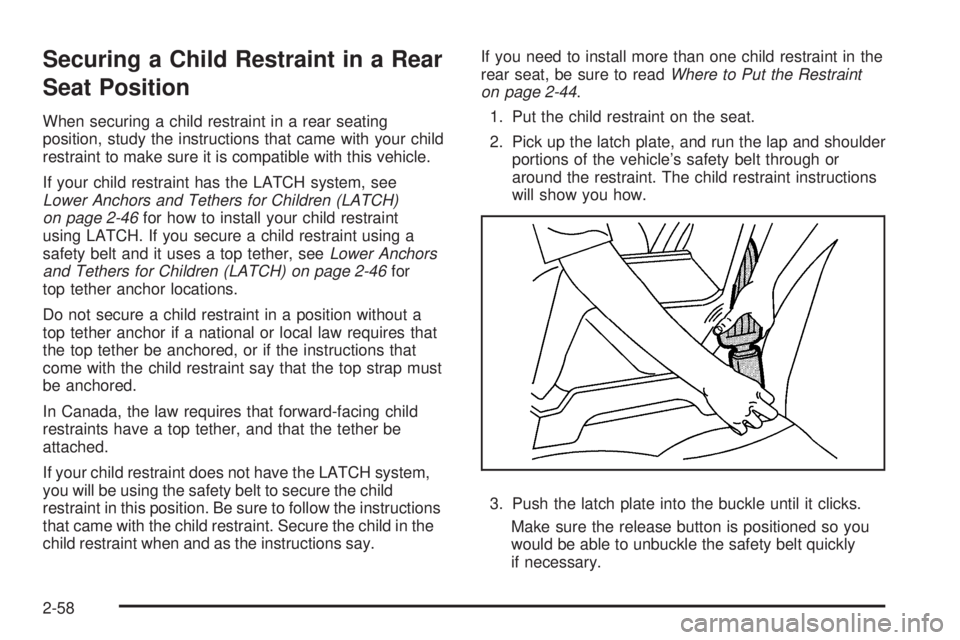
1. Put the child restraint on the seat.
2. Pick up the latch plate, and run the lap and shoulder
portions of the vehicle’s safety belt through or
around the restraint. The child restraint instructions
will show you how.
3. Push the latch plate into the buckle until it clicks.
Make sure the release button is positioned so you
would be able to unbuckle the safety belt quickly
if necessary.
2-58
Page 87 of 448
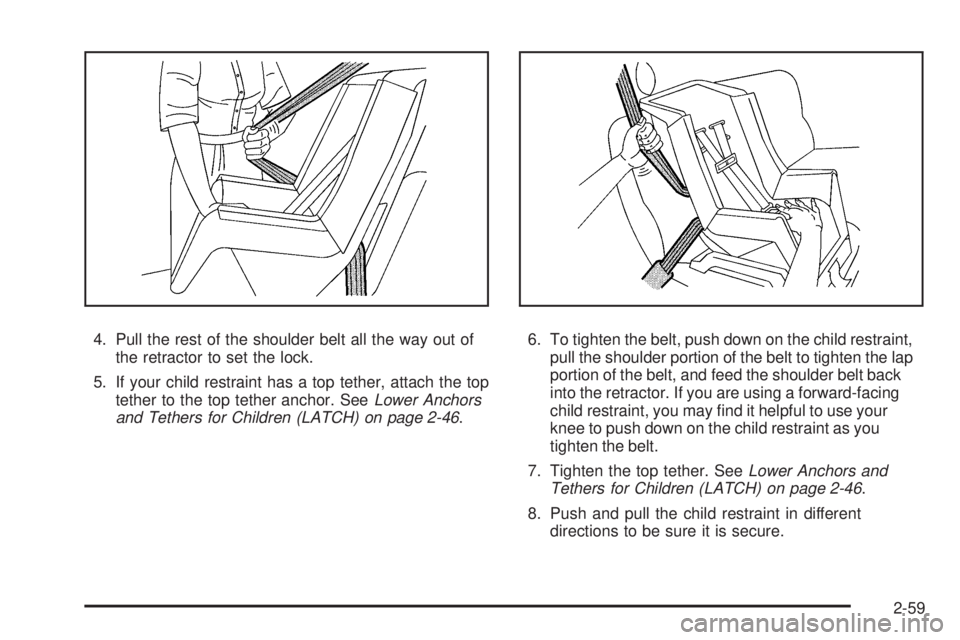
4. Pull the rest of the shoulder belt all the way out of
the retractor to set the lock.
5. If your child restraint has a top tether, attach the top
tether to the top tether anchor. SeeLower Anchors
and Tethers for Children (LATCH) on page 2-46.6. To tighten the belt, push down on the child restraint,
pull the shoulder portion of the belt to tighten the lap
portion of the belt, and feed the shoulder belt back
into the retractor. If you are using a forward-facing
child restraint, you may find it helpful to use your
knee to push down on the child restraint as you
tighten the belt.
7. Tighten the top tether. SeeLower Anchors and
Tethers for Children (LATCH) on page 2-46.
8. Push and pull the child restraint in different
directions to be sure it is secure.
2-59
Page 89 of 448
{WARNING:
A child in a rear-facing child restraint can be
seriously injured or killed if the right front
passenger airbag inflates. This is because the
back of the rear-facing child restraint would be
very close to the inflating airbag. A child in a
forward-facing child restraint can be seriously
injured or killed if the right front passenger airbag
inflates and the passenger seat is in a forward
position.
The vehicle may have a passenger sensing
system which is designed to turn off the right front
passenger frontal airbag under certain conditions.
Even if the passenger sensing system, if
equipped, has turned off the right front passenger
frontal airbag, no system is fail-safe. No one can
guarantee that an airbag will not deploy under
some unusual circumstance, even though it is
turned off.
WARNING: (Continued)
WARNING: (Continued)
Secure rear-facing child restraints in a rear
seat, even if the airbag is off. If you secure a
forward-facing child restraint in the right front seat,
always move the front passenger seat as far back
as it will go. It is better to secure the child restraint
in a rear seat.
SeePassenger Sensing System on page 2-73for
additional information.
If the vehicle does not have a rear seat that will
accommodate a rear-facing child restraint, a child
restraint should not be installed in your vehicle, even if
the airbag is off.
If your child restraint has the LATCH system, see
Lower Anchors and Tethers for Children (LATCH)
on page 2-46for how and where to install your child
restraint using LATCH. If a child restraint is secured
using a safety belt and it uses a top tether, seeLower
Anchors and Tethers for Children (LATCH) on page 2-46
for top tether anchor locations.
2-61
Page 91 of 448
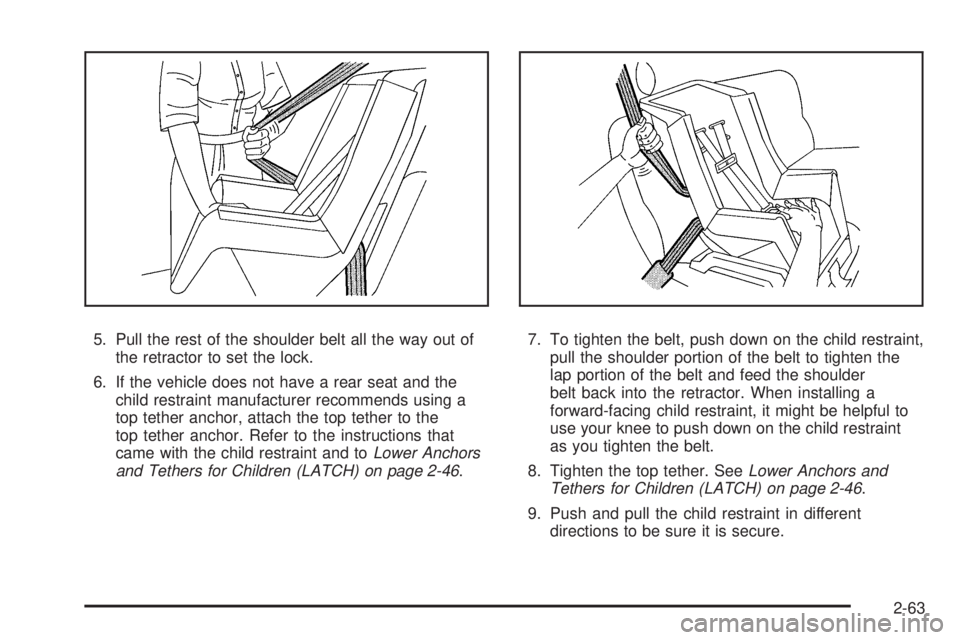
5. Pull the rest of the shoulder belt all the way out of
the retractor to set the lock.
6. If the vehicle does not have a rear seat and the
child restraint manufacturer recommends using a
top tether anchor, attach the top tether to the
top tether anchor. Refer to the instructions that
came with the child restraint and toLower Anchors
and Tethers for Children (LATCH) on page 2-46.7. To tighten the belt, push down on the child restraint,
pull the shoulder portion of the belt to tighten the
lap portion of the belt and feed the shoulder
belt back into the retractor. When installing a
forward-facing child restraint, it might be helpful to
use your knee to push down on the child restraint
as you tighten the belt.
8. Tighten the top tether. SeeLower Anchors and
Tethers for Children (LATCH) on page 2-46.
9. Push and pull the child restraint in different
directions to be sure it is secure.
2-63
Page 119 of 448
Removing the Tailgate
To remove the tailgate:
1. With the tailgate fully open, lift up slightly on the
entire tailgate assembly.
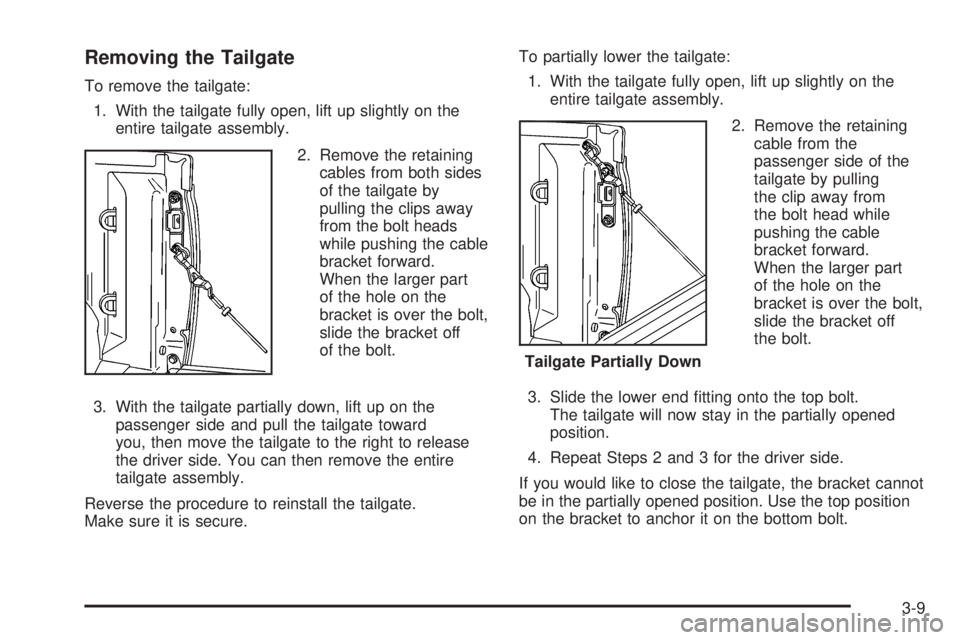
2. Remove the retaining
cables from both sides
of the tailgate by
pulling the clips away
from the bolt heads
while pushing the cable
bracket forward.
When the larger part
of the hole on the
bracket is over the bolt,
slide the bracket off
of the bolt.
3. With the tailgate partially down, lift up on the
passenger side and pull the tailgate toward
you, then move the tailgate to the right to release
the driver side. You can then remove the entire
tailgate assembly.
Reverse the procedure to reinstall the tailgate.
Make sure it is secure.To partially lower the tailgate:
1. With the tailgate fully open, lift up slightly on the
entire tailgate assembly.
2. Remove the retaining
cable from the
passenger side of the
tailgate by pulling
the clip away from
the bolt head while
pushing the cable
bracket forward.
When the larger part
of the hole on the
bracket is over the bolt,
slide the bracket off
the bolt.
3. Slide the lower end fitting onto the top bolt.
The tailgate will now stay in the partially opened
position.
4. Repeat Steps 2 and 3 for the driver side.
If you would like to close the tailgate, the bracket cannot
be in the partially opened position. Use the top position
on the bracket to anchor it on the bottom bolt.
Tailgate Partially Down
3-9