Page 296 of 448
Engine Air Cleaner/Filter
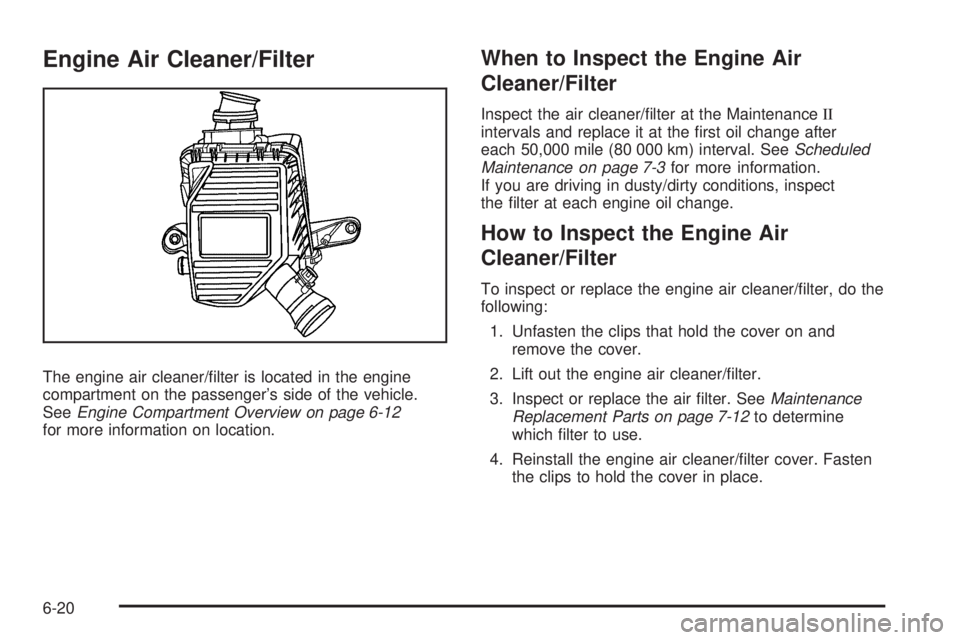
The engine air cleaner/filter is located in the engine
compartment on the passenger’s side of the vehicle.
SeeEngine Compartment Overview on page 6-12
for more information on location.
When to Inspect the Engine Air
Cleaner/Filter
Inspect the air cleaner/filter at the MaintenanceII
intervals and replace it at the first oil change after
each 50,000 mile (80 000 km) interval. SeeScheduled
Maintenance on page 7-3for more information.
If you are driving in dusty/dirty conditions, inspect
the filter at each engine oil change.
How to Inspect the Engine Air
Cleaner/Filter
To inspect or replace the engine air cleaner/filter, do the
following:
1. Unfasten the clips that hold the cover on and
remove the cover.
2. Lift out the engine air cleaner/filter.
3. Inspect or replace the air filter. SeeMaintenance
Replacement Parts on page 7-12to determine
which filter to use.
4. Reinstall the engine air cleaner/filter cover. Fasten
the clips to hold the cover in place.
6-20
Page 297 of 448
{WARNING:
Operating the engine with the air cleaner/filter off
can cause you or others to be burned. The air
cleaner not only cleans the air; it helps to stop
flames if the engine backfires. If it is not there and
the engine backfires, you could be burned. Do not
drive with it off, and be careful working on the
engine with the air cleaner/filter off.
Notice:If the air cleaner/lter is off, a backre
can cause a damaging engine re. And, dirt
can easily get into the engine, which will damage it.
Always have the air cleaner/lter in place when
you are driving.
Automatic Transmission Fluid
When to Check and Change Automatic
Transmission Fluid
A good time to check the automatic transmission fluid
level is when the engine oil is changed.
Change the fluid and filter at the intervals listed in
Scheduled Maintenance on page 7-3, and be sure
to use the transmission fluid listed inRecommended
Fluids and Lubricants on page 7-10.
6-21
Page 300 of 448
3. Check both sides of the dipstick, and read the lower
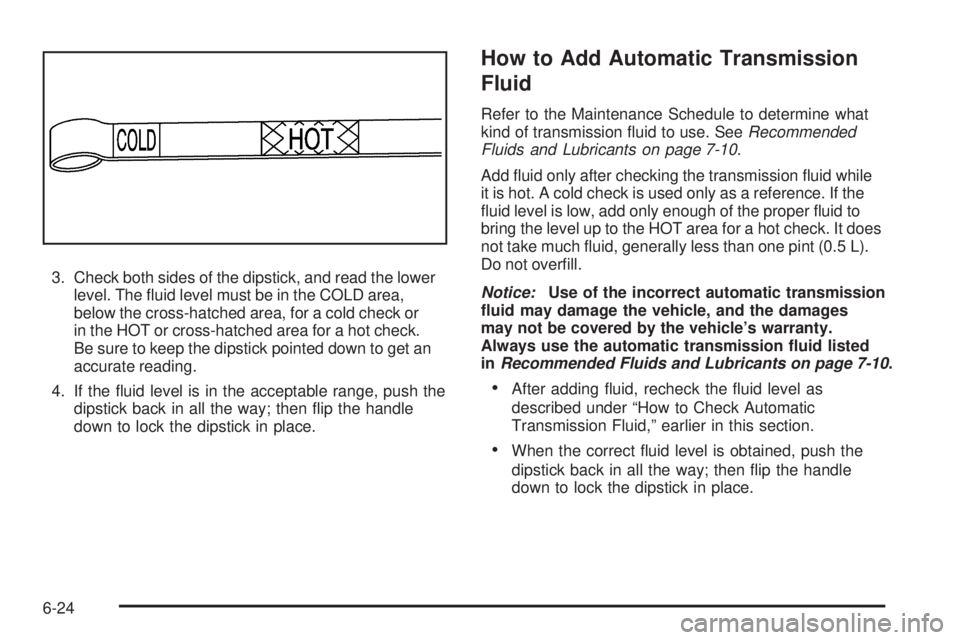
level. The fluid level must be in the COLD area,
below the cross-hatched area, for a cold check or
in the HOT or cross-hatched area for a hot check.
Be sure to keep the dipstick pointed down to get an
accurate reading.
4. If the fluid level is in the acceptable range, push the
dipstick back in all the way; then flip the handle
down to lock the dipstick in place.
How to Add Automatic Transmission
Fluid
Refer to the Maintenance Schedule to determine what
kind of transmission fluid to use. SeeRecommended
Fluids and Lubricants on page 7-10.
Add fluid only after checking the transmission fluid while
it is hot. A cold check is used only as a reference. If the
fluid level is low, add only enough of the proper fluid to
bring the level up to the HOT area for a hot check. It does
not take much fluid, generally less than one pint (0.5 L).
Do not overfill.
Notice:Use of the incorrect automatic transmission
uid may damage the vehicle, and the damages
may not be covered by the vehicle’s warranty.
Always use the automatic transmission uid listed
inRecommended Fluids and Lubricants on page 7-10.
•After adding fluid, recheck the fluid level as
described under “How to Check Automatic
Transmission Fluid,” earlier in this section.
•When the correct fluid level is obtained, push the
dipstick back in all the way; then flip the handle
down to lock the dipstick in place.
6-24
Page 302 of 448
How to Add Fluid
Here is how to add fluid. Refer to the Maintenance
Schedule to determine what kind of fluid to use.
SeeRecommended Fluids and Lubricants on page 7-10.
1. Remove the filler plug.
2. Add fluid at the filler plug hole. Add only enough
fluid to bring the fluid level up to the bottom of the
filler plug hole.
3. Install the filler plug. Be sure the plug is fully
seated.
Hydraulic Clutch
The hydraulic clutch linkage in the vehicle is
self-adjusting. The clutch master cylinder reservoir
is filled with hydraulic clutch fluid.
The hydraulic clutch fluid
reservoir cap has this
symbol on it. SeeEngine
Compartment Overview
on page 6-12for reservoir
location.
It is not necessary to regularly check clutch fluid unless
a leak in the system is suspected. Adding fluid will
not correct a leak.
A fluid loss in this system could indicate a problem.
Have the system inspected and repaired.
6-26
Page 303 of 448
When to Check and What to Use
Refer to the Maintenance Schedule to determine how
often to check the fluid level in the clutch master cylinder
reservoir and for the proper fluid. SeeRecommended
Fluids and Lubricants on page 7-10.
How to Check and Add Fluid
The proper fluid should be added if the level does not
reach the bottom of the diaphragm when it is in place in
the reservoir. See the instructions on the reservoir cap.
Cooling System
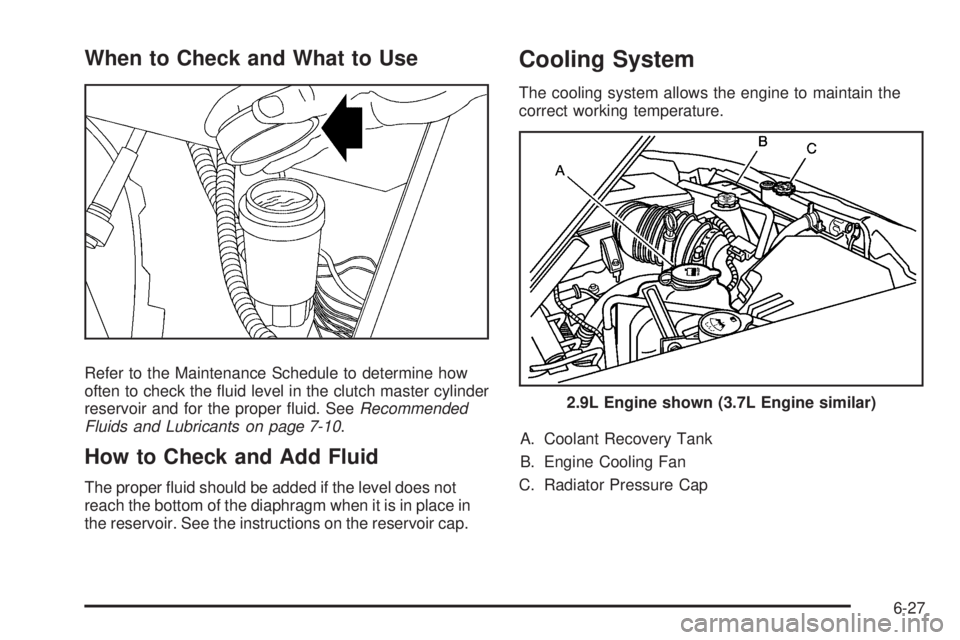
The cooling system allows the engine to maintain the
correct working temperature.
A. Coolant Recovery Tank
B. Engine Cooling Fan
C. Radiator Pressure Cap
2.9L Engine shown (3.7L Engine similar)
6-27
Page 315 of 448
Brakes
Brake Fluid
The brake master cylinder
reservoir is filled with
DOT 3 brake fluid. See
Engine Compartment
Overview on page 6-12for
the location of the reservoir.
There are only two reasons why the brake fluid level in
the reservoir might go down:
•The brake fluid level goes down because of normal
brake lining wear. When new linings are installed,
the fluid level goes back up.
•A fluid leak in the brake hydraulic system can also
cause a low fluid level. Have the brake hydraulic
system fixed, since a leak means that sooner
or later the brakes will not work well.Do not top off the brake fluid. Adding fluid does not
correct a leak. If fluid is added when the linings are worn,
there will be too much fluid when new brake linings are
installed. Add or remove brake fluid, as necessary, only
when work is done on the brake hydraulic system.
{WARNING:
If too much brake fluid is added, it can spill on
the engine and burn, if the engine is hot enough.
You or others could be burned, and the vehicle
could be damaged. Add brake fluid only when
work is done on the brake hydraulic system.
See “Checking Brake Fluid” in this section.
Refer to the Maintenance Schedule to determine when
to check the brake fluid. SeeScheduled Maintenance
on page 7-3.
6-39
Page 324 of 448
Four-Wheel Drive
Lubricant checks in this section apply to this vehicle.
There are two additional systems that need lubrication.
Transfer Case
When to Check Lubricant
Refer to the Maintenance Schedule to determine
how often to check the lubricant. SeeScheduled
Maintenance on page 7-3.
How to Check Lubricant
To get an accurate reading, the vehicle should be on a
level surface.
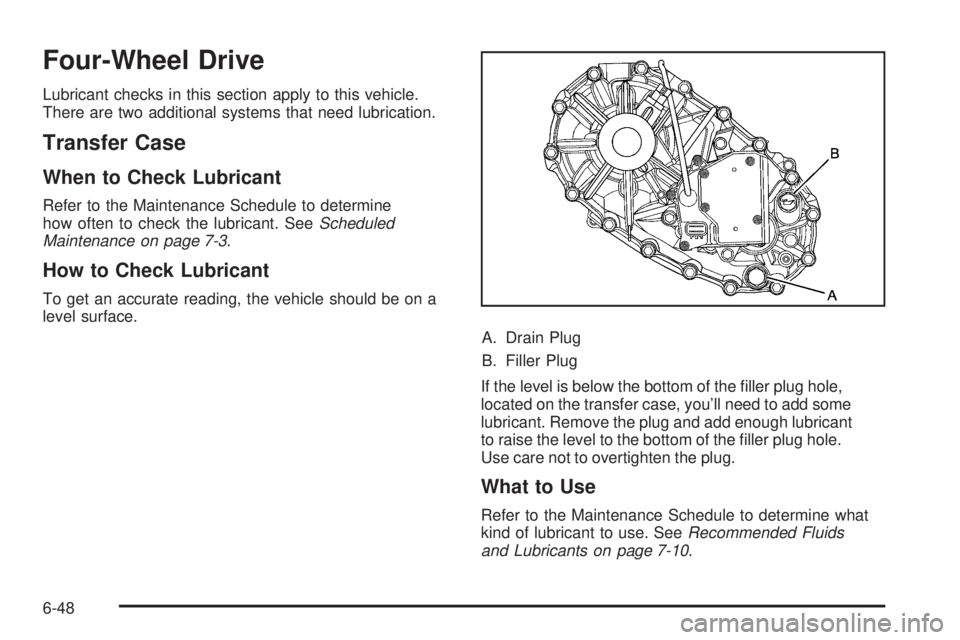
A. Drain Plug
B. Filler Plug
If the level is below the bottom of the filler plug hole,
located on the transfer case, you’ll need to add some
lubricant. Remove the plug and add enough lubricant
to raise the level to the bottom of the filler plug hole.
Use care not to overtighten the plug.
What to Use
Refer to the Maintenance Schedule to determine what
kind of lubricant to use. SeeRecommended Fluids
and Lubricants on page 7-10.
6-48
Page 331 of 448
Windshield Wiper Blade
Replacement
Windshield wiper blades should be inspected for wear
and cracking. SeeScheduled Maintenance on page 7-3
for more information.
Replacement blades come in different types and are
removed in different ways. For proper type and length,
seeMaintenance Replacement Parts on page 7-12.
Allowing the wiper blade arm to touch the windshield
when no wiper blade is installed could damage the
windshield. Any damage that occurs would not be
covered by your warranty. Do not allow the wiper
blade arm to touch the windshield.
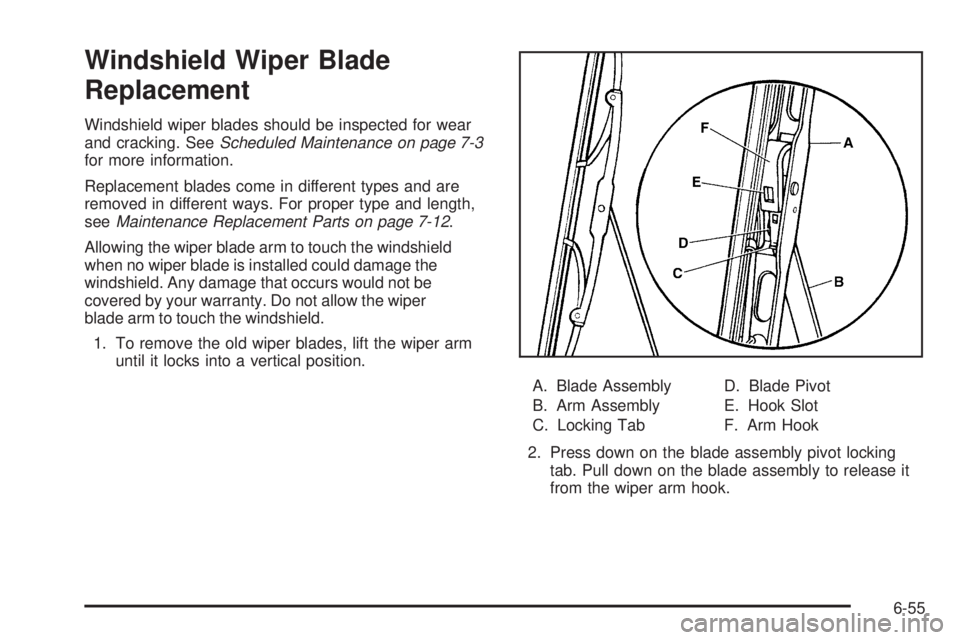
1. To remove the old wiper blades, lift the wiper arm
until it locks into a vertical position.
A. Blade Assembly
B. Arm Assembly
C. Locking TabD. Blade Pivot
E. Hook Slot
F. Arm Hook
2. Press down on the blade assembly pivot locking
tab. Pull down on the blade assembly to release it
from the wiper arm hook.
6-55