2010 FORD TRANSIT CONNECT fuel
[x] Cancel search: fuelPage 171 of 258

•To return to D (Overdrive), move the gearshift lever into the D
(Overdrive) position.
•Selecting 2 (Second) at higher speeds will cause the transmission to
downshift to second gear once the vehicle has slowed down to the
appropriate speed.
1 (First)
This position allows for first gear only.
•Provides maximum engine braking.
•Selecting 1 (First) at higher speeds will cause the transmission to
downshift to first gear once the vehicle has slowed down to the
appropriate speed.
Note:2 (Second) and 1 (First) are not intended for use under extended
or normal driving conditions and results in lower fuel economy.
REVERSE SENSING SYSTEM (IF EQUIPPED)
The Reverse Sensing System (RSS) sounds a tone to warn the driver of
obstacles near the rear bumper when the R (Reverse) is selected and the
vehicle is moving at low speeds. The system is not effective at high
speeds and may not detect certain angular or moving objects.
WARNING:To help avoid personal injury, please read and
understand the limitations of the reverse sensing system as
contained in this section. Reverse sensing is only an aid for some
(generally large and fixed) objects when moving in reverse on a flat
surface at “parking speeds”. Inclement weather may also affect the
function of the RSS; this may include reduced performance or a false
activation.
WARNING:To help avoid personal injury, always use caution
when in reverse and when using the RSS.
WARNING:This system is not designed to prevent contact with
small or moving objects. The system is designed to provide a
warning to assist the driver in detecting large stationary objects to
avoid damaging the vehicle. The system may not detect smaller
objects, particularly those close to the ground.
Driving
171
2010 Transit Connect(tst)
Owners Guide, 3rd Printing
USA(fus)
Page 174 of 258

ROADSIDE ASSISTANCE
Getting roadside assistance
To fully assist you should you have a vehicle concern, Ford Motor
Company offers a complimentary roadside assistance program. This
program is separate from the New Vehicle Limited Warranty. The service
is available:
•24-hours, seven days a week
•for the coverage period listed on the Roadside Assistance Card
included in your Owner Guide portfolio.
Roadside assistance will cover:
•a flat tire change with a good spare (except vehicles that have been
supplied with a tire inflation kit)
•battery jump start
•lock-out assistance (key replacement cost is the customer’s
responsibility)
•fuel delivery – Independent Service Contractors, if not prohibited by
state, local or municipal law shall deliver up to 2.0 gallons (7.5L) of
gasoline or 5.0 gallons (18.9L) of diesel fuel to a disabled vehicle. Fuel
delivery service is limited to two no-charge occurrences within a
12-month period.
•winch out – available within 100 feet (30.5 meters) of a paved or
county maintained road, no recoveries.
•towing – Ford/Mercury/Lincoln eligible vehicle towed to an authorized
dealer within 35 miles (56 km) of the disablement location or to the
nearest authorized dealer. If a member requests to be towed to an
authorized dealer more than 35 miles (56 km) from the disablement
location, the member shall be responsible for any mileage costs in
excess of 35 miles (56 km).
Trailers shall be covered up to $200 if the disabled eligible vehicle
requires service at the nearest authorized dealer. If the trailer is disabled,
but the towing vehicle is operational, the trailer does not qualify for any
roadside services.
Canadian customers refer to your Customer Information Guide
for information on:
•coverage period
•exact fuel amounts
Roadside Emergencies
174
2010 Transit Connect(tst)
Owners Guide, 3rd Printing
USA(fus)
Page 176 of 258

FUEL PUMP SHUT-OFF SWITCH
This device stops the electric fuel pump from sending fuel to the engine
when your vehicle has had a substantial jolt.
After an accident, if the engine cranks but does not start, this switch
may have been activated.
The fuel pump shut-off switch is
accessible from behind the glove
box. The button will be raised when
the switch is activated.
To reset the switch:
1. Turn the ignition off.
2. Check the fuel system for leaks.
3. If no leaks are apparent, open the
glove box then push in the sides
and swing the glove box down.
4. Reset the switch by pushing in
the reset button.
5. Turn the ignition on.
6. Wait a few seconds and return
the key to off.
7. Make another check for leaks.
FUSES AND RELAYS
Fuses
If electrical components in the
vehicle are not working, a fuse may
have blown. Blown fuses are
identified by a broken wire within
the fuse. Check the appropriate
fuses before replacing any electrical
components.
Note:Always replace a fuse with one that has the specified amperage
rating. Using a fuse with a higher amperage rating can cause severe wire
damage and could start a fire.
15
Roadside Emergencies
176
2010 Transit Connect(tst)
Owners Guide, 3rd Printing
USA(fus)
Page 181 of 258

WARNING:Always disconnect the battery before servicing high
current fuses.
WARNING:To reduce risk of electrical shock, always replace
the cover to the power distribution box before reconnecting the
battery or refilling fluid reservoirs.
If the battery has been disconnected and reconnected, refer to the
Batterysection of theMaintenance and Specificationschapter.
Note:To remove the power distribution box cover, the battery negative
cable clip needs to be removed first. Pull up on the clip to detach it from
the battery tray.
The high-current fuses are coded as follows:
Fuse/Relay
LocationFuse Amp
RatingProtected circuits
1 — Not used
2 40A** Passenger compartment fuse
panel
3 20A** Ignition switch
4 20A** Fuel pump
5 10A* Powertrain control module (PCM)
keep alive power, Canister
solenoid
6 15A* PCM, Data link connector
7 10A* Backup lamps
25
24
22 2326 2728
29
21A
21B21C
21D
30A
30B30C 30D
31A
31B31C 31D31E 31F
32 3334 35 36
15
16 17
18 19 20
10 11 12
9
3 4
1
25
67 81314
Roadside Emergencies
181
2010 Transit Connect(tst)
Owners Guide, 3rd Printing
USA(fus)
Page 182 of 258
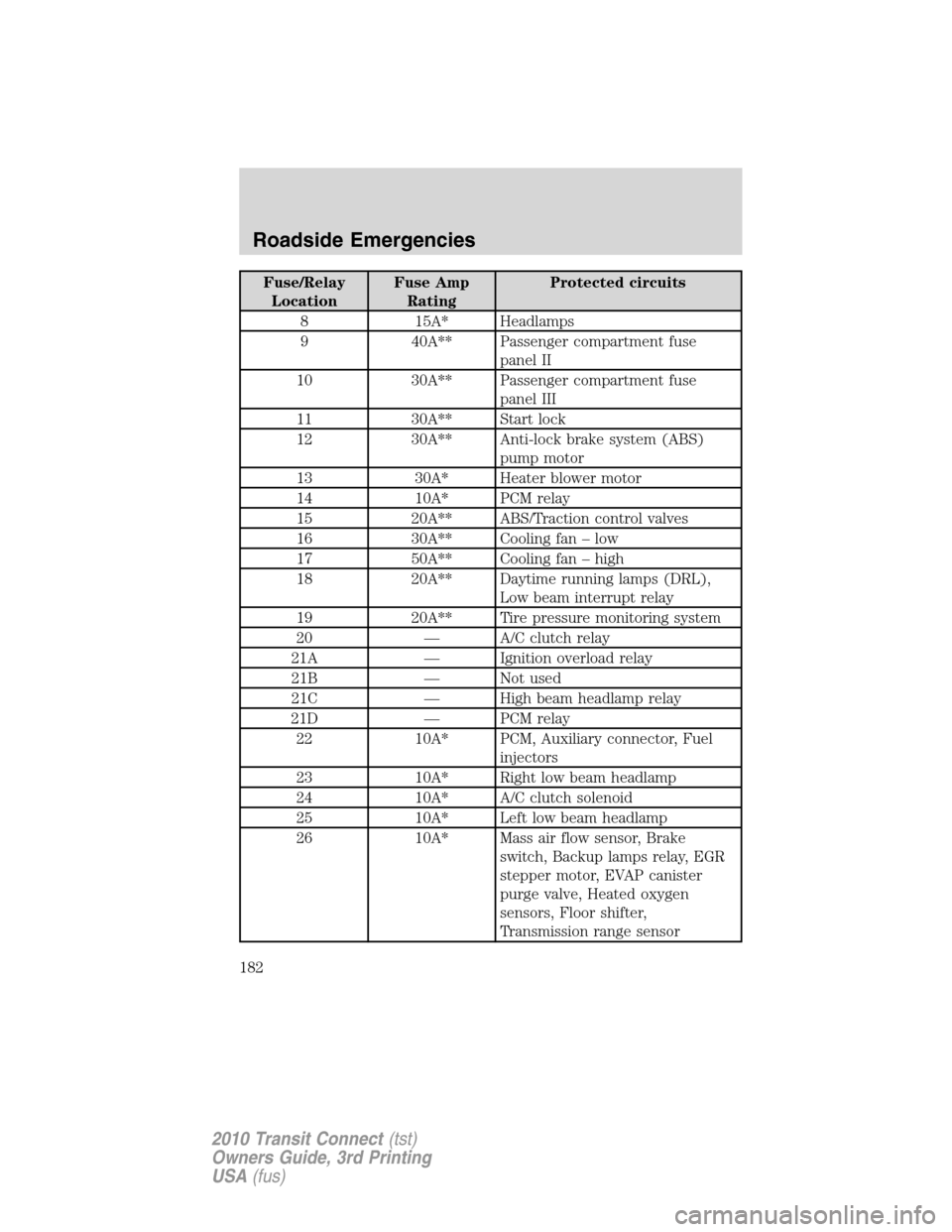
Fuse/Relay
LocationFuse Amp
RatingProtected circuits
8 15A* Headlamps
9 40A** Passenger compartment fuse
panel II
10 30A** Passenger compartment fuse
panel III
11 30A** Start lock
12 30A** Anti-lock brake system (ABS)
pump motor
13 30A* Heater blower motor
14 10A* PCM relay
15 20A** ABS/Traction control valves
16 30A** Cooling fan – low
17 50A** Cooling fan – high
18 20A** Daytime running lamps (DRL),
Low beam interrupt relay
19 20A** Tire pressure monitoring system
20 — A/C clutch relay
21A — Ignition overload relay
21B — Not used
21C — High beam headlamp relay
21D — PCM relay
22 10A* PCM, Auxiliary connector, Fuel
injectors
23 10A* Right low beam headlamp
24 10A* A/C clutch solenoid
25 10A* Left low beam headlamp
26 10A* Mass air flow sensor, Brake
switch, Backup lamps relay, EGR
stepper motor, EVAP canister
purge valve, Heated oxygen
sensors, Floor shifter,
Transmission range sensor
Roadside Emergencies
182
2010 Transit Connect(tst)
Owners Guide, 3rd Printing
USA(fus)
Page 183 of 258

Fuse/Relay
LocationFuse Amp
RatingProtected circuits
27 — Not used
28 15A* PCM vehicle power 1
29 15A* Auxiliary connector, Coil on plugs
30A 70A Relay Cooling fan high relay
30B
30C — Cooling fan low relay
30D — Start lock relay
31A — Backup lamp relay
31B — Fuel pump relay
31C — DRL relay
31D — Low beam headlamps relay
31E — Not used
31F — Not used
32 — Cooling fan diode
33 — Fuel pump relay diode
34 — Gear shifter diode
35 10A* PCM ignition
36 — Not used
*Mini fuse **Cartridge fuse
CHANGING THE TIRES
If you get a flat tire while driving, do not apply the brake heavily.
Instead, gradually decrease your speed. Hold the steering wheel firmly
and slowly move to a safe place on the side of the road.
Note:The tire pressure monitoring system (TPMS) indicator light will
illuminate when the spare tire is in use. To restore the full functionality
of the monitoring system, all road wheels equipped with tire pressure
monitoring sensors must be mounted on the vehicle.
Have a flat serviced by an authorized dealer in order to prevent damage
to the TPMS sensors, refer toTire pressure monitoring system
(TPMS)in theTires, Wheels and Loadingchapter. Replace the spare
tire with a road tire as soon as possible. During repairing or replacing of
the flat tire, have the authorized dealer inspect the TPMS sensor for
damage.
Roadside Emergencies
183
2010 Transit Connect(tst)
Owners Guide, 3rd Printing
USA(fus)
Page 194 of 258

3. Connect the negative (-) cable to the negative (-) terminal of the
assisting battery.
4. Make the final connection of the negative (-) cable to an exposed
metal part of the stalled vehicle’s engine, away from the battery and the
carburetor/fuel injection system.
Note:Do not attach the negative (-) cable to fuel lines, engine rocker
covers, the intake manifold or electrical components asgrounding
points.
WARNING:Do not connect the end of the second cable to the
negative (-) terminal of the battery to be jumped. A spark may
cause an explosion of the gases that surround the battery.
5. Ensure that the cables are clear of fan blades, belts, moving parts of
both engines, or any fuel delivery system parts.
Jump starting
1. Start the engine of the booster vehicle and run the engine at
moderately increased speed.
+–+–
+–+–
Roadside Emergencies
194
2010 Transit Connect(tst)
Owners Guide, 3rd Printing
USA(fus)
Page 203 of 258

UTILIZING THE MEDIATION/ARBITRATION PROGRAM
(CANADA ONLY)
For vehicles delivered to authorized Canadian dealers. In those cases
where you continue to feel that the efforts by Ford of Canada and the
authorized dealer to resolve a factory-related vehicle service concern
have been unsatisfactory, Ford of Canada participates in an impartial
third party mediation/arbitration program administered by the Canadian
Motor Vehicle Arbitration Plan (CAMVAP).
The CAMVAP program is a straight-forward and relatively speedy
alternative to resolve a disagreement when all other efforts to produce a
settlement have failed. This procedure is without cost to you and is
designed to eliminate the need for lengthy and expensive legal
proceedings.
In the CAMVAP program, impartial third-party arbitrators conduct
hearings at mutually convenient times and places in an informal
environment. These impartial arbitrators review the positions of the
parties, make decisions and, when appropriate, render awards to resolve
disputes. CAMVAP decisions are fast, fair, and final as the arbitrator’s
award is binding both to you and Ford of Canada.
CAMVAP services are available in all territories and provinces. For more
information, without charge or obligation, call your CAMVAP Provincial
Administrator directly at 1-800-207-0685.
GETTING ASSISTANCE OUTSIDE THE U.S. AND CANADA
Before exporting your vehicle to a foreign country, contact the
appropriate foreign embassy or consulate. These officials can inform you
of local vehicle registration regulations and where to find unleaded fuel.
If you cannot find unleaded fuel or can only get fuel with an anti-knock
index lower than is recommended for your vehicle, contact a regional
office or owner relations/customer relationship office.
The use of leaded fuel in your vehicle without proper conversion may
damage the effectiveness of your emission control system and may cause
engine knocking or serious engine damage. Ford Motor Company/Ford of
Canada is not responsible for any damage caused by use of improper
fuel. Using leaded fuel may also result in difficulty importing your vehicle
back into the U.S.
Customer Assistance
203
2010 Transit Connect(tst)
Owners Guide, 3rd Printing
USA(fus)