Page 18 of 57
It is important that you take the time to become familiar with the
controls and dynamics of your vehicle before attempting higher speed
off-roading. Some points to consider:
•Build up speed slowly. Initially, drive at a pace which allows ample
time to fully assess the terrain around you and to understand how the
vehicle is responding to both the terrain and driver inputs. Increase
pace as comfort increases while always being mindful of how the
vehicle is responding to various events at different speeds.
•Find a wide open place to experiment with different functions on the
truck. Try a given maneuver with different vehicle settings (4H vs.
4L), (differential locked vs. unlocked), (AdvanceTrac in key-on vs.
single press vs. press and hold modes) and see how the truck
responds. Start slowly and build pace as comfort increases.
•Similarly, in a wide open space, experiment with different driving
techniques. For example, if the vehicle is tending to push straight
ahead when trying to negotiate a turn (understeering or plowing), a
light application of the brake while turning may help rotate the truck.
A wider entry to the corner or entering the corner more slowly may
help the truck turn and allow you to apply the throttle sooner after
negotiating the turn.
•Remember the phrase�smooth is fast�. This refers to your steering,
throttle, and brake movements. Smooth decisive movements will yield
improved results while helping to increase safety.
•As speed increases, it is wise look farther ahead of the vehicle so that
there is time to react to oncoming obstacles. Remember that in many
off-road environments, obstacles will be hard to see until they are
relatively near. A good strategy is to alternate between looking far
ahead and up closer to the front of the vehicle as you’re driving.
•Also remember to�drive what you can see�. This refers to not driving
faster than you are able to negotiate unforeseen upcoming obstacles.
This could refer to obstacles over a brow, in a ravine, in brush, in
dusty conditions, and in the darkness among others.
•If you are driving in a dusty area. Be sure to leave ample distance
between you and any other vehicles to ensure adequate vision.
•Always remember that you may not be the only one in a particular
recreational area, always be cognizant of others in your area. This is
especially true of motorcycles and ATV’s which may be more difficult
to spot than a full-sized vehicle.
•If driving in desert conditions, it is advised that you always drive with
your headlights on to help other drivers more easily see you.
Driving
18
2010 F-150(f12)
Supplement, 1st Printing
USA(fus)
Page 35 of 57
VALUE SHOPPING FOR YOUR VEHICLE’S MAINTENANCE NEEDS
Your dealership recognizes the competitive landscape of maintenance and
light repair automotive services. With factory-trained technicians and
one-stop service for everything from routine maintenance like oil changes
and tire rotations to your most complex needs, Ford and Lincoln
Mercury Dealerships offer outstanding value.
It is recommended that the following basic maintenance checks and
inspections be performed at the designated time intervals. See your
“Owner’s Guide” for more information.
Check every month for all vehicles
❑Check function of all interior and exterior lights.❑Check tires for wear and proper air pressure, including spare.
❑Check engine oil fluid level.
❑Check windshield washer fluid level.
Check every six months for all vehicles
❑Check lap/shoulder belts and seat latches for wear and proper operation.❑Check that externally mounted spare tire is properly stowed (tight) (see yourOwner’s Guide).
❑Check power steering fluid level, if equipped.
❑Check washer spray, wiper operation, and clean all wiper blades (replace blades as necessary).
❑Check parking brake for proper operation.
❑Check and lubricate all hinges, latches, door check straps (see dealer) and outside locks.
❑Check and lubricate upper and lower sliding door tracks, if equipped.
❑Check and clean sliding door contact switches, if equipped.
❑Check and lubricate door rubber weatherstrips.
❑Check and clean body and door drain holes.
❑Check safety warning lamps (brake, ABS, air bag, safety belt) for operation.
❑Check engine cooling system level and strength.
❑Check battery connections and clean if necessary.
❑Check clutch fluid level, if equipped.
Retightening lug nuts
❑On vehicles equipped with dual rear wheels, retighten the wheel lug nuts to the specified torque at 100 miles (160 km),
and again at 500 miles (800 km) of new vehicle operation and after any wheel disturbance (tire rotation, changing a flat
tire, wheel removal, etc.).
❑Refer toWheel Lug Nut Torque Specificationin yourOwner’s Guidefor the proper lug nut torque specification.
Scheduled Maintenance Guide
35
2010 F-150(f12)
Supplement, 1st Printing
USA(fus)
Page 40 of 57
Parts
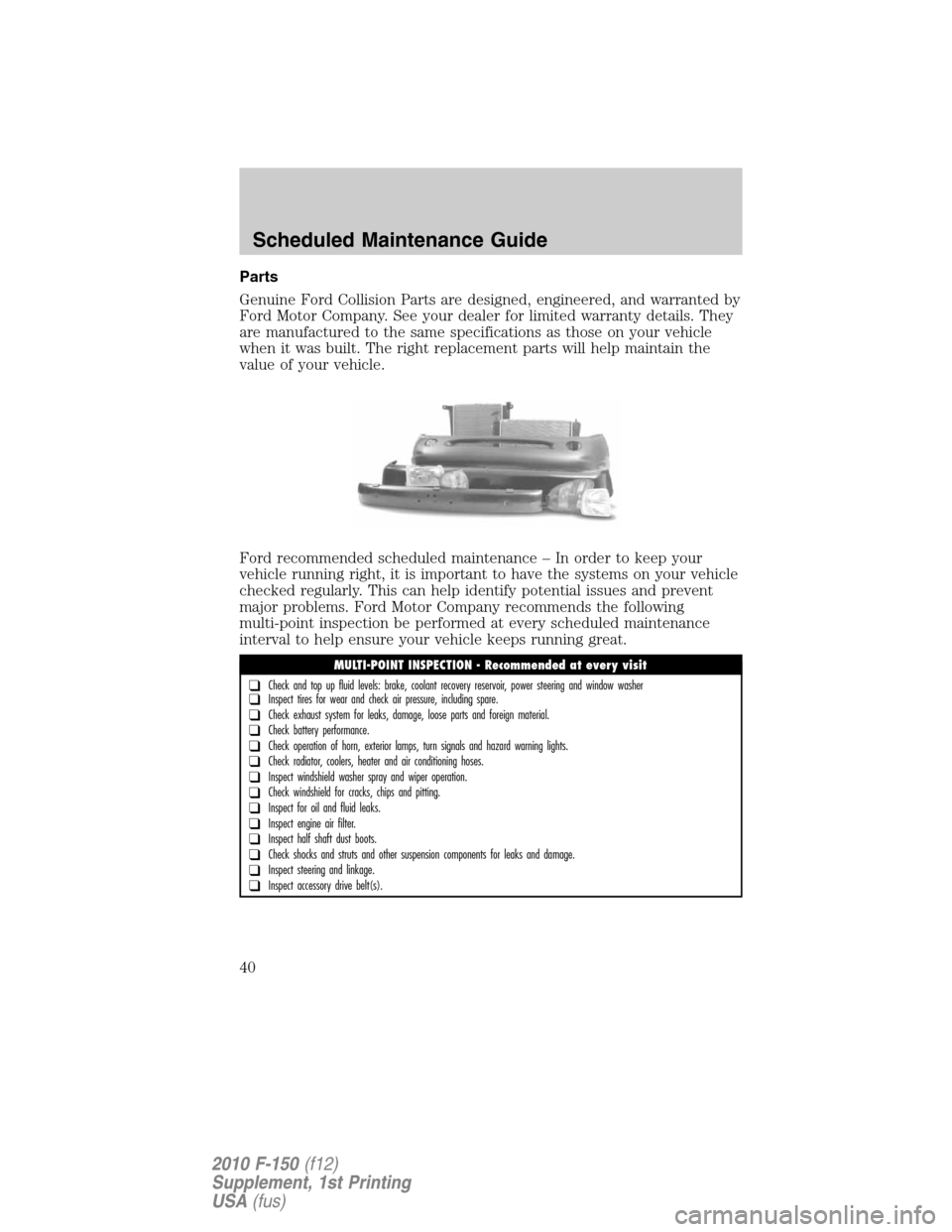
Genuine Ford Collision Parts are designed, engineered, and warranted by
Ford Motor Company. See your dealer for limited warranty details. They
are manufactured to the same specifications as those on your vehicle
when it was built. The right replacement parts will help maintain the
value of your vehicle.
Ford recommended scheduled maintenance – In order to keep your
vehicle running right, it is important to have the systems on your vehicle
checked regularly. This can help identify potential issues and prevent
major problems. Ford Motor Company recommends the following
multi-point inspection be performed at every scheduled maintenance
interval to help ensure your vehicle keeps running great.
MULTI-POINT INSPECTION - Recommended at every visit
❑Check and top up fluid levels: brake, coolant recovery reservoir, power steering and window washer❑Inspect tires for wear and check air pressure, including spare.
❑Check exhaust system for leaks, damage, loose parts and foreign material.
❑Check battery performance.
❑Check operation of horn, exterior lamps, turn signals and hazard warning lights.
❑Check radiator, coolers, heater and air conditioning hoses.
❑Inspect windshield washer spray and wiper operation.
❑Check windshield for cracks, chips and pitting.
❑Inspect for oil and fluid leaks.
❑Inspect engine air filter.
❑Inspect half shaft dust boots.
❑Check shocks and struts and other suspension components for leaks and damage.
❑Inspect steering and linkage.
❑Inspect accessory drive belt(s).
Scheduled Maintenance Guide
40
2010 F-150(f12)
Supplement, 1st Printing
USA(fus)