Page 320 of 512

Anti-Lock Brake Light
The Anti-Lock Brake Light monitors the ABS.
The light will turn on when the ignition switch
is turned to the ON position and may stay on
for as long as four seconds.
If the ABS Light remains on or comes on while driving, it
indicates that the Anti-Lock portion of the brake system
is not functioning and that service is required. However,
the conventional brake system will continue to operate
normally if the Brake System Warning Light is not on.
If the ABS Light is on, the brake system should be
serviced as soon as possible to restore the benefits of
Anti-Lock brakes. If the ABS Light does not come on
when the ignition switch is turned to the ON position,
have the light repaired as soon as possible. If both the Brake System Warning Light and the ABS
Light remain on, the ABS and Electronic Brake Force
Distribution (EBD) systems are not functioning. Immedi-
ate repair to the ABS system is required.
Brake Assist System (BAS)
The BAS is designed to optimize the vehicle’s braking
capability during emergency braking maneuvers. The
system detects an emergency braking situation by sens-
ing the rate and amount of brake application and then
applies optimum pressure to the brakes. This can help
reduce braking distances. The BAS complements the
ABS. Applying the brakes very quickly results in the best
BAS assistance. To receive the benefit of the system, you
must apply continuous braking pressure during the
stopping sequence, (do not “pump” the brakes). Do not
reduce brake pedal pressure unless braking is no longer
desired. Once the brake pedal is released, the BAS is
deactivated.
5
STARTING AND OPERATING 319
Page 372 of 512

WARNING!
Improper towing can lead to an injury accident.
Follow these guidelines to make your trailer towing
as safe as possible:
•Make certain that the load is secured in the trailer
and that it will not shift during travel. When
trailering cargo that is not fully secured, dynamic
load shifts can occur that may be difficult for the
driver to control. You could lose control of your
vehicle and have an accident.
•When hauling cargo or towing a trailer, do not
overload your vehicle or trailer. Overloading can
cause a loss of control, poor performance, or dam-
age to brakes, axle, engine, transmission, steering,
suspension, chassis structure, or tires.(Continued)
WARNING! (Continued)
•Safety chains must always be used between your
vehicle and trailer. Always connect the chains to
the frame or hook retainers of the vehicle hitch.
Cross the chains under the trailer tongue and
allow enough slack for turning corners.
•Vehicles with trailers should not be parked on a
grade. When parking, apply the parking brake on
the tow vehicle. Put the tow vehicle automatic
transmission in PARK. Always, block or �chock�
the trailer wheels.
•GCWR must not be exceeded.
•Total weight must be distributed between the tow
vehicle and the trailer such that the following four
ratings are not exceeded:
1. GVWR
2. GTW
(Continued)
5
STARTING AND OPERATING 371
Page 381 of 512

HAZARD WARNING FLASHER
The Hazard Warning flasher switch is located in the
instrument panel switch bank, above the climate controls.Press the switch to turn on the Hazard Warning
flasher. When the switch is activated, all directional
turn signals will flash on and off to warn oncoming
traffic of an emergency. Press the switch a second time to
turn off the Hazard Warning flasher.
This is an emergency warning system and it should not
be used when the vehicle is in motion. Use it when your
vehicle is disabled and it is creating a safety hazard for
other motorists.
When you must leave the vehicle to seek assistance, the
Hazard Warning flasher will continue to operate even
though the ignition switch is in the LOCK position.
NOTE: With extended use, the Hazard Warning flasher
may wear down your battery.
IF YOUR ENGINE OVERHEATS
In any of the following situations, you can reduce the
potential for overheating by taking the appropriate ac-
tion.
•On the highways — Slow down.
•In city traffic — While stopped, put the transaxle in
NEUTRAL, but do not increase engine idle speed.
CAUTION!
Driving with a hot cooling system could damage
your vehicle. If the temperature gauge reads “H,”
safely pull over and stop the vehicle. Idle the vehicle
with the A/C turned off until the pointer drops back
into the normal range. If the pointer remains on the
“H,” and you hear continuous chimes, turn the en-
gine OFF immediately, and call for service.
380 WHAT TO DO IN EMERGENCIES
Page 384 of 512
Spare Tire Location
The spare tire is stowed underneath the rear of the
vehicle and is held in place by means of a cable winch
mechanism.
Preparations For Jacking
1. Park the vehicle on a firm level surface as far from the
edge of the roadway as possible, avoid icy or slippery
areas.
WARNING!
Do not attempt to change a tire on the side of the
vehicle close to moving traffic. Pull far enough off
the road to avoid the danger of being hit when
operating the jack or changing the wheel.
2. Set the parking brake.
3. Place the shift lever in PARK. 4. Turn OFF the ignition.
5. Turn on the Hazard Warning flashers.
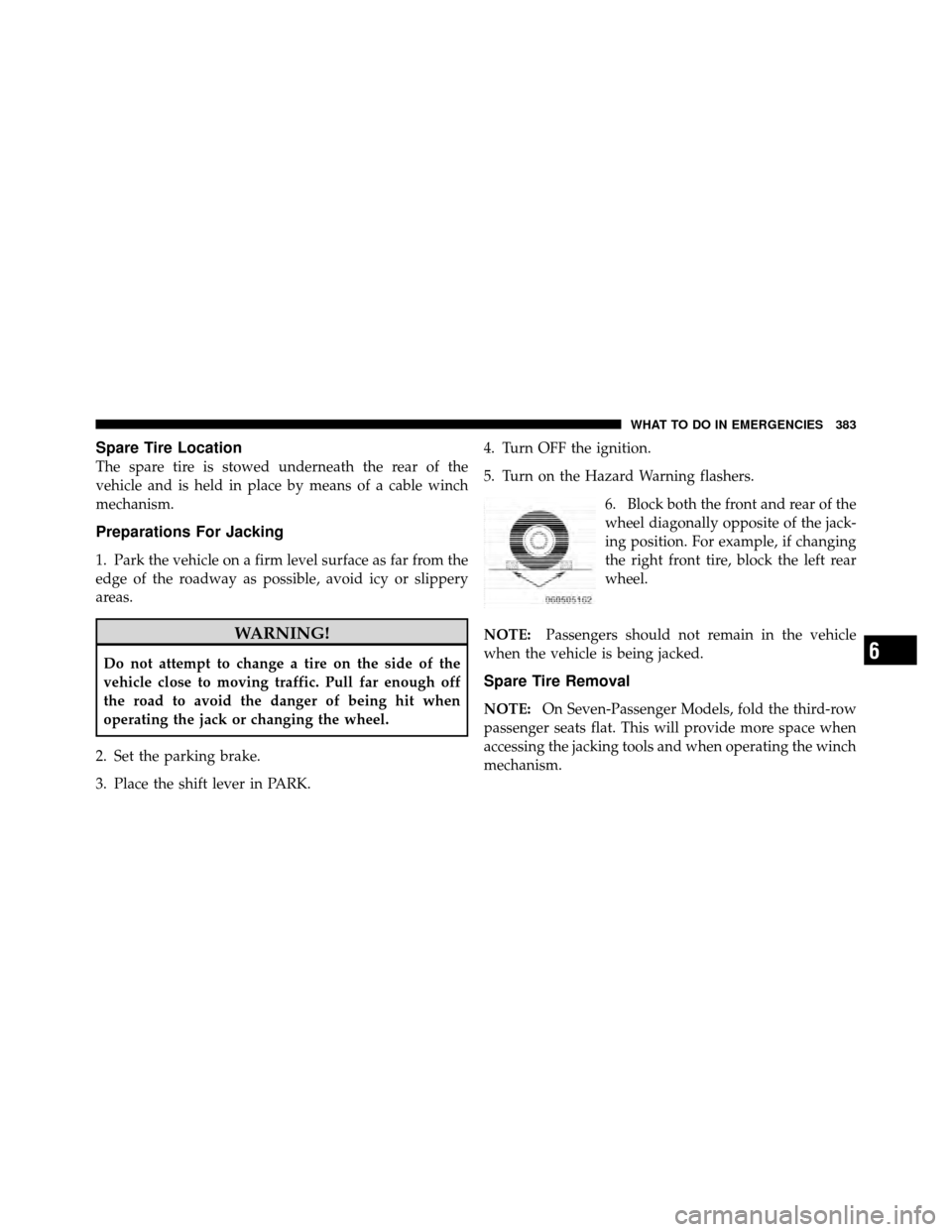
6. Block both the front and rear of the
wheel diagonally opposite of the jack-
ing position. For example, if changing
the right front tire, block the left rear
wheel.
NOTE: Passengers should not remain in the vehicle
when the vehicle is being jacked.
Spare Tire Removal
NOTE: On Seven-Passenger Models, fold the third-row
passenger seats flat. This will provide more space when
accessing the jacking tools and when operating the winch
mechanism.
6
WHAT TO DO IN EMERGENCIES 383
Page 385 of 512

1. Remove the jack-handle components 1, 2 and 3 from
storage and assemble them.
NOTE:Assemble components 2 and 3 by seating the
small ball at the end of component 2 in the small hole at
the end of component 3. This will lock these components
together. Assemble components 1 and 2 so that the wheel nut socket at the end of component 1 faces upward when
seated on component 2. This will make it easier to rotate
the assembly when operating the winch mechanism.
2. Fit the assembled jack-handle over the winch drive
nut located in the jack storage area. Rotate the jack-
handle assembly counterclockwise until the spare tire is
on the ground with enough cable slack to allow you to
pull the spare tire out from underneath the vehicle.
CAUTION!
The winch mechanism is designed for use with the
jack-handle only. Use of an air wrench or other power
tools is not recommended and it can damage the
winch.
3. Pull the spare tire out from underneath the vehicle and
raise it upright so the tire’s tread is on the ground.
Lowering/Raising Spare Tire
384 WHAT TO DO IN EMERGENCIES
Page 387 of 512

NOTE:Assemble components 2 and 3 by seating the
small ball at the end of component 2 in the small hole at
the end of component 3. This will lock these components
together. Assemble components 1 and 2 so that the wheel
nut socket at the end of component 1 faces upward when seated on component 2. This will make it easier to rotate
the assembly when operating the winch mechanism.
2. Fit the assembled jack-handle over the winch drive
nut located in the jack storage area. Rotate the jack-
handle assembly counterclockwise until there is enough
cable slack to allow you to pull the cable and retainer out
from underneath the vehicle.
CAUTION!
The winch mechanism is designed for use with the
jack-handle only. Use of an air wrench or other power
tools is not recommended and it can damage the
winch.
3. Place the spare tire near to the winch cable. Hold the
spare upright so that the tire’s tread is on the ground and
the valve stem is at the top of the wheel and facing away
from the rear of the vehicle.
Lowering/Raising Spare Tire
386 WHAT TO DO IN EMERGENCIES
Page 388 of 512
4. Tilt the retainer at the end of the winch cable and drop
it through the center of the wheel. Then place the spare
tire with the cable and retainer underneath the vehicle.
5. Fit the assembled jack-handle over the winch drive
nut. Rotate the jack-handle assembly clockwise to raise
the spare tire into the storage area. Continue to rotate thejack-handle assembly until you hear the winch mecha-
nism click three times. It cannot be over tightened. Push
against the tire several times to be sure it is held securely
in place.
Jacking Instructions
WARNING!
Carefully follow these tire changing warnings to
help prevent personal injury or damage to your
vehicle:
•Always park on a firm, level surface as far from
the edge of the roadway as possible before raising
the vehicle.
•Block the wheel diagonally opposite the wheel to
be raised.
•Set the parking brake firmly and set an automatic
transmission in PARK.
(Continued)
Spare Tire Retainer
6
WHAT TO DO IN EMERGENCIES 387
Page 389 of 512
WARNING! (Continued)
•Never start or run the engine with the vehicle on a
jack.
•Do not let anyone sit in the vehicle when it is on a
jack.
•Do not get under the vehicle when it is on a jack.
•Only use the jack in the positions indicated and
for lifting this vehicle during a tire change.
•If working on or near a roadway, be extremely
careful of motor traffic.
•To assure that spare tires, flat or inflated, are
securely stowed, spares must be stowed with the
valve stem facing the ground.
•Turn on the Hazard Warning flasher.1. Remove the spare tire, jack, and jack-handle from
stowage.
2. Loosen, but do not remove, the wheel nuts on the
wheel with the flat tire. Turn the wheel nuts counter-
clockwise one turn while the wheel is still on the ground.
3. Place the jack underneath the lift area that is closest to
the flat tire. Turn the jack screw clockwise to firmly
engage the jack saddle with the lift area of the sill flange.
Jack Warning Label
388 WHAT TO DO IN EMERGENCIES

