Page 261 of 477
•The electronically-controlled transmission provides a
precise shift schedule. The transmission electronics are
self-calibrating. Therefore, the first few shifts on a new
vehicle may be somewhat abrupt or soft until after the
break-in period. This is a normal condition, and pre-
cision shifts will develop within a few shift cycles.
The shift lever is automatically locked while in the PARK
position. To move the shift lever out of the PARK
position, the brake pedal must be firmly pressed before
the shift lock will release.
Move the shift lever to the desired position only when the
engine is idling normally and the brake pedal is applied.
Do not release the brake pedal until ready to drive. The
vehicle may otherwise accelerate quickly when the shift
lever is in DRIVE or REVERSE position.WARNING!
Unintended movement of a vehicle could injure
those in and near the vehicle. As with all vehicles,
you should never exit a vehicle while the engine is
running. Before exiting a vehicle, you should always
shift the transmission into PARK, remove the key fob
from the ignition, and apply the parking brake. Once
the key fob is removed from the ignition, the shift
lever is locked in the PARK position, securing the
vehicle against unwanted movement. Furthermore,
you should never leave unattended children inside a
vehicle.
Over-Temperature Mode
The transmission electronics constantly monitor the
transmission oil temperature. If the transmission exceeds
normal operating temperature, the transmission will
change the way it shifts to help control the condition.
5
STARTING AND OPERATING 259
Page 262 of 477

This may result in a slightly different feeling or response
during normal operation in DRIVE position. After the
transmission cools down, it will return to normal
operation.
Key Ignition Park Interlock
This vehicle is equipped with a Key Ignition Park Inter-
lock which requires the shift lever to be placed in PARK
prior to rotating the key fob to the LOCK position. The
key fob can only be removed from the ignition when the
ignition is in the LOCK position and once removed the
shift lever is locked in PARK.
Brake/Transmission Shift Interlock System
This vehicle is equipped with a Brake Transmission Shift
Interlock (BTSI) system that holds the shift lever in the
PARK position when the ignition switch is in the LOCK
position (OFF position with Keyless Go™) and the en-
gine is not running. To move the shift lever out of the
PARK position, the ignition switch must be turned to anyother ignition position (ACC, ON/RUN) position, and
the brake pedal must be pressed whether or not the
engine is running.
Brake/Transmission Interlock Manual Override
There is an override for the BTSI that allows you to move
the shift lever out of the PARK position if an electrical
system malfunction occurs (i.e., dead battery). To access
the override (using a flat-bladed screwdriver), carefully
remove the override cover which is located to the right of
the shift lever.
1. Turn the ignition switch to the ACC or ON position
(RUN position with Keyless Go™) without starting the
engine.
2. Firmly set the parking brake.
3. Press and maintain firm pressure on the brake pedal.
260 STARTING AND OPERATING
Page 263 of 477
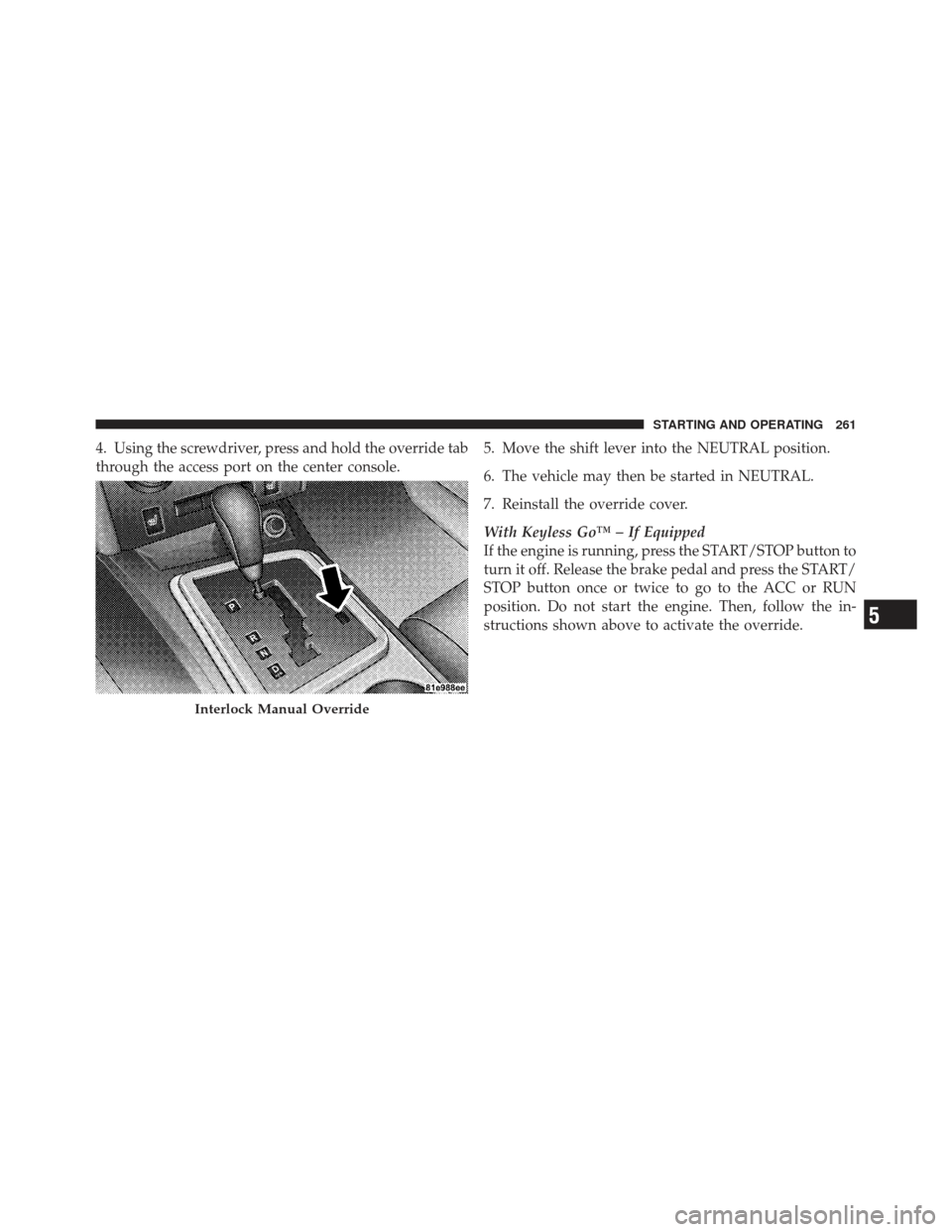
4. Using the screwdriver, press and hold the override tab
through the access port on the center console.5. Move the shift lever into the NEUTRAL position.
6. The vehicle may then be started in NEUTRAL.
7. Reinstall the override cover.
With Keyless Go™ – If Equipped
If the engine is running, press the START/STOP button to
turn it off. Release the brake pedal and press the START/
STOP button once or twice to go to the ACC or RUN
position. Do not start the engine. Then, follow the in-
structions shown above to activate the override.
Interlock Manual Override
5
STARTING AND OPERATING 261
Page 265 of 477

WARNING!
Never use the PARK position as a substitute for the
parking brake. Always apply the parking brake fully
when parked to guard against vehicle movement and
possible injury or damage.
The following indicators should be used to ensure that
you have engaged the shift lever in the PARK position:
•When shifting into PARK, move the shift lever all the
way forward and to the left until it stops and is fully
seated.
•Look at the shift indicator display on the instrument
panel to ensure it is in the PARK position.
CAUTION!
Damage to the shifter could result if the shift lever is
moved out of PARK before the ignition is turned
from the LOCK (OFF position with Keyless Go™) to
the ON position (RUN position with Keyless Go™).
REVERSE
This range is for moving the vehicle backward. Use only
after the vehicle has come to a complete stop.
NEUTRAL
This range is used when vehicle is standing for pro-
longed periods with engine running. Engine may be
started in this range. Set the parking brake if you must
leave the vehicle.
5
STARTING AND OPERATING 263
Page 275 of 477

If necessary, add fluid to restore to the proper indicated
level. With a clean cloth, wipe any spilled fluid from all
surfaces. Refer to “Fluids, Lubricants, and Genuine
Parts” in “Maintaining Your Vehicle” for further
information.
PARKING BRAKE
Before leaving the vehicle, make sure that the parking
brake is fully applied and place the shift lever in the
PARK or REVERSE (manual transmission only) position.
When the parking brake is applied and the ignition
switch is in the ON position (RUN position with Keyless
Go™), the “Brake Warning Light” in the instrument
cluster will illuminate.
NOTE:
•When the parking brake is applied and the transmis-
sion is placed in gear, the “Brake Warning Light” willflash. If vehicle speed is detected, a chime will sound
to alert the driver. Fully release the parking brake
before attempting to move the vehicle.
•This light only shows that the parking brake is ap-
plied. It does not show the degree of brake application.
When parking on a hill, it is important to turn the front
wheels toward the curb on a downhill grade and away
from the curb on an uphill grade. For vehicles equipped
with an automatic transmission, apply the parking brake
before placing the shift lever in PARK, otherwise the load
on the transmission locking mechanism may make it
difficult to move the shift lever out of PARK. The parking
brake should always be applied whenever the driver is
not in the vehicle.
5
STARTING AND OPERATING 273
Page 277 of 477
WARNING!
•Never use the PARK position as a substitute for
the parking brake. Always apply the parking
brake fully when parked to guard against vehicle
movement and possible injury or damage.
•Never leave children alone in a vehicle. Leaving
unattended children in a vehicle is dangerous for a
number of reasons. A child or others could be
seriously or fatally injured.
•Do not leave the key fob in the ignition switch. A
child could operate power windows, other con-
trols, or move the vehicle.
•Be sure the parking brake is fully disengaged
before driving; failure to do so can lead to brake
failure and a collision.(Continued)
WARNING! (Continued)
•Always fully apply the parking brake when leav-
ing your vehicle, or it may roll and cause damage
or injury. Also be certain to leave the transmission
in PARK. Failure to do so may allow the vehicle to
roll and cause damage or injury.
CAUTION!
If the “Brake Warning Light” remains on with the
parking brake released, a brake system malfunction
is indicated. Have the brake system serviced by an
authorized dealer immediately.5
STARTING AND OPERATING 275
Page 340 of 477
�Towing A Disabled Vehicle ............... 366
▫ Without The Key FOB ................. 366
▫ Towing This Vehicle Behind Another Vehicle
(Flat Towing With All Four Wheels On The
Ground) ........................... 367 ▫
Towing This Vehicle Behind Another Vehicle
With A Tow Dolly .................... 368
338 WHAT TO DO IN EMERGENCIES
Page 352 of 477
4. Have the tire inspected and repaired or replaced at the
earliest opportunity at an authorized dealer or tire ser-
vice center.
5. Replace the Sealant Bottle (1) and Sealant Hose (6)
assembly at your authorized dealer as soon as possible.
Refer to “(F) Sealant Bottle and Hose Replacement.”
NOTE:When having the tire serviced advise the autho-
rized dealer or service center that the tire has been sealed
using the TIREFIT service kit.
(F) Sealant Bottle and Hose Replacement:
1. Uncoil the Sealant Hose (6).
2. Locate the rectangular Sealant Bottle release button in
the recessed area where you place your fingers to unlatch
the hoses (6) (7) from their storage area. 3. Use the yellow cap on end of the Sealant Hose (6) to
depress the Sealant Bottle release button. The Sealant
Bottle (1) will pop up. Remove the bottle and dispose of
it accordingly.
4. Clean any remaining sealant from the TIREFIT hous-
ing.
5.
Position the new Sealant Bottle (1) to the housing so that
the Sealant Hose (6) aligns with the hose slot in the front of
the housing and the alignment keys on the bottom of the
bottle align with the alignment slots in the housing. Then,
press the bottle into the housing. An audible click will be
heard, indicating the bottle is locked in place.
6. Verify the yellow cap is installed on the fitting at the
end of the Sealant Hose (6) and return the hose to its
storage area (located on the bottom of the air pump).
7. Return the TIREFIT kit to its storage location in the
vehicle.
350 WHAT TO DO IN EMERGENCIES