Page 150 of 444

12. Tachometer
The silver area of the scale shows the permissible engine
revolutions-per-minute (RPM x 1000) for each gear range.
Before reaching the red area, ease up on the accelerator to
prevent engine damage.
13. Shift Lever Indicator
The Shift Lever Indicator is self-contained within the
instrument cluster. It displays the gear position of the
automatic transmission.
NOTE:You must apply the brakes before shifting from
PARK.
14. Odometer/Trip Odometer Display Area
The odometer shows the total distance the vehicle has
been driven. U.S. Federal regulations require that upon
transfer of vehicle ownership, the seller certify to the
purchaser the correct mileage that the vehicle has been driven. If your odometer needs to be repaired or serviced,
the repair technician should leave the odometer reading
the same as it was before the repair or service. If s/he
cannot do so, then the odometer must be set at zero, and
a sticker must be placed in the door jamb stating what the
mileage was before the repair or service. It is a good idea
for you to make a record of the odometer reading before
the repair/service, so that you can be sure that it is
properly reset, or that the door jamb sticker is accurate if
the odometer must be reset at zero.
The two trip odometers show individual trip mileage. To
switch from odometer to trip odometers, press and
release the Trip Odometer button. To reset a trip odom-
eter, display the desired trip odometer to be reset then
push and hold the button until the display resets (ap-
proximately 2 seconds). Refer to “Trip Odometer Button”
for additional information.
4
UNDERSTANDING YOUR INSTRUMENT PANEL 149
Page 154 of 444

If the light is flashing when the engine is running you
may experience power loss, an elevated/rough idle, and
increased brake pedal effort, and your vehicle may
require towing. Immediate service is required.
The light will come on when the ignition switch is first
turned on and remain on approximately 15 seconds as a
bulb check. This is normal. If the light does not come on
during starting, have the system checked by an autho-
rized dealer.
18. Position Light Indicator — If EquippedThis indicator will illuminate when the park
lights or headlights are turned on. 19. Electronic Stability Control (ESC) OFF Indicator
Light — If Equipped
This light indicates the Electronic Stability Con-
trol system (ESC) has been turned off by the
driver.
20. Turn Signal Indicators The arrows will flash in unison with the exterior
turn signal, when using the turn signal lever.
21. Front Fog Light Indicator — If Equipped This indicator will illuminate when the front fog
lights are on.
22. Vehicle Security Light — If Equipped This light will flash rapidly for approximately
16 seconds when the alarm system is arming.
The light will begin to flash slowly indicating
that the system is armed. The light will stop
flashing when the vehicle is disarmed.
4
UNDERSTANDING YOUR INSTRUMENT PANEL 153
Page 155 of 444

23. Anti-Lock Brake (ABS) Light — If EquippedThis light monitors the ABS. This light will
come on when the ignition key is turned to the
ON position and may stay on for approxi-
mately three seconds.
If the ABS light remains on or comes on during driving,
it indicates that the Anti-Lock portion of the brake system
is not functioning and that service is required, however,
the conventional brake system will continue to operate
normally provided that the BRAKE warning light is not
on.
If the ABS light is on, the brake system should be serviced
as soon as possible to restore the benefit of Anti-Lock
Brakes.
The ABS warning light should be checked frequently to
assure that it is operating properly. Turn the ignition key
to the on position, but do not start the vehicle. The light should come on. If the light does not come on, have the
system inspected by an authorized dealer.
24. Electronic Stability Control (ESC) Activation/
Malfunction Indicator Light — If Equipped
The “ESC Activation/Malfunction Indicator
Light” in the instrument cluster will come on
when the ignition switch is turned to the ON
position. It should go out with the engine
running. If the “ESC Activation/Malfunction Indicator
Light” comes on continuously with the engine running, a
malfunction has been detected in the ESC system. If this
light remains on after several ignition cycles, and the
vehicle has been driven several miles (kilometers) at
speeds greater than 30 mph (48 km/h), see your autho-
rized dealer as soon as possible to have the problem
diagnosed and corrected.
NOTE:
•The “ESC Off Indicator Light” and the “ESC
154 UNDERSTANDING YOUR INSTRUMENT PANEL
Page 234 of 444
STARTING AND OPERATING
CONTENTS
�Starting Procedures .................... 238
▫ Automatic Transmission ............... 238
▫ Normal Starting ..................... 238
▫ Extreme Cold Weather
(Below �20°F Or �29°C)............... 239
▫ If Engine Fails To Start ................ 239
▫ After Starting ....................... 240
� Engine Block Heater — If Equipped ........ 241�
Automatic Transmission ................. 241
▫ Key Ignition Park Interlock ............. 243
▫ Brake/Transmission Interlock System ...... 243
▫ Automatic Transmission Ignition Interlock
System ............................ 244
▫ Four-Speed/Six-Speed Automatic
Transmission ....................... 244
▫ Gear Ranges ........................ 244
5
Page 235 of 444

�AutoStick� — If Equipped ............... 248
▫ Operation ......................... 248
▫ General Information .................. 249
� Driving On Slippery Surfaces ............. 250
▫ Acceleration ........................ 250
▫ Traction ........................... 250
� Driving Through Water ................. 251
▫ Flowing/Rising Water ................. 251
▫ Shallow Standing Water ............... 251
� Power Steering ....................... 253
▫ Power Steering Fluid Check ............. 253
� Parking Brake ........................ 254
� Anti-Lock Brake System (ABS) ............ 256�
Electronic Brake Control System ........... 259
▫ Anti-Lock Brake System (ABS) ........... 259
▫ Traction Control System (TCS) ........... 259
▫ Brake Assist System (BAS) .............. 260
▫ Hill Start Assist (HSA) – If Equipped ...... 261
▫ Electronic Stability Control (ESC) ......... 263
� Tire Safety Information ................. 266
▫ Tire Markings ....................... 266
▫ Tire Identification Number (TIN) ......... 270
▫ Tire Terminology And Definitions ......... 271
▫ Tire Loading And Tire Pressure .......... 272
� Tires — General Information ............. 276
▫ Tire Pressure ....................... 276
234 STARTING AND OPERATING
Page 239 of 444
STARTING PROCEDURES
Before starting your vehicle, adjust your seat, adjust the
inside and outside mirrors, fasten your seat belt, and if
present, instruct all other occupants to buckle their seat
belts.
WARNING!
Never leave children alone in a vehicle. Leaving
children in a vehicle unattended is dangerous for a
number of reasons. A child or others could be seri-
ously or fatally injured. Do not leave the keys in the
ignition. A child could operate power windows,
other controls, or move the vehicle.
Automatic Transmission
The shift lever must be in the PARK or NEUTRAL
position before you can start the engine. Apply the brakes
before shifting to any driving gear.NOTE:
The ignition switch must be in the ON position,
and you must press the brake pedal before shifting out of
PARK.
Normal Starting
NOTE: Normal starting of either a cold or a warm
engine is obtained without pumping or pressing the
accelerator pedal.
For vehicles not equipped with Tip Start (Four-Speed
Transmission), turn the ignition switch to the START
position and release it when the engine starts. If the
engine fails to start within 10 seconds, turn the ignition
switch to the LOCK position, wait 10 to 15 seconds, then
repeat the “Normal Starting” procedure.
For vehicles equipped with Tip Start (Six-Speed Trans-
mission), turn the ignition switch to the START position
and release it as soon as the starter engages. The starter
238 STARTING AND OPERATING
Page 243 of 444
CAUTION! (Continued)
•Before shifting the shift lever into any gear, make
sure your foot is firmly on the brake pedal.
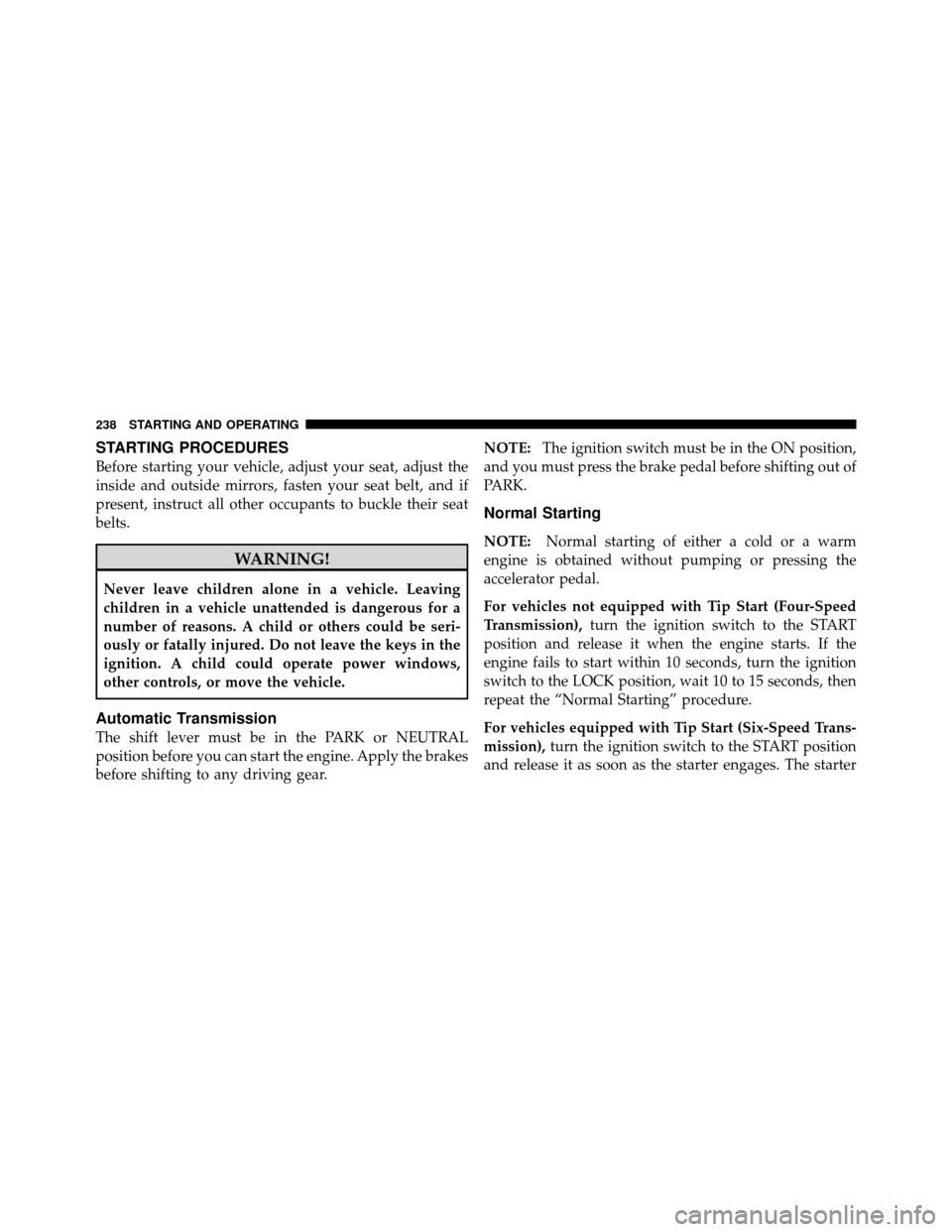
NOTE: You MUST press and hold the brake pedal down
while shifting the shift lever out of PARK.
WARNING!
•It is dangerous to move the shift lever out of PARK
or NEUTRAL if the engine speed is higher than
idle speed. If your foot is not firmly on the brake
pedal, the vehicle could accelerate quickly forward
or in reverse. You could lose control of the vehicle
and hit someone or something. Only shift into
gear when the engine is idling normally and when
your right foot is firmly on the brake pedal.
(Continued)
Shift Lever
242 STARTING AND OPERATING
Page 244 of 444

WARNING! (Continued)
•Unintended movement of a vehicle could injure
those in and near the vehicle. As with all vehicles,
you should never exit a vehicle while the engine is
running. Before exiting a vehicle, you should
always shift the vehicle into PARK, remove the
key from the ignition, and apply the parking
brake. Once the key is removed from the ignition,
the shift lever is locked in the PARK position,
securing the vehicle against unwanted movement.
Furthermore, you should never leave children un-
attended inside a vehicle.
Key Ignition Park Interlock
This vehicle is equipped with a Key Ignition Park Inter-
lock which requires the shift lever to be placed in PARK
prior to rotating the key to the LOCK position. The key
can only be removed from the ignition when the ignition
is in the LOCK position and once removed the shift lever
is locked in PARK.
Brake/Transmission Interlock System
This vehicle is equipped with a Brake Transmission Shift
Interlock System (BTSI) that holds the shift lever in the
PARK position when the ignition switch is in the LOCK
position. To move the shift lever out of the PARK
position, the ignition switch must be turned to any other
switch position (ACC, ON, or START) (engine running or
not) and the brake pedal must be pressed.
NOTE:If a malfunction occurs, the transmission will
not shift out of PARK. Battery power is required to
release the Brake/Transmission Interlock system. How-
ever, an override system allows you to shift out of PARK
in case of loss of power. To activate the override system:
•Firmly apply the parking brake.
•Insert the ignition key into the ignition switch and
rotate it to the ON position.
•Remove the cup holder liner.
5
STARTING AND OPERATING 243