Page 276 of 368
MAINTAINING YOUR VEHICLE
CONTENTS
�Engine Compartment — 2.4L ............ 277
� Onboard Diagnostic System — OBD II ..... 278
▫ Loose Fuel Filler Cap Message .......... 278
� Emissions Inspection And Maintenance
Programs ............................ 278
� Replacement Parts .................... 280
� Dealer Service ....................... 280
� Maintenance Procedures ................ 281
▫ Engine Oil ........................ 281 ▫
Engine Oil Filter .................... 284
▫ Engine Air Cleaner Filter .............. 285
▫ Maintenance-Free Battery ............. 286
▫ Air Conditioner Maintenance ........... 287
▫ Body Lubrication ................... 288
▫ Windshield Wiper Blades ............. 289
▫ Adding Washer Fluid ................ 289
▫ Exhaust System .................... 290
▫ Cooling System .................... 292
7
Page 283 of 368

The best time to check the engine oil level is about five
minutes after a fully warmed engine is shut off. Do not
check oil level before starting the engine after it has sat
overnight. Checking engine oil level when the engine is
cold will give you an incorrect reading.
Checking the oil while the vehicle is on level ground, will
improve the accuracy of the oil level readings. Maintain
the oil level between the MIN and MAX markings on the
dipstick. Adding one quart of oil when the reading is at
the MIN mark will result in a MAX reading on these
engines.
CAUTION!
Overfilling the crankcase as indicated by an oil level
above the “MAX” mark on the engine oil dipstick
will cause oil aeration, which can lead to loss of oil
pressure and an increase in oil temperature. This
could damage your engine.
Change Engine Oil
Road conditions and your kind of driving affects the
interval at which your oil should be changed. Check the
following list to decide if any apply to you.
•Day and night temperatures are below 32°F (0°C).
•Stop and go driving.
•Extensive engine idling.
•Driving in dusty conditions.
•Short trips of less than 10 miles (16 km).
•More than 50% of your driving is at sustained high
speeds during hot weather, above 90°F (32°C).
•Trailer towing.
•Taxi, Police, or delivery service (commercial service).
•Off-road or desert operation.
282 MAINTAINING YOUR VEHICLE
Page 289 of 368
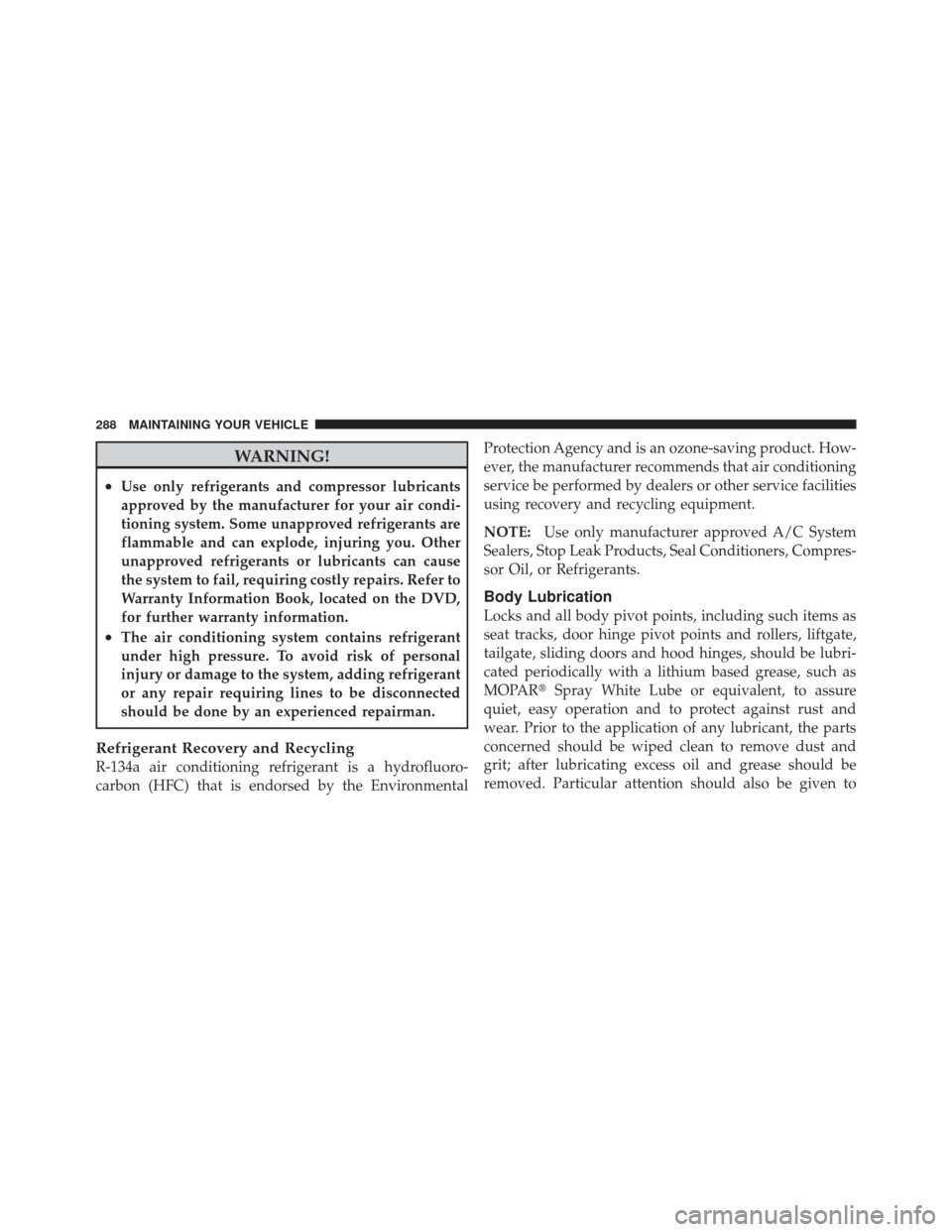
WARNING!
•Use only refrigerants and compressor lubricants
approved by the manufacturer for your air condi-
tioning system. Some unapproved refrigerants are
flammable and can explode, injuring you. Other
unapproved refrigerants or lubricants can cause
the system to fail, requiring costly repairs. Refer to
Warranty Information Book, located on the DVD,
for further warranty information.
•The air conditioning system contains refrigerant
under high pressure. To avoid risk of personal
injury or damage to the system, adding refrigerant
or any repair requiring lines to be disconnected
should be done by an experienced repairman.
Refrigerant Recovery and Recycling
R-134a air conditioning refrigerant is a hydrofluoro-
carbon (HFC) that is endorsed by the EnvironmentalProtection Agency and is an ozone-saving product. How-
ever, the manufacturer recommends that air conditioning
service be performed by dealers or other service facilities
using recovery and recycling equipment.
NOTE:
Use only manufacturer approved A/C System
Sealers, Stop Leak Products, Seal Conditioners, Compres-
sor Oil, or Refrigerants.
Body Lubrication
Locks and all body pivot points, including such items as
seat tracks, door hinge pivot points and rollers, liftgate,
tailgate, sliding doors and hood hinges, should be lubri-
cated periodically with a lithium based grease, such as
MOPAR� Spray White Lube or equivalent, to assure
quiet, easy operation and to protect against rust and
wear. Prior to the application of any lubricant, the parts
concerned should be wiped clean to remove dust and
grit; after lubricating excess oil and grease should be
removed. Particular attention should also be given to
288 MAINTAINING YOUR VEHICLE
Page 290 of 368

hood latching components to ensure proper function.
When performing other underhood services, the hood
latch, release mechanism and safety catch should be
cleaned and lubricated.
The external lock cylinders should be lubricated twice a
year, preferably in the Fall and Spring. Apply a small
amount of a high quality lubricant, such as MOPAR�
Lock Cylinder Lubricant or equivalent directly into the
lock cylinder.
Windshield Wiper Blades
Clean the rubber edges of the wiper blades and the
windshield periodically with a sponge or soft cloth and a
mild non-abrasive cleaner, or use the washer solvent.
This will remove accumulations of salt, waxes or road
film and help reduce streaking and smearing.Operation of the wipers on dry glass for long periods
may cause deterioration of the wiper blades. Always use
washer fluid when using the wipers to remove salt or dirt
from a dry windshield. Avoid using the wiper blades to
remove frost or ice from the windshield. To avoid dam-
aging the blades, make sure that they are not frozen to the
glass before turning them on. Keep the blade rubber out
of contact with petroleum products such as engine oil,
gasoline, etc.
Adding Washer Fluid
The washer fluid reservoir is located in the rear of the
engine compartment on the passenger side and should be
checked for fluid level at regular intervals. Fill the
reservoir with windshield washer solvent (not radiator
antifreeze) and operate the system for a few seconds to
flush out the residual water.
7
MAINTAINING YOUR VEHICLE 289
