Page 98 of 368
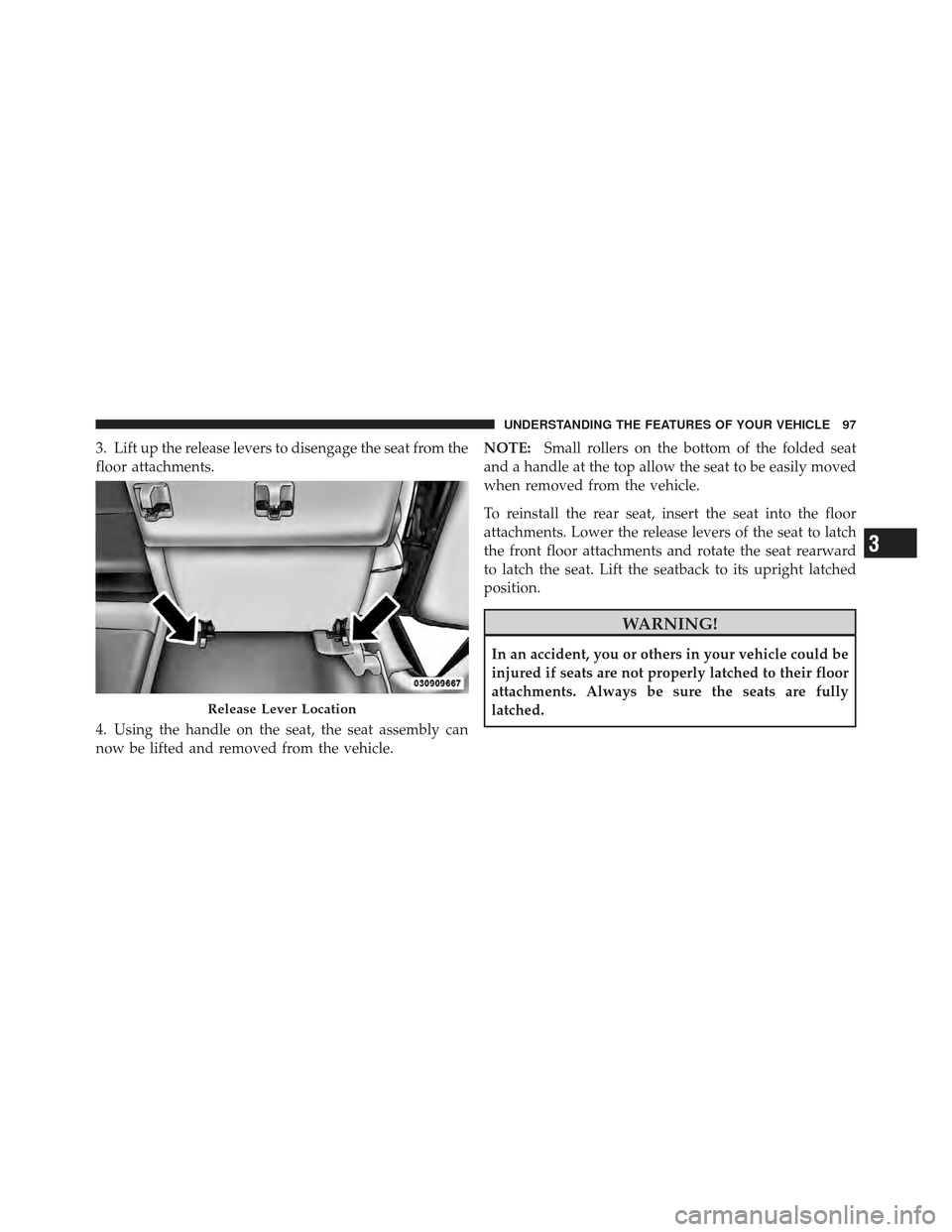
3. Lift up the release levers to disengage the seat from the
floor attachments.
4. Using the handle on the seat, the seat assembly can
now be lifted and removed from the vehicle.NOTE:
Small rollers on the bottom of the folded seat
and a handle at the top allow the seat to be easily moved
when removed from the vehicle.
To reinstall the rear seat, insert the seat into the floor
attachments. Lower the release levers of the seat to latch
the front floor attachments and rotate the seat rearward
to latch the seat. Lift the seatback to its upright latched
position.
WARNING!
In an accident, you or others in your vehicle could be
injured if seats are not properly latched to their floor
attachments. Always be sure the seats are fully
latched.
Release Lever Location
3
UNDERSTANDING THE FEATURES OF YOUR VEHICLE 97
Page 99 of 368
EMERGENCY SEATBACK RELEASE
WARNING!
Do not allow children to have access to the liftgate
area with the rear shelf panel in position 1 (Top) or
position 2 (Middle), either by climbing into the
liftgate from outside, or through the inside of the
vehicle. Always close the liftgate when your vehicle
is unattended. Once in the liftgate area, young chil-
dren may not be able to escape, even if they entered
through the rear seat. If trapped in the liftgate,
children can die from suffocation or heat stroke.
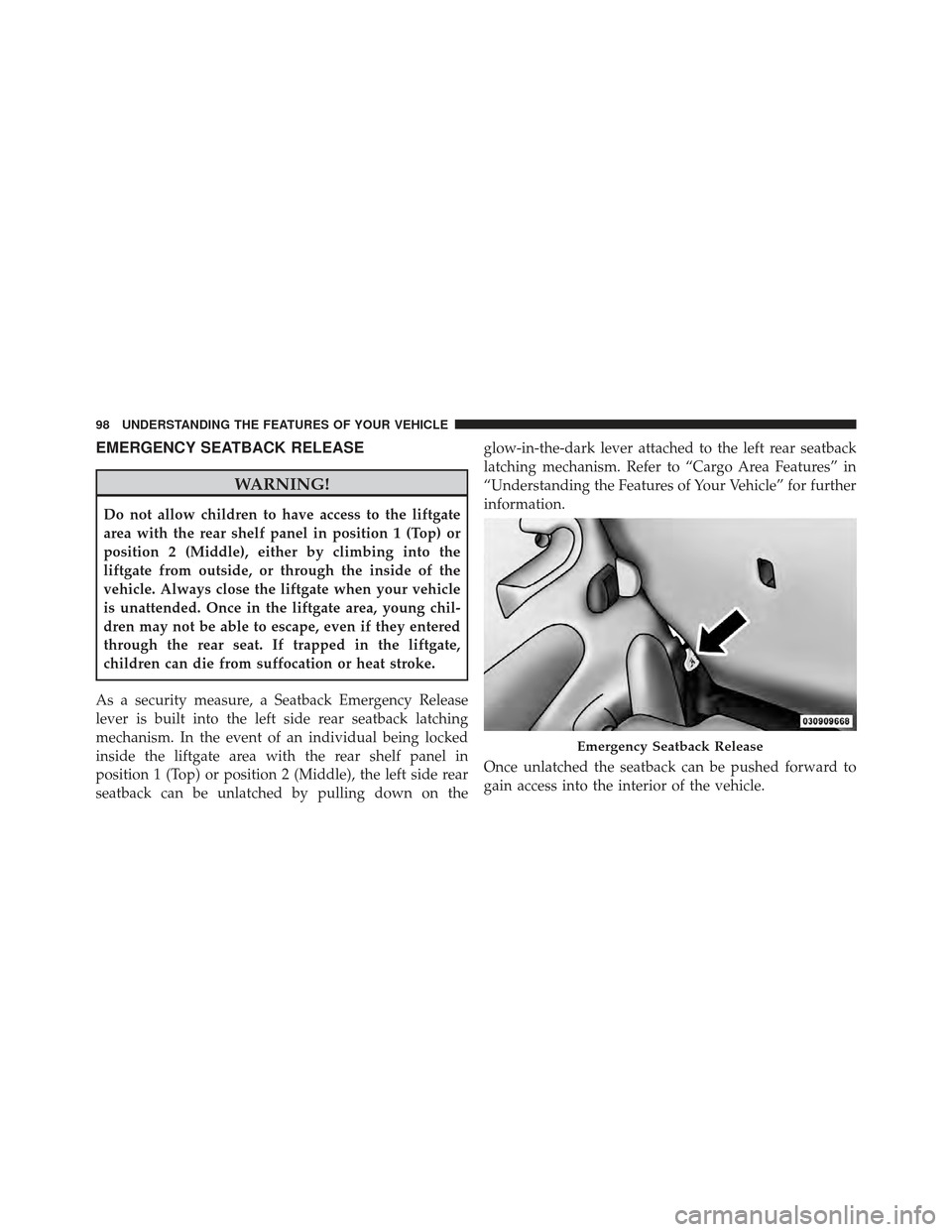
As a security measure, a Seatback Emergency Release
lever is built into the left side rear seatback latching
mechanism. In the event of an individual being locked
inside the liftgate area with the rear shelf panel in
position 1 (Top) or position 2 (Middle), the left side rear
seatback can be unlatched by pulling down on the glow-in-the-dark lever attached to the left rear seatback
latching mechanism. Refer to “Cargo Area Features” in
“Understanding the Features of Your Vehicle” for further
information.
Once unlatched the seatback can be pushed forward to
gain access into the interior of the vehicle.
Emergency Seatback Release
98 UNDERSTANDING THE FEATURES OF YOUR VEHICLE
Page 101 of 368
2.Move the safety latch, located under the front edge of
the hood, slightly to the right of center and raise the hood.
Use the hood prop rod clipped to the driver’s side of the
engine compartment to secure the hood in the open
position. Place the hood prop at the location stamped into
the inner hood surface.
CAUTION!
To prevent possible damage, do not slam the hood to
close it. Lower the hood until it is open approxi-
mately 8 in (20 cm) and then drop it. This should
secure both latches. Never drive your vehicle unless
the hood is fully closed, with both latches engaged.
WARNING!
Be sure the hood is fully latched before driving your
vehicle. If the hood is not fully latched, it could open
when the vehicle is in motion and block your vision.
Failure to follow this warning could result in serious
injury or death.
Safety Latch
100 UNDERSTANDING THE FEATURES OF YOUR VEHICLE
Page 110 of 368

to a maximum of approximately 18 seconds between
cycles at vehicle speeds greater than 10 mph (16 km/h).
NOTE:The wiper delay times depend on vehicle speed.
If the vehicle is moving less than 10 mph (16 km/h),
delay times will be doubled.
Windshield Washers
To use the washer, pull the windshield wiper/washer
control lever toward you and hold it for as long as
washer spray is desired.
If you activate the washer while the wiper control is in
the delay range, the wipers will operate in low-speed for
two or three wipe cycles after releasing the lever and then
resume the intermittent interval previously selected. If you activate the washer while the wiper control is in
the OFF position, the wipers will operate for two or three
wipe cycles and then turn OFF.
WARNING!
Sudden loss of visibility through the windshield
could lead to an accident. You might not see other
vehicles or other obstacles. To avoid sudden icing of
the windshield during freezing weather, warm the
windshield with the defroster before and during
windshield washer use.3
UNDERSTANDING THE FEATURES OF YOUR VEHICLE 109
Page 112 of 368
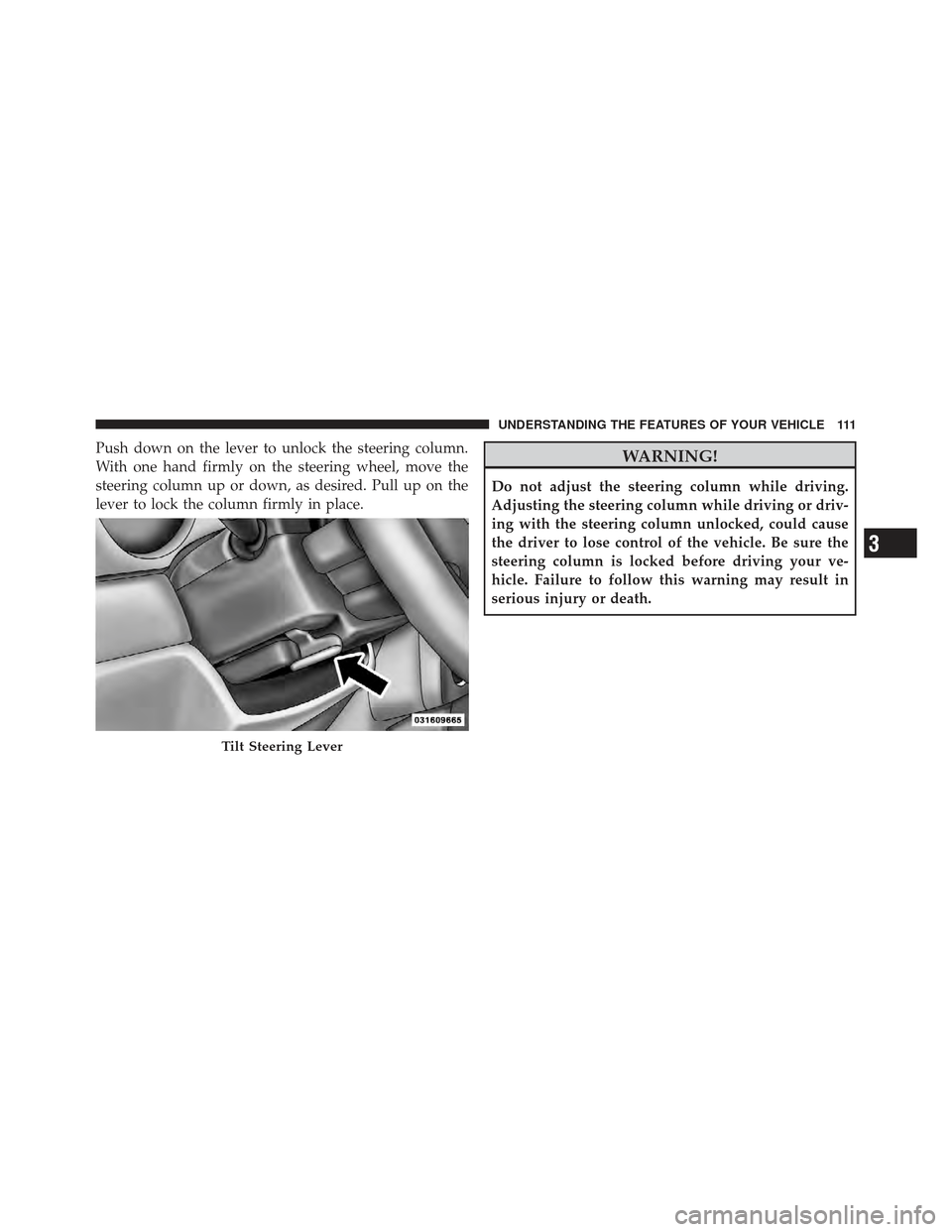
Push down on the lever to unlock the steering column.
With one hand firmly on the steering wheel, move the
steering column up or down, as desired. Pull up on the
lever to lock the column firmly in place.WARNING!
Do not adjust the steering column while driving.
Adjusting the steering column while driving or driv-
ing with the steering column unlocked, could cause
the driver to lose control of the vehicle. Be sure the
steering column is locked before driving your ve-
hicle. Failure to follow this warning may result in
serious injury or death.
Tilt Steering Lever
3
UNDERSTANDING THE FEATURES OF YOUR VEHICLE 111
Page 114 of 368

WARNING!
Leaving the Electronic Speed Control system on
when not in use is dangerous. You could accidentally
set the system or cause it to go faster than you want.
You could lose control and have an accident. Always
leave the system off when you are not using it.
To Set a Desired Speed
When the vehicle has reached the desired speed, pull
down on the lever and release. Release the accelerator
and the vehicle will operate at the selected speed.
NOTE:The vehicle should be traveling at a steady
speed and on level ground before pressing the SET lever.
While in the AutoStick� mode, Electronic Speed Control
will only operate in 3rd and 4th gear.
To Deactivate
A soft tap on the brake pedal, pulling the Electronic
Speed Control lever toward CANCEL, or normal brake
or clutch pressure while slowing the vehicle will deacti-
vate Electronic Speed Control without erasing the set
speed memory. Pressing the ON/OFF button or turning
off the ignition switch erases the set speed memory.
To Resume Speed
To resume a previously set speed, pull the RESUME
ACCEL lever up and release. Resume can be used at any
speed above 20 mph (32 km/h).
To Vary the Speed Setting
When the Electronic Speed Control is ON, speed can be
increased by pulling up and holding RESUME ACCEL.
Release the lever when the desired speed is reached, and
the new speed will be set.
3
UNDERSTANDING THE FEATURES OF YOUR VEHICLE 113
Page 116 of 368
WARNING!
Electronic Speed Control can be dangerous where the
system cannot maintain a constant speed. Your ve-
hicle could go too fast for the conditions, and you
could lose control. An accident could be the result.
Do not use Electronic Speed Control in heavy traffic
or on roads that are winding, icy, snow-covered or
slippery.
GARAGE DOOR OPENER — IF EQUIPPED
HomeLink�replaces up to three remote controls (hand-
held transmitters) that operate devices such as garage
door openers, motorized gates, lighting or home security
systems. The HomeLink� unit operates off your vehicle’s
battery.
The HomeLink� buttons that are located in the headliner
or sun visor designate the three different HomeLink �
channels. NOTE:
HomeLink� is disabled when the Vehicle Secu-
rity Alarm is active.HomeLink� Buttons
3
UNDERSTANDING THE FEATURES OF YOUR VEHICLE 115
Page 117 of 368

WARNING!
•Your motorized door or gate will open and close
while you are training the universal transceiver.
Do not train the transceiver if people, pets or other
objects are in the path of the door or gate. Only use
this transceiver with a garage door opener that has
a “stop and reverse” feature as required by Federal
safety standards. This includes most garage door
opener models manufactured after 1982. Do not
use a garage door opener without these safety
features. Call toll-free 1–800–355–3515 or, on the
Internet at www.HomeLink.com for safety infor-
mation or assistance.
•Vehicle exhaust contains carbon monoxide, a dan-
gerous gas. Do not run your vehicle in the garage
while training the transceiver. Exhaust gas can
cause serious injury or death.
Programming HomeLink�
Before You Begin
If you have not trained any of the HomeLink �buttons,
erase all channels before you begin training.
To do this, press and hold the two outside buttons for up
to 20 seconds until the red indicator flashes.
It is recommended that a new battery be placed in the
handheld transmitter of the device that is being copied to
HomeLink� for more efficient training and accurate
transmission of the radio-frequency signal.
Your vehicle should be parked outside of the garage
when programming.
Begin Programming
1. Turn the ignition switch to the ON/RUN position.
2. Hold the battery side of the handheld transmitter
away from the HomeLink� button you wish to program.
116 UNDERSTANDING THE FEATURES OF YOUR VEHICLE