Page 70 of 368

the outboard positions only. Regardless of the specific
type of lower attachment,NEVERinstall LATCH-
compatible child seats such that two seats share a com-
mon lower anchorage. If you are installing LATCH-
compatible child restraints in adjacent rear seating
positions, you can use the LATCH anchors or the vehi-
cle’s seat belt for the outboard position, but you must use
the vehicle’s seat belt at the center position. If your child
restraints are not LATCH-compatible, you can only in-
stall the child restraints using the vehicle’s seat belts.
Please refer to “Installing the Child Restraint System” for
typical installation instructions.
Child restraint systems having attachments designed to
connect to the lower anchorages are now available. Child
restraints having tether straps and hooks for connection
to the top tether anchorage, have been available for some
time. In fact, many child restraint manufacturers will
LATCH Anchors
2
THINGS TO KNOW BEFORE STARTING YOUR VEHICLE 69
Page 73 of 368

Children too Large for Booster Seats
Children who are large enough to wear the shoulder belt
comfortably, and whose legs are long enough to bend
over the front of the seat when their back is against the
seatback, should use the lap/shoulder belt in a rear seat.
•Make sure that the child is upright in the seat.
•The lap portion should be low on the hips and as snug
as possible.
•Check belt fit periodically. A child’s squirming or
slouching can move the belt out of position.
•If the shoulder belt contacts the face or neck, move the
child closer to the center of the vehicle. Never allow a
child to put the shoulder belt under an arm or behind
their back.
Transporting Pets
Airbags deploying in the front seat could harm your pet.
An unrestrained pet will be thrown about and possibly
injured, or injure a passenger during panic braking or in
a collision.
Pets should be restrained in the rear seat in pet harnesses
or pet carriers that are secured by seat belts.
ENGINE BREAK-IN RECOMMENDATIONS
A long break-in period is not required for the engine and
drivetrain (transmission and axle) in your vehicle.
Drive moderately during the first 300 miles (500 km).
After the initial 60 miles (100 km), speeds up to 50 or
55 mph (80 or 90 km/h) are desirable.
72 THINGS TO KNOW BEFORE STARTING YOUR VEHICLE
Page 74 of 368

While cruising, brief full-throttle acceleration within the
limits of local traffic laws, contributes to a good break-in.
Wide-open throttle acceleration in low gear can be detri-
mental and should be avoided.
The engine oil installed in the engine at the factory is a
high-quality energy conserving type lubricant. Oil
changes should be consistent with anticipated climate
conditions under which vehicle operations will occur. For
the recommended viscosity and quality grades refer to
“Maintenance Procedures” in “Maintaining Your Ve-
hicle”. NON-DETERGENT OR STRAIGHT MINERAL
OILS MUST NEVER BE USED.
A new engine may consume some oil during its first few
thousand miles (kilometers) of operation. This should be
considered a normal part of the break-in and not inter-
preted as an indication of difficulty.SAFETY TIPS
Transporting Passengers
NEVER TRANSPORT PASSENGERS IN THE CARGO
AREA.
WARNING!
•Do not leave children or animals inside parked
vehicles in hot weather. Interior heat build-up may
cause serious injury or death.
•It is extremely dangerous to ride in a cargo area,
inside or outside of a vehicle. In a collision, people
riding in these areas are more likely to be seri-
ously injured or killed.
•Do not allow people to ride in any area of your
vehicle that is not equipped with seats and seat
belts.(Continued)
2
THINGS TO KNOW BEFORE STARTING YOUR VEHICLE 73
Page 80 of 368
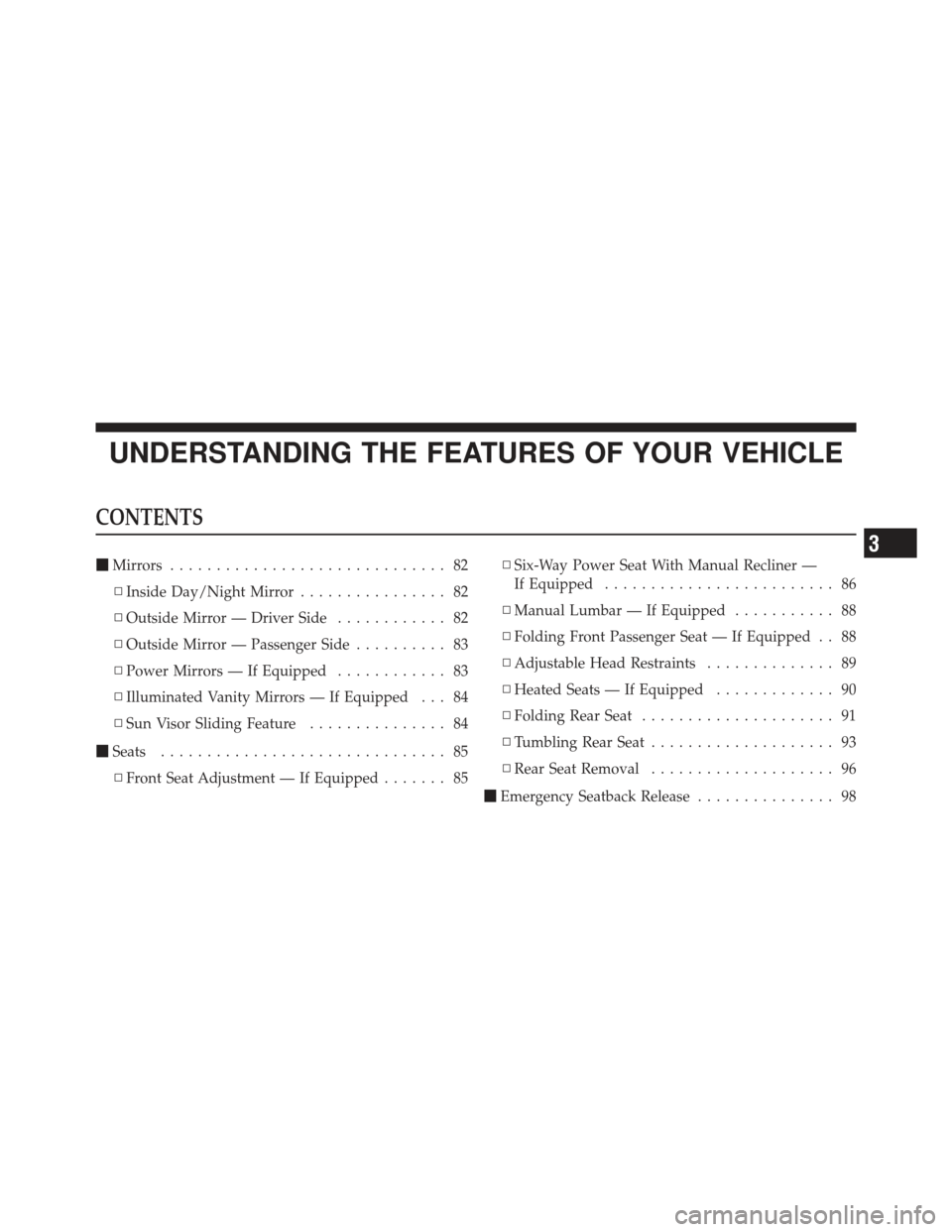
UNDERSTANDING THE FEATURES OF YOUR VEHICLE
CONTENTS
�Mirrors .............................. 82
▫ Inside Day/Night Mirror ................ 82
▫ Outside Mirror — Driver Side ............ 82
▫ Outside Mirror — Passenger Side .......... 83
▫ Power Mirrors — If Equipped ............ 83
▫ Illuminated Vanity Mirrors — If Equipped . . . 84
▫ Sun Visor Sliding Feature ............... 84
� Seats ............................... 85
▫ Front Seat Adjustment — If Equipped ....... 85▫
Six-Way Power Seat With Manual Recliner —
If Equipped ......................... 86
▫ Manual Lumbar — If Equipped ........... 88
▫ Folding Front Passenger Seat — If Equipped . . 88
▫ Adjustable Head Restraints .............. 89
▫ Heated Seats — If Equipped ............. 90
▫ Folding Rear Seat ..................... 91
▫ Tumbling Rear Seat .................... 93
▫ Rear Seat Removal .................... 96
� Emergency Seatback Release ............... 98
3
Page 86 of 368
SEATS
Seats are a primary part of the Occupant Restraint System
of the vehicle. They need to be used properly for safe
operation of the vehicle.
WARNING!
•DO NOT allow people to ride in any area of your
vehicle that is not equipped with seats and seat
belts. In a collision, people riding in these areas
are more likely to be seriously injured or killed.
•Be sure everyone in your vehicle is in a seat and
using a seat belt properly.
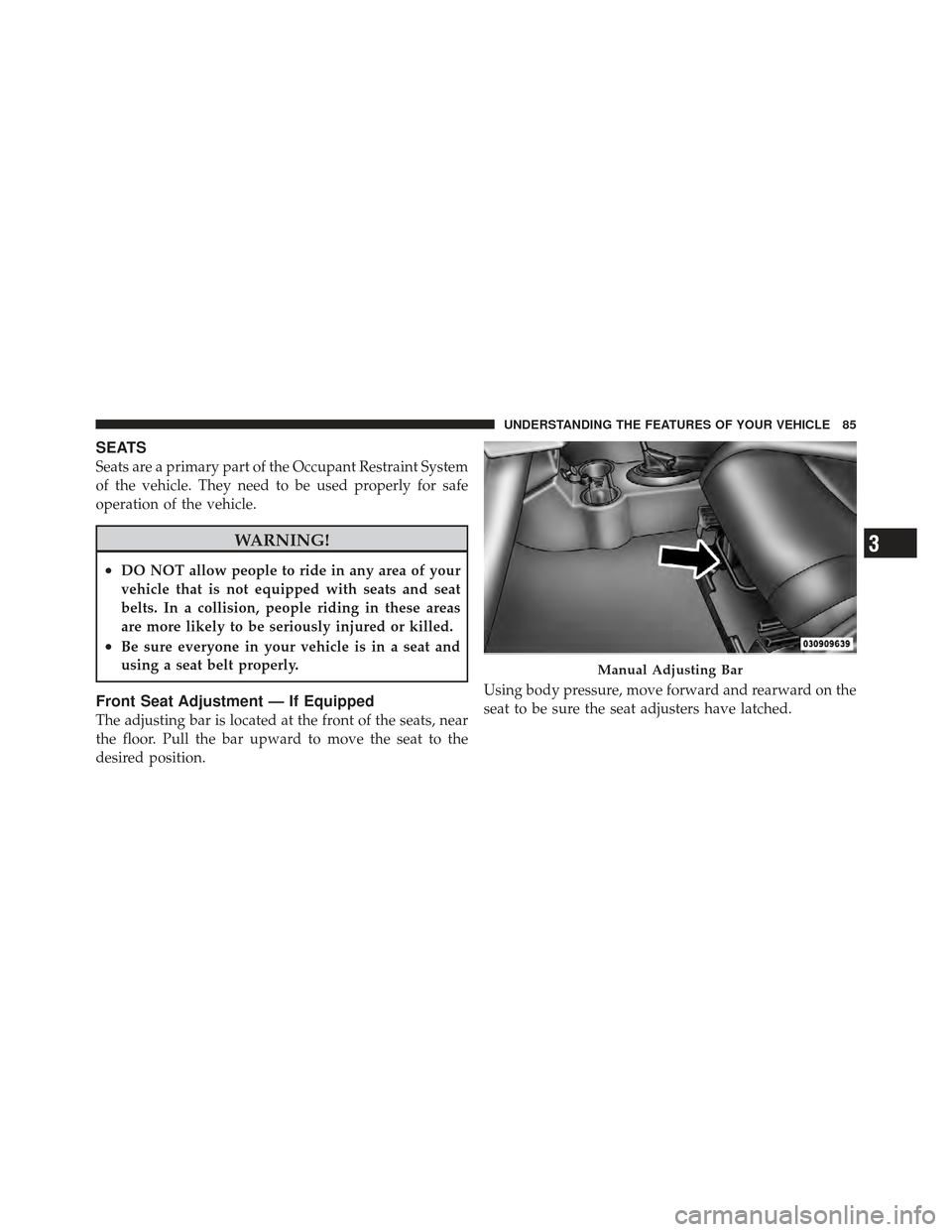
Front Seat Adjustment — If Equipped
The adjusting bar is located at the front of the seats, near
the floor. Pull the bar upward to move the seat to the
desired position.Using body pressure, move forward and rearward on the
seat to be sure the seat adjusters have latched.
Manual Adjusting Bar
3
UNDERSTANDING THE FEATURES OF YOUR VEHICLE 85
Page 91 of 368

Heated Seats — If Equipped
The heaters provide the same heat level for both cushion
and seatback. The driver and front passenger seats are
heated. The controls for each heater are located near the
bottom center of the instrument panel.
After turning the ignition ON, you can choose from High,
Low, or Off heat settings. Amber indicator lights in each
switch indicate the level of heat in use. Two indicator
lights will illuminate for High, one for Low, and none for
Off.Press the switch once to select High-level heat-
ing. Press the switch a second time to select
Low-level heating. Press the switch a third time
to shut Off the heating elements.
If High-level heating is selected, the system automatically
switches to Low-level heating and turns one indicator
light off after 30 minutes of continuous operation. It will
turn the heater and the remaining indicator light off after an additional 30 minutes of continuous operation. If
Low-level heating is selected, the system automatically
turns the heater and the indicator light off after 30 min-
utes of continuous operation.
NOTE:
Once a heat setting is selected, heat will be felt
within two to five minutes.
WARNING!
•Persons who are unable to feel pain to the skin
because of advanced age, chronic illness, diabetes,
spinal cord injury, medication, alcohol use, ex-
haustion or other physical condition must exercise
care when using the seat heater. It may cause burns
even at low temperatures, especially if used for
long periods of time.
(Continued)
90 UNDERSTANDING THE FEATURES OF YOUR VEHICLE
Page 93 of 368
WARNING!
•Do not ride in any of the rear seating positions
when one or more of the seat latches is not
engaged. Riding with the seat latches disengaged
could result in serious or fatal injury.
•It is extremely dangerous to ride in a cargo area,
inside or outside of a vehicle. In a collision, people
riding in these areas are more likely to be seri-
ously injured or killed.
•Do not allow people to ride in any area of your
vehicle that is not equipped with seats and seat
belts.
•Be sure that everyone in your vehicle is in a seat
and using a seat belt properly.NOTE:
•If the rear center lap/shoulder belt appears to be
locked into place, check to verify that the seatback is
fully latched.
•If the seatback is properly latched and the rear center
lap/shoulder belt still does not operate properly, check
and see if the Automatic Locking Retractor (ALR)
system is activated. Refer to “Occupant Restraints/
Automatic-Locking Retractor (ALR)” in “Things to
Know Before Starting Your Vehicle” for further
information.
92 UNDERSTANDING THE FEATURES OF YOUR VEHICLE
Page 94 of 368

WARNING!
The rear center lap/shoulder belt is equipped with a
lockout feature to ensure that the seatback is in the
fully upright and locked position when occupied. If
the rear seatback is not fully upright and locked and
the rear center lap/shoulder belt can be pulled out of
the retractor, the vehicle should immediately be
taken to an authorized dealer for service. Failure to
follow this warning could result in serious or fatal
injury.
Tumbling Rear Seat
To provide additional storage in the cargo area, each rear
seat can be tumbled forward.
CAUTION!
It is important that the front seats be pulled forward
to the midpoint of the seat track to avoid contact
between the rear seat and the front seatback. If the
front seat is not pulled forward the two seats will
make contact during the tumbling motion and cause
damage to the rear seat material. After the rear seat is
tumbled forward and secured the front seat can then
be repositioned to the preferred position.3
UNDERSTANDING THE FEATURES OF YOUR VEHICLE 93