Page 246 of 368

Curb Weight
The curb weight of a vehicle is defined as the total weight
of the vehicle with all fluids, including vehicle fuel, at full
capacity conditions, and with no occupants or cargo
loaded into the vehicle. The front and rear curb weight
values are determined by weighing your vehicle on a
commercial scale before any occupants or cargo are
added.
Overloading
The load carrying components (springs, tires, wheels,
etc.) of your vehicle will provide satisfactory service as
long as you do not exceed the GVWR.
The best way to figure out the total weight of your
vehicle is to weigh it when it is fully loaded and ready for
operation. Weigh it on a commercial scale to ensure that
it is not over the GVWR.Overloading can cause potential safety hazards and
shorten useful service life. Heavier suspension compo-
nents do not necessarily increase the vehicle’s GVWR.
Loading
To load your vehicle properly, first figure out its empty
weight. Store heavier items down low and be sure you
distribute their weight as evenly as possible. Stow all
loose items securely before driving. Improper weight
distribution can have an adverse effect on the way your
vehicle steers and handles, and the way the brakes
operate.
CAUTION!
Do not load your vehicle any heavier than the
GVWR. If you do, parts on your vehicle can break, or
it can change the way your vehicle handles. This
could cause you to lose control. Also, overloading can
shorten the life of your vehicle.
5
STARTING AND OPERATING 245
Page 276 of 368
MAINTAINING YOUR VEHICLE
CONTENTS
�Engine Compartment — 2.4L ............ 277
� Onboard Diagnostic System — OBD II ..... 278
▫ Loose Fuel Filler Cap Message .......... 278
� Emissions Inspection And Maintenance
Programs ............................ 278
� Replacement Parts .................... 280
� Dealer Service ....................... 280
� Maintenance Procedures ................ 281
▫ Engine Oil ........................ 281 ▫
Engine Oil Filter .................... 284
▫ Engine Air Cleaner Filter .............. 285
▫ Maintenance-Free Battery ............. 286
▫ Air Conditioner Maintenance ........... 287
▫ Body Lubrication ................... 288
▫ Windshield Wiper Blades ............. 289
▫ Adding Washer Fluid ................ 289
▫ Exhaust System .................... 290
▫ Cooling System .................... 292
7
Page 279 of 368

ONBOARD DIAGNOSTIC SYSTEM — OBD II
Your vehicle is equipped with a sophisticated onboard
diagnostic system called OBD II. This system monitors
the performance of the emissions, engine, and automatic
transmission control systems. When these systems are
operating properly, your vehicle will provide excellent
performance and fuel economy, as well as engine emis-
sions well within current government regulations.
If any of these systems require service, the OBD II system
will turn on the Malfunction Indicator Light (MIL). OBD
II will also store diagnostic codes and other information
to assist an authorized service technician in making
repairs. Although your vehicle will usually be drivable
and not need towing, see your authorized dealer for
service as soon as possible.
Loose Fuel Filler Cap Message
After fuel is added, the vehicle diagnostic system can
determine if the fuel filler cap is loose, improperlyinstalled, or damaged. A “gASCAP” message will be
displayed in the instrument cluster. Tighten the gas cap
until a
�clicking� sound is heard. This is an indication that
the gas cap is properly tightened. Press the odometer
reset button to turn the message off. If the problem
persists, the message will appear the next time the
vehicle is started. This might indicate a damaged cap. If
the problem is detected twice in a row, the system will
turn on the MIL. Resolving the problem will turn the MIL
light off.
EMISSIONS INSPECTION AND MAINTENANCE
PROGRAMS
In some localities, it may be a legal requirement to pass
an inspection of your vehicle’s emissions control system.
Failure to pass could prevent vehicle registration.
For states that require an Inspection and Mainte-
nance (I/M), this check verifies the “Malfunction
278 MAINTAINING YOUR VEHICLE
Page 285 of 368

Engine Oil Viscosity (SAE Grade) – 2.4L Engine
SAE 5W-30 engine oil is recommended for all operating
temperatures. This engine oil improves low temperature
starting and vehicle fuel economy.
The engine oil filler cap also shows the recommended
engine oil viscosity for your engine. For information on
engine oil filler cap location, refer to “Engine Compart-
ment” in “Maintaining Your Vehicle” for further informa-
tion.
Lubricants which do not have both, the engine oil certi-
fication mark and the correct SAE viscosity grade num-
ber, should not be used.
Synthetic Engine Oils
You may use synthetic engine oils, provided the recom-
mended oil quality requirements are met, and the recom-
mended maintenance intervals for oil and filter changes
are followed.
Materials Added to Engine Oils
The manufacturer strongly recommends against the ad-
dition of any additives (other than leak detection dyes) to
the engine oil. Engine oil is an engineered product and its
performance may be impaired by supplemental
additives.
Disposing of Used Engine Oil and Oil Filters
Care should be taken in disposing of used engine oil and
oil filters from your vehicle. Used oil and oil filters,
indiscriminately discarded, can present a problem to the
environment. Contact your authorized dealer, service
station, or governmental agency for advice on how and
where they can be safely discarded in your area.
Engine Oil Filter
The engine oil filter should be replaced with a new filter
at every engine oil change.
284 MAINTAINING YOUR VEHICLE
Page 317 of 368
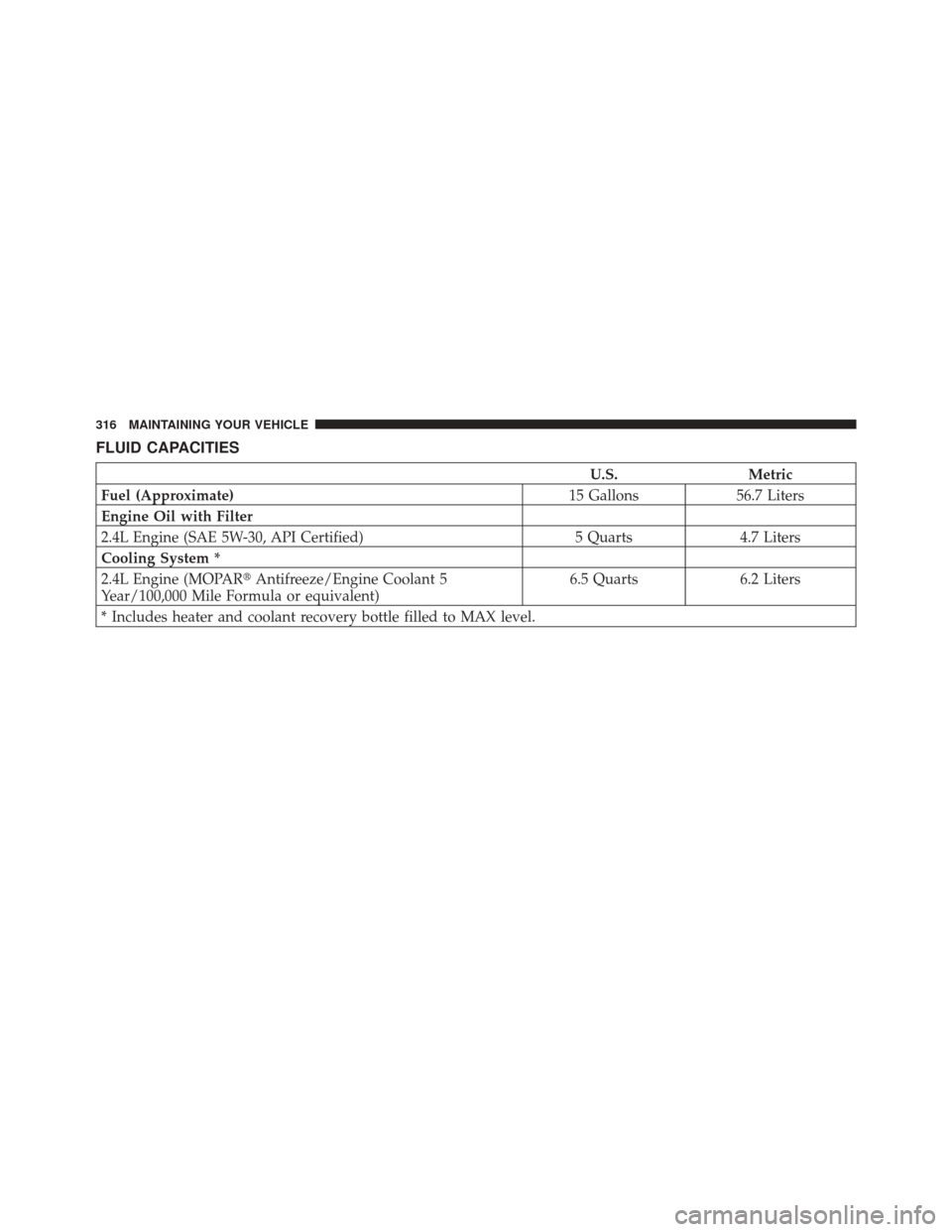
FLUID CAPACITIES
U.S.Metric
Fuel (Approximate) 15 Gallons56.7 Liters
Engine Oil with Filter
2.4L Engine (SAE 5W-30, API Certified) 5 Quarts4.7 Liters
Cooling System *
2.4L Engine (MOPAR� Antifreeze/Engine Coolant 5
Year/100,000 Mile Formula or equivalent) 6.5 Quarts
6.2 Liters
* Includes heater and coolant recovery bottle filled to MAX level.
316 MAINTAINING YOUR VEHICLE
Page 318 of 368
FLUIDS, LUBRICANTS AND GENUINE PARTS
Engine
ComponentFluid, Lubricant, or Genuine Part
Engine Coolant MOPAR�Antifreeze/Coolant 5 Year/100,000 Mile Formula HOAT (Hy-
brid Organic Additive Technology) or equivalent.
Engine Oil Use API Certified SAE 5W-30 Engine Oil, meeting the requirements of
Chrysler Material Standard MS-6395. Refer to your engine oil filler cap for
correct SAE grade.
Engine Oil Filter MOPAR�Engine Oil Filter or equivalent.
Spark Plugs – 2.4L Engine Champion�RE16MC (Gap 0.040 in [1.02 mm])
Fuel Selection 87 Octane
7
MAINTAINING YOUR VEHICLE 317
Page 351 of 368

ABS (Anti-Lock Brake System).............. 210
Adding Engine Coolant (Antifreeze) .......... 294
Adding Fuel ........................... 241
Additives, Fuel ......................... 239
Air Cleaner, Engine (Engine Air Cleaner Filter) . . . 285
Air Conditioner Maintenance ............... 287
Air Conditioning Controls ................. 180
Air Conditioning, Operating Tips ............ 185
Air Conditioning Refrigerant .............287,288
Air Conditioning System ................180,287
Air Pressure, Tires ....................... 224
Airbag ................................ 46
Airbag Deployment ....................... 58
Airbag Light ....................... 61,75,153
Airbag Maintenance ....................... 60
Airbag, Side ............................ 56
Alarm Light ........................... 152
Alarm, Panic ............................ 22 Alarm System (Security Alarm)
............... 18
Alterations/Modifications, Vehicle ............. 7
Antenna, Satellite Radio ................... 178
Antifreeze (Engine Coolant) ...........293,316,317
Capacities ........................... 316
Disposal ............................ 296
Anti-Lock Brake System (ABS) .............. 210
Anti-Lock Warning Light .................. 153
Anti-Theft Security Alarm (Theft Alarm) ........ 18
Appearance Care ........................ 302
Auto Down Power Windows ................ 32
Automatic Door Locks ................... 28,29
Automatic Transaxle ..............12,192,194,299
Adding Fluid ......................... 300
Filter ............................... 301
Fluid and Filter Changes ................. 301
Fluid Level Check ..................... 300
Interlock System ..................... 15,196
Reset Mode .......................... 197
350 INDEX
Page 352 of 368

Special Additives...................... 301
Autostick ............................. 200
Back-Up Lights ......................... 315
Battery ............................... 286
Keyless Transmitter Replacement (RKE) ....... 25
Belts, Seat .............................. 75
Body Mechanism Lubrication ............... 288
B-Pillar Location ........................ 219
Brake, Parking .......................... 207
Brake System ........................ 209,298
Anti-Lock (ABS) ....................... 210
Fluid Check .......................... 298
Master Cylinder ....................... 298
Parking ............................. 207
Warning Light ........................ 150
Brakes ............................... 209
Brake/Transmission Interlock ............... 195
Break-In Recommendations, New Vehicle ........ 72Bulb Replacement
..................... 31 1,312
Bulbs, Light .......................... 77,311
Calibration, Compass ...............157,162,167
Capacities, Antifreeze (Engine Coolant) ........ 316
Capacities, Fluid ........................ 316
Caps, Filler Fuel ............................... 242
Oil (Engine) ....................... 277,284
Power Steering ........................ 206
Radiator (Coolant Pressure) ............... 295
Car Washes ............................ 303
Carbon Monoxide Warning ...............74,241
CD (Compact Disc) Player ................. 168
Cellular Phone .......................... 180
Center High Mounted Stop Light ............ 315
Chains, Tire ............................ 231
Changing A Flat Tire ..................... 262
Chart, Tire Sizing ........................ 215
10
INDEX 351