Page 145 of 368

WARNING!
A hot engine cooling system is dangerous. You or
others could be badly burned by steam or boiling
coolant. You may want to call an authorized dealer-
ship for service if your vehicle overheats. If you
decide to look under the hood yourself, see “Main-
taining Your Vehicle”. Follow the warnings under the
Cooling System Pressure Cap paragraph.
4. Speedometer
The Speedometer shows the vehicle speed in miles per
hour (mph) and/or kilometers per hour (km/h).
5. Tachometer
The white area of the scale shows the permissible engine
revolutions-per-minute (RPM x 1000) for each gear range.
Before reaching the red area, ease up on the accelerator to
prevent engine damage. 6. Shift Lever Indicator
The Shift Lever Indicator is self-contained within the
instrument cluster. It displays the gear position of the
automatic transmission.
NOTE:
You must apply the brakes before shifting from
PARK.
7. Tire Pressure Monitoring Telltale Light — If
Equipped Each tire, including the spare (if provided),
should be checked monthly, when cold and
inflated to the inflation pressure recommended
by the vehicle manufacturer on the vehicle
placard or tire inflation pressure label. (If your vehicle
has tires of a different size than the size indicated on the
vehicle placard or tire inflation pressure label, you should
determine the proper tire inflation pressure for those
tires.)
144 UNDERSTANDING YOUR INSTRUMENT PANEL
Page 205 of 368

CAUTION!
•Always check the depth of the standing water
before driving through it. Never drive through
standing water that is deeper than the bottom of
the tire rims mounted on the vehicle.
•Determine the condition of the road or the path
that is under water and if there are any obstacles in
the way before driving through the standing wa-
ter.
•Do not exceed 5 mph (8 km/h) when driving
through standing water. This will minimize wave
effects.(Continued)
CAUTION! (Continued)
•Driving through standing water may cause dam-
age to your vehicle’s drivetrain components. Al-
ways inspect your vehicle’s fluids (i.e., engine oil,
transmission, axle, etc.) for signs of contamination
(i.e., fluid that is milky or foamy in appearance)
after driving through standing water. Do not con-
tinue to operate the vehicle if any fluid appears
contaminated, as this may result in further dam-
age. Such damage is not covered by the New
Vehicle Limited Warranty.
•Getting water inside your vehicle’s engine can
cause it to lock up and stall out, and cause serious
internal damage to the engine. Such damage is not
covered by the New Vehicle Limited Warranty.
204 STARTING AND OPERATING
Page 278 of 368
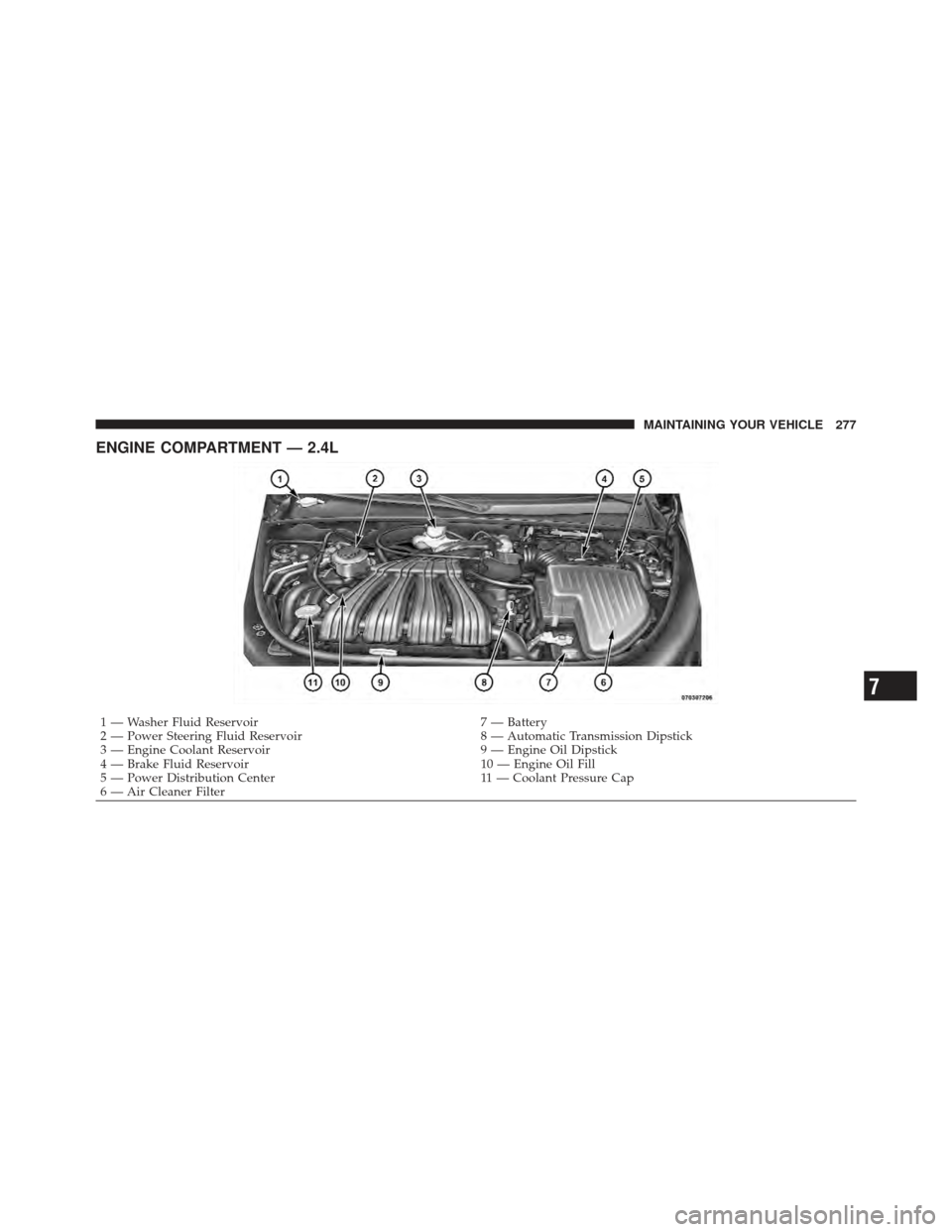
ENGINE COMPARTMENT — 2.4L
1 — Washer Fluid Reservoir7 — Battery
2 — Power Steering Fluid Reservoir 8 — Automatic Transmission Dipstick
3 — Engine Coolant Reservoir 9 — Engine Oil Dipstick
4 — Brake Fluid Reservoir 10 — Engine Oil Fill
5 — Power Distribution Center 11 — Coolant Pressure Cap
6 — Air Cleaner Filter
7
MAINTAINING YOUR VEHICLE 277
Page 282 of 368

MAINTENANCE PROCEDURES
The pages that follow contain therequiredmaintenance
services determined by the engineers who designed your
vehicle.
Besides those maintenance items specified in the fixed
maintenance schedule, there are other components which
may require servicing or replacement in the future.
CAUTION!
•Failure to properly maintain your vehicle or per-
form repairs and service when necessary could
result in more costly repairs, damage to other
components or negatively impact vehicle perfor-
mance. Immediately have potential malfunctions
examined by an authorized Chrysler Group LLC
dealership or qualified repair center.
(Continued)
CAUTION! (Continued)
•Your vehicle has been built with improved fluids
that protect the performance and durability of
your vehicle and also allow extended maintenance
intervals. Do not use chemical flushes in these
components as the chemicals can damage your
engine, transmission, power steering or air condi-
tioning. Such damage is not covered by the New
Vehicle Limited Warranty. If a flush is needed
because of component malfunction, use only the
specified fluid for the flushing procedure.
Engine Oil
Checking Oil Level
To assure proper engine lubrication, the engine oil must
be maintained at the correct level. Check the oil level at
regular intervals, such as every fuel stop.
7
MAINTAINING YOUR VEHICLE 281
Page 300 of 368

WARNING! (Continued)
•To avoid contamination from foreign matter or
moisture, use only new brake fluid or fluid that
has been in a tightly closed container. Keep the
master cylinder reservoir cap secured at all times.
Brake fluid in a open container absorbs moisture
from the air resulting in a lower boiling point.
This may cause it to boil unexpectedly during hard
or prolonged braking, resulting in sudden brake
failure. This could result in a accident.
•Overfilling the brake fluid reservoir can result in
spilling brake fluid on hot engine parts, causing
the brake fluid to catch fire. Brake fluid can also
damage painted and vinyl surfaces, care should be
taken to avoid its contact with these surfaces.(Continued)
WARNING! (Continued)
•Do not allow petroleum based fluid to contami-
nate the brake fluid. Brake seal components could
be damaged, causing partial or complete brake
failure. This could result in an accident.
Automatic Transmission
The automatic transmission and differential assembly are
contained within a single housing.
The fluid level in the automatic transmission should be
checked whenever the vehicle is serviced. Operation with
an improper fluid level will greatly reduce the life of the
transmission and the fluid.
7
MAINTAINING YOUR VEHICLE 299
Page 323 of 368
•Check the windshield washer solvent and add if
required.
Once a Month
•
Check tire pressure and look for unusual wear or
damage.
•Inspect the battery and clean and tighten the terminals
as required.
•Check the fluid levels of the coolant reservoir, brake
master cylinder and transmission, and add as needed.
•Check all lights and all other electrical items for correct
operation.
•Check rubber seals on each side of the radiator for
proper fit.
At Each Oil Change
•
Change the engine oil filter.
•Inspect the exhaust system.
•Inspect the brake hoses.
•Inspect the CV joints and front suspension compo-
nents.
•Check the automatic transmission fluid level.
•Check the coolant level, hoses, and clamps.
Maintenance Schedule B
Follow “Maintenance Schedule B” if you usually operate
your vehicle under one or more of the following condi-
tions.
8
MA I
N T
E
N A
N CE
S
C
H E
D
U L
E
S322 MAINTENANCE SCHEDULES
Page 324 of 368

Change the automatic transmission fluid and filter every
60,000 miles (100 000 km) if the vehicle is usually
operated under one or more of the conditions marked
with an\b.
•Day and night temperatures are below 32°F (0°C).
•Stop and go driving.
•Extensive engine idling.
•Driving in dusty conditions.
•Short trips of less than 10 miles (16.2 km).
•More than 50% of your driving is at sustained high
speeds during hot weather, above 90°F (32°C).
•Trailer towing.†\b
•Taxi, police, or delivery service (commercial ser-
vice).†\b
•Off-road or desert operation.
•If equipped for and operating with E-85 (ethanol) fuel.
NOTE:
•If ANY of these apply to you, then change your engine
oil every 3,000 miles (5 000 km) or three months,
whichever comes first, and follow ’Maintenance
Schedule B” in this section.
•If ANY of these apply to you, then flush and replace
the engine coolant every 102,000 miles (170 000 km) or
60 months, whichever comes first, and follow “Main-
tenance Schedule B” in this section.
If none of these apply to you, then change your engine oil
at every interval shown on “Maintenance Schedule A” in
this section.
8
M A I
N T
E
N A
N CE
S
C
H E
D
U L
E
SMAINTENANCE SCHEDULES 323
Page 328 of 368
Miles57,000 60,000 63,000 66,000 69,000 72,000
(Kilometers) (95 000) (100 000) (105 000) (110 000) (115 000) (120 000)
Change engine oil and engine oil filter, if not
replaced at three months. XXXXX X
Rotate tires. XX X
Inspect the brake linings. XX
Adjust parking brake on vehicles equipped
with four-wheel disc brakes. X
Replace the engine air cleaner filter.* X
Replace the spark plugs and ignition cables. X
Inspect the tie rod ends and boot seal. X
Replace the make-up air filter.* X
Adjust the generator drive belt tension. X
Change the automatic transmission fluid and
filter.\b X
Flush and replace engine coolant at
60 months, if not done at 102,000 miles
(170 000 km). X
8
M
A I
N T
E
N A
N CE
S
C
H E
D
U L
E
SMAINTENANCE SCHEDULES 327