2010 CHRYSLER PT CRUISER child lock
[x] Cancel search: child lockPage 69 of 368

•If the belt still can’t be tightened, or if pulling and
pushing on the restraint loosens the belt, disconnect
the latch plate from the buckle, turn the latch plate
around, and insert the latch plate into the buckle
again. If you still can’t make the child restraint secure,
try a different seating position.
•Buckle the child into the seat according to the child
restraint manufacturer’s directions.
•When your child restraint is not in use, secure it in the
vehicle with the seat belt or remove it from the vehicle.
Do not leave it loose in the vehicle. In a sudden stop or
collision, it could strike the occupants or seat backs
and cause serious personal injury.
Automatic Locking Retractor (ALR)
To operate the switchable retractor, pull the belt from the
retractor until there is enough to pass it through the child
restraint and slide the latch plate into the buckle. Then
pull on the belt until it is fully extended from theretractor. Allow the belt to return into the retractor,
pulling on the excess webbing to tighten the lap portion
around the child restraint. Follow the instructions of the
child restraint manufacture.
NOTE:
To reset this feature you must let all of the belt
webbing return into the retractor. You will not be able to
pull out more webbing until all of the webbing has been
returned back into the retractor.
Lower Anchors and Tether for CHildren (LATCH)
Your vehicle is equipped with the child restraint anchor-
age system called LATCH, which stands for Lower
Anchors and Tether for CHildren. The LATCH system
provides for the installation of the child restraint without
using the vehicle seat belt. All three rear seating positions
have lower and tether anchorages that are capable of
accommodating LATCH-compatible child seats having
flexible, webbing-mounted lower attachments. Child
seats with fixed lower attachments must be installed in
68 THINGS TO KNOW BEFORE STARTING YOUR VEHICLE
Page 99 of 368
EMERGENCY SEATBACK RELEASE
WARNING!
Do not allow children to have access to the liftgate
area with the rear shelf panel in position 1 (Top) or
position 2 (Middle), either by climbing into the
liftgate from outside, or through the inside of the
vehicle. Always close the liftgate when your vehicle
is unattended. Once in the liftgate area, young chil-
dren may not be able to escape, even if they entered
through the rear seat. If trapped in the liftgate,
children can die from suffocation or heat stroke.
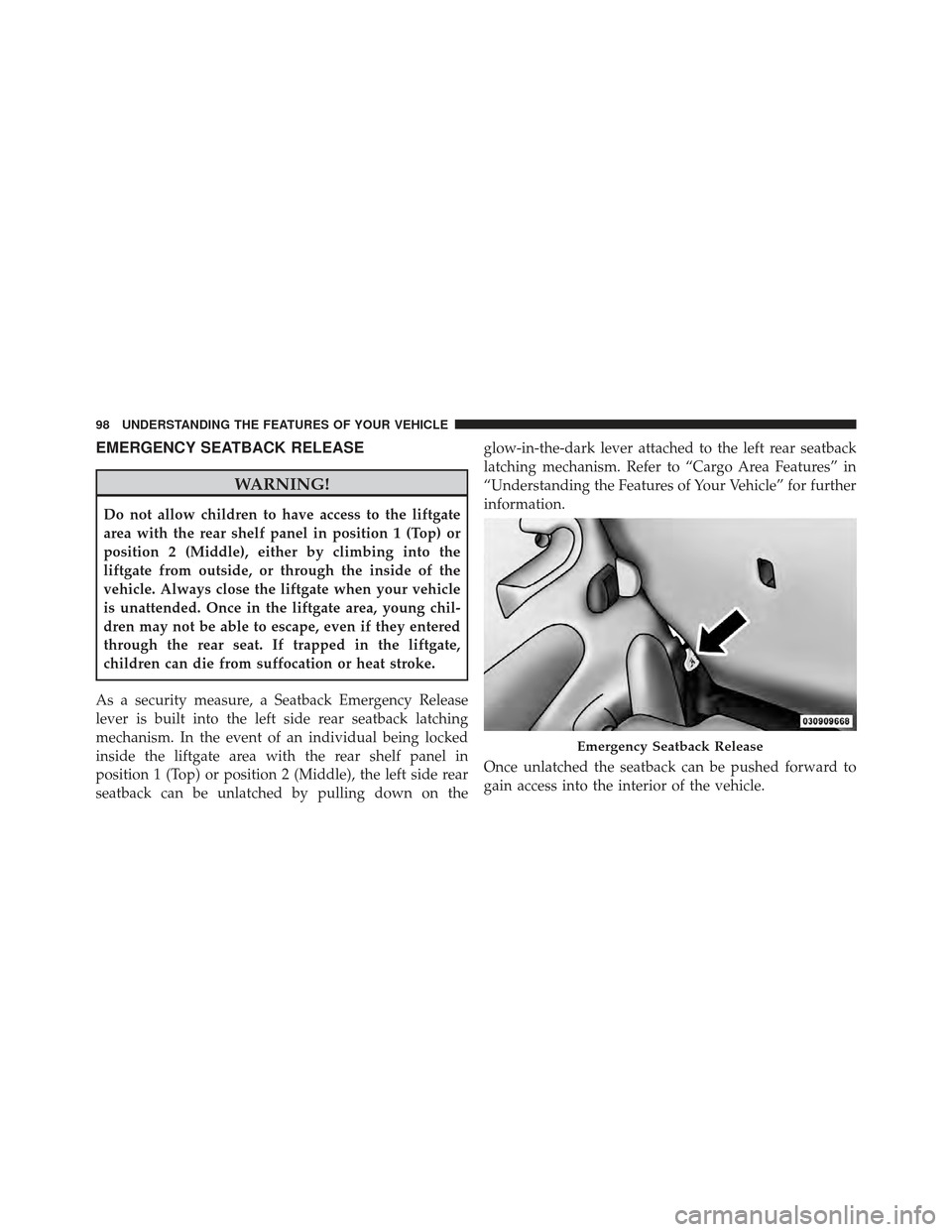
As a security measure, a Seatback Emergency Release
lever is built into the left side rear seatback latching
mechanism. In the event of an individual being locked
inside the liftgate area with the rear shelf panel in
position 1 (Top) or position 2 (Middle), the left side rear
seatback can be unlatched by pulling down on the glow-in-the-dark lever attached to the left rear seatback
latching mechanism. Refer to “Cargo Area Features” in
“Understanding the Features of Your Vehicle” for further
information.
Once unlatched the seatback can be pushed forward to
gain access into the interior of the vehicle.
Emergency Seatback Release
98 UNDERSTANDING THE FEATURES OF YOUR VEHICLE
Page 199 of 368
WARNING!
Unintended movement of a vehicle could injure
those in and near the vehicle. As with all vehicles,
you should never exit a vehicle while the engine is
running. Before exiting a vehicle, you should always
shift the vehicle into PARK, remove the key from the
ignition, and apply the parking brake. Once the key
is removed from the ignition, the shift lever is locked
in the PARK position, securing the vehicle against
unwanted movement. Furthermore, you should never
leave unattended children inside a vehicle.
The following indicators should be used to ensure that
you have engaged the shift lever into the PARK position:
•When moving the shift lever into PARK, press the
button on the shift lever knob and firmly move the
lever all the way forward until it stops.
•Look at the shift indicator window on the console to
ensure it is in the PARK position.
•When engaged in PARK, you will not be able to move
the shift lever rearward without pressing the lever
knob button.
CAUTION!
Before moving the shift lever out of PARK, you must
turn the ignition from LOCK to ON, so the steering
wheel and shift lever are released. Otherwise, dam-
age to the steering column or shift lever could result.
REVERSE
This range is for moving the vehicle backward. Shift into
REVERSE only after the vehicle has come to a complete
stop.
198 STARTING AND OPERATING
Page 209 of 368

NOTE:
•When the parking brake is applied and the transmis-
sion is placed in gear, the “Brake Warning Light” will
flash. If vehicle speed is detected, a chime will sound
to alert the driver. Fully release the parking brake
before attempting to move the vehicle.
•This light only shows that the parking brake is ap-
plied. It does not show the degree of brake application.
When parking on a hill, it is important to turn the front
wheels toward the curb on a downhill grade and away
from the curb on an uphill grade. Apply the parking
brake before placing the shift lever in PARK, otherwise
the load on the transmission locking mechanism may
make it difficult to move the shift lever out of PARK. The
parking brake should always be applied whenever the
driver is not in the vehicle.
WARNING!
•Never use the PARK position as a substitute for
the parking brake. Always apply the parking
brake fully when parked to guard against vehicle
movement and possible injury or damage.
•Never leave children alone in a vehicle. Leaving
unattended children in a vehicle is dangerous for a
number of reasons. A child or others could be
seriously or fatally injured.
•Do not leave the key in the ignition. A child could
operate power windows, other controls, or move
the vehicle.
•Be sure the parking brake is fully disengaged
before driving; failure to do so can lead to brake
failure and an accident. (Continued)
208 STARTING AND OPERATING
Page 353 of 368

Check Engine Light
(Malfunction Indicator Light).............148,278
Checking Your Vehicle For Safety ............. 73
Checks, Safety ........................... 73
Child Restraint .......................... 64
Child Restraint Tether Anchors ............... 68
Child Restraint with Automatic Belts ........... 67
Child Safety Locks ........................ 30
Child Seat .............................. 70
Clean Air Gasoline ....................... 237
Cleaning Wheels ............................. 304
Climate Control ......................... 180
Clock ............................. 168,170
Coin Holder ........................... 128
Compact Disc (CD) Maintenance ............. 179
Compact Spare Tire ...................... 226
Compass ..................... 154,155,157,162
Compass Calibration ................ 157,162,167Compass Variance
....................... 156
Computer, Trip/Travel .................... 154
Console .............................. 128
Contract, Service ........................ 343
Coolant (Antifreeze) ................... 316,317
Coolant Pressure Cap (Radiator Cap) .......... 295
Cooling System ......................... 292
Adding Coolant (Antifreeze) .............. 294
Coolant Level ...................... 292,296
Disposal of Used Coolant ................ 296
Drain, Flush, and Refill .................. 293
Inspection ........................... 296
Points to Remember .................... 297
Pressure Cap ......................... 295
Radiator Cap ......................... 295
Selection of Coolant (Antifreeze) ........... 293
Corrosion Protection ..................... 302
Cruise Light ........................... 148
Cupholders ............................ 128
352 INDEX
Page 359 of 368

Malfunction Indicator (Check Engine)........ 148
Map Reading ......................... 105
Oil Pressure .......................... 153
Passing ............................. 103
Rear Servicing ........................ 314
Seat Belt Reminder ..................... 151
Security Alarm (Theft Alarm) ............18,152
Service ............................. 312
Service Engine Soon (Malfunction Indicator) . . . 148
Theft Alarm (Security Alarm) .............. 152
Tire Pressure Monitoring (TPMS) ........144,232
Traction Control ....................... 213
Turn Signal ...................... 77,104,313
Voltage ............................. 149
Warning (Instrument Cluster Description) ..... 143
Loading Vehicle ...................... 244,245
Capacities ........................... 245
Tires ............................... 219 Locks
Child Protection ........................ 30
Door ................................ 26
Power Door ........................... 28
Steering Wheel ......................... 14
Low Tire Pressure System .................. 232
Lubrication, Body ....................... 288
Lumbar Support ......................... 88
Maintenance Free Battery .................. 286
Maintenance, General ..................... 281
Maintenance Procedures ................... 281
Maintenance Schedule Schedule “A”-Non Turbo ................ 333
Schedule “B” ......................... 322
Schedule “B”-All Engines ................ 322
Maintenance Schedules .................... 320
Malfunction Indicator Light (Check Engine) . . 148,278
Manual, Service ......................... 345
358 INDEX
Page 364 of 368

Engine Fails to Start.................... 193
Starting and Operating .................... 192
Starting Procedures ...................... 192
Steering Power ........................... 205,206
Tilt Column .......................... 110
Wheel Lock ........................... 14
Storage ............................ 126,311
Stuck, Freeing .......................... 272
Sun Roof .............................. 121
Sun Visor Extension ....................... 84
Supplemental Restraint System - Airbag ........ 46
Synthetic Engine Oil ...................... 284
Tachometer ............................ 144
Temperature Gauge, Engine Coolant .......143,261
Tether Anchor, Child Restraint ............... 68
Theft Alarm (Security Alarm) ................ 18
Theft System (Security Alarm) ............... 18Tilt Steering Column
..................... 110
Tire and Loading Information Placard ......... 219
Tire Identification Number (TIN) ............. 217
Tire Markings .......................... 214
Tire Safety Information .................... 214
Tires ............................ 77,223,346
Aging (Life of Tires) .................... 229
Air Pressure .......................... 223
Chains .............................. 231
Changing ............................ 262
Compact Spare ........................ 226
General Information .................... 223
High Speed .......................... 226
Inflation Pressures ..................... 224
Jacking ............................. 262
Life of Tires .......................... 229
Load Capacity ..................... 219,220
Pressure Monitor System (TPMS) ........... 232
Pressure Warning Light .................. 144
10
INDEX 363