Page 297 of 465
When the parking brake is applied with the ignition
switch in the ON position, the “Brake Warning Light” in
the instrument cluster will illuminate.
NOTE:
•When the parking brake is applied and the transmis-
sion is placed in gear, the “Brake Warning Light” will
flash. If vehicle speed is detected, a chime will sound
to alert the driver. Fully release the parking brake
before attempting to move the vehicle.
•This light only shows that the parking brake is ap-
plied. It does not show the degree of brake application.
When parking on a hill, it is important to turn the front
wheels toward the curb on a downhill grade and away
from the curb on an uphill grade. Apply the parking
brake before placing the shift lever in PARK, otherwise
the load on the transmission locking mechanism may make it difficult to move the shift lever out of PARK. The
parking brake should always be applied whenever the
driver is not in the vehicle.
WARNING!
•Never use the PARK position as a substitute for
the parking brake. Always apply the parking
brake fully when parked to guard against vehicle
movement and possible injury or damage.
•Never leave children alone in a vehicle. Leaving
unattended children in a vehicle is dangerous for a
number of reasons. A child or others could be
seriously or fatally injured.
•Do not leave the key fob in the ignition switch. A
child could operate power windows, other con-
trols, or move the vehicle.
(Continued)
296 STARTING AND OPERATING
Page 344 of 465
WHAT TO DO IN EMERGENCIES
CONTENTS
�Hazard Warning Flasher ................ 344
� If Your Engine Overheats ................ 344
� TIREFIT Kit ......................... 345
▫ TIREFIT Storage ..................... 346
▫ TIREFIT Kit Components And Operation . . . 346
▫ TIREFIT Usage Precautions ............. 348
▫ Sealing a Tire With TIREFIT ............. 350
� Jump-Starting Procedures ................ 355
▫ Preparations For Jump-Start ............. 356▫
Jump-Starting Procedure ............... 357
� Freeing A Stuck Vehicle ................. 359
� Towing A Disabled Vehicle ............... 360
▫ Without The Ignition Key FOB ........... 360
▫ Towing This Vehicle Behind Another
Vehicle ............................ 361
▫ Towing This Vehicle Behind Another Vehicle
With A Tow Dolly .................... 362
6
Page 356 of 465
(F) Sealant Bottle and Hose Replacement:
1. Uncoil the Sealant Hose (6).
2. Locate the rectangular Sealant Bottle release button in
the recessed area where you place your fingers to unlatch
the hoses (6) (7) from their storage area.
3. Use the yellow cap on end of the Sealant Hose (6) to
depress the Sealant Bottle release button. The Sealant
Bottle (1) will pop up. Remove the bottle and dispose of
it accordingly.
4. Clean any remaining sealant from the TIREFIT hous-
ing.
5. Position the new Sealant Bottle (1) to the housing so
that the Sealant Hose (6) aligns with the hose slot in the
front of the housing and the alignment keys on the
bottom of the bottle align with the alignment slots in thehousing. Then, press the bottle into the housing. An
audible click will be heard, indicating the bottle is locked
in place.
6. Verify the yellow cap is installed on the fitting at the
end of the Sealant Hose (6) and return the hose to its
storage area (located on the bottom of the air pump).
7. Return the TIREFIT kit to its storage location in the
vehicle.
JUMP-STARTING PROCEDURES
If your vehicle has a discharged battery it can be jump-
started using a set of jumper cables and a battery in
another vehicle or by using a portable battery booster
pack. Jump-starting can be dangerous if done improperly
so please follow the procedures in this section carefully.
NOTE:
When using a portable battery booster pack
follow the manufacturer ’s operating instructions and
precautions.6
WHAT TO DO IN EMERGENCIES 355
Page 361 of 465
CAUTION!
•When “rocking” a stuck vehicle by moving be-
tween 1st and REVERSE, do not spin the wheels
faster than 15 mph (24 km/h), or drivetrain damage
may result.
•Revving the engine or spinning the wheels too fast
may lead to transmission overheating and failure.
It can also damage the tires. Do not spin the
wheels above 30 mph (48 km/h) while in gear (no
transmission shifting occurring).
WARNING!
Fast spinning tires can be dangerous. Forces gener-
ated by excessive wheel speeds may cause damage, or
even failure, of the axle and tires. A tire could
explode and injure someone. Do not spin your vehi-
cle’s wheels faster than 30 mph (48 km/h) or for
longer than 30 seconds continuously without stop-
ping when you are stuck and do not let anyone near
a spinning wheel, no matter what the speed.
TOWING A DISABLED VEHICLE
Without The Ignition Key Fob
Special care must be taken when the vehicle is towed
with the ignition in the OFF position. The only approved
method of towing without the ignition key is with a
flatbed truck. Proper towing equipment is necessary to
prevent damage to the vehicle.
360 WHAT TO DO IN EMERGENCIES
Page 368 of 465

TRIP ODOMETER button to turn off the message. If the
problem continues, the message will appear the next time
the vehicle is started.
A loose, improperly installed, or damaged fuel filler cap
may also turn on the MIL.
EMISSIONS INSPECTION AND MAINTENANCE
PROGRAMS
In some localities, it may be a legal requirement to pass
an inspection of your vehicle’s emissions control system.
Failure to pass could prevent vehicle registration.For states that require an Inspection and Mainte-
nance (I/M), this check verifies the “Malfunction
Indicator Light (MIL)” is functioning and is not
on when the engine is running, and that the OBD II
system is ready for testing.
Normally, the OBD II system will be ready. The OBD II
system may notbe ready if your vehicle was recently serviced, recently had a dead battery or a battery replace-
ment. If the OBD II system should be determined not
ready for the I/M test, your vehicle may fail the test.
Your vehicle has a simple ignition key-actuated test,
which you can use prior to going to the test station. To
check if your vehicle’s OBD II system is ready, you must
do the following:
1. Turn the ignition switch to the ON position, but do not
crank or start the engine.
2. If you crank or start the engine, you will have to start
this test over.
3. As soon as you turn the ignition switch to the ON
position, you will see the MIL symbol come on as part of
a normal bulb check.
4. Approximately 15 seconds later, one of two things will
happen:
7
MAINTAINING YOUR VEHICLE 367
Page 408 of 465
BULB REPLACEMENT
Low Beam Headlamp, High Beam Headlamp, and
Park/Turn Lamp
High Intensity Discharge Headlamps (HID)
The headlamps are a type of high voltage discharge tube.
High voltage can remain in the circuit even with the
headlight switch off and the key removed.Because of
this, you should not attempt to service a headlamp bulb
yourself. If a headlamp bulb fails, take your vehicle to
an authorized dealer for service.
NOTE: When HID headlamps are turned on, there is a
blue hue to the lamps. This diminishes and becomes
more white after approximately 10 seconds, as the system
charges.
Tail/Stop, Tail, Turn Signal Lamp, and Backup
Lamp
1. Open the trunk. 2. Remove the two fasteners from the back of the tail
lamp assembly.
3. Pull back the trunk liner.
4. Remove the remaining fastener from the back of the
tail lamp assembly.
5. Push the electrical connector locking tab to the side.
7
MAINTAINING YOUR VEHICLE 407
Page 446 of 465
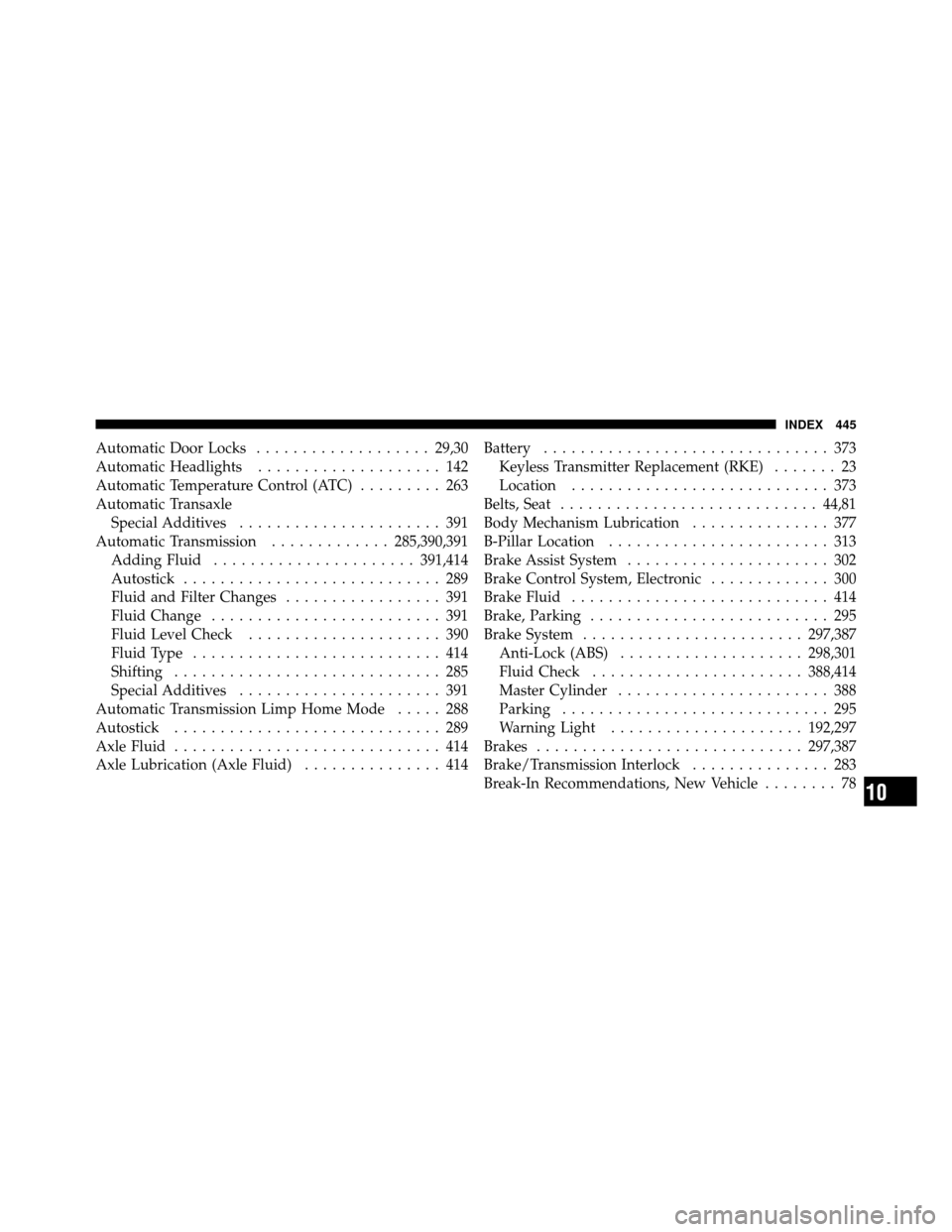
Automatic Door Locks................... 29,30
Automatic Headlights .................... 142
Automatic Temperature Control (ATC) ......... 263
Automatic Transaxle Special Additives ...................... 391
Automatic Transmission .............285,390,391
Adding Fluid ...................... 391,414
Autostick ............................ 289
Fluid and Filter Changes ................. 391
Fluid Change ......................... 391
Fluid Level Check ..................... 390
Fluid Type ........................... 414
Shifting ............................. 285
Special Additives ...................... 391
Automatic Transmission Limp Home Mode ..... 288
Autostick ............................. 289
Axle Fluid ............................. 414
Axle Lubrication (Axle Fluid) ............... 414Battery
............................... 373
Keyless Transmitter Replacement (RKE) ....... 23
Location ............................ 373
Belts, Seat ............................ 44,81
Body Mechanism Lubrication ............... 377
B-Pillar Location ........................ 313
Brake Assist System ...................... 302
Brake Control System, Electronic ............. 300
Brake Fluid ............................ 414
Brake, Parking .......................... 295
Brake System ........................ 297,387
Anti-Lock (ABS) .................... 298,301
Fluid Check ....................... 388,414
Master Cylinder ....................... 388
Parking ............................. 295
Warning Light ..................... 192,297
Brakes ............................. 297,387
Brake/Transmission Interlock ............... 283
Break-In Recommendations, New Vehicle ........ 78
10
INDEX 445
Page 453 of 465
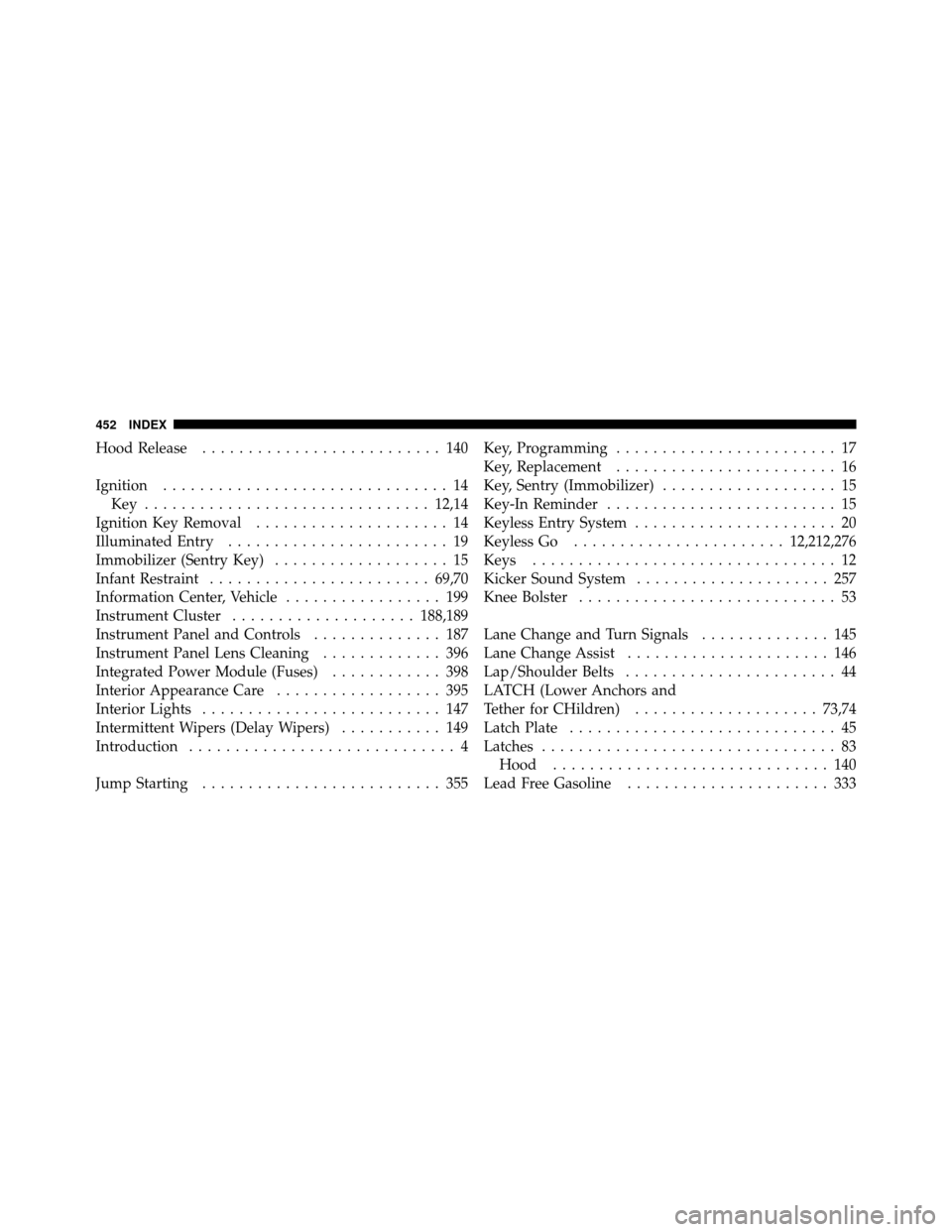
Hood Release.......................... 140
Ignition ............................... 14
Key ............................... 12,14
Ignition Key Removal ..................... 14
Illuminated Entry ........................ 19
Immobilizer (Sentry Key) ................... 15
Infant Restraint ........................ 69,70
Information Center, Vehicle ................. 199
Instrument Cluster .................... 188,189
Instrument Panel and Controls .............. 187
Instrument Panel Lens Cleaning ............. 396
Integrated Power Module (Fuses) ............ 398
Interior Appearance Care .................. 395
Interior Lights .......................... 147
Intermittent Wipers (Delay Wipers) ........... 149
Introduction ............................. 4
Jump Starting .......................... 355 Key, Programming
........................ 17
Key, Replacement ........................ 16
Key, Sentry (Immobilizer) ................... 15
Key-In Reminder ......................... 15
Keyless Entry System ...................... 20
Keyless Go ....................... 12,212,276
Keys ................................. 12
Kicker Sound System ..................... 257
Knee Bolster ............................ 53
Lane Change and Turn Signals .............. 145
Lane Change Assist ...................... 146
Lap/Shoulder Belts ....................... 44
LATCH (Lower Anchors and
Tether for CHildren) .................... 73,74
Latch Plate ............................. 45
Latches ................................ 83
Hood .............................. 140
Lead Free Gasoline ...................... 333
452 INDEX