Page 76 of 538
system provides for the installation of the child restraint
without using the vehicle’s seat belts, instead securing
the child restraint using lower anchorages and upper
tether straps from the child restraint to the vehicle
structure.
LATCH-compatible child restraint systems are now avail-
able. However, because the lower anchorages are to be
introduced over a period of years, child restraint systems
having attachments for those anchorages will continue to
have features for installation using the vehicle’s seat
belts. Child restraints having tether straps and hooks for
connection to the top tether anchorages, have been
available for some time. For some older child restraints,
many child restraint manufacturers offer add-on tether
strap kits or retrofit kits. You are urged to take advantage
of all the available attachments provided with your child
restraint in any vehicle.
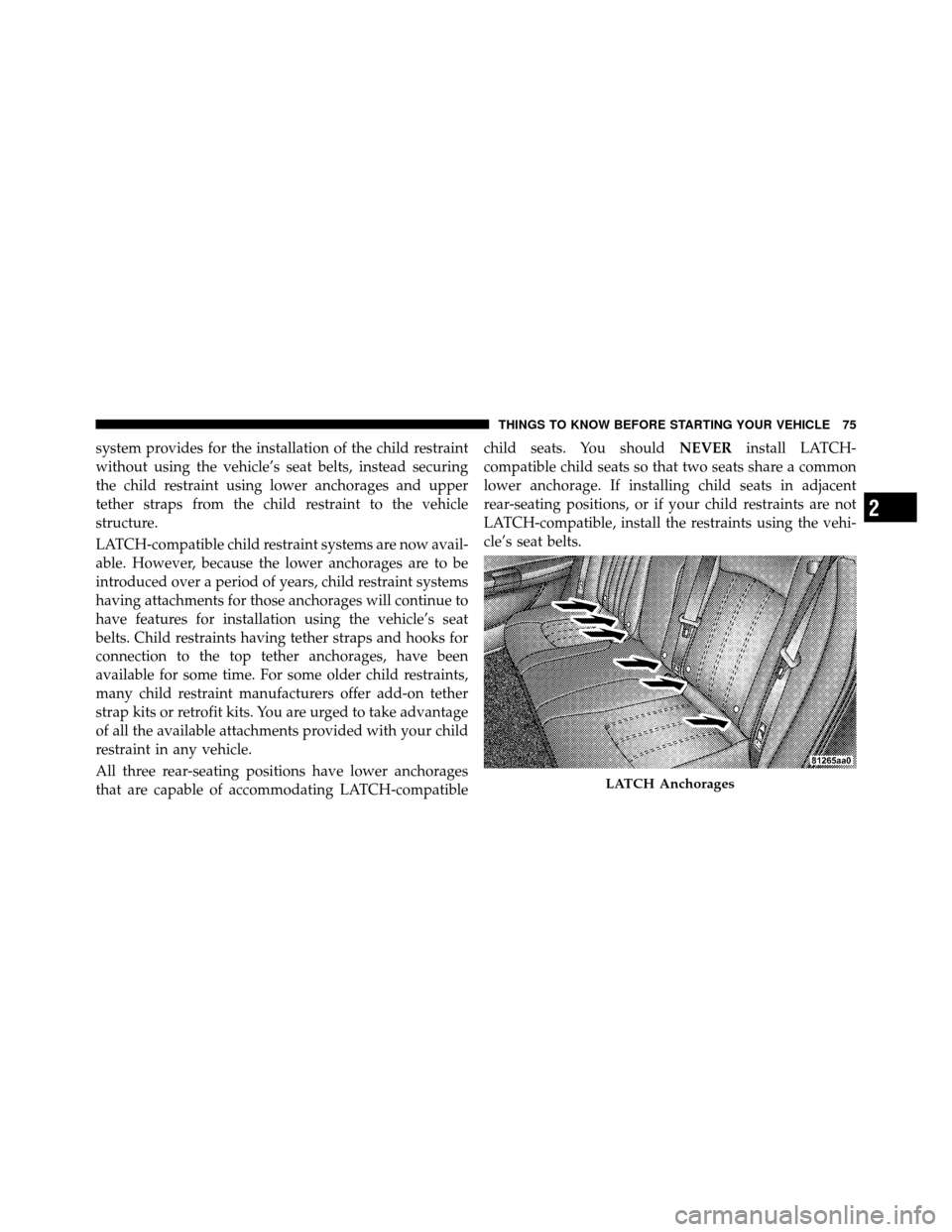
All three rear-seating positions have lower anchorages
that are capable of accommodating LATCH-compatiblechild seats. You should
NEVERinstall LATCH-
compatible child seats so that two seats share a common
lower anchorage. If installing child seats in adjacent
rear-seating positions, or if your child restraints are not
LATCH-compatible, install the restraints using the vehi-
cle’s seat belts.
LATCH Anchorages
2
THINGS TO KNOW BEFORE STARTING YOUR VEHICLE 75
Page 82 of 538
SAFETY TIPS
Transporting Passengers
NEVER TRANSPORT PASSENGERS IN THE CARGO
AREA.
WARNING!
•Do not leave children or animals inside parked
vehicles in hot weather. Interior heat build-up may
cause serious injury or death.
•It is extremely dangerous to ride in a cargo area,
inside or outside of a vehicle. In a collision, people
riding in these areas are more likely to be seri-
ously injured or killed.
•Do not allow people to ride in any area of your
vehicle that is not equipped with seats and seat
belts.(Continued)
WARNING! (Continued)
•Be sure everyone in your vehicle is in a seat and
using a seat belt properly.
Exhaust Gas
WARNING!
Exhaust gases can injure or kill. They contain carbon
monoxide (CO), which is colorless and odorless.
Breathing it can make you unconscious and can
eventually poison you. To avoid breathing (CO)
follow these safety tips:
Do not run the engine in a closed garage or in confined
areas any longer than needed to move your vehicle in or
out of the area.
2
THINGS TO KNOW BEFORE STARTING YOUR VEHICLE 81
Page 87 of 538

▫Things You Should Know About Your
Uconnect™ Phone .................... 116
▫ General Information .................. 124
� Voice Command — If Equipped ........... 124
▫ Voice Command System Operation ........ 124
▫ Commands ........................ 126
▫ Voice Training ...................... 129
� Seats .............................. 129
▫ Power Seats ........................ 130
▫ Power Reclining Seats ................. 131
▫ Lumbar Support ..................... 132
▫ Head Restraints ..................... 132
▫ Heated Seats — If Equipped ............ 134▫
Folding Rear Seat .................... 136
� Driver Memory Seat — If Equipped ........ 138
▫ Programming The Memory Feature ....... 139
▫ Linking And Unlinking The Remote Keyless
Entry Transmitter To Memory ........... 139
▫ Memory Position Recall ................ 140
▫ Easy Entry/Exit Seat (Available With
Memory Seat Only) ................... 141
� To Open And Close The Hood ............ 142
� Lights ............................. 144
▫ Headlight Switch .................... 144
▫ Automatic Headlights — If Equipped ...... 145
▫ Headlights On With Wipers (Available With
Automatic Headlights Only) ............ 145
86 UNDERSTANDING THE FEATURES OF YOUR VEHICLE
Page 130 of 538
NOTE:Keep in mind that you have to press the Voice
Command
button first and wait for the beep
before speaking the “Barge In” commands.
Voice Training
For users experiencing difficulty with the system recog-
nizing their voice commands or numbers the Uconnect™
Voice “Voice Training” feature may be used.
1. Press the Voice Command
button, say “System
Setup” and once you are in that menu then say “Voice
Training.” This will train your own voice to the system
and will improve recognition.
2. Repeat the words and phrases when prompted by
Uconnect™ Voice. For best results, the “Voice Training”
session should be completed when the vehicle is parked,
engine running, all windows closed, and the blower fan
switched off. This procedure may be repeated with a new
user. The system will adapt to the last trained voice only.
SEATS
Seats are a primary part of the Occupant Restraint System
of the vehicle. They need to be used properly for safe
operation of the vehicle.
WARNING!
•DO NOT allow people to ride in any area of your
vehicle that is not equipped with seats and seat
belts. In a collision, people riding in these areas
are more likely to be seriously injured or killed.
•Be sure everyone in your vehicle is in a seat and
using a seat belt properly.
3
UNDERSTANDING THE FEATURES OF YOUR VEHICLE 129
Page 131 of 538
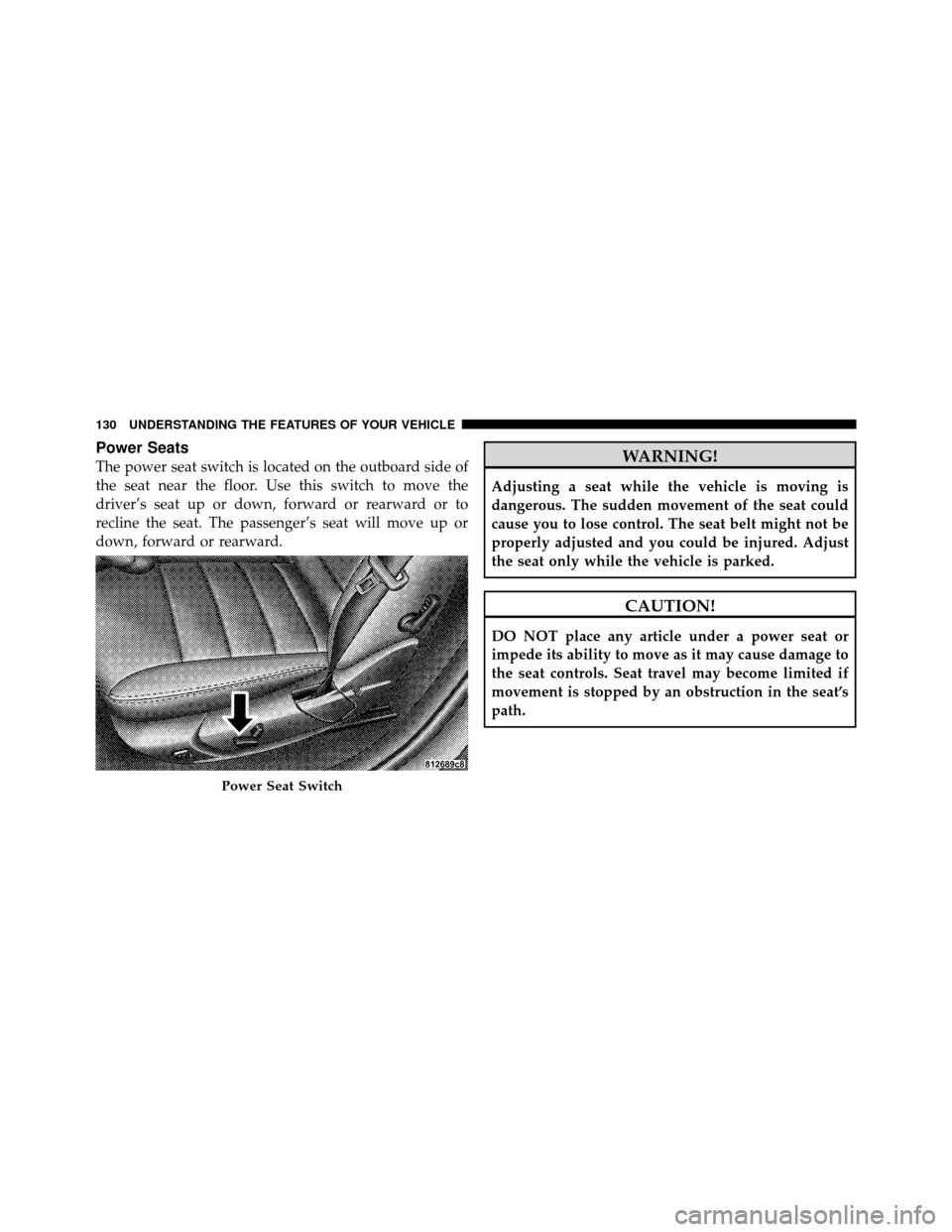
Power Seats
The power seat switch is located on the outboard side of
the seat near the floor. Use this switch to move the
driver’s seat up or down, forward or rearward or to
recline the seat. The passenger’s seat will move up or
down, forward or rearward.WARNING!
Adjusting a seat while the vehicle is moving is
dangerous. The sudden movement of the seat could
cause you to lose control. The seat belt might not be
properly adjusted and you could be injured. Adjust
the seat only while the vehicle is parked.
CAUTION!
DO NOT place any article under a power seat or
impede its ability to move as it may cause damage to
the seat controls. Seat travel may become limited if
movement is stopped by an obstruction in the seat’s
path.
Power Seat Switch
130 UNDERSTANDING THE FEATURES OF YOUR VEHICLE
Page 132 of 538
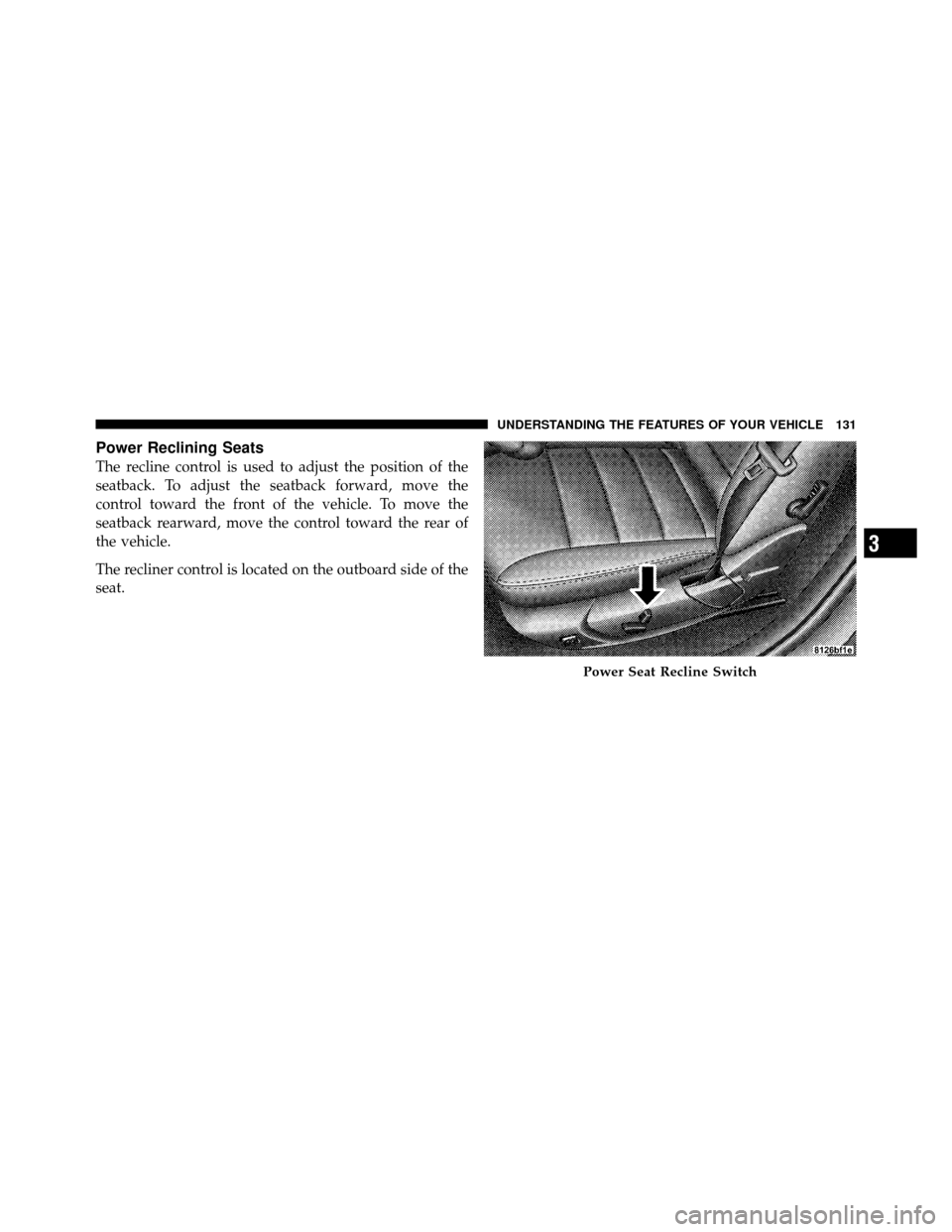
Power Reclining Seats
The recline control is used to adjust the position of the
seatback. To adjust the seatback forward, move the
control toward the front of the vehicle. To move the
seatback rearward, move the control toward the rear of
the vehicle.
The recliner control is located on the outboard side of the
seat.
Power Seat Recline Switch
3
UNDERSTANDING THE FEATURES OF YOUR VEHICLE 131
Page 135 of 538
To install the head restraint, insert the head restraint rods
into each guide, apply pressure down on the headrest
until the head restraint reaches the first lock position,
push the large button in and push down and adjust head
restraint to desired position.
NOTE:Ensure that the front of the head restraint is
facing toward the front of the vehicle.
WARNING!
Driving a vehicle with the head restraints removed or
improperly adjusted could cause serious injury or
death in the event of a collision. The head restraints
should always be checked prior to operating the
vehicle and never adjusted while the vehicle is in
motion. Always adjust the head restraints when the
vehicle is in PARK.
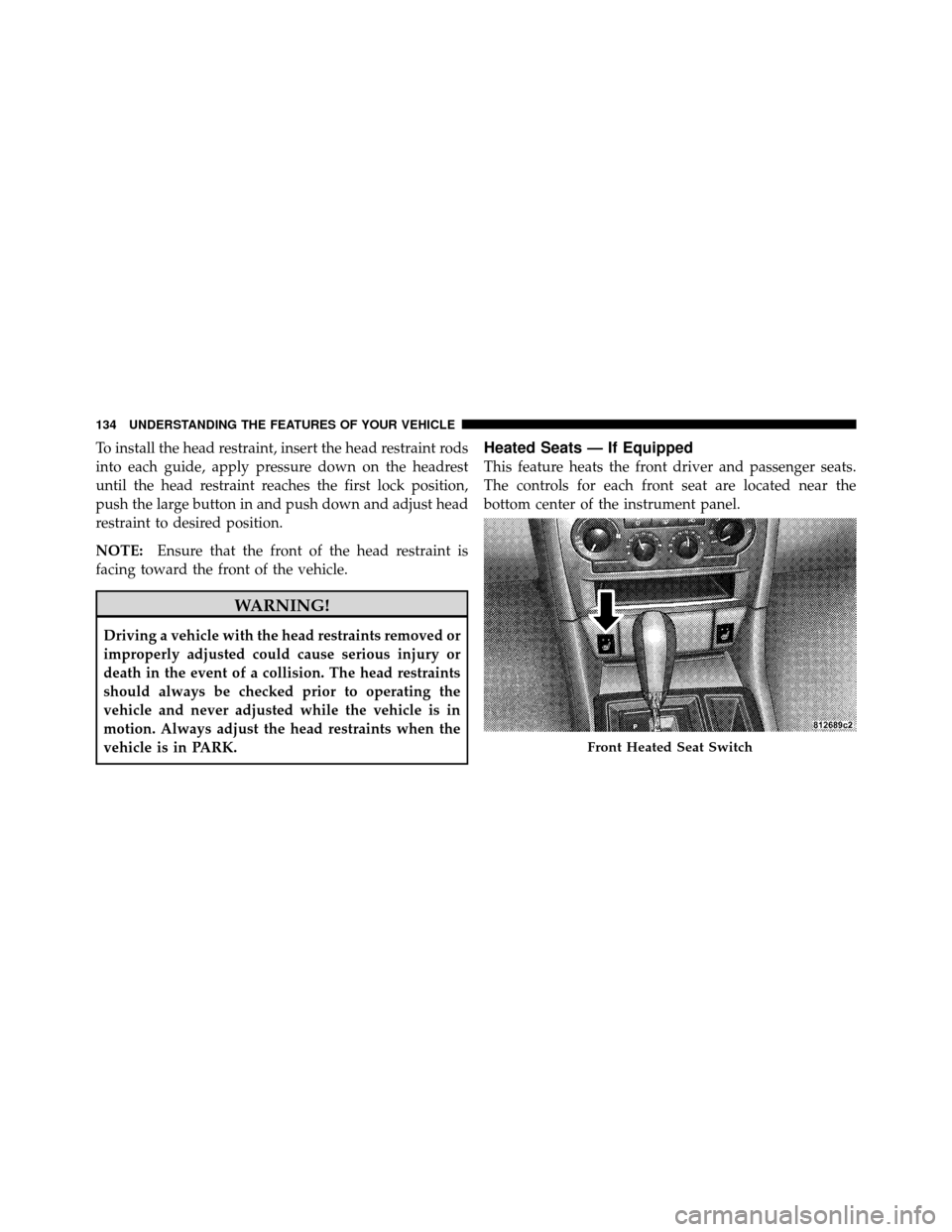
Heated Seats — If Equipped
This feature heats the front driver and passenger seats.
The controls for each front seat are located near the
bottom center of the instrument panel.
Front Heated Seat Switch
134 UNDERSTANDING THE FEATURES OF YOUR VEHICLE
Page 136 of 538
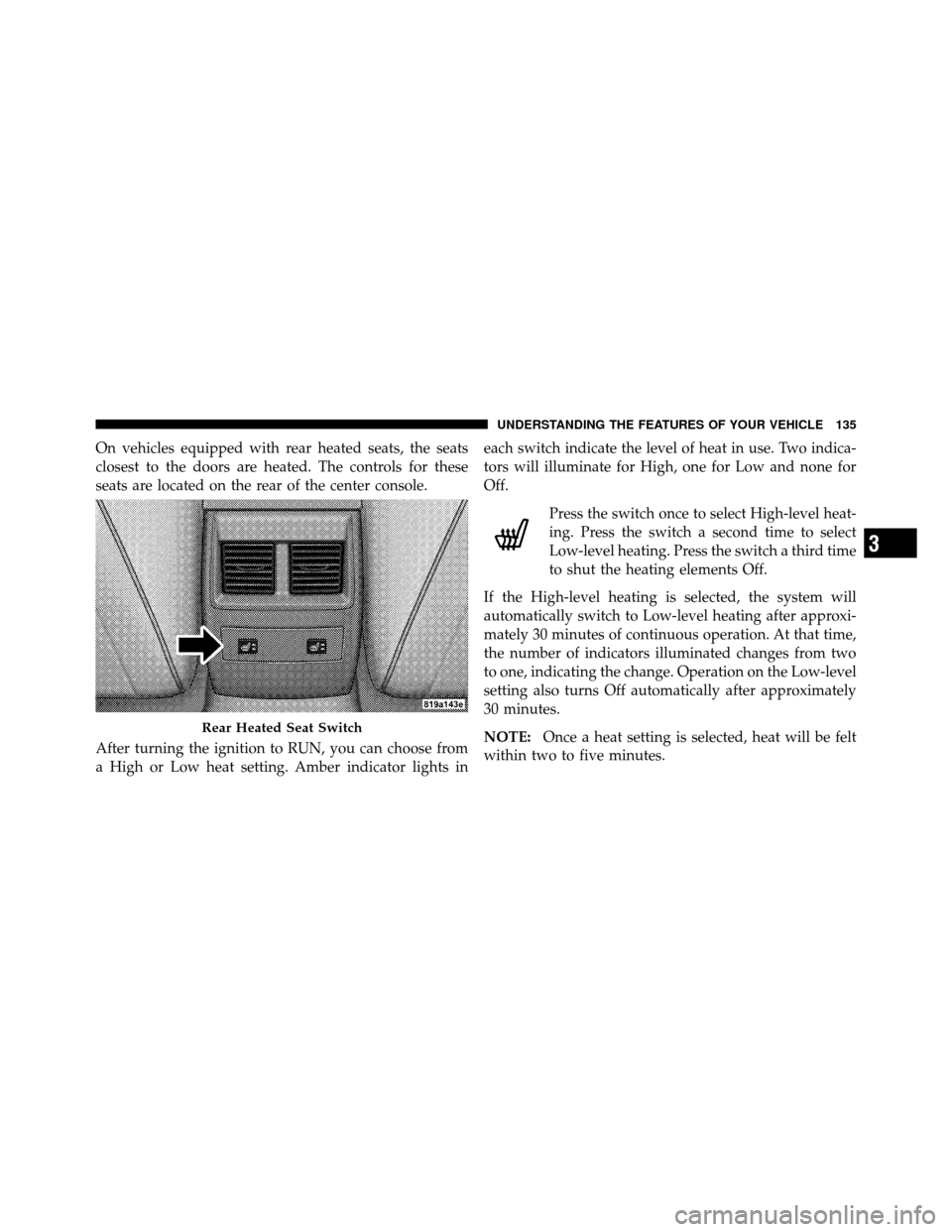
On vehicles equipped with rear heated seats, the seats
closest to the doors are heated. The controls for these
seats are located on the rear of the center console.
After turning the ignition to RUN, you can choose from
a High or Low heat setting. Amber indicator lights ineach switch indicate the level of heat in use. Two indica-
tors will illuminate for High, one for Low and none for
Off.
Press the switch once to select High-level heat-
ing. Press the switch a second time to select
Low-level heating. Press the switch a third time
to shut the heating elements Off.
If the High-level heating is selected, the system will
automatically switch to Low-level heating after approxi-
mately 30 minutes of continuous operation. At that time,
the number of indicators illuminated changes from two
to one, indicating the change. Operation on the Low-level
setting also turns Off automatically after approximately
30 minutes.
NOTE: Once a heat setting is selected, heat will be felt
within two to five minutes.
Rear Heated Seat Switch
3
UNDERSTANDING THE FEATURES OF YOUR VEHICLE 135