Page 285 of 432

A. Windshield Washer Fluid Reservoir. See “Adding
Washer Fluid” underWindshield Washer Fluid
on page 6-33.
B. Battery. SeeBattery on page 6-38.
C. Underhood Fuse Block. SeeUnderhood Fuse Block
on page 6-97.
D. Remote Positive (+) Terminal. SeeJump Starting on
page 6-39.
E. Coolant Recovery Tank. See “Checking Coolant”
underCooling System on page 6-24.
F. Pressure Cap. SeeCooling System on page 6-24.
G. Power Steering Fluid Cap. SeePower Steering Fluid
on page 6-32.
H. Engine Oil Fill Cap. See “When to Add Engine Oil”
underEngine Oil on page 6-15.
I. Engine Oil Dipstick. See “Checking Engine Oil”
underEngine Oil on page 6-15.
J. Automatic Transmission Fluid Dipstick (Out of View).
See “Checking the Fluid Level” underAutomatic
Transmission Fluid on page 6-22.
K. Brake Master Cylinder Reservoir. See “Brake Fluid”
underBrakes on page 6-35.
L. Engine Air Cleaner/Filter. SeeEngine Air
Cleaner/Filter on page 6-19.
Engine OilChecking Engine OilIt is a good idea to check the engine oil level at each
fuel fill. In order to get an accurate reading, the oil must
be warm and the vehicle must be on level ground.
The engine oil dipstick handle is a yellow loop.
SeeEngine Compartment Overview on page 6-14
for the location of the engine oil dipstick.
1. Turn off the engine and give the oil several minutes
to drain back into the oil pan. If this is not done, the
oil dipstick might not show the actual level.
2. Pull out the dipstick and clean it with a paper towel
or cloth, then push it back in all the way. Remove it
again, keeping the tip down, and check the level.
6-15
Page 289 of 432
How to Reset the Engine Oil Life
SystemThe Engine Oil Life System calculates when to change
the engine oil and filter based on vehicle use. Whenever
the oil is changed, reset the system so it can calculate
when the next oil change is required. If a situation occurs
where the oil is changed prior to a CHANGE ENGINE OIL
SOON message being turned on, reset the system.
Always reset the engine oil life to 100% after every oil
change. It will not reset itself. To reset the Engine
Oil Life System:
1. Display the OIL LIFE REMAINING on the DIC.
2. Press and hold the SET/RESET button on the DIC
for more than five seconds. The oil life will change
to 100%.
If the CHANGE ENGINE OIL SOON message comes
back on when the vehicle is started, the Engine Oil Life
System has not reset. Repeat the procedure.
What to Do with Used OilUsed engine oil contains certain elements that can be
unhealthy for your skin and could even cause cancer.
Do not let used oil stay on your skin for very long. Clean
your skin and nails with soap and water, or a good
hand cleaner. Wash or properly dispose of clothing or
rags containing used engine oil. See the manufacturer’s
warnings about the use and disposal of oil products.
Used oil can be a threat to the environment. If you
change your own oil, be sure to drain all the oil from the
filter before disposal. Never dispose of oil by putting it
in the trash, pouring it on the ground, into sewers, or into
streams or bodies of water. Recycle it by taking it to a
place that collects used oil.Engine Air Cleaner/FilterThe engine air cleaner/filter is located in the engine
compartment on the driver’s side of the vehicle.
SeeEngine Compartment Overview on page 6-14for
more information on location.
6-19
Page 290 of 432
When to Inspect the Engine Air
Cleaner/FilterInspect the air cleaner/filter at the MaintenanceII
intervals and replace it at the first oil change after each
50,000 mile (80 000 km) interval. SeeScheduled
Maintenance on page 7-3for more information. If you
are driving in dusty/dirty conditions, inspect the filter
at each engine oil change.How to Inspect the Engine Air
Cleaner/FilterTo inspect the air cleaner/filter, remove the filter from
the vehicle and lightly shake the filter to release
loose dust and dirt. If the filter remains caked with dirt, a
new filter is required.To inspect or replace the engine air cleaner/filter do the
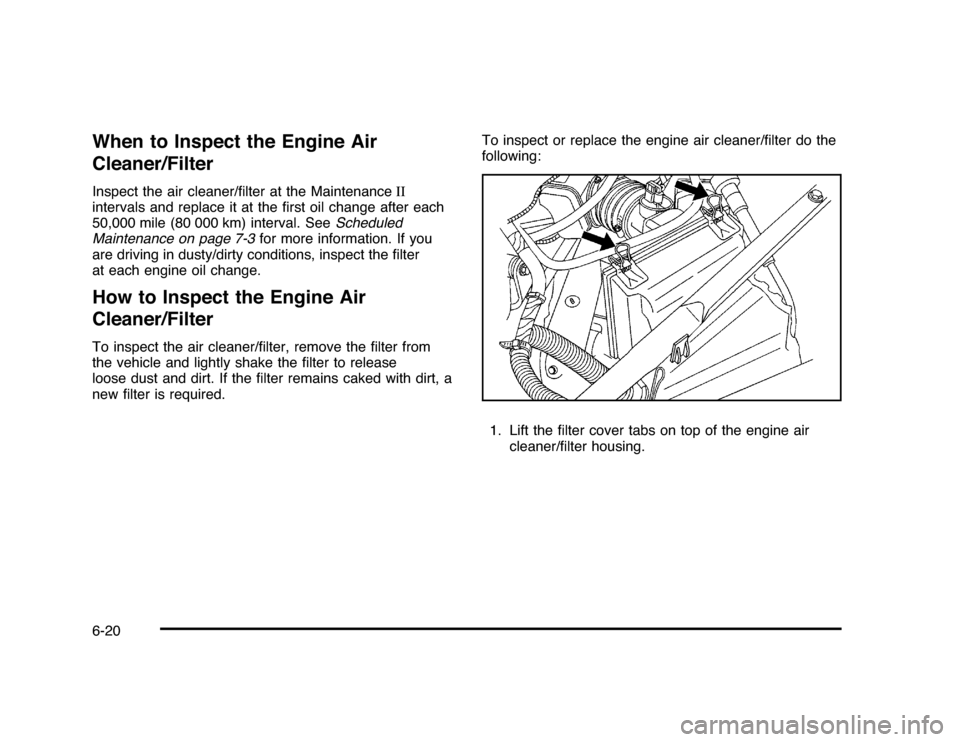
following:
1. Lift the filter cover tabs on top of the engine air
cleaner/filter housing.6-20
Page 370 of 432

Capacities and SpecificationsThe following approximate capacities are given in Metric and English conversions. SeeRecommended Fluids and
Lubricants on page 7-10for more information.
ApplicationCapacities
Metric English
Air Conditioning Refrigerant R134aFor the air conditioning system refrigerant charge
amount, see the refrigerant caution label located
under the hood. See your dealer/retailer for more
information.
Automatic Transmission (Bottom Pan Removal) 7.0 L 7.4 qt
Cooling System Including Reservoir
3.5L V6, 3.5L and 3.9L V6 Flexible Fuel Engines 9.6 L 10.1 qt
Engine Oil with Filter
3.5L V6, 3.5L and 3.9L V6 Flexible Fuel Engines 3.8 L 4.0 qt
Fuel Tank
3.5L V6 Engine (with NU6 emissions) 64.4 L 17.0 gal
3.5L V6 Engine (without NU6 emissions) 66.2 L 17.5 gal
3.9L V6 Engine 66.2 L 17.5 gal
Wheel Nut Torque 140Y100 lb ft
All capacities are approximate. When adding, be sure to fill to the approximate level, as recommended in this
manual. Recheck fluid level after filling.
6-100
Page 376 of 432

MaintenanceI•
Change engine oil and filter. SeeEngine Oil on
page 6-15.An Emission Control Service.
•
Engine coolant level check. SeeEngine Coolant on
page 6-25.
•
Windshield washer fluid level check. SeeWindshield
Washer Fluid on page 6-33.
•
Tire inflation check. SeeInflation - Tire Pressure on
page 6-59.
•
Tire wear inspection. SeeTire Inspection and
Rotation on page 6-65.
•
Rotate tires. SeeTire Inspection and Rotation on
page 6-65.
•
Fluids visual leak check (or every 12 months,
whichever occurs first). A leak in any system must
be repaired and the fluid level checked.
•
Engine air cleaner filter inspection (vehicles driven
in dusty conditions only). SeeEngine Air
Cleaner/Filter on page 6-19.
•
Brake system inspection (or every 12 months,
whichever occurs first).
MaintenanceII•
Perform all services described in MaintenanceI.
•
Steering and suspension inspection. Visual
inspection for damaged, loose, or missing parts or
signs of wear.
•
Engine cooling system inspection. Visual inspection
of hoses, pipes, fittings, and clamps and
replacement, if needed.
•
Windshield wiper blade inspection for wear,
cracking, or contamination and windshield and wiper
blade cleaning, if contaminated. SeeWindshield
and Wiper Blades on page 6-92. Worn or damaged
wiper blade replacement. SeeWindshield Wiper
Blade Replacement on page 6-49.
•
Body hinges and latches, key lock cylinders, folding
seat hardware, and rear compartment hinges
lubrication. SeeRecommended Fluids and
Lubricants on page 7-10. More frequent lubrication
may be required when vehicle is exposed to a
corrosive environment. Applying silicone grease on
weatherstrips with a clean cloth makes them last
longer, seal better, and not stick or squeak.
•
Restraint system component check. SeeChecking
the Restraint Systems on page 2-74.
7-4