2010 CHEVROLET IMPALA tow
[x] Cancel search: towPage 378 of 432

First Engine Oil Change After Every
40 000 km/25,000 Miles
•
Fuel system inspection for damage or leaks.
First Engine Oil Change After Every
80 000 km/50,000 Miles
•
Engine air cleaner filter replacement. SeeEngine
Air Cleaner/Filter on page 6-19.
•
Automatic transmission fluid change (severe
service) for vehicles mainly driven in heavy
city traffic in hot weather, in hilly or mountainous
terrain, when frequently towing a trailer, or used for
taxi, police, or delivery service. SeeAutomatic
Transmission Fluid on page 6-22.
First Engine Oil Change After Every
160 000 km/100,000 Miles
•
Automatic transmission fluid change (normal
service). SeeAutomatic Transmission Fluid
on page 6-22.
•
Spark plug replacement and spark plug wires
inspection.An Emission Control Service.
First Engine Oil Change After Every
240 000 km/150,000 Miles
•
Engine cooling system drain, flush, and refill,
cooling system and cap pressure check, and
cleaning of outside of radiator and air conditioning
condenser (or every 5 years, whichever occurs
first). SeeEngine Coolant on page 6-25.
An Emission Control Service.
•
Engine accessory drive belt inspection for fraying,
excessive cracks, or obvious damage and
replacement, if needed.An Emission Control
Service.
7-6
Page 397 of 432
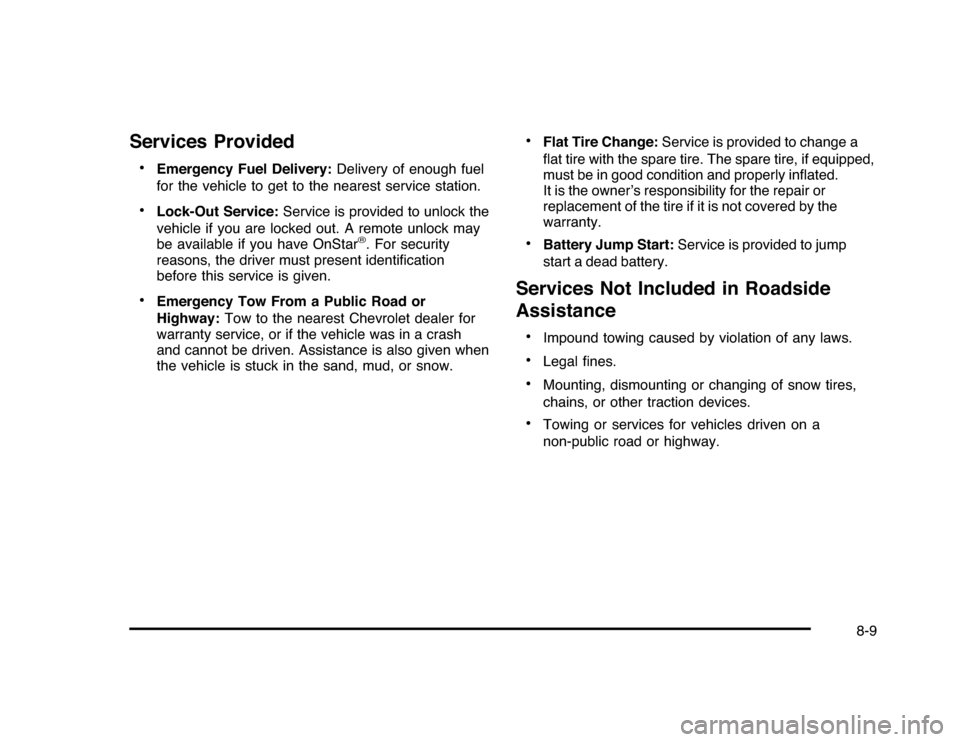
Services Provided•
Emergency Fuel Delivery:Delivery of enough fuel
for the vehicle to get to the nearest service station.
•
Lock-Out Service:Service is provided to unlock the
vehicle if you are locked out. A remote unlock may
be available if you have OnStar
®. For security
reasons, the driver must present identification
before this service is given.
•
Emergency Tow From a Public Road or
Highway:Tow to the nearest Chevrolet dealer for
warranty service, or if the vehicle was in a crash
and cannot be driven. Assistance is also given when
the vehicle is stuck in the sand, mud, or snow.
•
Flat Tire Change:Service is provided to change a
flat tire with the spare tire. The spare tire, if equipped,
must be in good condition and properly inflated.
It is the owner’s responsibility for the repair or
replacement of the tire if it is not covered by the
warranty.
•
Battery Jump Start:Service is provided to jump
start a dead battery.
Services Not Included in Roadside
Assistance•
Impound towing caused by violation of any laws.
•
Legal fines.
•
Mounting, dismounting or changing of snow tires,
chains, or other traction devices.
•
Towing or services for vehicles driven on a
non-public road or highway.
8-9
Page 402 of 432
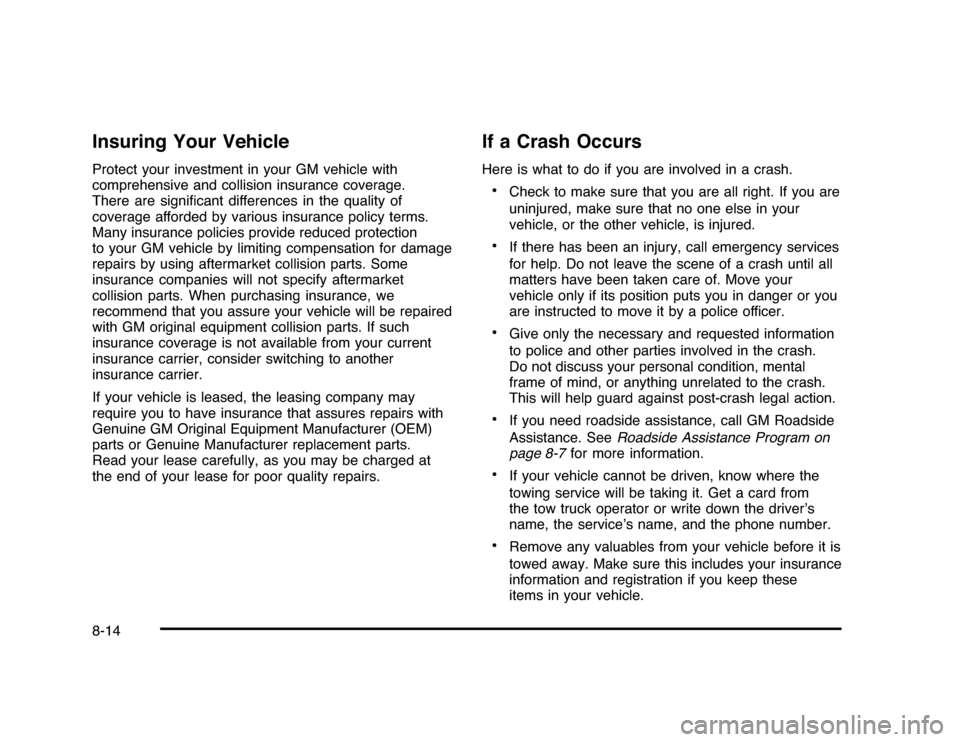
Insuring Your VehicleProtect your investment in your GM vehicle with
comprehensive and collision insurance coverage.
There are significant differences in the quality of
coverage afforded by various insurance policy terms.
Many insurance policies provide reduced protection
to your GM vehicle by limiting compensation for damage
repairs by using aftermarket collision parts. Some
insurance companies will not specify aftermarket
collision parts. When purchasing insurance, we
recommend that you assure your vehicle will be repaired
with GM original equipment collision parts. If such
insurance coverage is not available from your current
insurance carrier, consider switching to another
insurance carrier.
If your vehicle is leased, the leasing company may
require you to have insurance that assures repairs with
Genuine GM Original Equipment Manufacturer (OEM)
parts or Genuine Manufacturer replacement parts.
Read your lease carefully, as you may be charged at
the end of your lease for poor quality repairs.
If a Crash OccursHere is what to do if you are involved in a crash.•
Check to make sure that you are all right. If you are
uninjured, make sure that no one else in your
vehicle, or the other vehicle, is injured.
•
If there has been an injury, call emergency services
for help. Do not leave the scene of a crash until all
matters have been taken care of. Move your
vehicle only if its position puts you in danger or you
are instructed to move it by a police officer.
•
Give only the necessary and requested information
to police and other parties involved in the crash.
Do not discuss your personal condition, mental
frame of mind, or anything unrelated to the crash.
This will help guard against post-crash legal action.
•
If you need roadside assistance, call GM Roadside
Assistance. SeeRoadside Assistance Program on
page 8-7for more information.
•
If your vehicle cannot be driven, know where the
towing service will be taking it. Get a card from
the tow truck operator or write down the driver’s
name, the service’s name, and the phone number.
•
Remove any valuables from your vehicle before it is
towed away. Make sure this includes your insurance
information and registration if you keep these
items in your vehicle.
8-14
Page 403 of 432
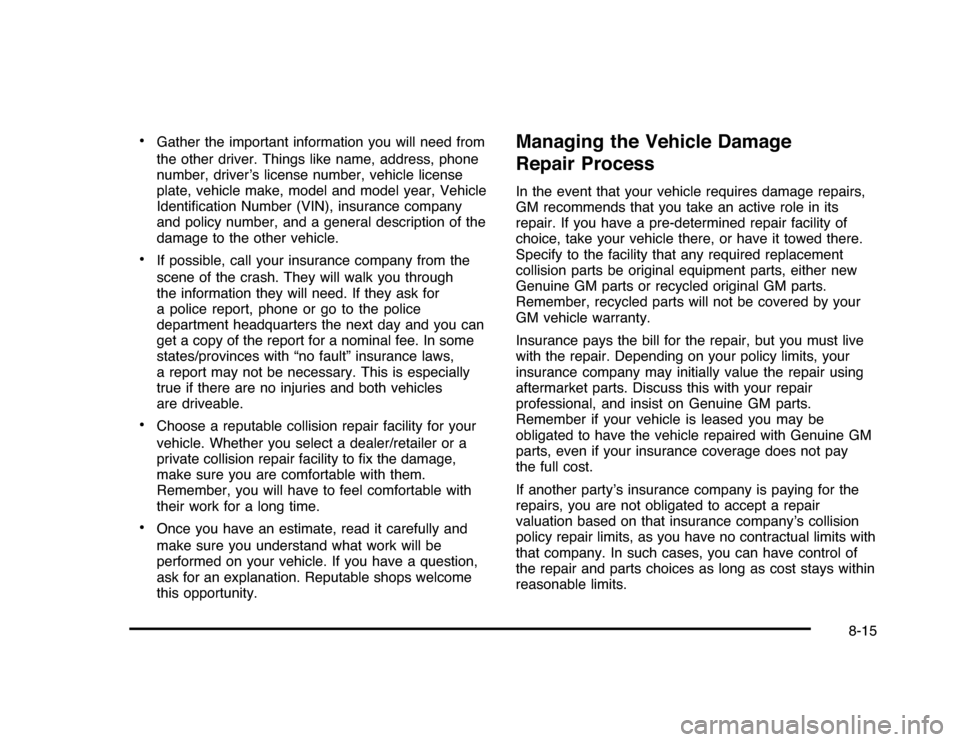
•
Gather the important information you will need from
the other driver. Things like name, address, phone
number, driver’s license number, vehicle license
plate, vehicle make, model and model year, Vehicle
Identification Number (VIN), insurance company
and policy number, and a general description of the
damage to the other vehicle.
•
If possible, call your insurance company from the
scene of the crash. They will walk you through
the information they will need. If they ask for
a police report, phone or go to the police
department headquarters the next day and you can
get a copy of the report for a nominal fee. In some
states/provinces with “no fault” insurance laws,
a report may not be necessary. This is especially
true if there are no injuries and both vehicles
are driveable.
•
Choose a reputable collision repair facility for your
vehicle. Whether you select a dealer/retailer or a
private collision repair facility to fix the damage,
make sure you are comfortable with them.
Remember, you will have to feel comfortable with
their work for a long time.
•
Once you have an estimate, read it carefully and
make sure you understand what work will be
performed on your vehicle. If you have a question,
ask for an explanation. Reputable shops welcome
this opportunity.
Managing the Vehicle Damage
Repair ProcessIn the event that your vehicle requires damage repairs,
GM recommends that you take an active role in its
repair. If you have a pre-determined repair facility of
choice, take your vehicle there, or have it towed there.
Specify to the facility that any required replacement
collision parts be original equipment parts, either new
Genuine GM parts or recycled original GM parts.
Remember, recycled parts will not be covered by your
GM vehicle warranty.
Insurance pays the bill for the repair, but you must live
with the repair. Depending on your policy limits, your
insurance company may initially value the repair using
aftermarket parts. Discuss this with your repair
professional, and insist on Genuine GM parts.
Remember if your vehicle is leased you may be
obligated to have the vehicle repaired with Genuine GM
parts, even if your insurance coverage does not pay
the full cost.
If another party’s insurance company is paying for the
repairs, you are not obligated to accept a repair
valuation based on that insurance company’s collision
policy repair limits, as you have no contractual limits with
that company. In such cases, you can have control of
the repair and parts choices as long as cost stays within
reasonable limits.
8-15
Page 418 of 432
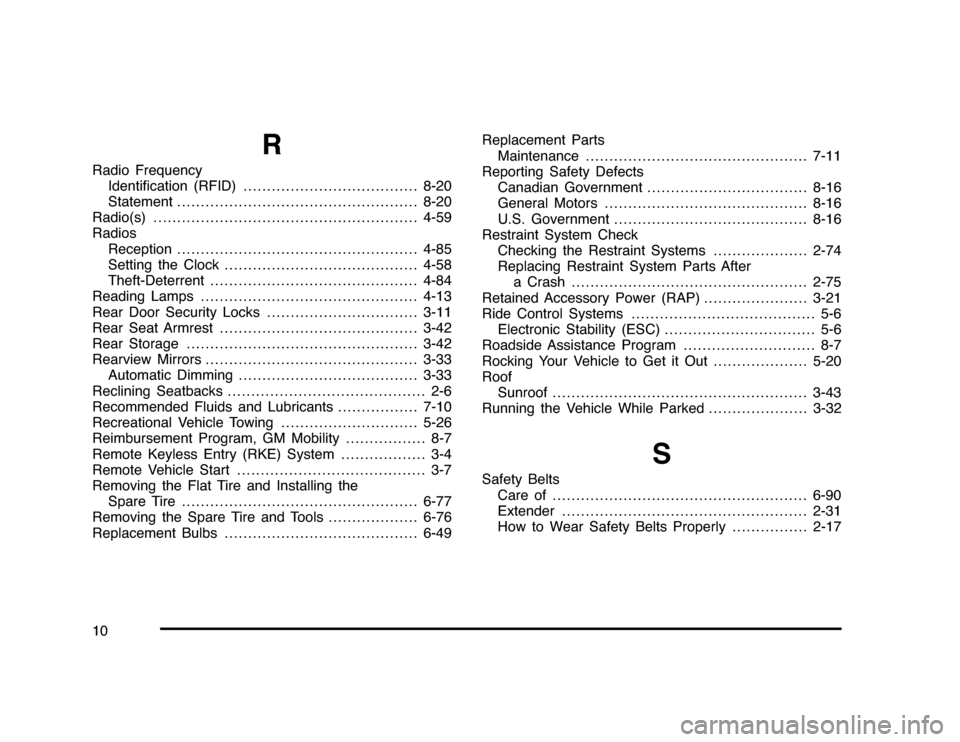
R
Radio Frequency
Identification (RFID).....................................8-20
Statement . . . . . . . ............................................8-20
Radio(s) . . . . . . . . . . . . . . ..........................................4-59
Radios
Reception . . . . . . . ............................................4-85
Setting the Clock.........................................4-58
Theft-Deterrent............................................4-84
Reading Lamps . . ............................................4-13
Rear Door Security Locks................................3-11
Rear Seat Armrest..........................................3-42
Rear Storage . . . . . . ...........................................3-42
Rearview Mirrors.............................................3-33
Automatic Dimming......................................3-33
Reclining Seatbacks.......................................... 2-6
Recommended Fluids and Lubricants.................7-10
Recreational Vehicle Towing . . ...........................5-26
Reimbursement Program, GM Mobility................. 8-7
Remote Keyless Entry (RKE) System.................. 3-4
Remote Vehicle Start........................................ 3-7
Removing the Flat Tire and Installing the
Spare Tire . . . . . . . ...........................................6-77
Removing the Spare Tire and Tools...................6-76
Replacement Bulbs.........................................6-49Replacement Parts
Maintenance...............................................7-11
Reporting Safety Defects
Canadian Government..................................8-16
General Motors...........................................8-16
U.S. Government.........................................8-16
Restraint System Check
Checking the Restraint Systems....................2-74
Replacing Restraint System Parts After
a Crash..................................................2-75
Retained Accessory Power (RAP) . . ....................3-21
Ride Control Systems....................................... 5-6
Electronic Stability (ESC)................................ 5-6
Roadside Assistance Program............................ 8-7
Rocking Your Vehicle to Get it Out....................5-20
Roof
Sunroof......................................................3-43
Running the Vehicle While Parked
.....................3-32
S
Safety Belts
Care of......................................................6-90
Extender....................................................2-31
How to Wear Safety Belts Properly................2-17
10
Page 421 of 432
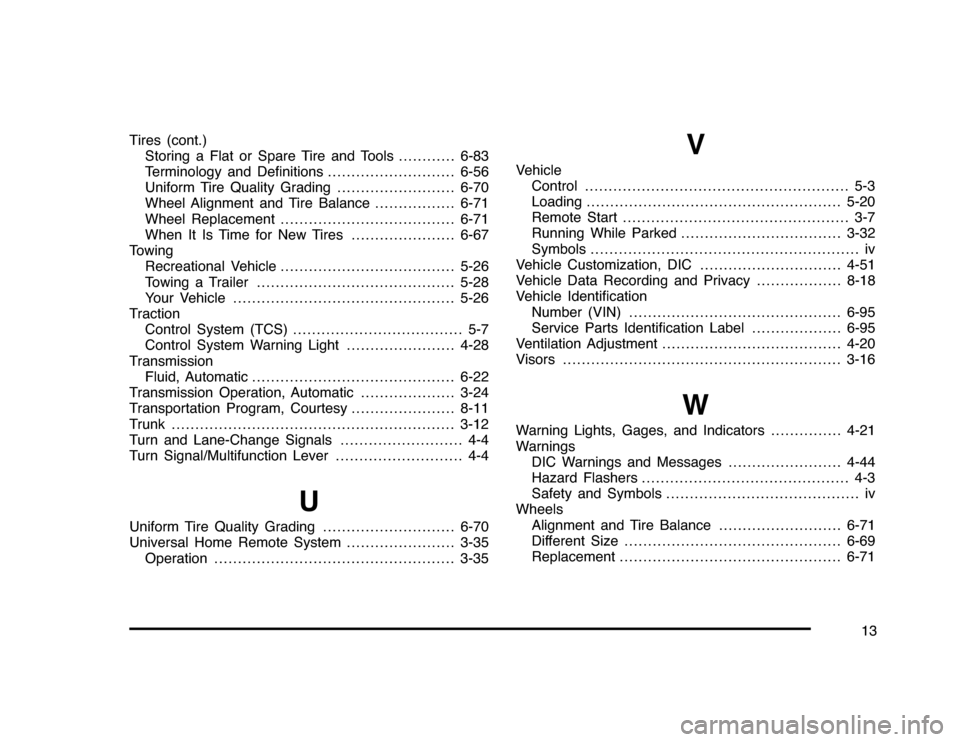
Tires (cont.)
Storing a Flat or Spare Tire and Tools............6-83
Terminology and Definitions...........................6-56
Uniform Tire Quality Grading.........................6-70
Wheel Alignment and Tire Balance.................6-71
Wheel Replacement.....................................6-71
When It Is Time for New Tires......................6-67
Towing
Recreational Vehicle.....................................5-26
Towing a Trailer..........................................5-28
Your Vehicle...............................................5-26
Traction
Control System (TCS).................................... 5-7
Control System Warning Light .......................4-28
Transmission
Fluid, Automatic...........................................6-22
Transmission Operation, Automatic . . ..................3-24
Transportation Program, Courtesy......................8-11
Trunk............................................................3-12
Turn and Lane-Change Signals.......................... 4-4
Turn Signal/Multifunction Lever........................... 4-4
U
Uniform Tire Quality Grading............................6-70
Universal Home Remote System .......................3-35
Operation ...................................................3-35
V
Vehicle
Control........................................................ 5-3
Loading......................................................5-20
Remote Start................................................ 3-7
Running While Parked..................................3-32
Symbols......................................................... iv
Vehicle Customization, DIC..............................4-51
Vehicle Data Recording and Privacy . . . ...............8-18
Vehicle Identification
Number (VIN).............................................6-95
Service Parts Identification Label . . .................6-95
Ventilation Adjustment......................................4-20
Visors...........................................................3-16
W
Warning Lights, Gages, and Indicators...............4-21
Warnings
DIC Warnings and Messages........................4-44
Hazard Flashers............................................ 4-3
Safety and Symbols......................................... iv
Wheels
Alignment and Tire Balance..........................6-71
Different Size..............................................6-69
Replacement...............................................6-71
13