Page 34 of 480
Head Restraints
The front seats have adjustable head restraints in the
outboard seating positions.
{WARNING:
With head restraints that are not installed and
adjusted properly, there is a greater chance that
occupants will suffer a neck/spinal injury in a
crash. Do not drive until the head restraints for all
occupants are installed and adjusted properly.
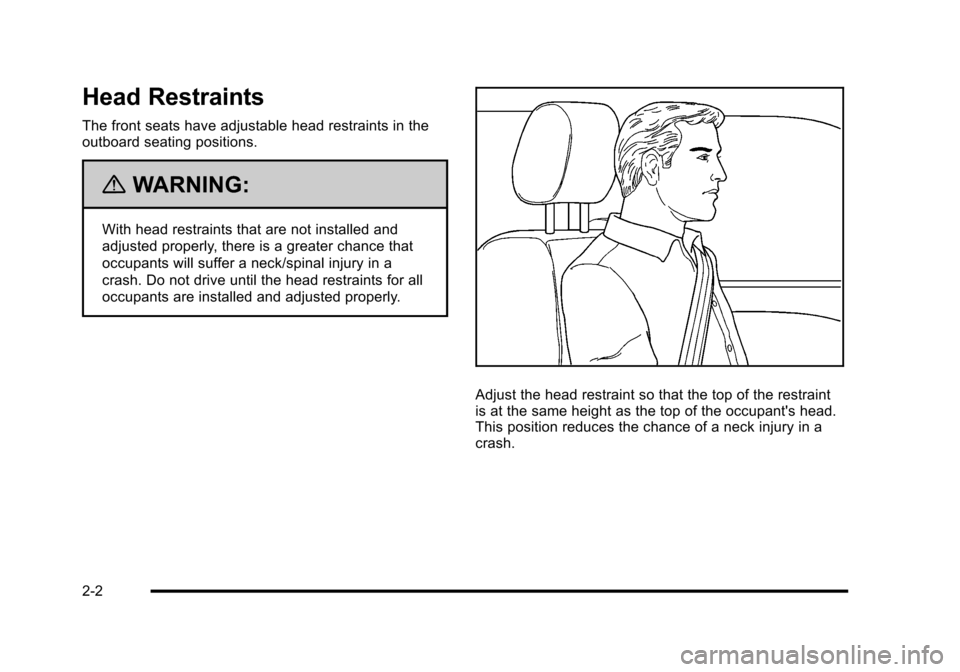
Adjust the head restraint so that the top of the restraint
is at the same height as the top of the occupant's head.
This position reduces the chance of a neck injury in a
crash.
2-2
Page 36 of 480
Front Seats
Manual Seats
{WARNING:
You can lose control of the vehicle if you try to
adjust a manual driver's seat while the vehicle is
moving. The sudden movement could startle and
confuse you, or make you push a pedal when you
do not want to. Adjust the driver's seat only when
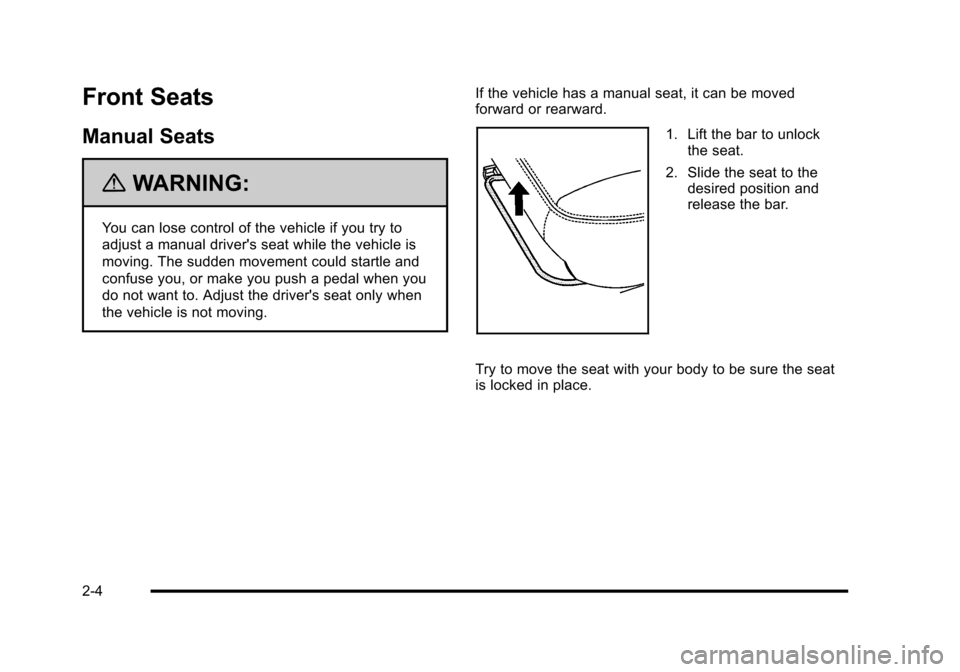
the vehicle is not moving.If the vehicle has a manual seat, it can be moved
forward or rearward.
1. Lift the bar to unlock
the seat.
2. Slide the seat to the desired position and
release the bar.
Try to move the seat with your body to be sure the seat
is locked in place.
2-4
Page 39 of 480
Reclining Seatbacks
{WARNING:
You can lose control of the vehicle if you try to
adjust a manual driver's seat while the vehicle is
moving. The sudden movement could startle and
confuse you, or make you push a pedal when you
do not want to. Adjust the driver's seat only when
the vehicle is not moving.
{WARNING:
If either seatback is not locked, it could move
forward in a sudden stop or crash. That could
cause injury to the person sitting there. Always
push and pull on the seatbacks to be sure they
are locked.
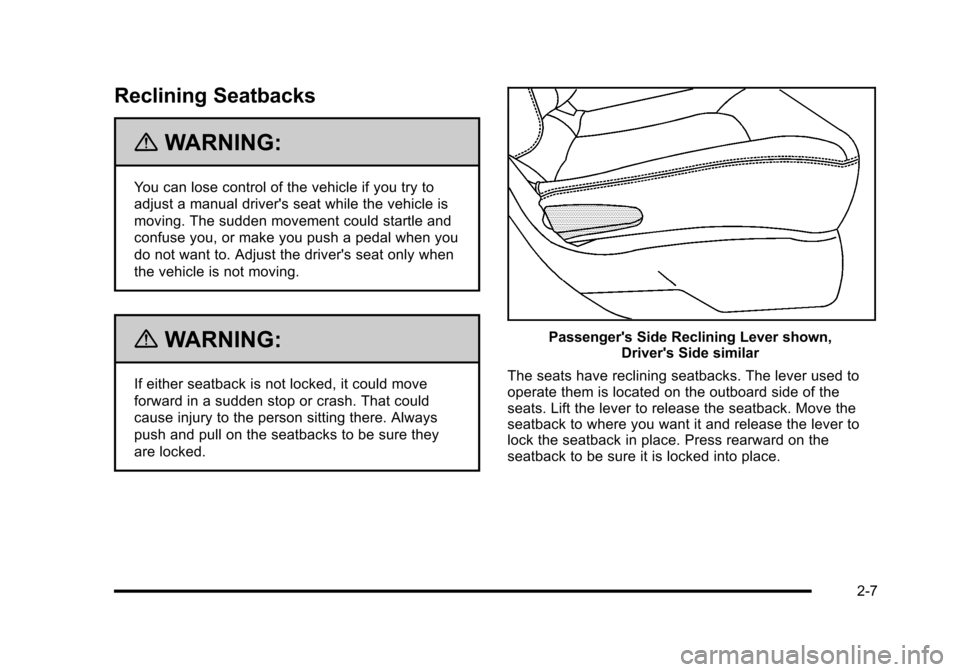
Passenger's Side Reclining Lever shown,Driver's Side similar
The seats have reclining seatbacks. The lever used to
operate them is located on the outboard side of the
seats. Lift the lever to release the seatback. Move the
seatback to where you want it and release the lever to
lock the seatback in place. Press rearward on the
seatback to be sure it is locked into place.
2-7
Page 40 of 480
{WARNING:
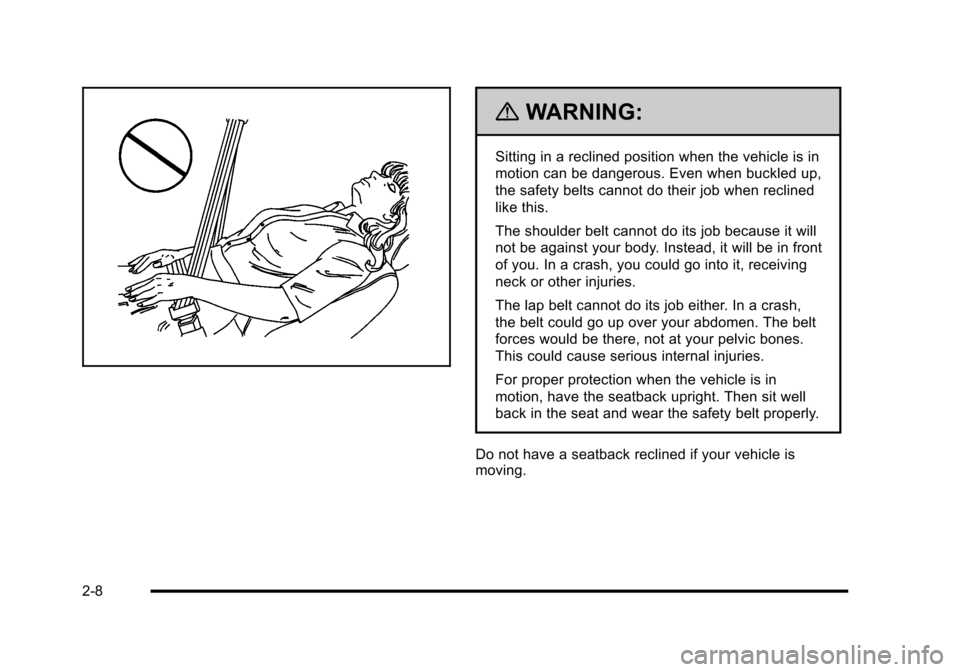
Sitting in a reclined position when the vehicle is in
motion can be dangerous. Even when buckled up,
the safety belts cannot do their job when reclined
like this.
The shoulder belt cannot do its job because it will
not be against your body. Instead, it will be in front
of you. In a crash, you could go into it, receiving
neck or other injuries.
The lap belt cannot do its job either. In a crash,
the belt could go up over your abdomen. The belt
forces would be there, not at your pelvic bones.
This could cause serious internal injuries.
For proper protection when the vehicle is in
motion, have the seatback upright. Then sit well
back in the seat and wear the safety belt properly.
Do not have a seatback reclined if your vehicle is
moving.
2-8
Page 41 of 480
Passenger Folding Seatback
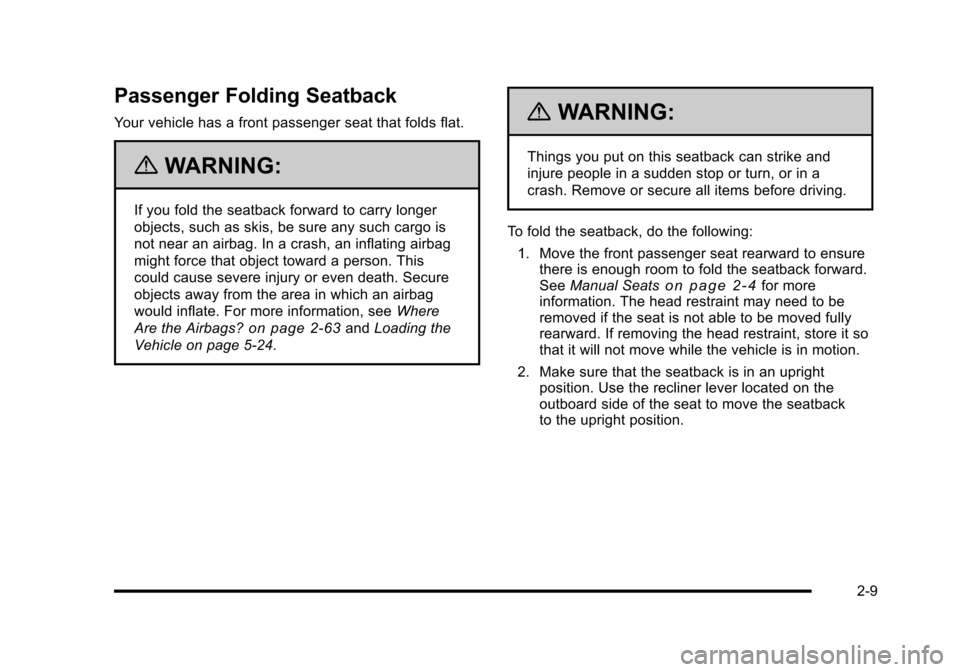
Your vehicle has a front passenger seat that folds flat.
{WARNING:
If you fold the seatback forward to carry longer
objects, such as skis, be sure any such cargo is
not near an airbag. In a crash, an inflating airbag
might force that object toward a person. This
could cause severe injury or even death. Secure
objects away from the area in which an airbag
would inflate. For more information, seeWhere
Are the Airbags?
on page 2‑63and Loading the
Vehicle on page 5‑24.
{WARNING:
Things you put on this seatback can strike and
injure people in a sudden stop or turn, or in a
crash. Remove or secure all items before driving.
To fold the seatback, do the following: 1. Move the front passenger seat rearward to ensure there is enough room to fold the seatback forward.
See Manual Seats
on page 2‑4for more
information. The head restraint may need to be
removed if the seat is not able to be moved fully
rearward. If removing the head restraint, store it so
that it will not move while the vehicle is in motion.
2. Make sure that the seatback is in an upright position. Use the recliner lever located on the
outboard side of the seat to move the seatback
to the upright position.
2-9
Page 42 of 480
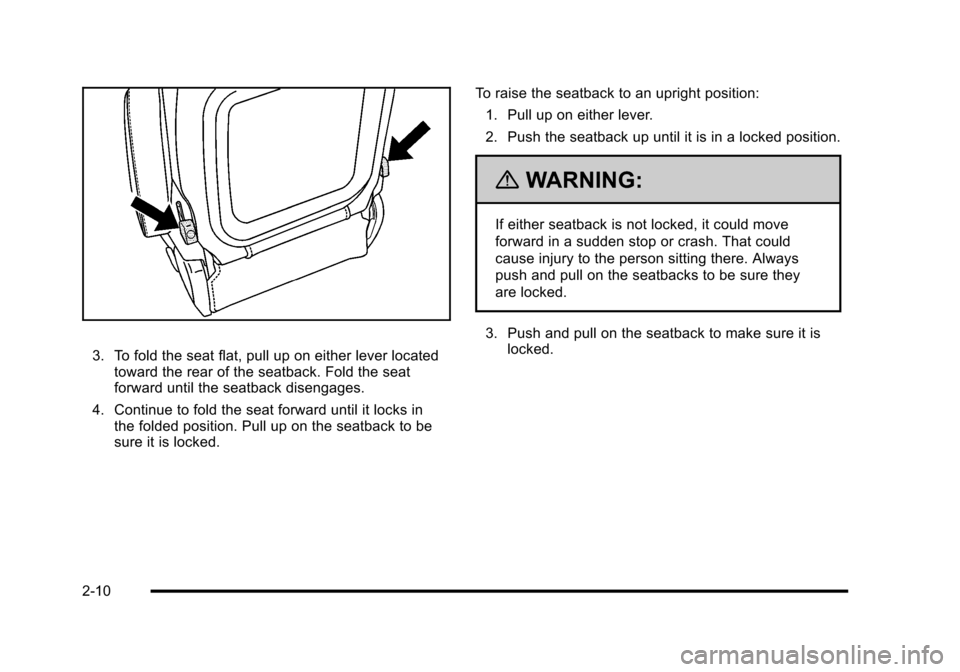
3. To fold the seat flat, pull up on either lever locatedtoward the rear of the seatback. Fold the seat
forward until the seatback disengages.
4. Continue to fold the seat forward until it locks in the folded position. Pull up on the seatback to be
sure it is locked. To raise the seatback to an upright position:
1. Pull up on either lever.
2. Push the seatback up until it is in a locked position.
{WARNING:
If either seatback is not locked, it could move
forward in a sudden stop or crash. That could
cause injury to the person sitting there. Always
push and pull on the seatbacks to be sure they
are locked.
3. Push and pull on the seatback to make sure it is locked.
2-10
Page 45 of 480
To raise the rear seatback(s):
{WARNING:
A safety belt that is improperly routed, not
properly attached, or twisted will not provide the
protection needed in a crash. The person wearing
the belt could be seriously injured. After raising
the rear seatback, always check to be sure that
the safety belts are properly routed and attached,
and are not twisted.
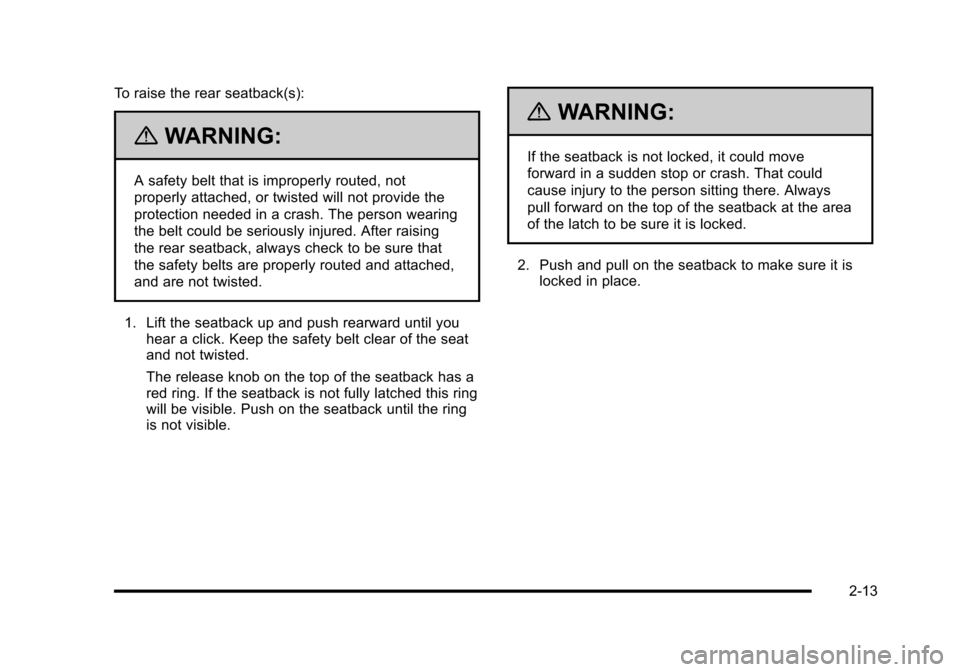
1. Lift the seatback up and push rearward until you hear a click. Keep the safety belt clear of the seat
and not twisted.
The release knob on the top of the seatback has a
red ring. If the seatback is not fully latched this ring
will be visible. Push on the seatback until the ring
is not visible.
{WARNING:
If the seatback is not locked, it could move
forward in a sudden stop or crash. That could
cause injury to the person sitting there. Always
pull forward on the top of the seatback at the area
of the latch to be sure it is locked.
2. Push and pull on the seatback to make sure it is locked in place.
2-13
Page 46 of 480
Safety Belts
Safety Belts: They Are for Everyone
This section of the manual describes how to use safety
belts properly. It also describes some things not to do
with safety belts.
{WARNING:
Do not let anyone ride where a safety belt cannot
be worn properly. In a crash, if you or your
passenger(s) are not wearing safety belts, the
injuries can be much worse. You can hit things
inside the vehicle harder or be ejected from the
vehicle. You and your passenger(s) can be
seriously injured or killed. In the same crash, you
might not be, if you are buckled up. Always fasten
your safety belt, and check that your passenger(s)
are restrained properly too.
{WARNING:
It is extremely dangerous to ride in a cargo area,
inside or outside of a vehicle. In a collision,
people riding in these areas are more likely to
be seriously injured or killed. Do not allow people
to ride in any area of your vehicle that is not
equipped with seats and safety belts. Be sure
everyone in your vehicle is in a seat and using a
safety belt properly.
This vehicle has indicators as a reminder to buckle the
safety belts. See Safety Belt Reminders
on page 4‑26for additional information.
In most states and in all Canadian provinces, the law
requires wearing safety belts. Here is why:
You never know if you will be in a crash. If you do have
a crash, you do not know if it will be a serious one.
2-14