2010 CHEVROLET HHR wheel size
[x] Cancel search: wheel sizePage 109 of 480

Adding Equipment to Your
Airbag-Equipped Vehicle
Q: Is there anything I might add to or change aboutthe vehicle that could keep the airbags from
working properly?
A: Yes. If you add things that change the vehicle's
frame, bumper system, height, front end or side
sheet metal, they may keep the airbag system from
working properly. Changing or moving any parts of
the front seats, safety belts, the airbag sensing and
diagnostic module, steering wheel, instrument panel,
roof-rail airbag modules, ceiling headliner or pillar
garnish trim, front sensors, side impact sensors,
rollover sensor module, or airbag wiring can affect
the operation of the airbag system.
In addition, the vehicle may have a passenger
sensing system for the right front passenger
position, which includes sensors that are part of the
passenger seat. The passenger sensing system
may not operate properly if the original seat trim is
replaced with non-GM covers, upholstery or trim,
or with GM covers, upholstery or trim designed for a
different vehicle. Any object, such as an aftermarket
seat heater or a comfort enhancing pad or device,
installed under or on top of the seat fabric, could
also interfere with the operation of the passenger sensing system. This could either prevent proper
deployment of the passenger airbag(s) or prevent
the passenger sensing system from properly turning
off the passenger airbag(s). See
Passenger Sensing
Systemon page 2‑70.
If you have questions, call Customer Assistance.
The phone numbers and addresses for Customer
Assistance are in Step Two of the Customer
Satisfaction Procedure in this manual. See
Customer Satisfaction Procedure on page 8‑2.
If the vehicle has rollover roof-rail airbags, see
Different Size Tires and Wheels
on page 6‑74for
additional important information.
Q: Because I have a disability, I have to get my vehicle modified. How can I find out whether this
will affect my airbag system?
A: If you have questions, call Customer Assistance.
The phone numbers and addresses for Customer
Assistance are in Step Two of the Customer
Satisfaction Procedure in this manual. See
Customer Satisfaction Procedure on page 8‑2.
In addition, your dealer/retailer and the service manual
have information about the location of the airbag
sensors, sensing and diagnostic module and airbag
wiring.
2-77
Page 304 of 480

Section 6 Service and Appearance Care
When It Is Time for New Tires . . . . . . . . . . . . . . . . . 6-71
Buying New Tires . . . . . . . . . . . . . . . . . . . . . . . . . . . . . . 6-72
Different Size Tires and Wheels . . . . . . . . . . . . . . . 6-74
Uniform Tire Quality Grading . . . . . . . . . . . . . . . . . . . 6-74
Wheel Alignment and Tire Balance . . . . . . . . . . . . 6-76
Wheel Replacement . . . . . . . . . . . . . . . . . . . . . . . . . . . 6-76
Tire Chains . . . . . . . . . . . . . . . . . . . . . . . . . . . . . . . . . . . . 6-77
If a Tire Goes Flat . . . . . . . . . . . . . . . . . . . . . . . . . . . . . 6-77
Tire Sealant and Compressor Kit . . . . . . . . . . . . . . 6-78
Tire Sealant and Compressor Kit Storage . . . . . . 6-87
Changing a Flat Tire . . . . . . . . . . . . . . . . . . . . . . . . . . . 6-88
Removing the Spare Tire and Tools . . . . . . . . . . . . 6-89
Removing the Flat Tire and Installing the SpareTire (All Models Except SS) . . . . . . . . . . . . . . . . . 6-92
Removing the Flat Tire and Installing the Spare Tire (SS Model) . . . . . . . . . . . . . . . . . . . . . . . . . . . . . . 6-96
Storing a Flat or Spare Tire and Tools . . . . . . . . 6-106
Compact Spare Tire . . . . . . . . . . . . . . . . . . . . . . . . . . 6-110
Appearance Care . . . . . . . . . . . . . . . . . . . . . . . . . . . . . . . . 6-111
Interior Cleaning . . . . . . . . . . . . . . . . . . . . . . . . . . . . . 6-111
Fabric/Carpet . . . . . . . . . . . . . . . . . . . . . . . . . . . . . . . . . 6-112
Leather . . . . . . . . . . . . . . . . . . . . . . . . . . . . . . . . . . . . . . . 6-113
Instrument Panel, Vinyl, and Other Plastic Surfaces . . . . . . . . . . . . . . . . . . . . . . . . . . . . . . . . . . . . 6-113
Care of Safety Belts . . . . . . . . . . . . . . . . . . . . . . . . . . 6-113 Weatherstrips . . . . . . . . . . . . . . . . . . . . . . . . . . . . . . . . . 6-114
Washing Your Vehicle . . . . . . . . . . . . . . . . . . . . . . . . 6-114
Cleaning Exterior Lamps/Lenses . . . . . . . . . . . . . 6-114
Finish Care . . . . . . . . . . . . . . . . . . . . . . . . . . . . . . . . . . . 6-114
Windshield and Wiper Blades . . . . . . . . . . . . . . . . . 6-115
Aluminum or Chrome-Plated Wheels
and Trim . . . . . . . . . . . . . . . . . . . . . . . . . . . . . . . . . . . . 6-116
Tires . . . . . . . . . . . . . . . . . . . . . . . . . . . . . . . . . . . . . . . . . . 6-117
Sheet Metal Damage . . . . . . . . . . . . . . . . . . . . . . . . . 6-117
Finish Damage . . . . . . . . . . . . . . . . . . . . . . . . . . . . . . . 6-117
Underbody Maintenance . . . . . . . . . . . . . . . . . . . . . . 6-117
Chemical Paint Spotting . . . . . . . . . . . . . . . . . . . . . . 6-117
Vehicle Identification . . . . . . . . . . . . . . . . . . . . . . . . . . . . 6-118
Vehicle Identification Number (VIN) . . . . . . . . . . . 6-118
Service Parts Identification Label . . . . . . . . . . . . . 6-118
Electrical System . . . . . . . . . . . . . . . . . . . . . . . . . . . . . . . . 6-118
Add-On Electrical Equipment . . . . . . . . . . . . . . . . . 6-118
Headlamp Wiring . . . . . . . . . . . . . . . . . . . . . . . . . . . . . 6-119
Windshield Wiper Fuses . . . . . . . . . . . . . . . . . . . . . . 6-119
Power Windows and Other Power Options . . . 6-119
Fuses and Circuit Breakers . . . . . . . . . . . . . . . . . . . 6-119
Floor Console Fuse Block . . . . . . . . . . . . . . . . . . . . 6-120
Engine Compartment Fuse Block . . . . . . . . . . . . . 6-122
Capacities and Specifications . . . . . . . . . . . . . . . . . . 6-125
6-2
Page 357 of 480
WARNING: (Continued)
.Underinflated tires pose the same
danger as overloaded tires. The resulting
accident could cause serious injury.
Check all tires frequently to maintain the
recommended pressure. Tire pressure
should be checked when your vehicle's
tires are cold. SeeInflation - Tire
Pressure
on page 6‑63.
.Overinflated tires are more likely to be
cut, punctured, or broken by a sudden
impact —such as when you hit a pothole.
Keep tires at the recommended pressure.
.Worn, old tires can cause accidents.
If the tire's tread is badly worn, or if your
vehicle's tires have been damaged,
replace them.
Low-Profile Performance Tire
If your vehicle has P225/45R18 size tires, they are
classified as low‐profile performance tires. These
tires are designed for very responsive driving on
wet or dry pavement. You may also notice more
road noise with low‐profile performance tires and
that they tend to wear faster.
Notice:If the vehicle has low‐profile tires, they
are more susceptible to damage from road
hazards or curb impact than standard profile
tires. Tire and/or wheel assembly damage can
occur when coming into contact with road
hazards like, potholes, or sharp edged objects,
or when sliding into a curb. The vehicle
warranty does not cover this type of damage.
Keep tires set to the correct inflation pressure
and, when possible avoid contact with curbs,
potholes, and other road hazards.
6-55
Page 361 of 480
Tire Size
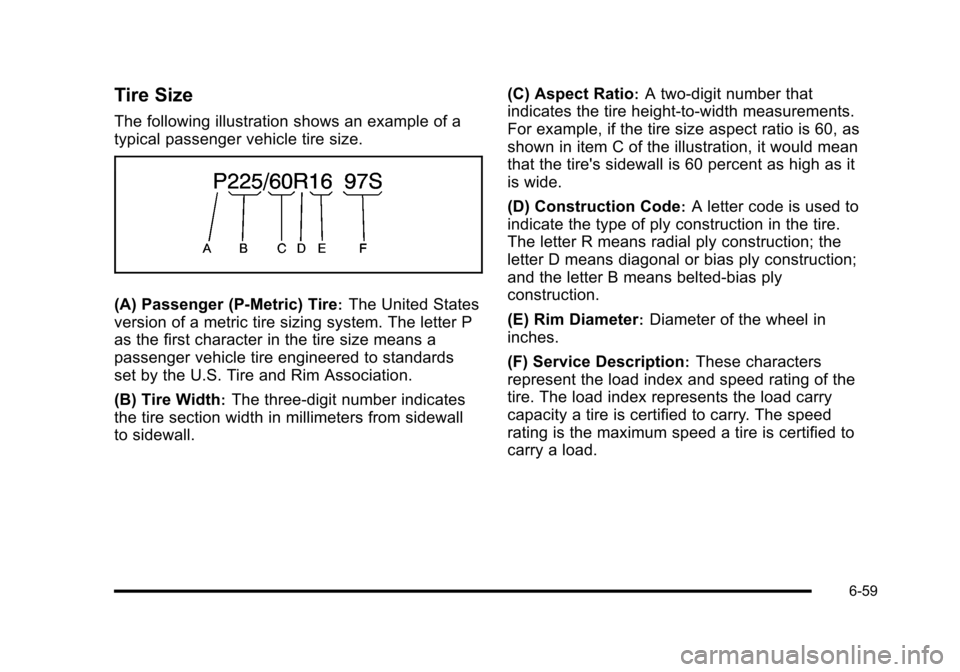
The following illustration shows an example of a
typical passenger vehicle tire size.
(A) Passenger (P‐Metric) Tire:The United States
version of a metric tire sizing system. The letter P
as the first character in the tire size means a
passenger vehicle tire engineered to standards
set by the U.S. Tire and Rim Association.
(B) Tire Width
:The three‐digit number indicates
the tire section width in millimeters from sidewall
to sidewall. (C) Aspect Ratio
:A two‐digit number that
indicates the tire height‐to‐width measurements.
For example, if the tire size aspect ratio is 60, as
shown in item C of the illustration, it would mean
that the tire's sidewall is 60 percent as high as it
is wide.
(D) Construction Code
:A letter code is used to
indicate the type of ply construction in the tire.
The letter R means radial ply construction; the
letter D means diagonal or bias ply construction;
and the letter B means belted‐bias ply
construction.
(E) Rim Diameter
:Diameter of the wheel in
inches.
(F) Service Description
:These characters
represent the load index and speed rating of the
tire. The load index represents the load carry
capacity a tire is certified to carry. The speed
rating is the maximum speed a tire is certified to
carry a load.
6-59
Page 374 of 480
Buying New Tires
GM has developed and matched specific tires for
your vehicle. The original equipment tires installed
on your vehicle, when it was new, were designed
to meet General Motors Tire Performance Criteria
Specification (TPC Spec) system rating. If you
need replacement tires, GM strongly recommends
that you get tires with the same TPC Spec rating.
This way, your vehicle will continue to have tires
that are designed to give the same performance
and vehicle safety, during normal use, as the
original tires.
GM's exclusive TPC Spec system considers over
a dozen critical specifications that impact the
overall performance of your vehicle, including
brake system performance, ride and handling,
traction control, and tire pressure monitoring
performance. GM's TPC Spec number is molded
onto the tire's sidewall near the tire size. If the
tires have an all‐season tread design, the TPC
Spec number will be followed by an MS for mud
and snow. SeeTire Sidewall Labeling
on
page 6‑56
for additional information. GM recommends replacing tires in sets of four.
This is because uniform tread depth on all tires
will help keep your vehicle performing most like it
did when the tires were new. Replacing less than
a full set of tires can affect the braking and
handling performance of your vehicle. See
Tire
Inspection and Rotation
on page 6‑69for
information on proper tire rotation.
{WARNING:
Mixing tires could cause you to lose
control while driving. If you mix tires of
different sizes, brands, or types (radial and
bias-belted tires), the vehicle may not handle
properly, and you could have a crash. Using
tires of different sizes, brands, or types may
also cause damage to your vehicle. Be sure
to use the correct size, brand, and type of
tires on all wheels. It is all right to drive with
your compact spare temporarily, as it was
developed for use on your vehicle. See
Compact Spare Tire
on page 6‑110.
6-72
Page 375 of 480
{WARNING:
If you use bias-ply tires on the vehicle, the
wheel rim flanges could develop cracks after
many miles of driving. A tire and/or wheel
could fail suddenly, causing a crash. Use
only radial-ply tires with the wheels on the
vehicle.
If you must replace your vehicle's tires with those
that do not have a TPC Spec number, make sure
they are the same size, load range, speed rating,
and construction type (radial and bias‐belted tires)
as your vehicle's original tires. Vehicles that have a tire pressure monitoring
system could give an inaccurate low‐pressure
warning if non‐TPC Spec rated tires are installed
on your vehicle. Non‐TPC Spec rated tires may
give a low‐pressure warning that is higher or lower
than the proper warning level you would get with
TPC Spec rated tires. See
Tire Pressure Monitor
System
on page 6‑64.
Your vehicle's original equipment tires are listed
on the Tire and Loading Information Label. See
Loading the Vehicle
on page 5‑24, for more
information about the Tire and Loading
Information Label and its location on your vehicle.
6-73
Page 376 of 480
Different Size Tires and Wheels
If you add wheels or tires that are a different size than
your original equipment wheels and tires, this could
affect the way your vehicle performs, including its
braking, ride and handling characteristics, stability, and
resistance to rollover. Additionally, if your vehicle has
electronic systems such as anti‐lock brakes, rollover
airbags, traction control, and electronic stability control,
the performance of these systems can be affected.
{WARNING:
If you add different sized wheels, your vehicle
may not provide an acceptable level of
performance and safety if tires not recommended
for those wheels are selected. You may increase
the chance that you will crash and suffer serious
injury. Only use GM specific wheel and tire
systems developed for your vehicle, and have
them properly installed by a GM certified
technician.
See Buying New Tires
on page 6‑72andAccessories
and Modificationson page 6‑3for additional
information.
Uniform Tire Quality Grading
Quality grades can be found where applicable on
the tire sidewall between tread shoulder and
maximum section width. For example:
Treadwear 200 Traction AA
Temperature A
The following information relates to the system
developed by the United States National Highway
Traffic Safety Administration (NHTSA), which
grades tires by treadwear, traction, and
temperature performance. This applies only to
vehicles sold in the United States. The grades are
molded on the sidewalls of most passenger car
tires. The Uniform Tire Quality Grading (UTQG)
system does not apply to deep tread, winter-type
snow tires, space-saver, or temporary use spare
tires, tires with nominal rim diameters of
10 to 12 inches (25 to 30 cm), or to some
limited-production tires.
While the tires available on General Motors
passenger cars and light trucks may vary with
respect to these grades, they must also conform
to federal safety requirements and additional
General Motors Tire Performance Criteria (TPC)
standards.
6-74
Page 379 of 480
Used Replacement Wheels
{WARNING:
Putting a used wheel on the vehicle is dangerous.
You cannot know how it has been used or how far
it has been driven. It could fail suddenly and
cause a crash. If you have to replace a wheel, use
a new GM original equipment wheel.
Tire Chains
{WARNING:
Do not use tire chains. There is not enough
clearance. Tire chains used on a vehicle without
the proper amount of clearance can cause
damage to the brakes, suspension or other
vehicle parts. The area damaged by the tire
chains could cause you to lose control of the
vehicle and you or others may be injured in a
crash.(Continued)
WARNING: (Continued)
Use another type of traction device only if its
manufacturer recommends it for use on the
vehicle and tire size combination and road
conditions. Follow that manufacturer's
instructions. To help avoid damage to the vehicle,
drive slowly, readjust or remove the device if it is
contacting the vehicle, and do not spin the
vehicle's wheels. If you do find traction devices
that will fit, install them on the front tires.
If a Tire Goes Flat
It is unusual for a tire to blowout while you are driving,
especially if you maintain your vehicle's tires properly.
If air goes out of a tire, it is much more likely to leak out
slowly. But if you should ever have a blowout, here are
a few tips about what to expect and what to do:
If a front tire fails, the flat tire creates a drag that pulls
the vehicle toward that side. Take your foot off the
accelerator pedal and grip the steering wheel firmly.
Steer to maintain lane position, and then gently brake
to a stop well out of the traffic lane.
6-77