Page 423 of 480
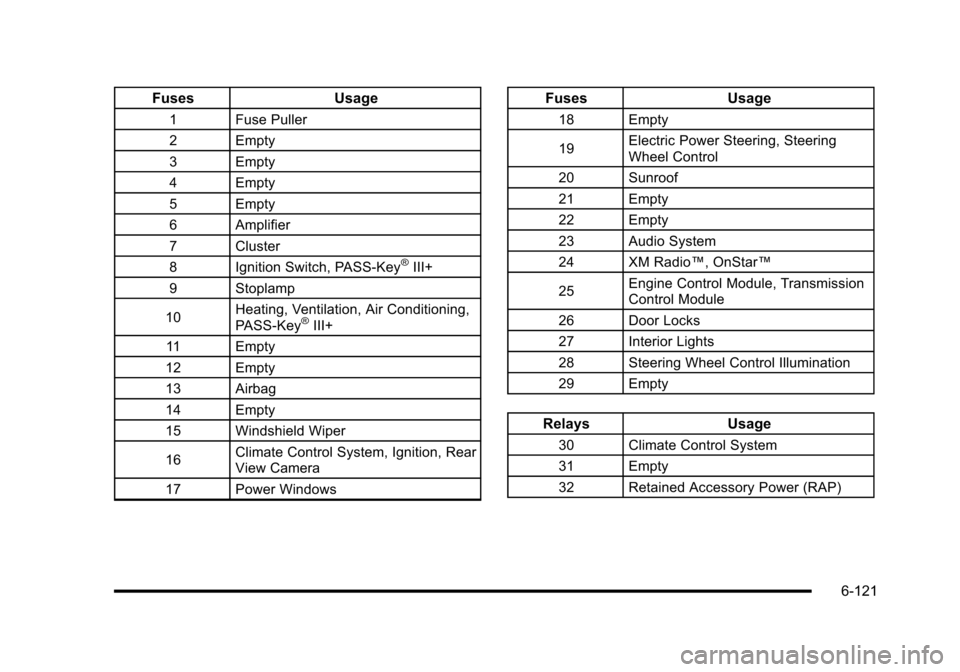
FusesUsage
1 Fuse Puller
2 Empty
3 Empty
4 Empty
5 Empty
6 Amplifier
7 Cluster
8 Ignition Switch, PASS-Key
®III+
9 Stoplamp
10 Heating, Ventilation, Air Conditioning,
PASS-Key
®III+
11 Empty
12 Empty
13 Airbag
14 Empty
15 Windshield Wiper
16 Climate Control System, Ignition, Rear
View Camera
17 Power Windows
Fuses Usage
18 Empty
19Electric Power Steering, Steering
Wheel Control
20 Sunroof
21 Empty
22 Empty
23 Audio System
24 XM Radio™, OnStar™
25 Engine Control Module, Transmission
Control Module
26 Door Locks
27 Interior Lights
28 Steering Wheel Control Illumination
29 Empty
Relays Usage
30 Climate Control System
31 Empty
32 Retained Accessory Power (RAP)
6-121
Page 424 of 480
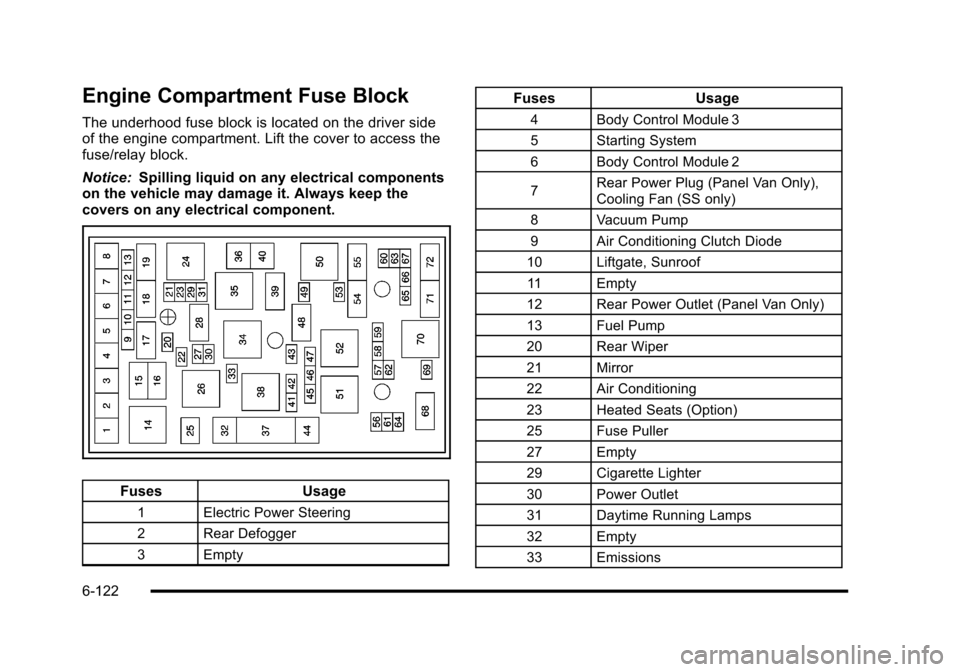
Engine Compartment Fuse Block
The underhood fuse block is located on the driver side
of the engine compartment. Lift the cover to access the
fuse/relay block.
Notice:Spilling liquid on any electrical components
on the vehicle may damage it. Always keep the
covers on any electrical component.
Fuses Usage
1 Electric Power Steering
2 Rear Defogger
3 Empty
FusesUsage
4 Body Control Module 3
5 Starting System
6 Body Control Module 2
7Rear Power Plug (Panel Van Only),
Cooling Fan (SS only)
8 Vacuum Pump
9 Air Conditioning Clutch Diode
10 Liftgate, Sunroof 11 Empty
12 Rear Power Outlet (Panel Van Only)
13 Fuel Pump
20 Rear Wiper
21 Mirror
22 Air Conditioning
23 Heated Seats (Option)
25 Fuse Puller
27 Empty
29 Cigarette Lighter
30 Power Outlet
31 Daytime Running Lamps
32 Empty
33 Emissions
6-122
Page 425 of 480
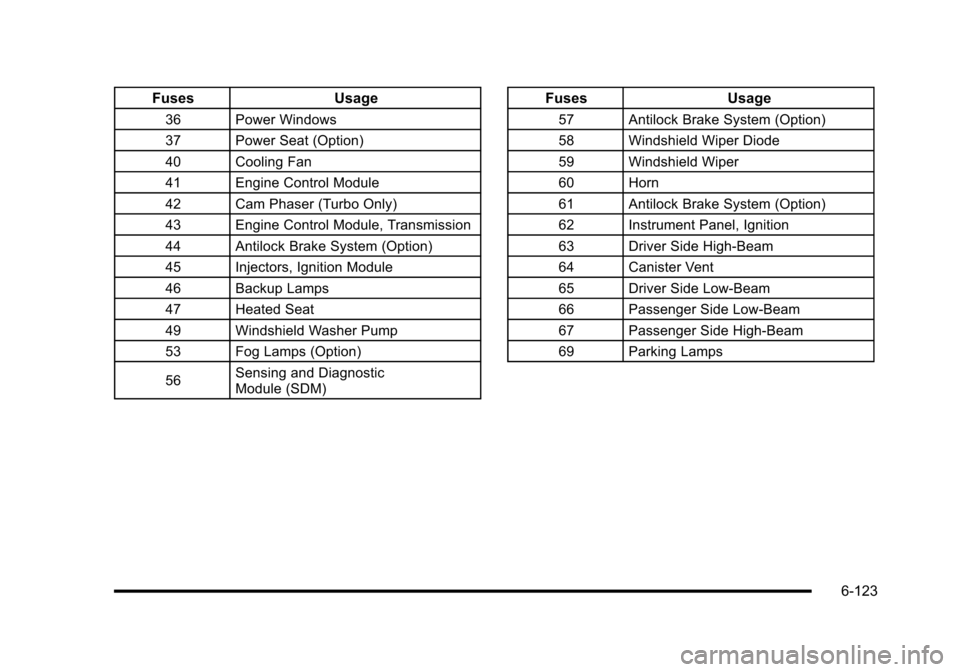
FusesUsage
36 Power Windows
37 Power Seat (Option)
40 Cooling Fan
41 Engine Control Module
42 Cam Phaser (Turbo Only)
43 Engine Control Module, Transmission
44 Antilock Brake System (Option)
45 Injectors, Ignition Module
46 Backup Lamps
47 Heated Seat
49 Windshield Washer Pump
53 Fog Lamps (Option)
56Sensing and Diagnostic
Module (SDM)
Fuses
Usage
57 Antilock Brake System (Option)
58 Windshield Wiper Diode
59 Windshield Wiper
60 Horn
61 Antilock Brake System (Option)
62 Instrument Panel, Ignition
63 Driver Side High-Beam
64 Canister Vent
65 Driver Side Low-Beam
66 Passenger Side Low-Beam
67 Passenger Side High-Beam
69 Parking Lamps
6-123
Page 426 of 480
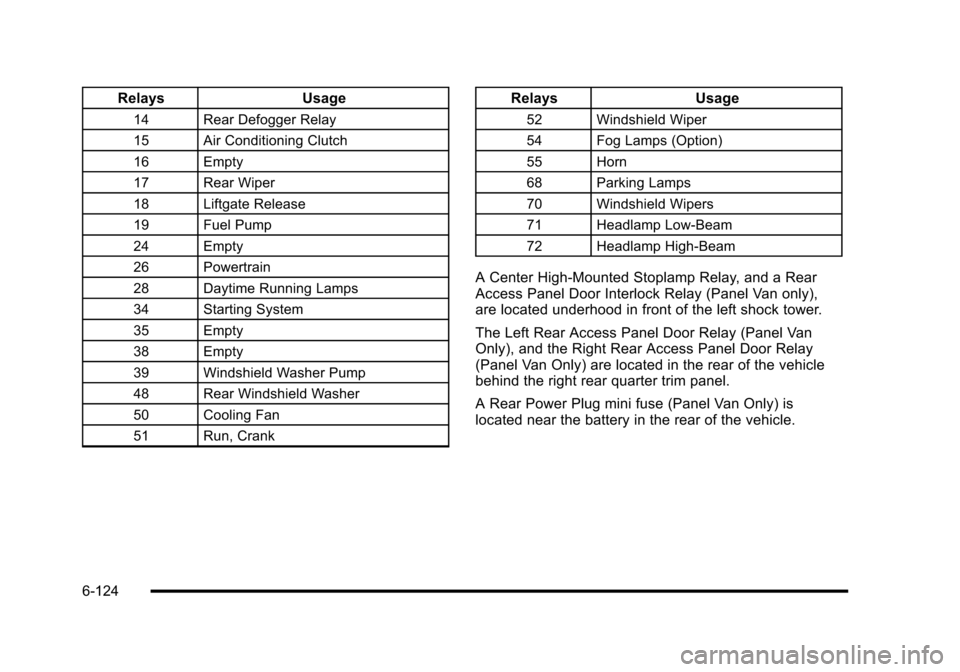
RelaysUsage
14 Rear Defogger Relay
15 Air Conditioning Clutch
16 Empty
17 Rear Wiper
18 Liftgate Release
19 Fuel Pump
24 Empty
26 Powertrain
28 Daytime Running Lamps
34 Starting System
35 Empty
38 Empty
39 Windshield Washer Pump
48 Rear Windshield Washer
50 Cooling Fan
51 Run, Crank
RelaysUsage
52 Windshield Wiper
54 Fog Lamps (Option)
55 Horn
68 Parking Lamps
70 Windshield Wipers
71 Headlamp Low-Beam
72 Headlamp High-Beam
A Center High-Mounted Stoplamp Relay, and a Rear
Access Panel Door Interlock Relay (Panel Van only),
are located underhood in front of the left shock tower.
The Left Rear Access Panel Door Relay (Panel Van
Only), and the Right Rear Access Panel Door Relay
(Panel Van Only) are located in the rear of the vehicle
behind the right rear quarter trim panel.
A Rear Power Plug mini fuse (Panel Van Only) is
located near the battery in the rear of the vehicle.
6-124
Page 432 of 480

MaintenanceI
.Change engine oil and filter. See Engine Oilon
page 6‑19. An Emission Control Service.
.Engine coolant level check. See Engine Coolanton page 6‑29.
.Windshield washer fluid level check. See
Windshield Washer Fluid on page 6‑36.
.Tire inflation check. SeeInflation - Tire Pressureon page 6‑63.
.Tire wear inspection. See Tire Inspection and
Rotation on page 6‑69.
.Rotate tires. See Tire Inspection and Rotationon
page 6‑69.
.Fluids visual leak check (or every 12 months,
whichever occurs first). A leak in any system
must be repaired and the fluid level checked.
.2.2L and 2.4L Engines: Engine air cleaner filter
inspection (vehicles driven in dusty conditions
only). See Engine Air Cleaner/Filter on page 6‑25.
.2.0L Engine: Engine air cleaner filter inspection.
SeeEngine Air Cleaner/Filter on page 6‑25.
.Brake system inspection (or every 12 months,
whichever occurs first).
Maintenance II
.Perform all services described in Maintenance I.
.Steering and suspension inspection. Visual
inspection for damaged, loose, or missing parts or
signs of wear.
.Engine cooling system inspection. Visual
inspection of hoses, pipes, fittings, and clamps
and replacement, if needed.
.Windshield wiper blade inspection for wear,
cracking, or contamination and windshield and
wiper blade cleaning, if contaminated. See
Windshield and Wiper Blades
on page 6‑115. Worn
or damaged wiper blade replacement. See
Windshield Wiper Blade Replacement
on
page 6‑53.
.Body hinges and latches, key lock cylinders, and
rear compartment hinges lubrication. See
Recommended Fluids and Lubricants
on
page 7‑10. More frequent lubrication may be
required when vehicle is exposed to a corrosive
environment. Applying silicone grease on
weatherstrips with a clean cloth makes them last
longer, seal better, and not stick or squeak.
.Restraint system component check. See Checking
the Restraint Systems on page 2‑78.
7-4
Page 433 of 480
.Passenger compartment air filter replacement (or
every 12 months, whichever occurs first). More
frequent replacement may be required if vehicle is
driven regularly under dusty conditions.
.2.2L and 2.4L Engines: Engine air cleaner filter
inspection (vehicles not driven in dusty conditions).
SeeEngine Air Cleaner/Filter on page 6‑25.
Additional Required Services
At Each Fuel Stop
.Engine oil level check. See Engine Oilon
page 6‑19.
.Engine coolant level check. See Engine Coolanton page 6‑29.
.Windshield washer fluid level check. See
Windshield Washer Fluid on page 6‑36.
Once a Month
.Tire inflation check. SeeInflation - Tire Pressureon page 6‑63.
.Tire wear inspection. See Tire Inspection and
Rotation on page 6‑69.
Once a Year
.Starter switch check. See Owner Checks and
Services on page 7‑8.
.Parking brake and automatic transmission P (Park)
mechanism check. See Owner Checks and
Services on page 7‑8.
.Automatic transmission shiftlock control system
check. See Owner Checks and Serviceson
page 7‑8.
.Ignition transmission lock check. See Owner
Checks and Services on page 7‑8.
.Engine cooling system and pressure cap pressure
check. Radiator and air conditioning condenser
outside cleaning. See Cooling System
on
page 6‑28.
.Exhaust system and nearby heat shields
inspection for loose or damaged components.
.Throttle system inspection for interference, binding
or for damaged or missing parts. Replace parts as
needed. Replace any components that have high
effort or excessive wear. Do not lubricate
accelerator or cruise control cables.
7-5
Page 436 of 480
Owner Checks and Services
Starter Switch Check
{WARNING:
When you are doing this inspection, the vehicle
could move suddenly. If the vehicle moves, you or
others could be injured.
1. Before starting this check, be sure there is enough room around the vehicle.
2. Firmly apply both the parking brake and the regular brake. See Parking Brake on page 3‑34.
Do not use the accelerator pedal, and be ready to
turn off the engine immediately if it starts.
3. For automatic transmission vehicles, try to start the engine in each gear. The starter should work only
in P (Park) or N (Neutral). If the starter works in any
other position, your vehicle needs service.
For manual transmission vehicles, put the shift
lever in Neutral, push the clutch pedal down
halfway, and try to start the engine. The starter
should work only when the clutch pedal is pushed down all the way to the floor. If the starter works
when the clutch pedal is not pushed all the way
down, your vehicle needs service.
Automatic Transmission Shift Lock
Control System Check
{WARNING:
When you are doing this inspection, the vehicle
could move suddenly. If the vehicle moves, you or
others could be injured.
1. Before starting this check, be sure there is enough room around the vehicle. It should be parked on a
level surface.
2. Firmly apply the parking brake. See Parking Brake
on page 3‑34.
Be ready to apply the regular brake immediately if
the vehicle begins to move.
3. With the engine off, turn the ignition to ON/RUN, but do not start the engine. Without applying the
regular brake, try to move the shift lever out of
P (Park) with normal effort. If the shift lever moves
out of P (Park), contact your dealer/retailer for
service.
7-8
Page 437 of 480
Ignition Transmission Lock Check
While parked, and with the parking brake set, try to turn
the ignition to LOCK/OFF in each shift lever position.
.For automatic transmission vehicles, the ignition
should turn to LOCK/OFF only when the shift lever
is in P (Park). The ignition key should come out
only in LOCK/OFF.
.For manual transmission vehicles, the ignition key
should come out only in LOCK/OFF.
Turn the steering wheel to the left and to the right.
It should only lock when turned to the right.
Contact your dealer/retailer if service is required.
Parking Brake and Automatic
Transmission P (Park) Mechanism
Check
{WARNING:
When you are doing this check, the vehicle could
begin to move. You or others could be injured and
property could be damaged. Make sure there is (Continued)
WARNING: (Continued)
room in front of the vehicle in case it begins to
roll. Be ready to apply the regular brake at once
should the vehicle begin to move.
Park on a fairly steep hill, with the vehicle facing
downhill. Keeping your foot on the regular brake, set the
parking brake.
.To check the parking brake's holding ability: With
the engine running and the transmission in
N (Neutral), slowly remove foot pressure from the
regular brake pedal. Do this until the vehicle is held
by the parking brake only.
.To check the P (Park) mechanism's holding ability:
With the engine running, shift to P (Park). Then
release the parking brake followed by the regular
brake.
Contact your dealer/retailer if service is required.
7-9