Page 386 of 480
Using the Tire Sealant and Compressor
Kit without Sealant to Inflate a Tire
(Not Punctured)
To use the air compressor to inflate a tire with air only
and not sealant:
Always do a safety check first. SeeIf a Tire Goes Flaton page 6‑77.
1. Remove the tire sealant and compressor kit from its storage location. See Tire Sealant and
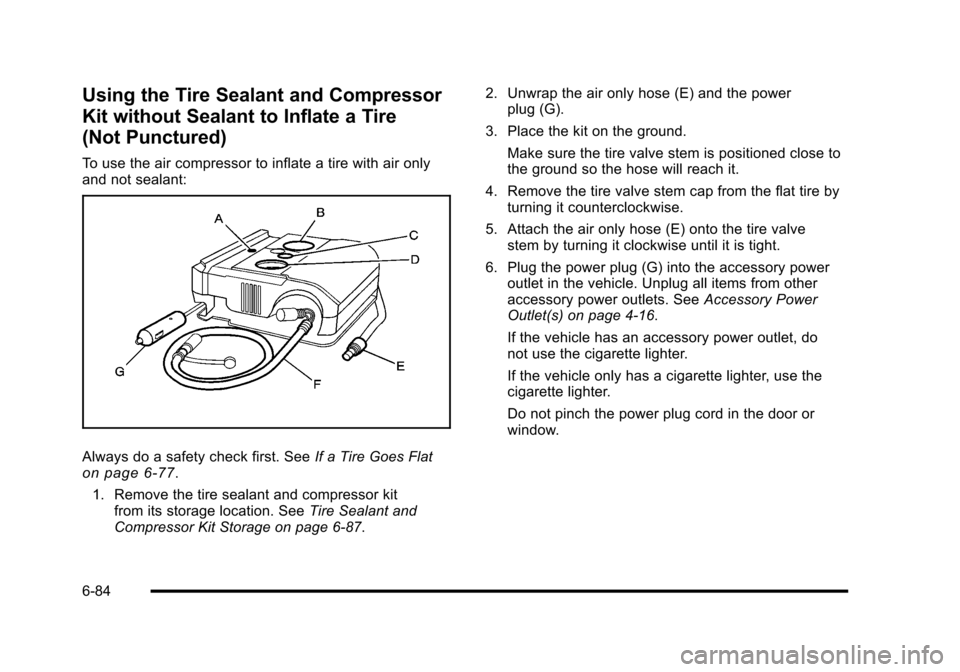
Compressor Kit Storage on page 6‑87. 2. Unwrap the air only hose (E) and the power
plug (G).
3. Place the kit on the ground. Make sure the tire valve stem is positioned close to
the ground so the hose will reach it.
4. Remove the tire valve stem cap from the flat tire by turning it counterclockwise.
5. Attach the air only hose (E) onto the tire valve stem by turning it clockwise until it is tight.
6. Plug the power plug (G) into the accessory power outlet in the vehicle. Unplug all items from other
accessory power outlets. See Accessory Power
Outlet(s) on page 4‑16.
If the vehicle has an accessory power outlet, do
not use the cigarette lighter.
If the vehicle only has a cigarette lighter, use the
cigarette lighter.
Do not pinch the power plug cord in the door or
window.
6-84
Page 387 of 480

7. Start the vehicle. The vehicle must be runningwhile using the air compressor.
8. Turn the selector switch (B) counterclockwise to the Air Only position.
9. Press the on/off (A) button to turn the compressor on.
The compressor will inflate the tire with air only.
10. Inflate the tire to the recommended inflation pressure using the pressure gauge (D). The
recommended inflation pressure can be found
on the Tire and Loading Information label. See
Inflation - Tire Pressure on page 6‑63.
The pressure gauge (D) may read higher than the
actual tire pressure while the compressor is on.
Turn the compressor off to get an accurate
reading. The compressor may be turned on/off
until the correct pressure is reached. 11. Press the on/off button (A) to turn the tire sealant
and compressor kit off.
Be careful while handling the tire sealant and
compressor kit as it could be warm after usage.
12. Unplug the power plug (G) from the accessory power outlet in the vehicle.
13. Disconnect the air only hose (E) from the tire valve stem, by turning it counterclockwise, and replace
the tire valve stem cap.
14. Replace the air only hose (E) and the power plug (G) and cord back in its original location.
15. Place the equipment in the original storage location in the vehicle.
6-85
Page 389 of 480
Tire Sealant and Compressor Kit
Storage
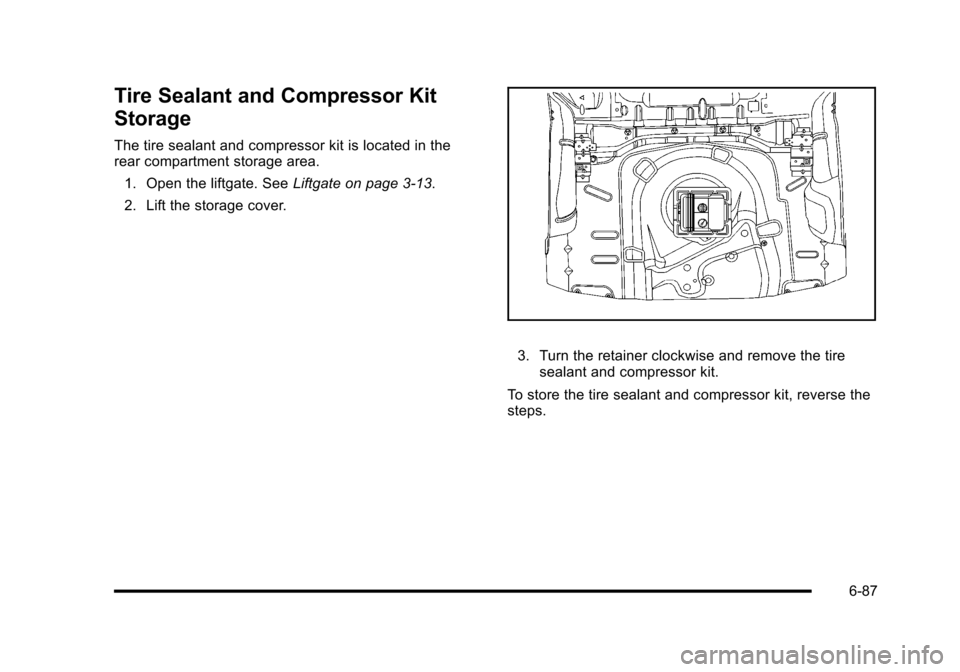
The tire sealant and compressor kit is located in the
rear compartment storage area.1. Open the liftgate. See Liftgate on page 3‑13.
2. Lift the storage cover.
3. Turn the retainer clockwise and remove the tire sealant and compressor kit.
To store the tire sealant and compressor kit, reverse the
steps.
6-87
Page 390 of 480
Changing a Flat Tire
If a tire goes flat, avoid further tire and wheel damage
by driving slowly to a level place. Turn on the hazard
warning flashers. SeeHazard Warning Flashers
on
page 4‑3.
{WARNING:
Changing a tire can be dangerous. The vehicle
can slip off the jack and roll over or fall on you or
other people. You and they could be badly injured
or even killed. Find a level place to change your
tire. To help prevent the vehicle from moving:
1. Set the parking brake firmly.
2. Put an automatic transmission shift lever in P (Park), or shift a manual transmission to
1 (First) or R (Reverse).
(Continued)
WARNING: (Continued)
3. Turn off the engine and do not restart whilethe vehicle is raised.
4. Do not allow passengers to remain in the vehicle.
To be even more certain the vehicle will not move,
you should put blocks at the front and rear of the
tire farthest away from the one being changed.
That would be the tire on the other side, at the
opposite end of the vehicle.
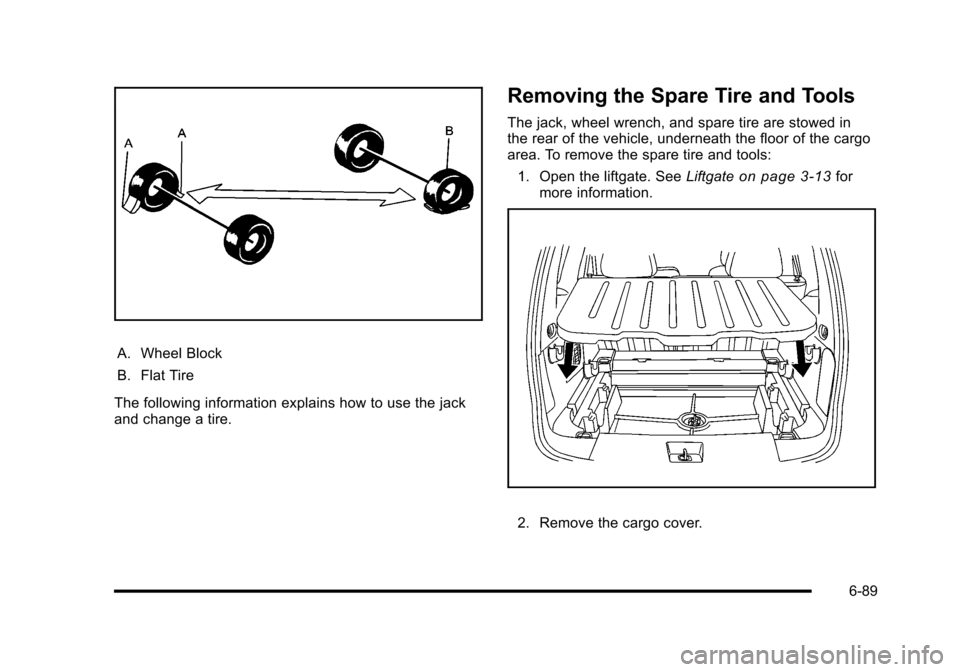
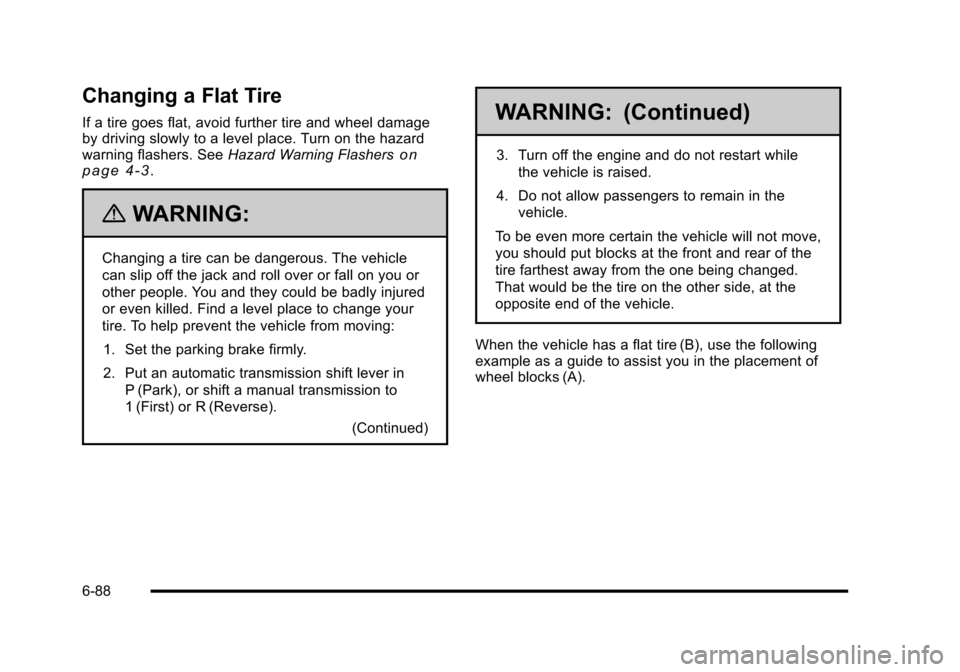
When the vehicle has a flat tire (B), use the following
example as a guide to assist you in the placement of
wheel blocks (A).
6-88
Page 391 of 480
A. Wheel Block
B. Flat Tire
The following information explains how to use the jack
and change a tire.
Removing the Spare Tire and Tools
The jack, wheel wrench, and spare tire are stowed in
the rear of the vehicle, underneath the floor of the cargo
area. To remove the spare tire and tools: 1. Open the liftgate. See Liftgate
on page 3‑13for
more information.
2. Remove the cargo cover.
6-89
Page 392 of 480
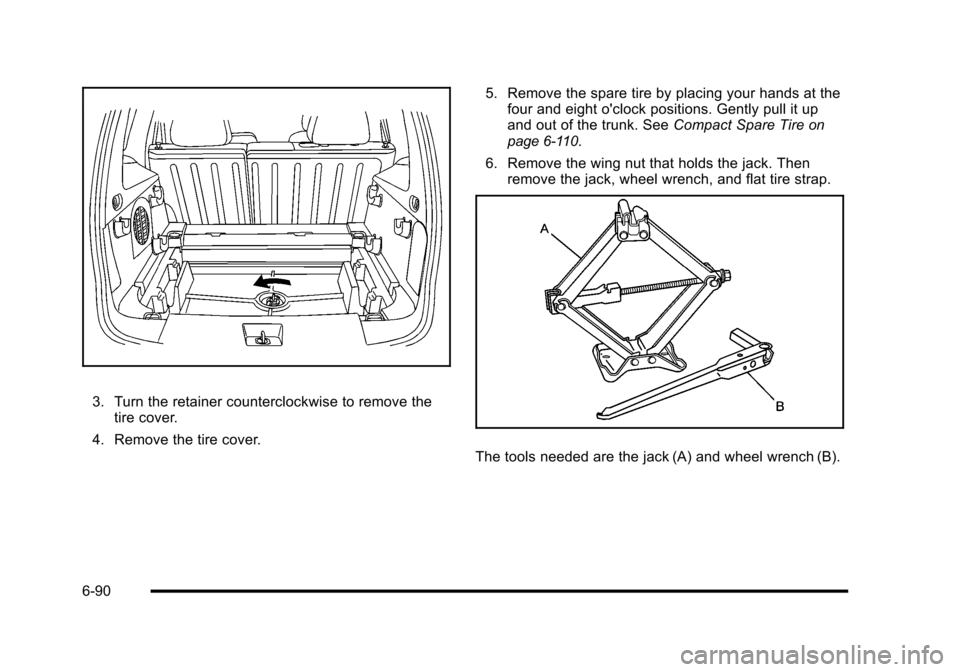
3. Turn the retainer counterclockwise to remove thetire cover.
4. Remove the tire cover. 5. Remove the spare tire by placing your hands at the
four and eight o'clock positions. Gently pull it up
and out of the trunk. See Compact Spare Tire
on
page 6‑110.
6. Remove the wing nut that holds the jack. Then remove the jack, wheel wrench, and flat tire strap.
The tools needed are the jack (A) and wheel wrench (B).
6-90
Page 393 of 480
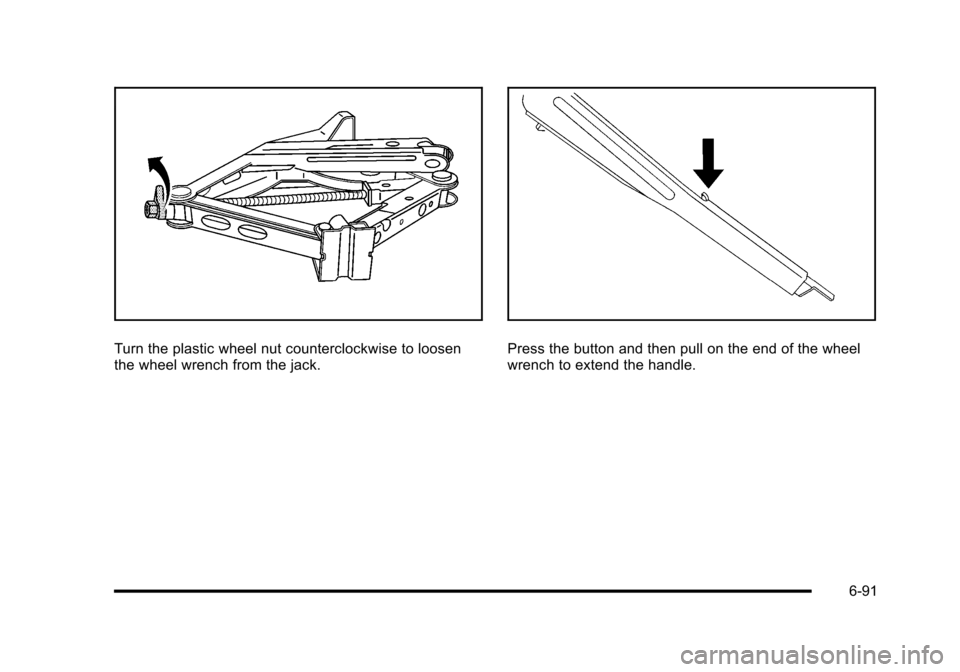
Turn the plastic wheel nut counterclockwise to loosen
the wheel wrench from the jack.Press the button and then pull on the end of the wheel
wrench to extend the handle.
6-91
Page 395 of 480
{WARNING:
Getting under a vehicle when it is jacked up is
dangerous. If the vehicle slips off the jack, you
could be badly injured or killed. Never get under a
vehicle when it is supported only by a jack.
{WARNING:
Raising your vehicle with the jack improperly
positioned can damage the vehicle and even
make the vehicle fall. To help avoid personal
injury and vehicle damage, be sure to fit the jack
lift head into the proper location before raising the
vehicle.
4. Raise the vehicle by turning the jack handleclockwise. Raise the vehicle far enough off the
ground so there is enough room for the compact
spare tire to fit underneath the wheel well.
6-93