2010 CHEVROLET EQUINOX fuse
[x] Cancel search: fusePage 338 of 394
9-70 Vehicle Care
1. The vehicle used to jump startmust have 12-volt battery with a
negative ground.
Notice: If the other vehicle's
system is not a 12-volt system
with a negative ground, both
vehicles can be damaged. Only
use vehicles with 12-volt systems
with negative grounds to jump
start your vehicle.
2. The vehicles should be close enough for the jumper cables to
reach, but the vehicles should
not be touching. Touching could
cause grounding and possible
electrical system damage.
Put both vehicles in P (Park)
and set the parking brake firmly.
3. Unplug accessories plugged into the cigarette lighter or the
accessory power outlet. Turn off
the radio and all lamps that are
not needed. Turn off the ignition
on both vehicles. 4. Locate the positive (+) and
negative (−) terminals on both
vehicles. Some vehicles have
remote jump starting terminals.
{WARNING
An electric fan can start up even
when the engine is not running
and can injure you. Keep hands,
clothing and tools away from any
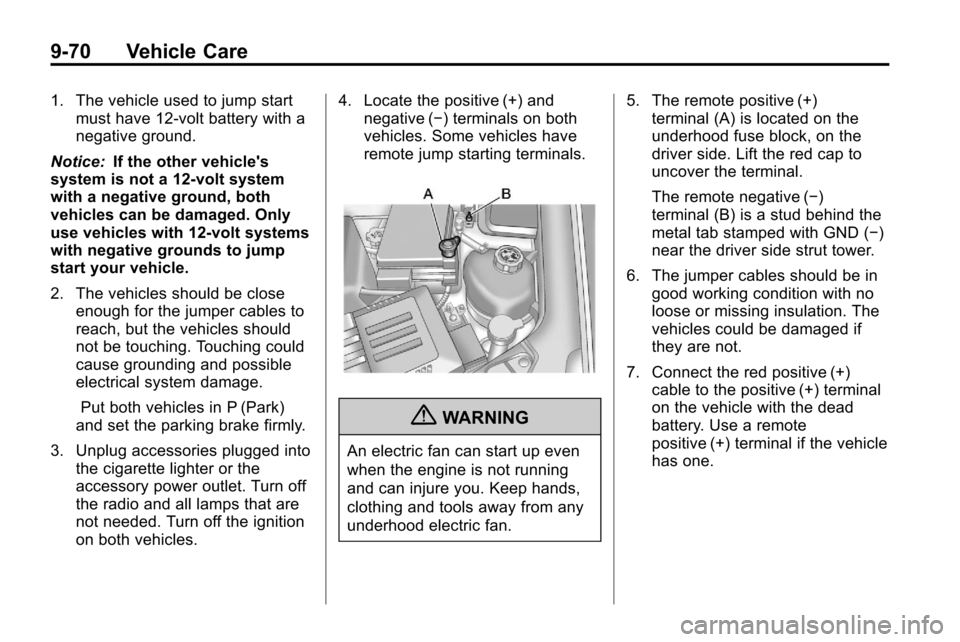
underhood electric fan. 5. The remote positive (+)
terminal (A) is located on the
underhood fuse block, on the
driver side. Lift the red cap to
uncover the terminal.
The remote negative (−)
terminal (B) is a stud behind the
metal tab stamped with GND (−)
near the driver side strut tower.
6. The jumper cables should be in good working condition with no
loose or missing insulation. The
vehicles could be damaged if
they are not.
7. Connect the red positive (+) cable to the positive (+) terminal
on the vehicle with the dead
battery. Use a remote
positive (+) terminal if the vehicle
has one.
Page 340 of 394
9-72 Vehicle Care
To disconnect the jumper cables
from both vehicles,
1. Disconnect the blacknegative (−) cable from the
vehicle that had the dead
battery.
2. Disconnect the black negative (−) cable from the
vehicle with the good battery.
3. Disconnect the red positive (+) cable from the vehicle with the
good battery.
4. Disconnect the red positive (+) cable from the other vehicle.
5. Return the underhood fuse block cover to its original position,
if applicable.Towing
Towing the Vehicle
To avoid damage, the disabled
vehicle should be towed with all four
wheels off the ground. Consult your
dealer or a professional towing
service if the disabled vehicle must
be towed. See Roadside Assistance
Program on page 12‑6.
To tow the vehicle behind
another vehicle for recreational
purposes —such as behind a
motorhome, see Recreational
Vehicle Towing following.
Recreational Vehicle
Towing
Recreational vehicle towing means
towing the vehicle behind another
vehicle –such as behind a
motorhome. The two most common
types of recreational vehicle towing
are known as dinghy towing and dolly towing. Dinghy towing is
towing the vehicle with all four
wheels on the ground. Dolly towing
is towing the vehicle with two
wheels on the ground and two
wheels up on a device known as a
dolly.
Here are some important things to
consider before recreational vehicle
towing:
.What is the towing capacity of
the towing vehicle? Be sure to
read the tow vehicle
manufacturer's
recommendations.
.What is the distance that will be
travelled? Some vehicles have
restrictions on how far and how
long they can tow.
.Is the proper towing equipment
going to be used? See your
dealer or trailering professional
for additional advice and
equipment recommendations.
Page 341 of 394
Vehicle Care 9-73
.Is the vehicle ready to be
towed? Just as preparing the
vehicle for a long trip, make sure
the vehicle is prepared to be
towed.
Dinghy Towing
Front-wheel‐drive and
all-wheel-drive vehicles may be
dinghy towed from the front. These
vehicles can also be towed by
placing them on a platform trailer
with all four wheels off of the
ground. For other towing options,
see“Dolly Towing” following in this
section.
For vehicles being dinghy towed,
the vehicle should be run at the
beginning of each day and at each
RV fuel stop for about five minutes.
This will ensure proper lubrication of
transmission components.
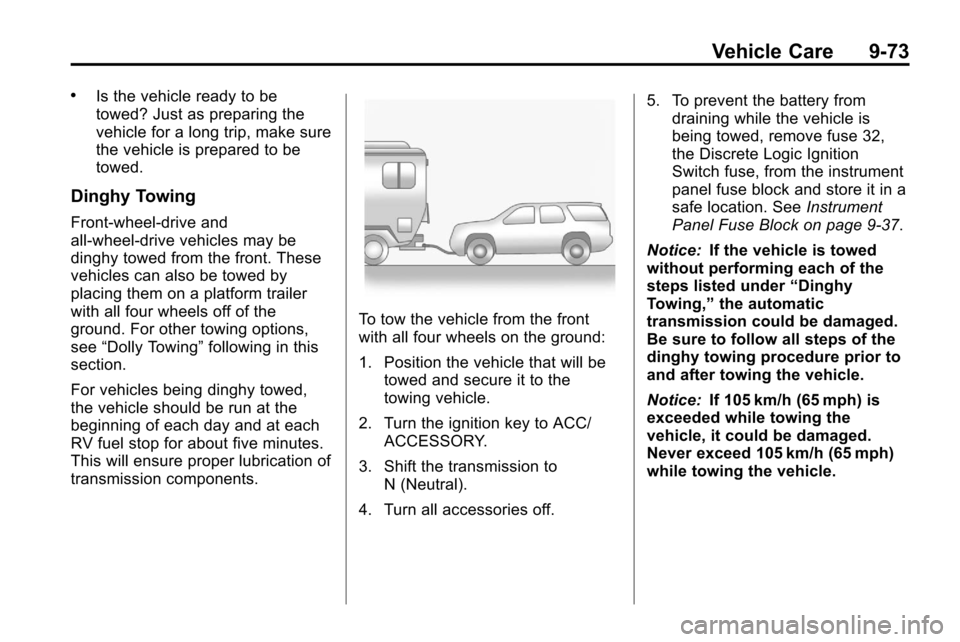
To tow the vehicle from the front
with all four wheels on the ground:
1. Position the vehicle that will be towed and secure it to the
towing vehicle.
2. Turn the ignition key to ACC/ ACCESSORY.
3. Shift the transmission to N (Neutral).
4. Turn all accessories off. 5. To prevent the battery from
draining while the vehicle is
being towed, remove fuse 32,
the Discrete Logic Ignition
Switch fuse, from the instrument
panel fuse block and store it in a
safe location. See Instrument
Panel Fuse Block on page 9‑37.
Notice: If the vehicle is towed
without performing each of the
steps listed under “Dinghy
Towing,” the automatic
transmission could be damaged.
Be sure to follow all steps of the
dinghy towing procedure prior to
and after towing the vehicle.
Notice: If 105 km/h (65 mph) is
exceeded while towing the
vehicle, it could be damaged.
Never exceed 105 km/h (65 mph)
while towing the vehicle.
Page 342 of 394
9-74 Vehicle Care
Once the destination has been
reached:
1. Set the parking brake.
2. Shift the transmission toP (Park).
3. Turn the ignition key to LOCK/OFF.
4. Install fuse 32, the Discrete Logic Ignition Switch fuse. See
Instrument Panel Fuse Block
on
page 9‑37.
5. Start the engine and let it idle for more than three minutes before
driving the vehicle.
Notice: Too much or too little
fluid can damage the
transmission. Be sure that the
transmission fluid is at the proper
level before towing with all four
wheels on the ground. Notice:
Do not tow a vehicle with
the front drive wheels on the
ground if one of the front tires is
a compact spare tire. Towing with
two different tire sizes on the
front of the vehicle can cause
severe damage to the
transmission.
Dolly Towing (All-Wheel‐Drive
Vehicles)
All-wheel‐drive vehicles should not
be towed with two wheels on the
ground. To properly tow these
vehicles, they should be placed on
a platform trailer with all four wheels
off of the ground or dinghy towed
from the front.
Dolly Towing
(Front-Wheel‐ Drive Vehicles)
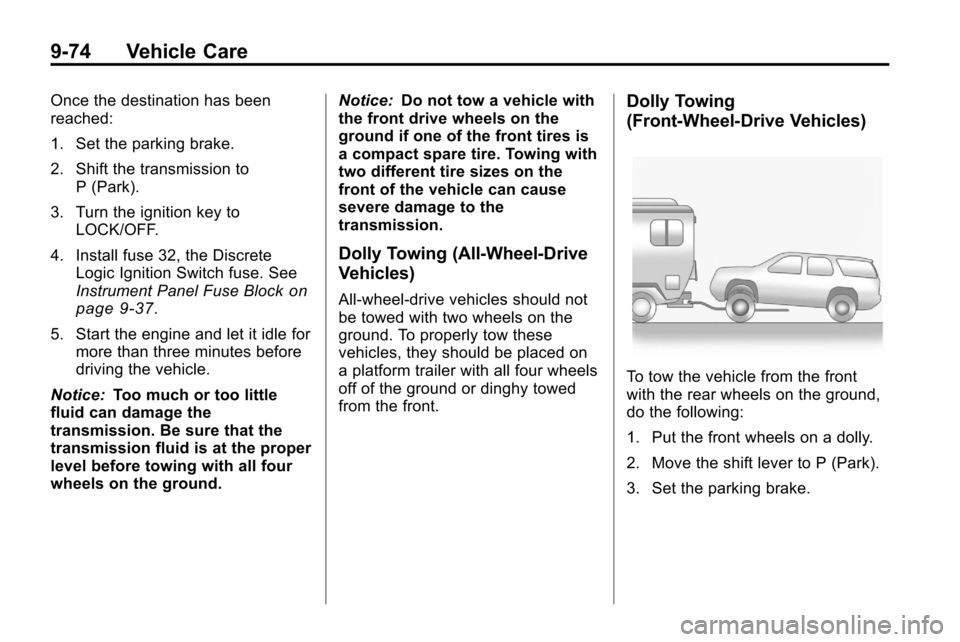
To tow the vehicle from the front
with the rear wheels on the ground,
do the following:
1. Put the front wheels on a dolly.
2. Move the shift lever to P (Park).
3. Set the parking brake.
Page 386 of 394

i-4 INDEX
DVDRear Seat Entertainment
System . . . . . . . . . . . . . . . . . . . . . . 6-33
DVD/CD Player . . . . . . . . . . . . . . . . 6-21
E
ECO Button . . . . . . . . . . . . . . . . . . . 8-37
Economy Mode Fuel . . . . . . . . . . . . . . . . . . . . . . . . . . 8-37
Electrical Equipment, Add-On . . . . . . . . . . . . . . . . . . . . . . 8-64
Electrical System Engine Compartment Fuse
Block . . . . . . . . . . . . . . . . . . . . . . . . 9-34
Fuses . . . . . . . . . . . . . . . . . . . . . . . . 9-34
Instrument Panel Fuse Block . . . . . . . . . . . . . . . . . . . . . . . . 9-37
Engine
Air Cleaner/Filter . . . . . . . . . . . . . 9-13
Check and Service EngineSoon Light . . . . . . . . . . . . . . . . . . 4-16
Compartment Overview . . . . . . . . 9-6
Coolant . . . . . . . . . . . . . . . . . . . . . . . 9-15 Engine (cont.)
Coolant Heater . . . . . . . . . . . . . . . 8-31
Coolant Temperature
Gauge . . . . . . . . . . . . . . . . . . . . . . 4-14
Cooling System . . . . . . . . . . . . . . . 9-14
Cooling System Messages . . . 4-29
Cover . . . . . . . . . . . . . . . . . . . . . . . . . . 9-9
Drive Belt Routing . . . . . . . . . . . . 11-4
Exhaust . . . . . . . . . . . . . . . . . . . . . . 8-34
Overheating . . . . . . . . . . . . . . . . . . 9-18
Power Messages . . . . . . . . . . . . . 4-30
Pressure Light . . . . . . . . . . . . . . . . 4-22
Running While Parked . . . . . . . . 8-34
Starting . . . . . . . . . . . . . . . . . . . . . . . 8-30
Engine Oil Life System . . . . . . . . . . . . . . . . . . . 9-11
Messages . . . . . . . . . . . . . . . . . . . . 4-30
Entry Lighting . . . . . . . . . . . . . . . . . . . 5-4
Equipment, Towing . . . . . . . . . . . . 8-63
Event Data Recorders . . . . . . . . 12-15
Extender, Safety Belt . . . . . . . . . . 2-21
Exterior Lamp Controls . . . . . . . . . 5-1
F
Filter
Engine Air Cleaner . . . . . . . . . . . 9-13
Flash-to-Pass . . . . . . . . . . . . . . . . . . . 5-2
Flashers, Hazard Warning . . . . . . 5-2
Flat Tire . . . . . . . . . . . . . . . . . . . . . . . 9-59
Flat Tire, Changing . . . . . . . . . . . . 9-61
Fluid Automatic Transmission . . . . . . 9-12
Brakes . . . . . . . . . . . . . . . . . . . . . . . . 9-22
Power Steering . . . . . . . . . . . . . . . 9-20
Washer . . . . . . . . . . . . . . . . . . . . . . . 9-21
Fog Lamps Bulb Replacement . . . . . . . 5-3, 9-31
Light . . . . . . . . . . . . . . . . . . . . . . . . . . 4-23
Front Seats
Adjustment . . . . . . . . . . . . . . . . . . . . 2-3
Heated . . . . . . . . . . . . . . . . . . . . . . . . 2-7
Fuel . . . . . . . . . . . . . . . . . . . . . . . . . . . 8-53 Additives . . . . . . . . . . . . . . . . . . . . . 8-55
Economy Driving . . . . . . . . . . . . . . 8-2
Economy Light . . . . . . . . . . . . . . . 4-22
Filling a Portable Fuel
Container . . . . . . . . . . . . . . . . . . . 8-57
Filling the Tank . . . . . . . . . . . . . . . 8-56
Fuels in Foreign Countries . . . . 8-54
Page 387 of 394

INDEX i-5
Fuel (cont.)Gasoline Specifications . . . . . . . 8-54
Gauge . . . . . . . . . . . . . . . . . . . . . . . . 4-13
Low Fuel Warning Light . . . . . . . 4-22
Recommended . . . . . . . . . . . . . . . 8-54
Requirements, California . . . . . 8-54
System Messages . . . . . . . . . . . . 4-30
Fuel Economy Mode . . . . . . . . . . . 8-37
Fuses . . . . . . . . . . . . . . . . . . . . . . . . . 9-34 Engine Compartment FuseBlock . . . . . . . . . . . . . . . . . . . . . . . . 9-34
Instrument Panel Fuse Block . . . . . . . . . . . . . . . . . . . . . . . . 9-37
G
GasolineSpecifications . . . . . . . . . . . . . . . . . 8-54
Gauges Engine CoolantTemperature . . . . . . . . . . . . . . . . 4-14
Fuel . . . . . . . . . . . . . . . . . . . . . . . . . . 4-13
Odometer . . . . . . . . . . . . . . . . . . . . . 4-13
Speedometer . . . . . . . . . . . . . . . . . 4-13
Tachometer . . . . . . . . . . . . . . . . . . . 4-13
Warning Lights and Indicators . . . . . . . . . . . . . . . . . . . 4-11 General Information
Service and Maintenance . . . . . 10-1
Towing . . . . . . . . . . . . . . . . . . . . . . . . 8-57
Vehicle Care . . . . . . . . . . . . . . . . . . . 9-3
Glove Box . . . . . . . . . . . . . . . . . . . . . . 3-1
GM Mobility Reimbursement Program . . . . . . . . . . . . . . . . . . . . . . 12-5
H
Hazard Warning Flashers . . . . . . . 5-2
Head Restraints . . . . . . . . . . . . . . . . 2-2
HeadlampsAiming . . . . . . . . . . . . . . . . . . . . . . . . 9-27
Bulb Replacement . . . . . . . . . . . . 9-30
Daytime Running
Lamps (DRL) . . . . . . . . . . . . . . . . . 5-2
Flash-to-Pass . . . . . . . . . . . . . . . . . . 5-2
Headlamps, Front Turn Signal, Sidemarker, and
Parking Lamps . . . . . . . . . . . . . . 9-30
High-Beam On Light . . . . . . . . . . 4-23
High/Low Beam Changer . . . . . . 5-1
Lamps On Reminder . . . . . . . . . 4-23
Heated Front Seats . . . . . . . . . . . . . 2-7
Heated Mirrors . . . . . . . . . . . . . . . . . 1-14 Heater
Engine Coolant . . . . . . . . . . . . . . . 8-31
High-Beam On Light . . . . . . . . . . . 4-23
Highway Hypnosis . . . . . . . . . . . . . 8-20
Hill and Mountain Roads . . . . . . . 8-20
Hill Start Assist (HSA) . . . . . . . . . 8-41
Hood . . . . . . . . . . . . . . . . . . . . . . . . . . . 9-5
Horn . . . . . . . . . . . . . . . . . . . . . . . . . . . . 4-7
How to Wear Safety Belts Properly . . . . . . . . . . . . . . . . . . . . . . 2-12
I
Ignition Positions . . . . . . . . . . . . . . 8-28
Ignition Transmission LockCheck . . . . . . . . . . . . . . . . . . . . . . . . 9-25
Immobilizer . . . . . . . . . . . . . . . . . . . . 1-13
Infants and Young Children, Restraints . . . . . . . . . . . . . . . . . . . . 2-39
Instrument Cluster . . . . . . . . . . . . . 4-12
Instrument Panel Storage Area . . . . . . . . . . . . . . . . . . 3-1
Instrument Panel Overview . . . . . 4-4
Introduction . . . . . . . . . . . . . . . . . . .iii, 6-1