2010 CHEVROLET CORVETTE tires
[x] Cancel search: tiresPage 374 of 472
Tires
Your new vehicle comes with high-quality tires
made by a leading tire manufacturer. If you ever
have questions about your tire warranty and
where to obtain service, see your vehicle
Warranty booklet for details. For additional
information refer to the tire manufacturer.
{WARNING:
.Poorly maintained and improperly used
tires are dangerous.
.Overloading your tires can cause
overheating as a result of too much
flexing. You could have an air-out and
a serious accident. SeeLoading the
Vehicle
on page 5‑28.
(Continued)
WARNING: (Continued)
.Underinflated tires pose the same
danger as overloaded tires. The resulting
accident could cause serious injury.
Check all tires frequently to maintain the
recommended pressure. Tire pressure
should be checked when your tires are
cold. See Inflation - Tire Pressure
on
page 6‑70
.
.Overinflated tires are more likely to be
cut, punctured, or broken by a sudden
impact —such as when you hit a
pothole. Keep tires at the recommended
pressure.
.Worn, old tires can cause accidents.
If your tread is badly worn, or if your tires
have been damaged, replace them.
See High-Speed Operation
on page 6‑72for
inflation pressure adjustment for high speed
driving.
6-62
Page 375 of 472
Low‐Profile Performance Tire
The original equipment tires on your vehicle are
classified as low‐profile performance tires. These
tires are designed for very responsive driving on
wet or dry pavement. You may also notice more
road noise with low‐profile tires and that they tend
to wear faster.
Notice:If the vehicle has low‐profile tires, they
are more susceptible to damage from road
hazards or curb impact than standard profile
tires. Tire and/or wheel assembly damage can
occur when coming into contact with road
hazards like, potholes, or sharp edged objects,
or when sliding into a curb. The vehicle
warranty does not cover this type of damage.
Keep tires set to the correct inflation pressure
and, when possible avoid contact with curbs,
potholes, and other road hazards.
Winter Tires
If you expect to drive on snow or ice covered roads
often, you may want to get winter tires for your vehicle.
All season tires provide good overall performance on
most surfaces but they may not offer the traction you
would like or the same level of performance as winter
tires on snow or ice covered roads. Winter tires, in general, are designed for increased
traction on snow and ice covered roads. With winter
tires, there may be decreased dry road traction,
increased road noise, and shorter tread life. After
switching to winter tires, be alert for changes in
vehicle handling and braking.
See your dealer/retailer for details regarding winter tire
availability and proper tire selection. Also, see
Buying
New Tires on page 6‑77.
If you choose to use winter tires:
.Use tires of the same brand and tread type on all
four wheel positions.
.Use only radial ply tires of the same size, load
range, and speed rating as the original equipment
tires.
Winter tires with the same speed rating as your original
equipment tires may not be available for H, V, W, Y, and
ZR speed rated tires. If you choose winter tires with a
lower speed rating, never exceed the tire's maximum
speed capability.
6-63
Page 376 of 472
Tire Sidewall Labeling
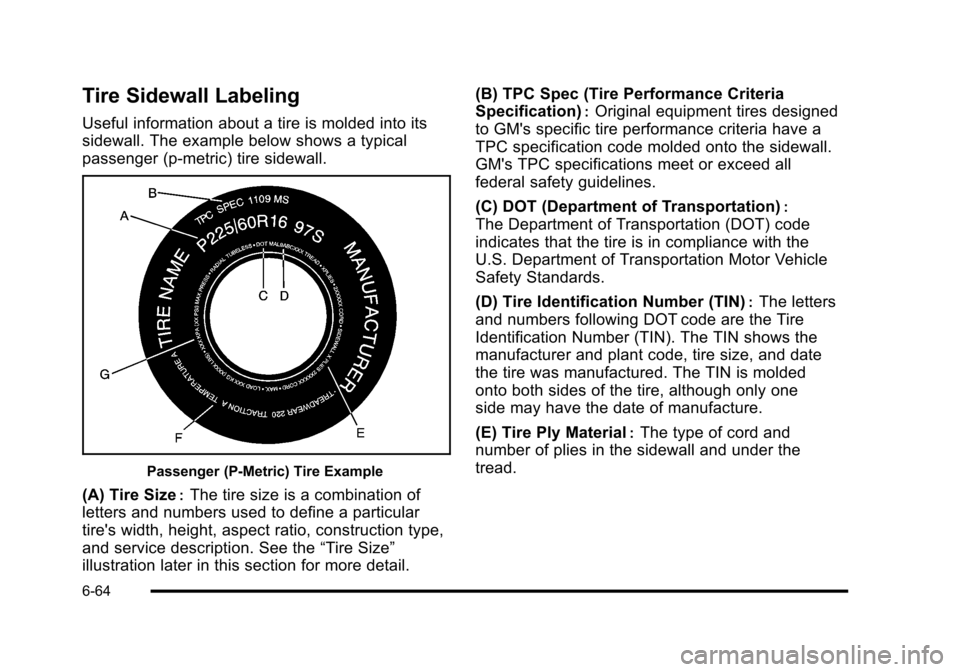
Useful information about a tire is molded into its
sidewall. The example below shows a typical
passenger (p‐metric) tire sidewall.
Passenger (P‐Metric) Tire Example
(A) Tire Size:The tire size is a combination of
letters and numbers used to define a particular
tire's width, height, aspect ratio, construction type,
and service description. See the “Tire Size”
illustration later in this section for more detail. (B) TPC Spec (Tire Performance Criteria
Specification)
:Original equipment tires designed
to GM's specific tire performance criteria have a
TPC specification code molded onto the sidewall.
GM's TPC specifications meet or exceed all
federal safety guidelines.
(C) DOT (Department of Transportation)
:
The Department of Transportation (DOT) code
indicates that the tire is in compliance with the
U.S. Department of Transportation Motor Vehicle
Safety Standards.
(D) Tire Identification Number (TIN)
:The letters
and numbers following DOT code are the Tire
Identification Number (TIN). The TIN shows the
manufacturer and plant code, tire size, and date
the tire was manufactured. The TIN is molded
onto both sides of the tire, although only one
side may have the date of manufacture.
(E) Tire Ply Material
:The type of cord and
number of plies in the sidewall and under the
tread.
6-64
Page 377 of 472
(F) Uniform Tire Quality Grading (UTQG):Tire
manufacturers are required to grade tires based
on three performance factors: treadwear, traction
and temperature resistance. For more information
see Uniform Tire Quality Grading
on page 6‑79.
(G) Maximum Cold Inflation Load Limit
:
Maximum load that can be carried and the
maximum pressure needed to support that load.
Tire Size
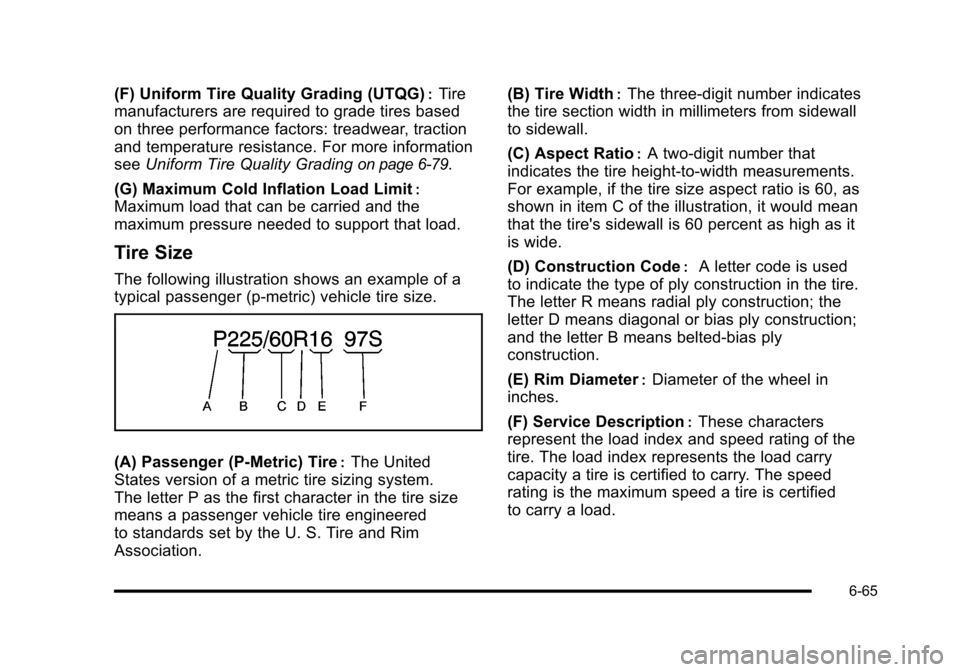
The following illustration shows an example of a
typical passenger (p‐metric) vehicle tire size.
(A) Passenger (P‐Metric) Tire:The United
States version of a metric tire sizing system.
The letter P as the first character in the tire size
means a passenger vehicle tire engineered
to standards set by the U. S. Tire and Rim
Association. (B) Tire Width
:The three‐digit number indicates
the tire section width in millimeters from sidewall
to sidewall.
(C) Aspect Ratio
:A two‐digit number that
indicates the tire height‐to‐width measurements.
For example, if the tire size aspect ratio is 60, as
shown in item C of the illustration, it would mean
that the tire's sidewall is 60 percent as high as it
is wide.
(D) Construction Code
:A letter code is used
to indicate the type of ply construction in the tire.
The letter R means radial ply construction; the
letter D means diagonal or bias ply construction;
and the letter B means belted‐bias ply
construction.
(E) Rim Diameter
:Diameter of the wheel in
inches.
(F) Service Description
:These characters
represent the load index and speed rating of the
tire. The load index represents the load carry
capacity a tire is certified to carry. The speed
rating is the maximum speed a tire is certified
to carry a load.
6-65
Page 380 of 472

Radial Ply Tire:A pneumatic tire in which the
ply cords that extend to the beads are laid at
90 degrees to the centerline of the tread.
Rim
:A metal support for a tire and upon which
the tire beads are seated.
Sidewall
:The portion of a tire between the tread
and the bead.
Speed Rating
:An alphanumeric code assigned
to a tire indicating the maximum speed at which a
tire can operate.
Traction
:The friction between the tire and the
road surface. The amount of grip provided.
Tread
:The portion of a tire that comes into
contact with the road.
Treadwear Indicators
:Narrow bands, sometimes
called wear bars, that show across the tread
of a tire when only 1/16 inch (1.6 mm) of tread
remains. See When It Is Time for New Tires
on
page 6‑76
. UTQGS (Uniform Tire Quality Grading
Standards)
:A tire information system that
provides consumers with ratings for a tire's
traction, temperature, and treadwear. Ratings
are determined by tire manufacturers using
government testing procedures. The ratings are
molded into the sidewall of the tire. See Uniform
Tire Quality Grading
on page 6‑79.
Vehicle Capacity Weight
:The number of
designated seating positions multiplied by 150 lbs
(68 kg) plus the rated cargo load. See Loading the
Vehicle
on page 5‑28.
Vehicle Maximum Load on the Tire
:Load on an
individual tire due to curb weight, accessory
weight, occupant weight, and cargo weight.
Vehicle Placard
:A label permanently attached
to a vehicle showing the vehicle's capacity
weight and the original equipment tire size and
recommended inflation pressure. See “Tire and
Loading Information Label” underLoading the
Vehicle
on page 5‑28.
6-68
Page 381 of 472
Run-Flat Tires
This vehicle, when new, had run-flat tires. There is no
spare tire, no tire changing equipment, and no place to
store a tire in the vehicle. Run-flat tires perform so well
without any air that a Tire Pressure Monitor System
(TPMS) is used to alert you if a tire has lost pressure.
{WARNING:
When the low tire warning light is displayed on
the instrument panel cluster, your vehicle's
handling capabilities will be reduced during
severe maneuvers. If you drive too fast, you could
lose control of your vehicle. You or others could
be injured. Do not drive over 55 mph (90 km/h)
when the low tire warning light is displayed.
Drive cautiously and check your tire pressures
as soon as you can.
If a tire goes flat, you will not need to stop on the side
of the road to change the tire. You can just keep on
driving. The shorter the distance you drive and the
slower the speed, the greater the chance that the tire will not have to be replaced. If you drive on a deflated
run-flat tire for 25 miles (40 km) or less and at speeds of
55 mph (90 km/h) or less, there is a good chance that
the tire can be repaired. The tires on coupe, convertible
and Z06 models can operate effectively with no air
pressure for up to 100 miles (160 km) at speeds up
to 55 mph (90 km/h), but the tire would then have to
be replaced. The tires on ZR1 models can operate
effectively with no air pressure for up to 50 miles
(80 km) at speeds up to 55 mph (90 km/h), but the tire
would then have to be replaced. When a tire is filled
with air, it provides a cushion between the road and the
wheel. Because you will not have this cushion when
driving on a deflated tire, try to avoid potholes that could
damage your wheel and require replacement of it.
Some road hazards can damage a tire beyond repair.
This damage could occur even before you have driven
on the tire in a deflated condition. When a tire has
been damaged, or if you have driven any distance on
a run-flat tire, check with an authorized run-flat tire
service center to determine whether the tire can be
repaired or should be replaced. To maintain your
vehicle's run-flat feature, all replacement tires must
be self-supporting tires. As soon as possible,
contact the nearest authorized GM or run-flat servicing
facility for inspection and repair or replacement.
6-69
Page 382 of 472
To locate the nearest GM or run-flat servicing facility,
call Roadside Assistance. For phone numbers and
Roadside Service details see Roadside Assistance
Program
on page 8‑7.
{WARNING:
Run-flat tires are constructed differently than other
tires and could explode during improper service.
You or others could be injured or killed if you
attempt to repair, replace, dismount, or mount
a run-flat tire. Let only an authorized run-flat
service center repair, replace, dismount, and
mount run-flat tires.
The valve stems on your run-flat tires have sensors that
are part of the Tire Pressure Monitor System (TPMS).
See Tire Pressure Monitor System
on page 6‑72.
These sensors contain batteries which are designed
to last for 10 years under normal driving conditions. See
your dealer/retailer if you ever need to have a wheel
replaced, or if the sensors ever need replacement.
Notice: Using liquid sealants can damage the tire
valves and tire pressure monitor sensors in the
vehicle's run-flat tires. This damage would not be
covered by warranty. Do not use liquid sealants in
the vehicle's run-flat tires.
Inflation - Tire Pressure
Tires need the correct amount of air pressure to
operate effectively.
Notice:Do not let anyone tell you that
under‐inflation or over‐inflation is all right.
It is not. If your tires do not have enough air
(under‐inflation), you can get the following:
.Too much flexing
.Too much heat
.Tire overloading
.Premature or irregular wear
.Poor handling
.Reduced fuel economy
If your tires have too much air (over‐inflation),
you can get the following:
.Unusual wear
.Poor handling
.Rough ride
.Needless damage from road hazards
6-70
Page 383 of 472
A vehicle specific Tire and Loading Information
label is attached to your vehicle. This label shows
your vehicle's original equipment tires and the
correct inflation pressures for your tires when they
are cold. The recommended cold tire inflation
pressure, shown on the label, is the minimum
amount of air pressure needed to support your
vehicle's maximum load carrying capacity.
For additional information regarding how much
weight your vehicle can carry, and an example
of the Tire and Loading Information label, see
Loading the Vehicle
on page 5‑28. How you
load your vehicle affects vehicle handling and
ride comfort. Never load your vehicle with more
weight than it was designed to carry.
When to Check
Check your tires once a month or more.
How to Check
Use a good quality pocket-type gauge to check
tire pressure. You cannot tell if your tires are
properly inflated simply by looking at them.
Radial tires may look properly inflated even
when they are under‐inflated. Check the tire's
inflation pressure when the tires are cold.
Cold means your vehicle has been sitting for
at least three hours or driven no more than
1 mile (1.6 km).
Remove the valve cap from the tire valve stem.
Press the tire gauge firmly onto the valve to get a
pressure measurement. If the cold tire inflation
pressure matches the recommended pressure on
the Tire and Loading Information label, no further
adjustment is necessary. If the inflation pressure
is low, add air until you reach the recommended
amount.
If you overfill the tire, release air by pushing on
the metal stem in the center of the tire valve.
Re‐check the tire pressure with the tire gauge.
Be sure to put the valve caps back on the valve
stems. They help prevent leaks by keeping out dirt
and moisture.
6-71