2010 CADILLAC ESCALADE ignition
[x] Cancel search: ignitionPage 395 of 616

Antilock Brake System (ABS)
This vehicle has the Antilock Brake System (ABS), anadvanced electronic braking system that helps preventa braking skid.
When the engine is started and the vehicle begins todrive away, ABS checks itself. A momentary motor orclicking noise might be heard while this test is going on.This is normal.
If there is a problem withABS, this warning lightstays on. SeeAntilockBrake System (ABS)Warning Lightonpage 4!34.
Along with ABS, the vehicle has a Dynamic RearProportioning (DRP) system. If there is a DRP problem,both the brake and ABS warning lights come onaccompanied by a 10!second chime. The lights andchime will come on each time the ignition is turned onuntil the problem is repaired. See your dealer/retailerfor service.
Let us say the road is wet and you are driving safely.Suddenly, an animal jumps out in front of you. You slamon the brakes and continue braking. Here is whathappens with ABS:
A computer senses that the wheels are slowing down.If one of the wheels is about to stop rolling, thecomputer will separately work the brakes at each frontwheel and at both rear wheels.
ABS can change the brake pressure to each wheel, asrequired, faster than any driver could. This can help thedriver steer around the obstacle while braking hard.
As the brakes are applied, the computer keepsreceiving updates on wheel speed and controls brakingpressure accordingly.
Remember: ABS does not change the time needed toget a foot up to the brake pedal or always decreasestopping distance. If you get too close to the vehicle infront of you, there will not be enough time to apply thebrakes if that vehicle suddenly slows or stops. Alwaysleave enough room up ahead to stop, even with ABS.
6-5
Page 414 of 616

Driving in Water
{WARNING:
Driving through rushing water can be dangerous.
Deep water can sweep your vehicle downstream
and you and your passengers could drown. If it is
only shallow water, it can still wash away the
ground from under your tires, and you could lose
traction and roll the vehicle over. Do not drive
through rushing water.
Heavy rain can mean flash flooding, and flood watersdemand extreme caution.
Find out how deep the water is before driving throughit. Do not try it if it is deep enough to cover the wheelhubs, axles, or exhaust pipe—you probably will not getthrough. Deep water can damage the axle and othervehicle parts.
If the water is not too deep, drive slowly through it.At faster speeds, water splashes on the ignition systemand the vehicle can stall. Stalling can also occur if youget the tailpipe under water. If the tailpipe is underwater, you will never be able to start the engine. Whengoing through water, remember that when the brakesget wet, it might take longer to stop. SeeDriving in Rainand on Wet Roads on page 6!25.
After Off-Road Driving
Remove any brush or debris that has collectedon the underbody, chassis, or under the hood.These accumulations can be a fire hazard.
After operation in mud or sand, have the brake liningscleaned and checked. These substances can causeglazing and uneven braking. Check the body structure,steering, suspension, wheels, tires, and exhaust systemfor damage and check the fuel lines and cooling systemfor any leakage.
The vehicle requires more frequent service due tooff-road use. Refer to the Maintenance Schedule foradditional information.
Driving at Night
Night driving is more dangerous than day drivingbecause some drivers are likely to be impaired—byalcohol or drugs, with night vision problems, or byfatigue.
Night driving tips include:
.Drive defensively.
.Do not drink and drive.
.Reduce headlamp glare by adjusting the insiderearview mirror.
6-24
Page 417 of 616

Hill and Mountain Roads
Driving on steep hills or through mountains is differentthan driving on flat or rolling terrain. Tips for driving inthese conditions include:
.Keep the vehicle serviced and in good shape.
.Check all fluid levels and brakes, tires, coolingsystem, and transmission.
.Going down steep or long hills, shift to alower gear.
{WARNING:
If you do not shift down, the brakes could get so
hot that they would not work well. You would then
have poor braking or even none going down a hill.
You could crash. Shift down to let the engine
assist the brakes on a steep downhill slope.
{WARNING:
Coasting downhill in N (Neutral) or with the
ignition off is dangerous. The brakes will have to
do all the work of slowing down and they could
get so hot that they would not work well. You
would then have poor braking or even none going
down a hill. You could crash. Always have the
engine running and the vehicle in gear when
going downhill.
.Stay in your own lane. Do not swing wide or cutacross the center of the road. Drive at speeds thatlet you stay in your own lane.
.Top of hills: Be alert—something could be in yourlane (stalled car, accident).
.Pay attention to special road signs (falling rocksarea, winding roads, long grades, passing orno-passing zones) and take appropriate action.
SeeOff-Road Drivingon page 6!13for informationabout driving off-road.
6-27
Page 428 of 616

The system is activated when the ignition key
is turned to RUN and will automatically adjust
vehicle height thereafter. The system may exhaust
(lower vehicle height) for up to 10 minutes after
the ignition key has been turned to LOCK. You
may hear the air compressor operating when the
height is being adjusted.
If a weight-distributing hitch is being used, it is
recommended to allow the shocks to inflate,
thereby leveling the vehicle prior to adjusting the
height. See“Weight distributing Hitches and
Weight Carrying Hitches”underTowing a Trailer
on page 6!42.
Towing
Towing Your Vehicle
To avoid damage, the disabled vehicle should betowed with all four wheels off the ground. Consult yourdealer/retailer or a professional towing service if thedisabled vehicle must be towed. SeeRoadside Serviceo n p a g e 9!8.
To tow the vehicle behind another vehicle forrecreational purposes (such as behind a motorhome),see“Recreational Vehicle Towing”following.
Recreational Vehicle Towing
If the vehicle has a two–mode hybrid engine, see theTwo–mode Hybrid manual for more information.
Recreational vehicle towing means towing the vehiclebehind another vehicle–such as behind a motorhome.The two most common types of recreational vehicletowing are known as“dinghy towing”(towing the vehiclewith all four wheels on the ground) and“dolly towing”(towing the vehicle with two wheels on the ground andtwo wheels up on a device known as a“dolly”).
Here are some important things to consider beforerecreational vehicle towing:
.What is the towing capacity of the towing vehicle?Be sure to read the tow vehicle manufacturer'srecommendations.
.What is the distance that will be travelled? Somevehicles have restrictions on how far and how longthey can tow.
.Is the proper towing equipment going to be used?See your dealer/retailer or trailering professionalfor additional advice and equipmentrecommendations.
.Is the vehicle ready to be towed? Just as preparingthe vehicle for a long trip, make sure the vehicle isprepared to be towed. SeeBefore Leaving on aLong Trip on page 6!26.
6-38
Page 431 of 616
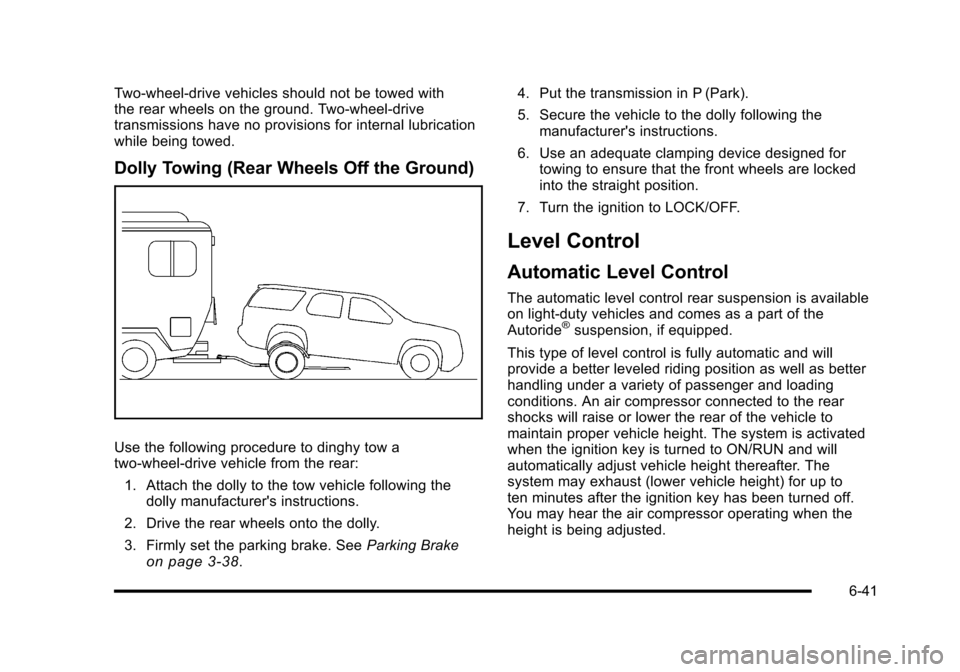
Two-wheel-drive vehicles should not be towed withthe rear wheels on the ground. Two-wheel-drivetransmissions have no provisions for internal lubricationwhile being towed.
Dolly Towing (Rear Wheels Off the Ground)
Use the following procedure to dinghy tow atwo-wheel-drive vehicle from the rear:
1. Attach the dolly to the tow vehicle following thedolly manufacturer's instructions.
2. Drive the rear wheels onto the dolly.
3. Firmly set the parking brake. SeeParking Brakeon page 3!38.
4. Put the transmission in P (Park).
5. Secure the vehicle to the dolly following themanufacturer's instructions.
6. Use an adequate clamping device designed fortowing to ensure that the front wheels are lockedinto the straight position.
7. Turn the ignition to LOCK/OFF.
Level Control
Automatic Level Control
The automatic level control rear suspension is availableon light!duty vehicles and comes as a part of theAutoride®suspension, if equipped.
This type of level control is fully automatic and willprovide a better leveled riding position as well as betterhandling under a variety of passenger and loadingconditions. An air compressor connected to the rearshocks will raise or lower the rear of the vehicle tomaintain proper vehicle height. The system is activatedwhen the ignition key is turned to ON/RUN and willautomatically adjust vehicle height thereafter. Thesystem may exhaust (lower vehicle height) for up toten minutes after the ignition key has been turned off.You may hear the air compressor operating when theheight is being adjusted.
6-41
Page 485 of 616

Windshield Washer Fluid
What to Use
When windshield washer fluid needs to be added, besure to read the manufacturer's instructions before use.Use a fluid that has sufficient protection against freezingin an area where the temperature may fall belowfreezing.
Adding Washer Fluid
The vehicle has a low washer fluid message in the DICthat comes on when the washer fluid is low. Themessage is displayed for 15 seconds at the start ofeach ignition cycle. When the WASHER FLUID LOWADD FLUID message displays, you will need to addwasher fluid to the windshield washer fluid reservoir.
Open the cap with thewasher symbol on it. Addwasher fluid until the tankis full. SeeEngineCompartment Overviewon page 7!16forreservoir location.
Notice:
.When using concentrated washer fluid,
follow the manufacturer's instructions for
adding water.
.Do not mix water with ready-to-use washer
fluid. Water can cause the solution to freeze
and damage the washer fluid tank and other
parts of the washer system. Also, water does
not clean as well as washer fluid.
.Fill the washer fluid tank only three-quarters
full when it is very cold. This allows for fluid
expansion if freezing occurs, which could
damage the tank if it is completely full.
.Do not use engine coolant (antifreeze) in the
windshield washer. It can damage the
vehicle's windshield washer system and
paint.
7-39
Page 491 of 616

Notice:Ignoring these steps could result in costlydamage to the vehicle that would not be covered bythe warranty.
Trying to start the vehicle by pushing or pulling itwill not work, and it could damage the vehicle.
1. Check the other vehicle. It must have a 12-voltbattery with a negative ground system.
Notice:If the other vehicle's system is not a 12-voltsystem with a negative ground, both vehicles canbe damaged. Only use vehicles with 12-volt systemswith negative grounds to jump start your vehicle.
2. Get the vehicles close enough so the jumpercables can reach, but be sure the vehicles are nottouching each other. If they are, it could cause aground connection you do not want. You would notbe able to start your vehicle, and the badgrounding could damage the electrical systems.
To avoid the possibility of the vehicles rolling, setthe parking brake firmly on both vehicles involvedin the jump start procedure. Put the automatictransmission in P (Park) or a manual transmissionin Neutral before setting the parking brake. If youhave a four-wheel-drive vehicle, be sure thetransfer case is in a drive gear, not in Neutral.
Notice:If you leave the radio or other accessorieson during the jump starting procedure, they couldbe damaged. The repairs would not be covered bythe warranty. Always turn off the radio and otheraccessories when jump starting the vehicle.
3. Turn off the ignition on both vehicles. Unplugunnecessary accessories plugged into thecigarette lighter or the accessory power outlets.Turn off the radio and all the lamps that are notneeded. This avoids sparks and helps save bothbatteries. And it could save the radio!
4. Open the hood on the other vehicle and locate thepositive (+) and negative (!) terminal locations onthat vehicle.
Your vehicle has a remote positive (+) jump startingterminal and a remote negative (!) jump startingterminal. You should always use these remoteterminals instead of the terminals on the battery.
If the vehicle has a remote positive (+) terminal, itis located under a red plastic cover at the positivebattery post. To uncover the remote positive (+)terminal, open the red plastic cover.
7-45
Page 514 of 616

Federal Communications Commission
(FCC) and Industry and Science Canada
SeeRadio Frequency Statementon page 9!20forinformation regarding Part 15 of the FederalCommunications Commission (FCC) Rules andRSS-210/211 of Industry and Science Canada.
Tire Pressure Monitor Operation
If your vehicle is a Two!mode Hybrid, see theTwo!mode Hybrid manual for more information.
This vehicle may have a Tire Pressure Monitor System(TPMS). The TPMS is designed to warn the driver whena low tire pressure condition exists. TPMS sensors aremounted onto each tire and wheel assembly, excludingthe spare tire and wheel assembly. The TPMS sensorsmonitor the air pressure in the vehicle's tires andtransmit the tire pressure readings to a receiver locatedin the vehicle.
When a low tire pressurecondition is detected, theTPMS illuminates the lowtire pressure warning lightlocated on the instrumentpanel cluster.
At the same time a message to check the pressure in aspecific tire appears on the Driver Information Center(DIC) display. The low tire pressure warning light andthe DIC warning message come on at each ignitioncycle until the tires are inflated to the correct inflationpressure. Using the DIC, tire pressure levels can beviewed by the driver. For additional information anddetails about the DIC operation and displays seeDICOperation and Displayson page 4!41andDICWarnings and Messages on page 4!48.
The low tire pressure warning light may come on in coolweather when the vehicle is first started, and then turnoff as you start to drive. This could be an early indicatorthat the air pressure in the tire(s) are getting low andneed to be inflated to the proper pressure.
A Tire and Loading Information label, attached to yourvehicle, shows the size of your vehicle's originalequipment tires and the correct inflation pressure foryour vehicle's tires when they are cold. SeeLoading theVehicleon page 6!32, for an example of the Tire andLoading Information label and its location on yourvehicle. Also seeInflation - Tire Pressure on page 7!65.
7-68