2010 CADILLAC ESCALADE light
[x] Cancel search: lightPage 117 of 616

{WARNING:
A child in a rear-facing child restraint can be
seriously injured or killed if the right front
passenger airbag inflates. This is because the
back of the rear-facing child restraint would be
very close to the inflating airbag. A child in a
forward-facing child restraint can be seriously
injured or killed if the right front passenger airbag
inflates and the passenger seat is in a forward
position.
Even if the passenger sensing system has turned
off the right front passenger frontal airbag, no
system is fail-safe. No one can guarantee that an
airbag will not deploy under some unusual
circumstance, even though the airbag is
turned off.
Secure rear-facing child restraints in a rear seat,
even if the airbag is off. If you secure a
forward-facing child restraint in the right front seat,
always move the front passenger seat as far back
as it will go. It is better to secure the child restraint
in a rear seat.
The passenger sensing system is designed to turn offthe right front passenger frontal airbag if:
.The right front passenger seat is unoccupied.
.The system determines an infant is present in achild restraint.
.A right front passenger takes his/her weight off ofthe seat for a period of time.
.Or, if there is a critical problem with the airbagsystem or the passenger sensing system.
When the passenger sensing system has turned off theright front passenger frontal airbag, the off indicator willlight and stay lit to remind you that the airbag is off. SeePassenger Airbag Status Indicator on page 4!31.
The passenger sensing system is designed to turn on(may inflate) the right front passenger frontal airbaganytime the system senses that a person of adult size issitting properly in the right front passenger seat.
When the passenger sensing system has allowed theairbag to be enabled, the on indicator will light and staylit to remind you that the airbag is active.
2-85
Page 118 of 616

For some children, including children in child restraints,and for very small adults, the passenger sensingsystem may or may not turn off the right front passengerfrontal airbag, depending upon the person's seatingposture and body build. Everyone in your vehicle whohas outgrown child restraints should wear a safety beltproperly—whether or not there is an airbag forthat person.
{WARNING:
If the airbag readiness light ever comes on and
stays on, it means that something may be wrong
with the airbag system. To help avoid injury to
yourself or others, have the vehicle serviced right
away. SeeAirbag Readiness Lighton page 4!30
for more information, including important safety
information.
If the On Indicator is Lit for a Child
Restraint
If a child restraint has been installed and the onindicator is lit:
1. Turn the vehicle off.
2. Remove the child restraint from the vehicle.
3. Remove any additional items from the seat such asblankets, cushions, seat covers, seat heaters,or seat massagers.
4. Reinstall the child restraint following the directionsprovided by the child restraint manufacturer andrefer toSecuring a Child Restraint in the RightFront Seat Position on page 2!71.
5. If, after reinstalling the child restraint and restartingthe vehicle, the on indicator is still lit, turn thevehicle off. Then slightly recline the vehicleseatback and adjust the seat cushion, if adjustable,to make sure that the vehicle seatback is notpushing the child restraint into the seat cushion.
Also make sure the child restraint is not trappedunder the vehicle head restraint. If this happens,adjust the head restraint. SeeHead Restraintsonp a g e 2!2.
6. Restart the vehicle.
The passenger sensing system may or may notturn off the airbag for a child in a child restraintdepending upon the child’s seating posture andbody build. It is better to secure the child restraintin a rear seat.
2-86
Page 123 of 616

Restraint System Check
Checking the Restraint Systems
Safety Belts
Now and then, check that the safety belt reminder light,safety belts, buckles, latch plates, retractors, andanchorages are all working properly.
Look for any other loose or damaged safety belt systemparts that might keep a safety belt system from doing itsjob. See your dealer/retailer to have it repaired. Torn orfrayed safety belts may not protect you in a crash. Theycan rip apart under impact forces. If a belt is torn orfrayed, get a new one right away.
Make sure the safety belt reminder light is working.SeeSafety Belt Reminderson page 4!29for moreinformation.
Keep safety belts clean and dry. SeeCare of SafetyBeltson page 7!102.
Airbags
The airbag system does not need regularly scheduledmaintenance or replacement. Make sure the airbagreadiness light is working. SeeAirbag Readiness Lighton page 4!30for more information.
Notice:If an airbag covering is damaged,opened, or broken, the airbag may not workproperly. Do not open or break the airbag coverings.If there are any opened or broken airbag covers,have the airbag covering and/or airbag modulereplaced. For the location of the airbag modules,seeWhat Makes an Airbag Inflate?on page 2!81.See your dealer/retailer for service.
2-91
Page 124 of 616

Replacing Restraint System Parts
After a Crash
{WARNING:
A crash can damage the restraint systems in your
vehicle. A damaged restraint system may not
properly protect the person using it, resulting in
serious injury or even death in a crash. To help
make sure your restraint systems are working
properly after a crash, have them inspected and
any necessary replacements made as soon as
possible.
If the vehicle has been in a crash, do you need newsafety belts or LATCH system (if equipped) parts?
After a very minor crash, nothing may be necessary.But the safety belt assemblies that were used duringany crash may have been stressed or damaged. Seeyour dealer/retailer to have the safety belt assembliesinspected or replaced.
If the vehicle has the LATCH system and it wasbeing used during a crash, you may need new LATCHsystem parts.
New parts and repairs may be necessary even if thesafety belt or LATCH system (if equipped), was notbeing used at the time of the crash.
If an airbag inflates, you will need to replace airbagsystem parts. See the part on the airbag system earlierin this section.
Have the safety belt pretensioners checked if thevehicle has been in a crash, if the airbag readiness lightstays on after the vehicle is started, or while you aredriving. SeeAirbag Readiness Lighton page 4!30.
2-92
Page 129 of 616

The following functions may be available if this vehiclehas the RKE system:
Q(Lock):Press to lock all the doors.
If enabled through the Driver Information Center (DIC),the turn signal lamps flash once to indicate locking hasoccurred. If enabled through the DIC, the horn chirps
whenQis pressed again within three seconds. SeeDIC
Vehicle Customizationon page 4!57for additionalinformation.
PressingQarms the content theft!deterrent system.
SeeContent Theft-Deterrent on page 3!22.
K(Unlock):Press once to unlock only the driver door.
IfKis pressed again within three seconds, all
remaining doors unlock. The interior lamps maycome on and stay on for 20 seconds or until theignition is turned on.
If enabled through the DIC, the turn signal lamps flashtwice to indicate unlocking has occurred. SeeDICVehicle Customizationon page 4!57. If enabledthrough the DIC, the exterior lights turn on briefly if it isdark enough outside. See“APPROACH LIGHTING”underDIC Vehicle Customizationon page 4!57.
PressingKon the RKE transmitter disarms the content
theft!deterrent system. SeeContent Theft-Deterrentonpage 3!22.
/(Remote Vehicle Start):For vehicles with this
feature, press/to start the engine from outside the
vehicle using the RKE transmitter. SeeRemote VehicleStarto n p a g e 3!7for additional information.
&(Power Liftgate):Press and hold to open andclose the liftgate. The taillamps flash and a chimesounds to indicate when the liftgate is opening andclosing.
m(Liftglass):Press and hold to open the liftglass.
L(Vehicle Locator/Panic Alarm):Press and releaseto locate the vehicle. The turn signal lamps flash andthe horn sounds three times.
Press and holdLfor more than two seconds to
activate the panic alarm. The turn signal lamps flashand the horn sounds repeatedly for 30 seconds.The alarm turns off when the ignition is moved to
ON/RUN orLis pressed again. The ignition must
be in LOCK/OFF for the panic alarm to work.
3-5
Page 132 of 616

If your vehicle has the remote start feature, theRKE transmitter functions will have an increased rangeof operation. However, the range may be less while thevehicle is running.
There are other conditions which can affect theperformance of the transmitter, seeRemote KeylessEntry (RKE) Systemo n p a g e 3!4for additionalinformation.
/(Remote Start) :This button will be on theRKE transmitter if you have remote start.
To start the vehicle using the remote start feature:
1. Aim the transmitter at the vehicle.
2. Press and release the transmitter's lock button.The vehicle's doors will lock. Immediately pressand hold the transmitter's remote start button untilthe turn signal lights flash. If you cannot see thevehicle's lights, press and hold the remote startbutton for two to four seconds. Pressing the remotestart button again after the vehicle has started willturn the engine off.
When the vehicle starts, the parking lamps will turnon and remain on while the vehicle is running.
If the vehicle is left running it will automatically shutoff after 10 minutes unless a time extension hasbeen done.
3. If it is the first remote start since the vehicle hasbeen driven, repeat these steps, while the engineis still running, to extend the engine running timeby 10 minutes. Remote start can be extendedone time.
After entering the vehicle during a remote start, insertand turn the key to ON/RUN to drive the vehicle.
To manually shut off a remote start, do any of thefollowing:
.Aim the RKE transmitter at the vehicle and pressthe remote start button until the parking lampsturn off.
.Turn on the hazard warning flashers.
.Turn the ignition switch on and then off.
The vehicle can be remote started two separate timesbetween driving sequences. The engine will run for10 minutes after each remote start.
Or, you can extend the engine run time by another10 minutes within the first 10 minute remote start timeframe, and before the engine stops.
3-8
Page 133 of 616

For example, if the lock button and then the remote startbuttons are pressed again after the vehicle has beenrunning for five minutes, 10 minutes are added, allowingthe engine to run for 15 minutes.
The additional ten minutes are considered a secondremote vehicle start.
After your vehicles engine has been started two timesusing the remote vehicle start button, or a single remotestart with one time extension, the vehicle must bestarted with the key.
After the key is removed from the ignition, the vehiclecan be remote started again.
The vehicle cannot be remote started if the key is inthe ignition, the hood is not closed, or if there is anemission control system malfunction and the checkengine light comes on.
Also, the engine will turn off during a remote vehiclestart if the coolant temperature gets too high or if the oilpressure gets low.
Vehicles that have the remote vehicle start feature areshipped from the factory with the remote vehicle startsystem enabled. The system may be enabled ordisabled through the DIC. See“REMOTE START”underDIC Vehicle Customizationon page 4!57foradditional information.
3-9
Page 137 of 616
SeePower Liftgateon page 3!14for more informationon how to use the power liftgate.
To unlock the liftgate, use the power door lock switch orpress the door unlock button on the Remote KeylessEntry (RKE) transmitter twice. SeeRemote KeylessEntry (RKE) System Operationo n p a g e 3!4.
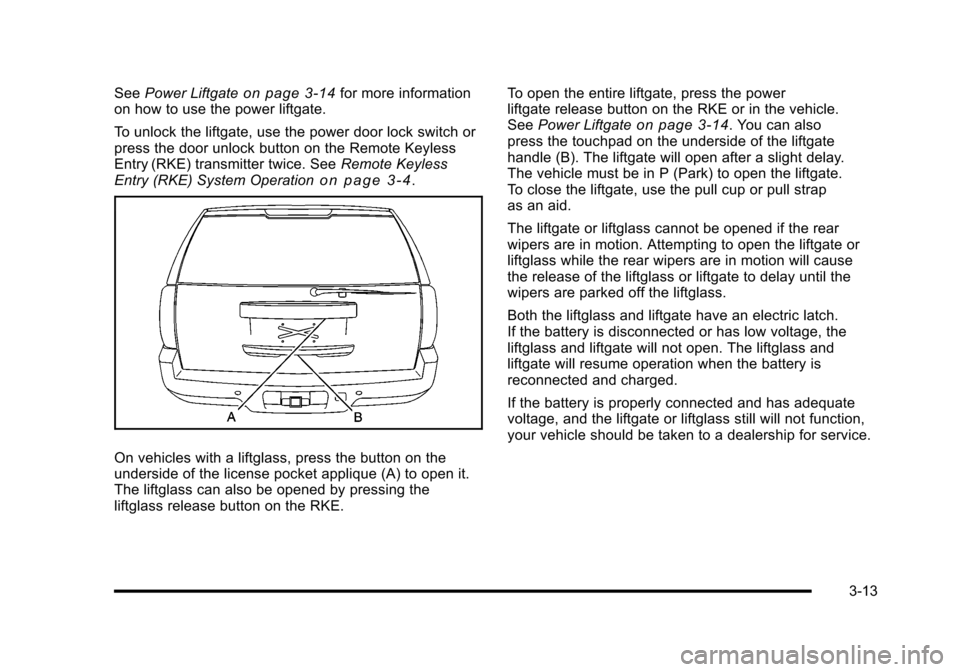
On vehicles with a liftglass, press the button on theunderside of the license pocket applique (A) to open it.The liftglass can also be opened by pressing theliftglass release button on the RKE.
To open the entire liftgate, press the powerliftgate release button on the RKE or in the vehicle.SeePower Liftgateon page 3!14. You can alsopress the touchpad on the underside of the liftgatehandle (B). The liftgate will open after a slight delay.The vehicle must be in P (Park) to open the liftgate.To close the liftgate, use the pull cup or pull strapas an aid.
The liftgate or liftglass cannot be opened if the rearwipers are in motion. Attempting to open the liftgate orliftglass while the rear wipers are in motion will causethe release of the liftglass or liftgate to delay until thewipers are parked off the liftglass.
Both the liftglass and liftgate have an electric latch.If the battery is disconnected or has low voltage, theliftglass and liftgate will not open. The liftglass andliftgate will resume operation when the battery isreconnected and charged.
If the battery is properly connected and has adequatevoltage, and the liftgate or liftglass still will not function,your vehicle should be taken to a dealership for service.
3-13