Page 28 of 616

Performance and Maintenance
StabiliTrak®
The vehicle may have a traction control system thatlimits wheel spin and the StabiliTrak system that assistswith directional control of the vehicle in difficult drivingconditions. Both systems turn on automatically everytime the vehicle is started.
.To turn off traction control, press and release5on
the instrument panel.Filluminates and the
appropriate DIC message displays. SeeDICWarnings and Messages on page 4!48.
.To turn off both traction control and Electronic
Stability Control, press and hold5untilF
illuminates and the appropriate DIC messagedisplays. SeeDIC Warnings and Messagesonpage 4!48.
.Press and release the button again to turn onboth systems.
For more information, seeStabiliTrak®Systemonp a g e 6!6.
Tire Pressure Monitor
This vehicle may have a Tire Pressure MonitorSystem (TPMS).
The Tire Pressure Monitoralerts you when asignificant reduction inpressure occurs in one ormore of the vehicle’s tiresby illuminating the low tirepressure warning light onthe instrument cluster.
The warning light will remain on until the tire pressure iscorrected. The proper tire pressures for your vehicle arelisted on the Tire and Loading Information label locatedon the driver side center pillar (B pillar). SeeLoadingthe Vehicleon page 6!32.
You may notice during cooler conditions that the low tirepressure warning light will appear when the vehicle isfirst started and then turn off as you drive. This may bean early indicator that your tire pressures are gettinglow and the tires need to be inflated to the properpressure.
1-22
Page 32 of 616
![CADILLAC ESCALADE 2010 3.G Owners Manual The OnStar system can record and transmit vehicleinformation. This information is automatically sent to an
OnStar call center whenQis pressed,]is pressed,
or if the airbags or ACR system deploy. This](/manual-img/23/7913/w960_7913-31.png "CADILLAC ESCALADE 2010 3.G Owners Manual The OnStar system can record and transmit vehicleinformation. This information is automatically sent to an
OnStar call center whenQis pressed,]is pressed,
or if the airbags or ACR system deploy. This")
The OnStar system can record and transmit vehicleinformation. This information is automatically sent to an
OnStar call center whenQis pressed,]is pressed,
or if the airbags or ACR system deploy. This informationusually includes the vehicle's GPS location and, in theevent of a crash, additional information regarding thecrash that the vehicle was involved in (e.g. the directionfrom which the vehicle was hit). When the virtualadvisor feature of OnStar hands-free calling is used, thevehicle also sends OnStar the vehicle's GPS locationso they can provide services where it is located.
Location information about the vehicle is only availableif the GPS satellite signals are unobstructed andavailable.
The vehicle must have a working electrical system,including adequate battery power, for the OnStarequipment to operate. There are other problemsOnStar cannot control that may prevent OnStar fromproviding OnStar service at any particular time or place.Some examples are damage to important parts of thevehicle in a crash, hills, tall buildings, tunnels, weatheror wireless phone network congestion.
OnStar Steering Wheel Controls
This vehicle may have a Talk/Mute button that can beused to interact with OnStar hands-free calling. SeeAudio Steering Wheel Controlson page 4!105for moreinformation.
On some vehicles, the mute button can be used to dialnumbers into voice mail systems, or to dial phoneextensions. See the OnStar Owner's Guide for moreinformation.
Your Responsibility
Increase the volume of the radio if the OnStar advisorcannot be heard.
If the light next to the OnStar buttons is red, the system
may not be functioning properly. PressQand request a
vehicle diagnostic. If the light appears clear (no light isappearing), your OnStar subscription has expired and
all services have been deactivated. PressQto confirm
that the OnStar equipment is active.
1-26
Page 46 of 616

Folding and Tumbling the Second Row
Seat(s) from the Third Row Seats or
Outside
{WARNING:
Using the third row seating position while the
second row is folded, or folded and tumbled, could
cause injury in a sudden stop or crash. Be sure to
return the seat to the passenger seating position.
Push and pull on the seat to make sure it is
locked into place.
To fold and tumble the seat from the third row seats,if your vehicle has them:
1. Make sure that there is nothing under, in front of,or on the seat.
Notice:Folding a rear seat with the safety beltsstill fastened may cause damage to the seat or thesafety belts. Always unbuckle the safety belts andreturn them to their normal stowed position beforefolding a rear seat.
Driver's Side Rear PanelButton shown
2. Press the automaticseat release buttonlocated on the panelbehind the rear doors.
One press of the button automatically foldsthe seatback flat and tumbles the seat forward.There will be a slight delay between the foldingof the seatback and the tumbling of the seat.
2-14
Page 53 of 616

Driver's Side Rear PanelButton shown
2. Press the automaticseat release buttonlocated on the panelbehind the rear doors.
One press of the button automatically foldsthe seatback flat and tumbles the seat forward.There will be a slight delay between the folding ofthe seatback and the tumbling of the seat.
Returning the Seat(s) to the Sitting
Position
To return the seat to the sitting position, do thefollowing:
1. Pull the seat down until it latches to the floor.The seatback cannot be raised if the seat is notlatched to the floor.
{WARNING:
If either seatback is not locked, it could move
forward in a sudden stop or crash. That could
cause injury to the person sitting there. Always
push and pull on the seatbacks to be sure they
are locked.
2. Lift the seatback and push it rearward. Push andpull on the seatback to make sure it is locked.
Third Row Seat
If the vehicle has a third row seat, the seatback(s) canbe folded and the entire seat can be tumbled,or removed from the vehicle.
2-21
Page 57 of 616

Installing the Third Row Seat
To install the seat, do the following:
1. Open the liftgate to access the rear of the vehicle.
2. Slide the front outboard seat wheels into the trackon the floor and roll the seat forward. The frontlatches should lock into place. If the latches do notlock, try tilting the rear of the seat upward slightly.
3. Lower the rear of the seat and push down on theseat to engage the rear floor latches.
{WARNING:
A seat that is not locked into place properly can
move around in a collision or sudden stop. People
in the vehicle could be injured. Be sure to lock the
seat into place properly when installing it.
4. Push and pull on the seat to make sure it islocked into place. The seatback cannot be raisedto the upright position unless the seat is securedto the floor.
5. Pull up on the seatback until it locks into theupright position.
{WARNING:
If either seatback is not locked, it could move
forward in a sudden stop or crash. That could
cause injury to the person sitting there. Always
push and pull on the seatbacks to be sure they
are locked.
6. Push and pull on the seatback to make sure itis locked.
{WARNING:
A safety belt that is improperly routed, not
properly attached, or twisted will not provide the
protection needed in a crash. The person wearing
the belt could be seriously injured. After raising
the rear seatback, always check to be sure that
the safety belts are properly routed and attached,
and are not twisted.
7. Make sure the safety belts are returned to theoriginal position over the seatbacks.
2-25
Page 71 of 616
Lap-Shoulder Belt
All seating positions in the vehicle have a lap-shoulderbelt except for the center front passenger position,if equipped, which has a lap belt. SeeLap Beltonpage 2!47for more information.
The lap!shoulder belts for the first and second rowseating positions are equipped with free!falling latchplates. If the vehicle has a third row, the lap!shoulderbelts have either free!falling or cinching latch plates.
Use the following pictures to determine the latchplate style:
Free-Falling Latch Plate
Cinching Latch Plate
The following instructions explain how to wear alap-shoulder belt properly.
1. Adjust the seat, if the seat is adjustable, so youcan sit up straight. To see how, see“Seats”inthe Index.
2. Pick up the latch plate and pull the belt across you.Do not let it get twisted.
The lap-shoulder belt may lock if you pull the beltacross you very quickly. If this happens, let the beltgo back slightly to unlock it. Then pull the beltacross you more slowly.
2-39
Page 106 of 616

If the vehicle is equipped with the passenger sensingsystem, and when the passenger sensing system hasturned off the right front passenger frontal airbag, the offindicator in the passenger airbag status indicator shouldlight and stay lit when you start the vehicle. SeePassenger Airbag Status Indicator on page 4!31.
If a child restraint has been installed and the onindicator is lit, see“If the On Indicator is Lit for aChild Restraint”underPassenger Sensing Systemonpage 2!84for more information.
To remove the child restraint, unbuckle the vehiclesafety belt and let it return to the stowed position.
Airbag System
The vehicle has the following airbags:
.A frontal airbag for the driver.
.A frontal airbag for the right front passenger.
.A roof-rail airbag for the driver and passengerdirectly behind the driver.
.A roof-rail airbag for the right front passenger andthe person seated directly behind that passenger.
The vehicle may have the following airbags:
.A seat!mounted side impact airbag for the driver.
.A seat!mounted side impact airbag for the rightfront passenger.
.If the vehicle has a third row seat, it will have athird row roof-rail airbag.
All of the airbags in the vehicle will have the wordAIRBAG embossed in the trim or on an attached labelnear the deployment opening.
For frontal airbags, the word AIRBAG will appear on themiddle part of the steering wheel for the driver and onthe instrument panel for the right front passenger.
With seat!mounted side impact airbags, the wordAIRBAG will appear on the side of the seatback closestto the door.
With roof-rail airbags, the word AIRBAG will appearalong the headliner or trim.
Airbags are designed to supplement the protectionprovided by safety belts. Even though today's airbagsare also designed to help reduce the risk of injury fromthe force of an inflating bag, all airbags must inflate veryquickly to do their job.
2-74
Page 108 of 616
{WARNING:
Children who are up against, or very close to, any
airbag when it inflates can be seriously injured or
killed. Airbags plus lap-shoulder belts offer
protection for adults and older children, but not for
young children and infants. Neither the vehicle's
safety belt system nor its airbag system is
designed for them. Young children and infants
need the protection that a child restraint system
can provide. Always secure children properly in
your vehicle. To read how, seeOlder Childrenon
page 2!49orInfants and Young Childrenon
page 2!52.
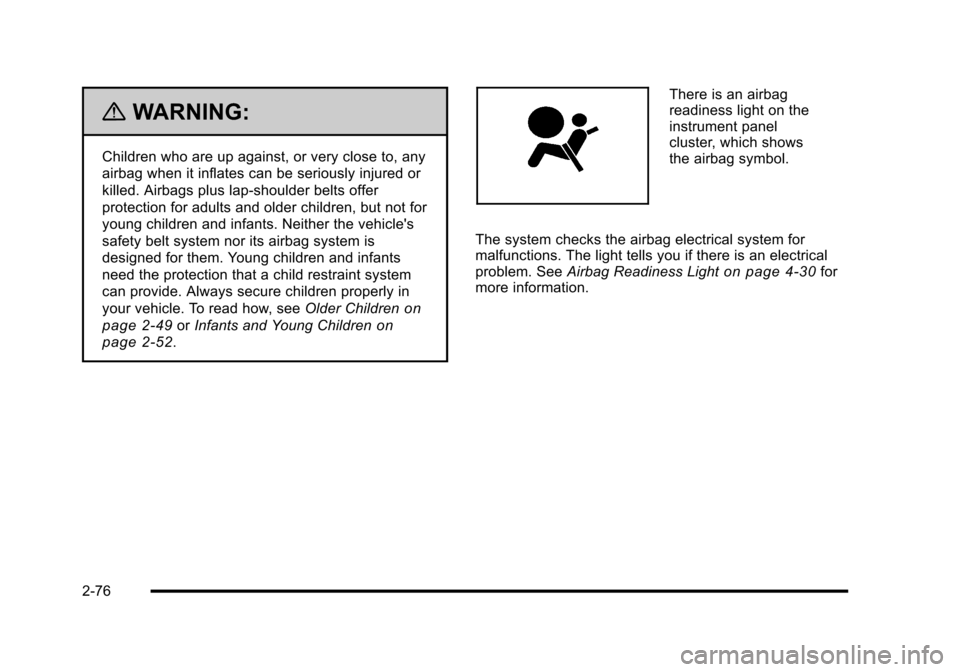
There is an airbagreadiness light on theinstrument panelcluster, which showsthe airbag symbol.
The system checks the airbag electrical system formalfunctions. The light tells you if there is an electricalproblem. SeeAirbag Readiness Lighton page 4!30formore information.
2-76