Page 61 of 616
or the instrument panel...or the safety belts!
With safety belts, you slow down as the vehicle does.You get more time to stop. You stop over more distance,and your strongest bones take the forces. That is whysafety belts make such good sense.
2-29
Page 106 of 616

If the vehicle is equipped with the passenger sensingsystem, and when the passenger sensing system hasturned off the right front passenger frontal airbag, the offindicator in the passenger airbag status indicator shouldlight and stay lit when you start the vehicle. SeePassenger Airbag Status Indicator on page 4!31.
If a child restraint has been installed and the onindicator is lit, see“If the On Indicator is Lit for aChild Restraint”underPassenger Sensing Systemonpage 2!84for more information.
To remove the child restraint, unbuckle the vehiclesafety belt and let it return to the stowed position.
Airbag System
The vehicle has the following airbags:
.A frontal airbag for the driver.
.A frontal airbag for the right front passenger.
.A roof-rail airbag for the driver and passengerdirectly behind the driver.
.A roof-rail airbag for the right front passenger andthe person seated directly behind that passenger.
The vehicle may have the following airbags:
.A seat!mounted side impact airbag for the driver.
.A seat!mounted side impact airbag for the rightfront passenger.
.If the vehicle has a third row seat, it will have athird row roof-rail airbag.
All of the airbags in the vehicle will have the wordAIRBAG embossed in the trim or on an attached labelnear the deployment opening.
For frontal airbags, the word AIRBAG will appear on themiddle part of the steering wheel for the driver and onthe instrument panel for the right front passenger.
With seat!mounted side impact airbags, the wordAIRBAG will appear on the side of the seatback closestto the door.
With roof-rail airbags, the word AIRBAG will appearalong the headliner or trim.
Airbags are designed to supplement the protectionprovided by safety belts. Even though today's airbagsare also designed to help reduce the risk of injury fromthe force of an inflating bag, all airbags must inflate veryquickly to do their job.
2-74
Page 108 of 616
{WARNING:
Children who are up against, or very close to, any
airbag when it inflates can be seriously injured or
killed. Airbags plus lap-shoulder belts offer
protection for adults and older children, but not for
young children and infants. Neither the vehicle's
safety belt system nor its airbag system is
designed for them. Young children and infants
need the protection that a child restraint system
can provide. Always secure children properly in
your vehicle. To read how, seeOlder Childrenon
page 2!49orInfants and Young Childrenon
page 2!52.
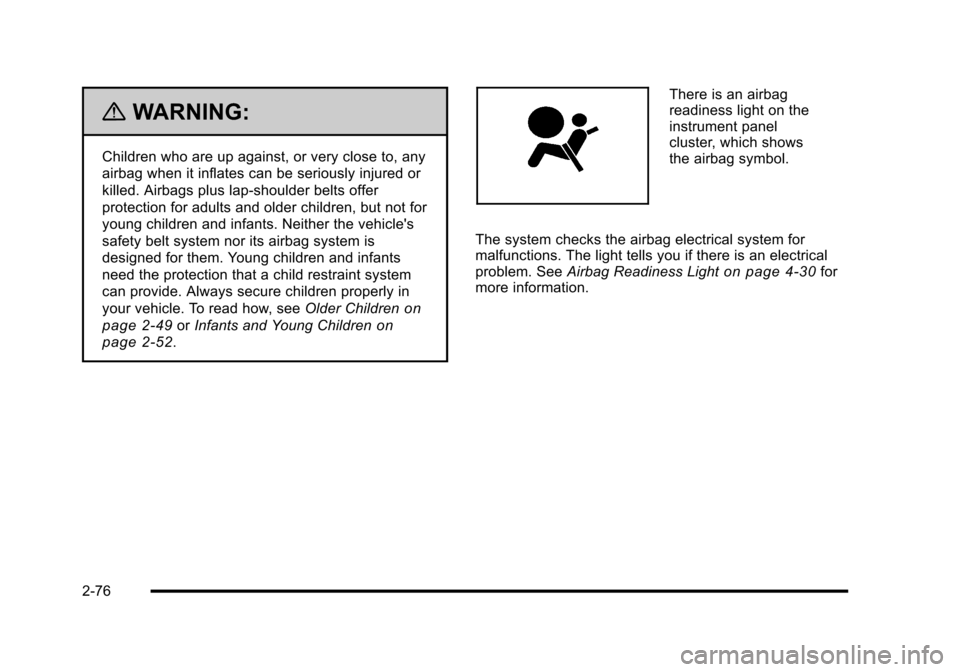
There is an airbagreadiness light on theinstrument panelcluster, which showsthe airbag symbol.
The system checks the airbag electrical system formalfunctions. The light tells you if there is an electricalproblem. SeeAirbag Readiness Lighton page 4!30formore information.
2-76
Page 109 of 616
Where Are the Airbags?
The driver's frontal airbag is in the middle of thesteering wheel.
The right front passenger's frontal airbag is in theinstrument panel on the passenger's side.
2-77
Page 113 of 616

The vehicle may or may not have seat!mounted sideimpact airbags. The vehicle has roof-rail airbags. SeeAirbag Systemon page 2!74. Seat!mounted sideimpact airbags and roof-rail airbags are intended toinflate in moderate to severe side crashes. In addition,these roof-rail airbags are intended to inflate during arollover or in a severe frontal impact. Seat!mounted sideimpact airbags and roof-rail airbags will inflate if thecrash severity is above the system's designedthreshold level. The threshold level can vary withspecific vehicle design.
Roof-rail airbags are not intended to inflate in rearimpacts. A seat!mounted side impact airbag is intendedto deploy on the side of the veicle that is struck. Bothroof-rail airbags will deploy when either side of thevehicle is struck or if the sensing system predicts thatthe vehicle is about to roll over, or in a severe frontalimpact.
In any particular crash, no one can say whether anairbag should have inflated simply because of thedamage to a vehicle or because of what the repaircosts were. For frontal airbags, inflation is determinedby what the vehicle hits, the angle of the impact, andhow quickly the vehicle slows down. For seat!mountedside impact and roof-rail airbags, deployment isdetermined by the location and severity of the sideimpact. In a rollover event, roof-rail airbag deploymentis determined by the direction of the roll.
What Makes an Airbag Inflate?
In a deployment event, the sensing system sends anelectrical signal triggering a release of gas from theinflator. Gas from the inflator fills the airbag causing thebag to break out of the cover and deploy. The inflator,the airbag, and related hardware are all part of theairbag module.
Frontal airbag modules are located inside the steeringwheel and instrument panel. For vehicles with seat!mounted side impact airbags, there are airbagsmodules in the side of the front seatbacks closest to thedoor. For vehicles with roof-rail airbags, there are airbagmodules in the ceiling of the vehicle, near the sidewindows that have occupant seating positions.
How Does an Airbag Restrain?
In moderate to severe frontal or near frontal collisions,even belted occupants can contact the steering wheelor the instrument panel. In moderate to severe sidecollisions, even belted occupants can contact the insideof the vehicle.
Airbags supplement the protection provided by safetybelts. Frontal airbags distribute the force of the impactmore evenly over the occupant's upper body, stoppingthe occupant more gradually. Seat!mounted side impactand roof-rail airbags distribute the force of the impactmore evenly over the occupant's upper body.
2-81
Page 121 of 616
Servicing Your Airbag-Equipped
Vehicle
Airbags affect how the vehicle should be serviced.There are parts of the airbag system in several placesaround the vehicle. Your dealer/retailer and the servicemanual have information about servicing the vehicleand the airbag system. To purchase a service manual,seeService Publications Ordering Informationonpage 9!17.
{WARNING:
For up to 10 seconds after the ignition is turned off
and the battery is disconnected, an airbag can still
inflate during improper service. You can be injured
if you are close to an airbag when it inflates. Avoid
yellow connectors. They are probably part of the
airbag system. Be sure to follow proper service
procedures, and make sure the person performing
work for you is qualified to do so.
Adding Equipment to Your
Airbag-Equipped Vehicle
Q: Is there anything I might add to or change aboutthe vehicle that could keep the airbags fromworking properly?
A:Yes. If you add things that change the vehicle'sframe, bumper system, height, front end or sidesheet metal, they may keep the airbag system fromworking properly. Changing or moving any parts ofthe front seats, safety belts, the airbag sensing anddiagnostic module, steering wheel, instrument panel,roof-rail airbag modules, ceiling headliner or pillargarnish trim, overhead console, front sensors, sideimpact sensors, rollover sensor module, or airbagwiring can affect the operation of the airbag system.
In addition, the vehicle may have a passengersensing system for the right front passengerposition, which includes sensors that are part of thepassenger seat. The passenger sensing systemmay not operate properly if the original seat trim isreplaced with non-GM covers, upholstery or trim,or with GM covers, upholstery or trim designed for a
2-89
Page 136 of 616

When you want to open a rear door when the securitylock is on, do the following:
1. Unlock the door by lifting the rear door manuallock, using the power door lock switch, or theRemote Keyless Entry (RKE) transmitter, if thevehicle has one.
2. Open the door from the outside.
To cancel the rear door security lock, do the following:
1. Unlock the door and open it from the outside.
2. Insert the key into the security lock slot and turn itso the slot is in the vertical position.
Lockout Protection
This feature protects you from locking the key in thevehicle when the key is in the ignition and a front dooris open.
If the driver's side power door lock switch is pressedwhen the driver's door is open and the key is in theignition, all of the doors will lock and then the driver'sdoor will unlock.
If the passenger's side power door lock switch ispressed when the front passenger's door is open andthe key is in the ignition, all of the doors will lock andthen the front passenger's door will unlock.
Liftgate/Liftglass
{WARNING:
It can be dangerous to drive with the liftglass or
liftgate open because carbon monoxide (CO) gas
can come into your vehicle. You cannot see or
smell CO. It can cause unconsciousness and
even death.
If you must drive with the liftglass or liftgate open,
or if electrical wiring or other cable connections
must pass through the seal between the body and
the liftglass or liftgate:
.Make sure all other windows are shut.
.Turn the fan on your heating or cooling
system to its highest speed with the
recirculation mode off. That will force outside
air into your vehicle. SeeDual Automatic
Climate Control System on page 4!20.
.If you have air outlets on or under the
instrument panel, open them all the way.
.If your vehicle is equipped with a power
liftgate, disable the power liftgate function.
SeeEngine Exhaust on page 3!41.
3-12
Page 138 of 616
Power Liftgate
Power Liftgate Operation
{WARNING:
Exhaust gases can enter the vehicle if it is driven
with the liftgate, trunk/hatch open, or with any
objects that pass through the seal between the
body and the trunk/hatch or liftgate. Engine
exhaust contains Carbon Monoxide (CO) which
cannot be seen or smelled. It can cause
unconsciousness and even death.
(Continued)
WARNING: (Continued)
If the vehicle must be driven with the liftgate,
or trunk/hatch open:
.Close all of the windows.
.Fully open the air outlets on or under the
instrument panel.
.Adjust the Climate Control system to a setting
that brings in only outside air and set the fan
speed to the highest setting. See Climate
Control System in the Index.
.If the vehicle is equipped with a power liftgate,
disable the power liftgate function.
For more information about carbon monoxide, see
Engine Exhaust on page 3!41.
3-14