2010 CADILLAC DTS brake
[x] Cancel search: brakePage 340 of 480

How to Check Automatic
Transmission Fluid
Because this operation can be a little difficult, you maychoose to have this done at the dealer/retailer servicedepartment.
If you do it yourself, be sure to follow all the instructionshere or you could get a false reading on the dipstick.
Notice:Too much or too little fluid can damageyour transmission. Too much can mean that someof the fluid could come out and fall on hot engineparts or exhaust system parts, starting a fire.Too little fluid could cause the transmission tooverheat. Be sure to get an accurate reading if youcheck your transmission fluid.
Wait at least 30 minutes before checking thetransmission fluid level if you have been driving:
•When outside temperatures are above 32°C (90°F).
•At high speed for quite a while.
•In heavy traffic — especially in hot weather.
•While pulling a trailer.
To get the right reading, the fluid should be atnormal operating temperature, which is 82°C to 93°C(180°F to 200°F).
Get the vehicle warmed up by driving about 24 km(15 miles) when outside temperatures are above10°C (50°F). If it is colder than 10°C (50°F), you mayhave to drive longer.
Checking the Fluid Level
Prepare the vehicle as follows:
1. Park the vehicle on a level place. Keep the enginerunning.
2. With the parking brake applied, place the shift leverin P (Park).
3. With your foot on the brake pedal, move the shiftlever through each gear range, pausing for aboutthree seconds in each range. Then, positionthe shift lever in P (Park).
4. Let the engine run at idle for three to five minutes.
Then, without shutting off the engine, follow these steps:
1. Locate the transmission fluid cap which is locatednext to the radiator hose and below the engine aircleaner/filter assembly on the driver side of thevehicle. The cap is marked TRANS FLUID.SeeEngine Compartment Overview on page 6-12for more information on location.
2. After removing the engine air cleaner/filter assemblyto reach the transmission fluid cap, turn the capcounterclockwise to remove. Pull out the dipstickand wipe it with a clean rag or paper towel.
6-20
Page 352 of 480
Brakes
Brake Fluid
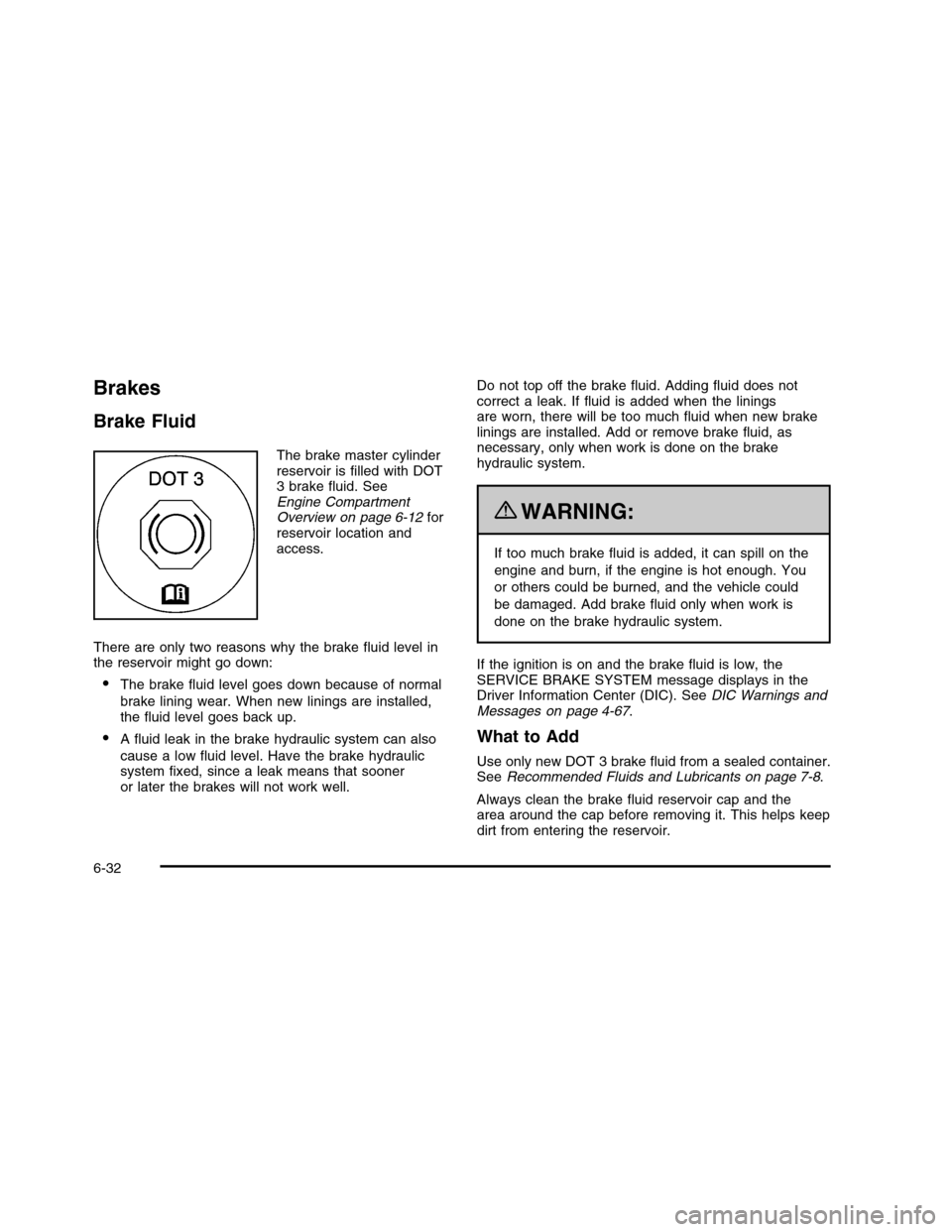
The brake master cylinderreservoir is filled with DOT3 brake fluid. SeeEngine CompartmentOverview on page 6-12forreservoir location andaccess.
There are only two reasons why the brake fluid level inthe reservoir might go down:
•The brake fluid level goes down because of normal
brake lining wear. When new linings are installed,the fluid level goes back up.
•A fluid leak in the brake hydraulic system can also
cause a low fluid level. Have the brake hydraulicsystem fixed, since a leak means that sooneror later the brakes will not work well.
Do not top off the brake fluid. Adding fluid does notcorrect a leak. If fluid is added when the liningsare worn, there will be too much fluid when new brakelinings are installed. Add or remove brake fluid, asnecessary, only when work is done on the brakehydraulic system.
{WARNING:
If too much brake fluid is added, it can spill on the
engine and burn, if the engine is hot enough. You
or others could be burned, and the vehicle could
be damaged. Add brake fluid only when work is
done on the brake hydraulic system.
If the ignition is on and the brake fluid is low, theSERVICE BRAKE SYSTEM message displays in theDriver Information Center (DIC). SeeDIC Warnings andMessages on page 4-67.
What to Add
Use only new DOT 3 brake fluid from a sealed container.SeeRecommended Fluids and Lubricants on page 7-8.
Always clean the brake fluid reservoir cap and thearea around the cap before removing it. This helps keepdirt from entering the reservoir.
6-32
Page 353 of 480

{WARNING:
With the wrong kind of fluid in the brake hydraulic
system, the brakes might not work well. This could
cause a crash. Always use the proper brake fluid.
Notice:
•Using the wrong fluid can badly damage brake
hydraulic system parts. For example, just afew drops of mineral-based oil, such as engineoil, in the brake hydraulic system can damagebrake hydraulic system parts so badly that theywill have to be replaced. Do not let someoneput in the wrong kind of fluid.
•If brake fluid is spilled on the vehicle’s painted
surfaces, the paint finish can be damaged. Becareful not to spill brake fluid on the vehicle.If you do, wash it off immediately. SeeWashingYour Vehicle on page 6-95.
Brake Wear
This vehicle has disc brakes. Disc brake pads havebuilt-in wear indicators that make a high-pitched warningsound when the brake pads are worn and new padsare needed. The sound can come and go or be heard allthe time the vehicle is moving, except when applyingthe brake pedal firmly.
{WARNING:
The brake wear warning sound means that soon
the brakes will not work well. That could lead to an
accident. When the brake wear warning sound is
heard, have the vehicle serviced.
Notice:Continuing to drive with worn-out brakepads could result in costly brake repair.
Some driving conditions or climates can cause a brakesqueal when the brakes are first applied or lightlyapplied. This does not mean something is wrong withthe brakes.
6-33
Page 354 of 480

Properly torqued wheel nuts are necessary to helpprevent brake pulsation. When tires are rotated, inspectbrake pads for wear and evenly tighten wheel nuts inthe proper sequence to torque specifications inCapacities and Specifications on page 6-109.
Brake linings should always be replaced as completeaxle sets.
Brake Pedal Travel
See your dealer/retailer if the brake pedal does notreturn to normal height, or if there is a rapid increase inpedal travel. This could be a sign that brake servicemight be required.
Brake Adjustment
Every time the brakes are applied, with or without thevehicle moving, the brakes adjust for wear.
Replacing Brake System Parts
The braking system on a vehicle is complex. Its manyparts have to be of top quality and work well together ifthe vehicle is to have really good braking. The vehiclewas designed and tested with top-quality brake parts.When parts of the braking system are replaced — forexample, when the brake linings wear down and newones are installed — be sure to get new approvedreplacement parts. If this is not done, the brakes mightnot work properly.
For example, if someone puts in brake linings that arewrong for the vehicle, the balance between the front andrear brakes can change — for the worse. The brakingperformance expected can change in many other ways ifthe wrong replacement brake parts are installed.
Battery
Refer to the replacement number on the original batterylabel when a new battery is needed.
{DANGER:
Battery posts, terminals, and related accessories
contain lead and lead compounds, chemicals
known to the State of California to cause cancer
and reproductive harm. Wash hands after
handling.
The battery is under the rear seat cushion. To accessthe battery, seeRear Underseat Fuse Block onpage 6-104. Access to the battery is not necessary tojump start the vehicle. SeeJump Starting on page 6-36.
6-34
Page 357 of 480

2. Get the vehicles close enough so the jumper cablescan reach, but be sure the vehicles are not touchingeach other. If they are, it could cause a groundconnection you do not want. You would not be ableto start your vehicle and the bad grounding coulddamage the electrical systems.
To avoid the possibility of the vehicles rolling, setthe parking brake firmly on both vehicles involved inthe jump start procedure. Put an automatictransmission in P (Park) or a manual transmissionin NEUTRAL before setting the parking brake.
Notice:If you leave the radio or other accessorieson during the jump starting procedure, they could bedamaged. The repairs would not be covered by thewarranty. Always turn off the radio and otheraccessories when jump starting the vehicle.
3. Turn off the ignition on both vehicles. Unplugunnecessary accessories plugged into the cigarettelighter or the accessory power outlets. Turn offthe radio and all lamps that are not needed. Thiswill avoid sparks and help save both batteries.And it could save the radio!
4. Open the hoods and locate the positive (+) andnegative (!) terminal locations on the othervehicle. Your vehicle has a remote positive (+) jumpstarting terminal and a remote negative (!) jumpstarting terminal.
The remote positive (+) terminal is located in theengine compartment on the passenger’s side of thevehicle. Lift the red plastic cap to access theterminal. SeeEngine Compartment Overview onpage 6-12for more information on the locationof the remote positive (+) terminal.
A second remote positive (+) terminal is located onthe rear underseat fuse block.
The remote negative (!) terminal is located behindthe power steering pulley, near the engine cover.It is marked GND (!).
4.6L LD8 Engine shown,4.6L L37 Enginesimilar
6-37
Page 372 of 480

Tire Terminology and Definitions
Air Pressure:The amount of air inside thetire pressing outward on each square inch of thetire. Air pressure is expressed in pounds persquare inch (psi) or kilopascal (kPa).
Accessory Weight:This means the combinedweight of optional accessories. Some examples ofoptional accessories are, automatic transmission,power steering, power brakes, power windows,power seats, and air conditioning.
Aspect Ratio:The relationship of a tire’s heightto its width.
Belt:A rubber coated layer of cords that is locatedbetween the plies and the tread. Cords may bemade from steel or other reinforcing materials.
Bead:The tire bead contains steel wires wrappedby steel cords that hold the tire onto the rim.
Bias Ply Tire:A pneumatic tire in which the pliesare laid at alternate angles less than 90 degreesto the centerline of the tread.
Cold Tire Pressure:The amount of air pressure ina tire, measured in pounds per square inch (psi) orkilopascals (kPa) before a tire has built up heatfrom driving. SeeInflation - Tire Pressure onpage 6-54.
Curb Weight:The weight of a motor vehicle withstandard and optional equipment including themaximum capacity of fuel, oil, and coolant,but without passengers and cargo.
DOT Markings:A code molded into the sidewallof a tire signifying that the tire is in compliancewith the U.S. Department of Transportation (DOT)motor vehicle safety standards. The DOT codeincludes the Tire Identification Number (TIN),an alphanumeric designator which can also identifythe tire manufacturer, production plant, brand,and date of production.
GVWR:Gross Vehicle Weight Rating. SeeLoading the Vehicle on page 5-18.
GAWR FRT:Gross Axle Weight Rating for thefront axle. SeeLoading the Vehicle on page 5-18.
GAWR RR:Gross Axle Weight Rating for therear axle. SeeLoading the Vehicle on page 5-18.
Intended Outboard Sidewall:The side of anasymmetrical tire, that must always face outwardwhen mounted on a vehicle.
Kilopascal (kPa):The metric unit for air pressure.
Light Truck (LT-Metric) Tire:A tire used onlight duty trucks and some multipurpose passengervehicles.
6-52
Page 381 of 480

The TPMS sensor matching process is outlined below:
1. Set the parking brake.
2. Turn the ignition switch to ON/RUN with theengine off.
3. Press the Remote Keyless Entry (RKE) transmitter’slock and unlock buttons at the same time forapproximately five seconds. The horn sounds twiceto signal the receiver is in relearn mode andTIRE LEARNING ACTIVE message displays on theDIC screen.
4. Start with the driver side front tire.
5. Remove the valve cap from the valve cap stem.Activate the TPMS sensor by increasing ordecreasing the tire’s air pressure for five seconds,or until a horn chirp sounds. The horn chirp,which may take up to 30 seconds to sound,confirms that the sensor identification code hasbeen matched to this tire and wheel position.
6. Proceed to the passenger side front tire, and repeatthe procedure in Step 5.
7. Proceed to the passenger side rear tire, and repeatthe procedure in Step 5.
8. Proceed to the driver side rear tire, and repeat theprocedure in Step 5. The horn sounds two times toindicate the sensor identification code has beenmatched to the driver side rear tire, and theTPMS sensor matching process is no longer active.The TIRE LEARNING ACTIVE message on theDIC display screen goes off.
9. Turn the ignition switch to LOCK/OFF.
10. Set all four tires to the recommended air pressurelevel as indicated on the Tire and LoadingInformation label.
11. Put the valve caps back on the valve stems.
6-61
Page 385 of 480

GM’s exclusive TPC Spec system considers over adozen critical specifications that impact the overallperformance of your vehicle, including brake systemperformance, ride and handling, traction control, and tirepressure monitoring performance. GM’s TPC Specnumber is molded onto the tire’s sidewall near the tiresize. If the tires have an all-season tread design,the TPC Spec number will be followed by an MS formud and snow. SeeTire Sidewall Labeling on page 6-47for additional information.
GM recommends replacing tires in sets of four. This isbecause uniform tread depth on all tires will helpkeep your vehicle performing most like it did when thetires were new. Replacing less than a full set of tires canaffect the braking and handling performance of yourvehicle. SeeTire Inspection and Rotation on page 6-62for information on proper tire rotation.
{WARNING:
Mixing tires could cause you to lose control of
your vehicle while driving. If you mix tires of
different sizes, brands, or types (radial and
bias-belted tires), the vehicle may not handle
properly, and you could have a crash. Using tires
of different sizes, brands, or types may also cause
damage to your vehicle. Be sure to use the correct
size, brand, and type of tires on all wheels.
Your vehicle may have a compact spare tire and
wheel assembly. If the vehicle has a compact
spare tire and wheel, they have the same overall
diameter as your vehicle’s full-size tires and
wheels. Because they were designed and
developed for use on your vehicle, it is all right to
drive your vehicle with the compact spare installed
properly. Compact spare tires are designed for
temporary use only. SeeSpare Tire on page 6-90.
6-65