2010 AUDI S8 warning
[x] Cancel search: warningPage 330 of 384
___ T_ i_ r _e _s_ a_n_ d_ w_ h_ e_e_ l_ s _______________________________________________ _
• Tire pressure must only be adjusted when the temperature of the
tires is about the same as ambient air temperature .
• When tires are replaced, the sensors and valves should not be
detached or exchanged . Only the valve core needs to be replaced and,
if necessary, the valve and the wheel electronics replaced .
• The tire pressure monitoring system on your Audi was calibrated
usiing tires with the "AO" or "RO" identification. We recommend
using these tires.
• If you should put different wheels and tires on your vehicle (e.g.
winter wheels and tires), you must be certain that the wheels and
tires are compatible with the tire pressure monitoring system. Other
wise the system will register a malfunction and a fault message will be displayed. For more information, contact your authorized Audi
dealer.
• Adjust the tire pressure and store the pressure in the tire pressure
monitoring system to the load you are carrying=:>
page 310.
• For Declaration of Compliance to United States FCC and Industry
Canada regulations =:>
page 364. •
Applies to veh icles: with Tire pressure monitoring system
Significant loss of air p ressure I
The yellow symbol appears in the event of a significant
loss of air pressure.
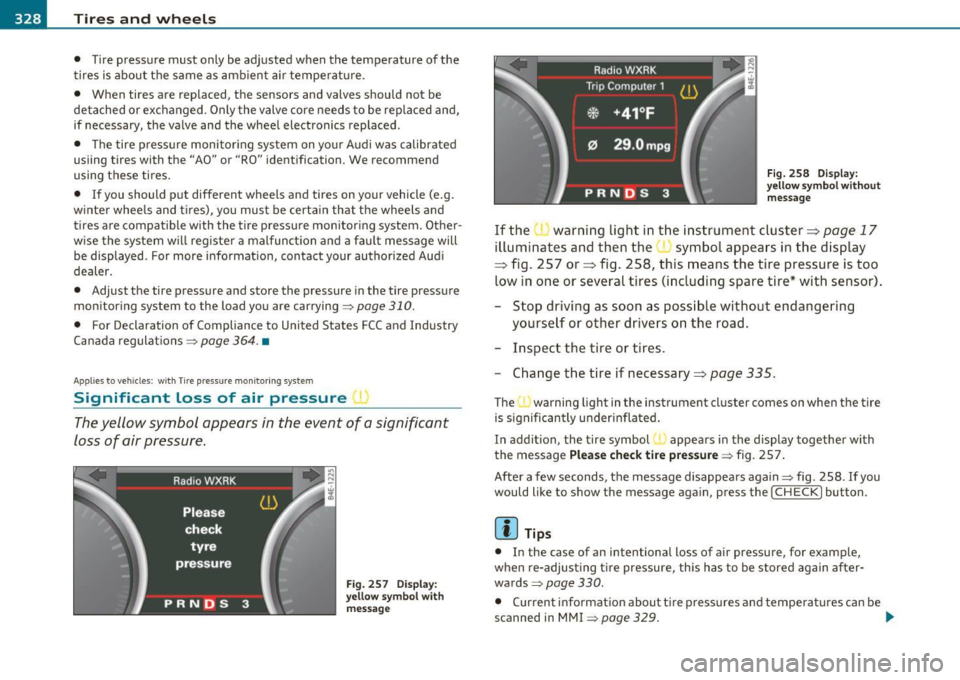
Fig. 257 Display:
yellow symbol with
message Fig.
258 Display:
yellow symbol without
message
If the warning light in the instrument cluster=> page 17
illuminates and then the symbol appears in the display
=:> fig. 257 or=> fig. 258, this means the tire pressure is too
low in one or several tires (including spare tire* with sensor).
- Stop driving as soon as possible without endangering
yourself or other drivers on the road.
- Inspect the tire or tires.
- Change the tire if necessary=>
page 335.
The"' warning light in the instrument cluster comes on when the tire
is significantly underinflated.
In addition, the tire symbol { appears in the display together with
the message
Please check tire pressure=:> fig. 25 7.
After a few seconds, the message disappears again=:> fig. 258 . If you
would like to show the message again, press the
I CHECK] button.
[ i] Tips
• In the case of an intentional loss of air pressure, for example,
when re-adjusting tire pressure, this has to be stored again after
wards:::::,
page 330.
• Current information about tire pressures and temperatures can be
scanned in MMI
=:> page 329. .,,.
Page 332 of 384

-~_T_ i_ re _ s_ a_n _ d_ w_ h _e_ e_ ls _________________________________________________ _
• The tire pressure monitoring system helps the driver to keep an
eye on tire pressures. B ut the driver still has the responsibility for
maintaining the correct tire pressure .•
A pplie s to v ehi cle s: w ith Tire pre ssure moni toring syst em
Storing tire pressures
Correct storage of specified pressure is the basic require
ment for reliable tire pressure monitoring.
In order for the tire pressure monitoring system to operate
appropriately, you have to re-save the specified pressures
whenever you adjust tire pressure, for example when the load
condition of your vehicle changes . Proceed as follows:
Corr ecting tir e pr essure
- Check the pressure in the tires (including the spare t ire*) .
- Adjust air pressure as needed in accordance with t he infor -
mation on the label located e ither on the driver's side B
pillar (visible when the door is open), inside the fuel filler
flap and additionally in the manual.
Saving tire p ressures
- Turn on the ignition.
- Press the [
CAR] function button .
- Select
Systems in the CAR menu .
- Select
Tire pressure mon itoring .
-Select Sto re curr. tire pressure s~ page 329, fig . 259 .
All pressure warning indicators in the display will be canceled.
Following each intentional change in specified pressures, tire pres
sures must be resaved . After the
pressures are saved, the tire pressure monitoring system
measures the c urrent tire pressures and saves them as the new spec
ified pressures .
(I] Tips
• The tire pressure is shown on the tire pressure label. On USA vehi
cles, the tire pressure label is located on the driver's side B-pillar. On
Canada veh icles, the tire pressure label is located either on the
driver's side B-pillar or inside the fuel filler flap . The tire pressure
label lists the recommended cold t ire inflation pressures for the
vehicle at its maximum capacity weight and the tires that were on
your vehicle at the time it was manufactured. For recommended tire
pressures for normal load conditions, please see chapter
=> page 310.
• The tire pressure monitoring system helps the driver to keep an
eye on tire p ressures. But the driver still has the responsib ility for
maintaining the correct tire pressure .
• If your veh icle is eq uipped w ith a standard spare ti re*, it must be
inflated to the maximum pressure specified for the vehicle .•
A pp lies to vehicles: with T ire pressu re monitor ing system
Changing a wheel
When you change a wheel, the new tire must be initial
ized.
Turn on the ignit ion .
- Press the
I CAR I function but ton .
- Select
Systems in the CAR menu.
- Select
Tire pre ssure mon itoring .
-Select Initialize wheels~ page 329, fig. 259 .
Programming is necessary:
Page 333 of 384

Tires and wheels Ill _______________ _____.
• Afte r the t ires have been rotated on the vehicle (includi ng use o f
the sp a re t i re*),
• If tires with new wheel sensors are used .
All pressure wa rning and system malfunction indicators in the display
will be canceled .
I f a wheel change has been made , it is necessary to complete the
Initializ e wheel s function .
The tire pressure monitor ing system is not available during the
prog ramming process and no p ressure and temperat ure val ues are
displayed on the MM I display .
After you have selected the function, th e new whe els are
programmed and the act ua l pressures are stored . Th is learn ing phase
can take up to 20 minutes d riving time .•
A pp lies to vehicles : w ith Tir e pressu re mon itor ing system
Malfunctions
A malfunction can have various causes.
Fig. 26 1 D ispl ay :
S ys tem malf uncti on
If the warning ligh t in the inst rument cl uste r flashes fo r approxi -
mately one minu te and then remain continuously illuminated and
additionally the => fig . 261 symbol appears in the d is p lay , the
tire pressure monito ring system is not available . This can have various
causes.
Vehicle OP-eration
• If the message appears at the end of the learning process, the
system c annot recognize the whee ls ins talled o n the veh icle . T his can
be because one or more wheels without a wheel sensor were
installed .
• A wheel sensor or other component may have failed .
• T he sy stem has detected more than S whee ls wi th whee l sensors
i n the ve hicle, for example when carry ing snow tires.
• A tire was changed but the
Init ialize wheel s function was not acti
vated =>
page 330.
• Audi rep lacemen t pa rts were no t used .
• If snow chai ns are be ing used, system function can be compro
mised due to the shielding properties of the chains .
• Th e tire press ure monitor in g sys tem may not be ava ilable because
of a radio malfunction.
• Transmitters wi th the same freq uen cy, s uch as radio headphones
in the vehicle or radio equipment, can cause a temporary disrupt io n
of the sys tem throug h ex cessive elect romag net ic fie lds.
• Eliminate the interference if possible/if you can and then re-start
t he
Initialize wheels f unc tion. If the wa rning light comes on again,
you should contact your authori zed Audi dealer immediately to have
the problem corrected .
• Do not use commercially ava ilab le tire sealants . Otherw ise, the
elect rical components of the tire pressure mon itor ing system w ill no
longer work proper ly and the sensor for the t ire pressure monitoring
system will have to be replaced by a qualified workshop. •
Vehicle care Do-it-yourselt service iTechnical data
Page 334 of 384

-What do I do now? PfH..._ _____________________ _
What do I do now?
Trunk escape handle
In case of an emergency, the rear lid can be opened from
the inside using the trunk escape handle.
To open rear Lid
Fig. 262 Trunk escape
handle : View from
inside the closed trunk
- Pull the handle down towards the bumper~ fig. 262.
The trunk escape handle inside the rear lid is made of fluorescent
material to glow in the dark.
& WARNING
The trunk escape handle is to be used only in an emergency.
(I) Tips
The emergency release lever should never be used as a handle for
closing the rear lid.•
Applies to vehicles: with emergency warning triangle
Emergency warning triangle
The warning triangle is located on the inside of the trunk
lid.
Fig. 263 Trunk lid:
Opening the cover
Fig. 264 Trunk lid:
Warning triangle
-To open the cover, turn the retainer in the direction of the
arrow and pull the cover down~ fig. 263. _,.
Page 335 of 384
![AUDI S8 2010 Owners Manual What do I do now? -_______________ __.EWII
(]] Tips
If you no longer have your or iginal warn ing triangle and need to equip
your vehicle with a new one, contact your authori](/manual-img/6/57617/w960_57617-334.png "AUDI S8 2010 Owners Manual What do I do now? -_______________ __.EWII
(]] Tips
If you no longer have your or iginal warn ing triangle and need to equip
your vehicle with a new one, contact your authori")
What do I do now? -_______________ __.EWII
(]] Tips
If you no longer have your or iginal warn ing triangle and need to equip
your vehicle with a new one, contact your authorized Aud i dealer for
a rep lacement. •
Jack, tools and spare wheel
Jack
The jack is stored underneath the floor panel in the
luggage compartment.
Fig. 26 5 Luggag e
c ompart ment vehicl e
jack
Be fore stori ng the jack, ma ke sure it is wound back down as far as it
w ill go .
& WARNING
Improper use of the vehicle jack can cause serious personal inju
ries.
• Never use the jack suppl ied with your Audi on another vehicle ,
particularly on a heavier one . The jack is only suitable for use on
the vehicle it came with .
Vehicle OP-eration
& WARNI NG (continued )
• Using a bumper jack to raise the veh icle will dam age the
bumper system . The ja ck may slip, causing injury .
• Never support your vehicle on cinder blocks , bricks or other
objects . These may not be able to support the load and could cause
injury when they fail.
• Never sta rt or run the engine while the vehicle is suppo rted by
the jack.
• If you must work under the vehicle , always use safety stands
specifically designed for this purpo se.
• Never use the he xagonal so cket in the handle of the screw
driver to loosen or tight en the wheel bolts .
• Always make sure the sp are tire and even a flat tire are secured
in pla ce and not loose, otherwis e they could fly forward, causing
personal injury to passengers in the vehicle in an accident or
sudden maneuver .
(]] Tips
Before you c an raise your vehi cle us ing t he jack, you mus t activate the
jack ing mode~
page 179 . •
Vehicle care Do-it-yourself service iTechnical data
Page 337 of 384

What do I do now? -____________________ .:..::......:..:...___Wi'.'11
- Disengage and lower the floor panel before you close the
luggage compartment lid again.
Storing the replaced wheel
-Place the replaced wheel inside the spare wheel well in the
luggage compartment.
Tighten the knurled retaining screw clockwise to secure
the wheel in place.
- Disengage and lower the floor panel before you close the luggage compartment lid again.
& WARNING
Loose items in the passenger compartment can cause serious
personal injury during hard braking or in an accident.
• Never store the spare wheel or jack and tools in the passenger
compartment.
• Always store all jacking equipment, tools, and the spare wheel
in the luggage compartment.
• Tighten the knurled retaining screw for the spare wheel
securely.
[I] Tips
Check the inflation pressure of the spare tire periodically to keep the
tire ready for use .•
Safety first
Changing a wheel
Before changing a wheel
Observe the following precautions for your own and your
passenger's safety when changing a wheel.
- After you experience a tire failure, pull the car well away
from moving traffic and try to reach
level ground before
you stop ~& .
- All passengers should
leave the car and move to a safe
location (for instance, behind the guardrail)~& .
- Engage the
parking brake to prevent your vehicle from
rolling unintentionally~ &.
- Move
selector lever to position P ~ & .
- If you are towing a trailer: unhitch the trailer from your
vehicle.
- Take the
jack and the spare tire out of the luggage
compartment~
page 333 .
& WARNING
You or your passengers could be injured while changing a wheel if
you do not follow these safety precautions:
• If you have a flat tire, move a safe distance off the road. Turn
off the engine, turn the emergency flashers on and use other
warning devices to alert other motorists.
• Make sure that passengers wait in a safe place away from the
vehicle and well away from the road and traffic.
• To help prevent the vehicle from moving suddenly and possibly
slipping off the jack, always fully set the parking brake and block
the wheel diagonally opposite the wheel being changed. When
one front wheel is lifted off the ground, placing the Automatic ..,
Vehicle care Do-it-yourself service Technical data
Page 338 of 384

-What do I do now? ..._ __________________________________________ _
& WARNING (conti nued)
Tra nsmissi on i n " P" ( Park) wi ll not preve nt th e vehicle from
m ov ing.
• Befor e you chan ge a wh eel, be s ure th e grou nd i s lev el and
firm . If n ece ssa ry , us e a s turdy board under th e j ack .
• Afte r in stalling the sp are whee l, make su re that you r eplace
the flat tire /wh ee l i n it s storage are a properly and t ight en th e
knu rled ret ain in g sc rew s ecu rely .
[ i J Tips
Before changing the wheel, you must activate the jacking mode, so
that the automatic contro ls for the Adaptive A ir Suspension do not
make it more difficult to
lift the vehicle with the jack=> page 179. •
Changing a wheel
When you change a wheel, follow the sequence described
below step-by-step and in exactly that order.
1. Activate the vehicle jacking mode==> page 179.
2 . Remove the decorati ve wheel cover* . For more details see
also ==>
page 33 7, "Decorative wheel covers" or
==>
page 337, "Wheels with wheel bolt caps".
3 . Loosen the
wh eel bolts ==> page 338.
4. L ocate the proper mounting point for the jack and align
the jack below that point==>
page 338 .
5. Lift the car with the jack==> page 338.
6. Remove the wheel with the flat tire and then install the
spare ==>
page 340.
7. Tighten all wheel bolts lightly . 8
.
Lower the vehicle with the jack.
9. Use the wheel bolt wrench and
firmly tighten all wheel
bolts==>
page 338.
10. Replace the decorative wheel cov er*.
11. Deactivate the vehicle jacking mode==> page 179.
& WARNING
A lw ays rea d and f ollow all W ARNING S and inf ormation => & in
" Rai sing th e vehicl e" on
page 33 8 and => pag e 341. •
After changing a wheel
A wheel change is not complete without the doing the
following .
-Store and secure the whe el you rep laced in the spare
wheel well.
- Replace the tools and the jack in their proper location.
- Check the
tire pre ssure on the spare wheel immediately
after mounting it .
- As soon as possible, have the
tighten ing torques on all
wheel bolts checked with a torque wrench . The correct
tightening torque is 90 ft lb (120 Nm).
- Have the flat tire
re placed as soon as possible .
[ i J Tips
• If you notice that the wheel bolts are corroded and diff icult to turn
wh ile chang ing a tire, they shou ld be rep laced before you check the
tightening torque. .,_
Page 340 of 384
111...__W_ h_ a_t _ d_ o_ I_d_ o_ n_o _w_ ? ___________________________________________ _
Loosening and tightening the wheel bolts
The wheel bolts must be loosened before raising the
vehicle .
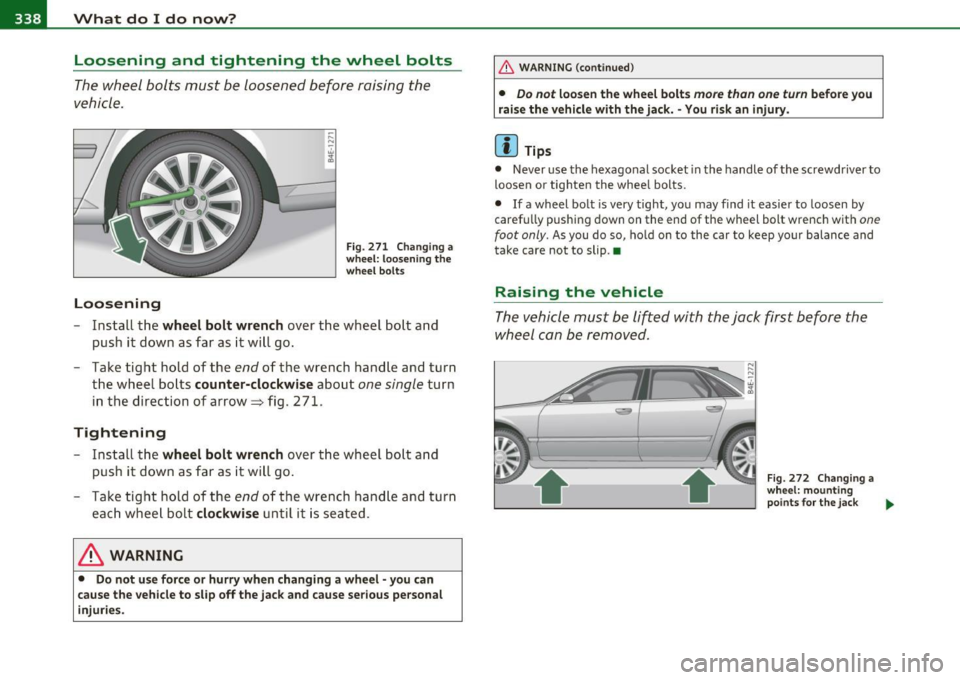
Loosening
Fig. 271 C hang in g a
w heel: loos eni ng t he
whe el b olt s
- Install the wheel bolt wrench over the wheel bolt and
push it down as far as it will go.
Ta ke tight hold of the
end of the wrench hand le and turn
the whee l bo lts
counter-clockwise ab out one single turn
in the direction of arrow:::::, fig. 271 .
Tightening
-Install the wheel bolt wrench over the w heel bo lt a nd
push i t down as far as it wi ll go .
- Tak e tight h old of the
end of the wr ench hand le and turn
eac h whee l bolt
clockwise u nti l it is seated.
& WARNING
• Do not use force or hurry when changing a wheel -you can
cause the vehicle to slip off the j ack and cause serious pe rsonal
injuries .
& WARNING (contin u ed )
• Do not loo sen the wheel bolt s more than one turn before you
raise the vehicle with the jack. -Y ou ri sk an injury.
(I] Tips
• N ever use the hexagonal socket in the handle of the screwdriver to
loosen or tighten the whee l bolts.
• If a wheel bo lt is very tight , yo u may find it easier to loosen by
carefu lly pushing down on the end of the wheel bolt wrench with
on e
foot only .
As you do so, ho ld on to the car to keep yo ur balance and
take care not to slip. •
Raising the vehicle
The vehicle must be lifted with the jack first bef ore the
w heel can be removed.
Fi g. 27 2 Chan ging a
wheel: m oun ting
poi nts fo r the jack ...