2010 AUDI S6 belt
[x] Cancel search: beltPage 242 of 368

Intelligent technology
'-----------------------------------------------
Intelligent technology
Notice about data recorded by
vehicle control modules
Your vehicle is not equipped with an Event Data Recorder (EDR),
installed by some manufacturers for the express purpose of
capturing data for retrieva l after an accident or crash event. ED R's are
sometimes called "crash recorders".
Some state laws restrict the retrieval or downloading of data stored
by ED R's that were installed in a vehicle for the express purpose of
retrieving data after an accident or crash event without the owner's
consent.
Although your vehicle is not equipped with an EDR, it is equipped w ith
a number of electronic control modu les for various vehicle systems
such as, for example, engine function, emission control, as well as for
the airbags and safety belts.
T hese electronic contro l modules also record vehicle-re lated data
during normal vehicle operation for diagnostic and repair purposes .
Th e recording capacity of the e lectronic control modu les is limited to
data (no sound is recorded) and only a sma ll amount of data is actu
ally recorded over a very limited period of time and stored when a
system fault or other condition is sensed by a control unit. Some of
the data then stored may relate to vehicle speed, direction, braking
as well as restraint system use and performance in the event of a
crash or other condition. Stored data can only be read and down
loaded with special equipment.
Electronic Stabilization Program
(ESP)
General information
The ESP improves the vehicle stability.
l, I
Fig. 201 Center
console with ESP
switch
ESP is des igned to help you maintain vehicle control in s ituations
where the car approaches the limits of "grip", especia lly when accel
erat ing and cornering. ESP reduces the risk of skidd ing and imp roves
stability under all road conditions.
Th e system operates across the entire speed range in combination
with the ABS system. If the Anti-Lock Brake System (ABS) malfunc
tions, the ESP will also shut down.
How the system works
The Anti-Lock Brake System (ABS), Electronic Differential Lock (EDL)
and the Anti-Slip Regulation System (ASR) are integrated in the elec
tronic stabilizatio n pro gram. In addition to the data provided by
these funct ions, the ESP control unit requires additional measure
ment data provided by high performance sensors. The rotational
speed of the vehicle about its vertical axis, veh icle acceleration in the ...
Page 269 of 368
____________________________________________ C_l_e _a_ n_ i n--= g=--- a_n_ d----' p,__ r_o _t_ e_ c_ t_ i _o_ n __ lffll
consider if childre n, animals or other factors might prove to be partic
ularly hard on the leathe r.
By contrast, leather types that are covered by a colored fin ish layer
are more durable . This has a positive effect on the leath er's resistance
to wear and so iling in daily use. On the othe r hand, the typical charac
teristics of natura l leathe r are barely or not apparent . However, this
does not mean that the leathe r itself is of infer io r quality.
C are and handling
Because of the exclusive nature of the types of leather that Audi uses
and the ir unique p roperties (such as sensitivity to oils, grease, so iling,
etc.), yo u will need to be somewhat ca refu l with these leat he rs , a nd
a certain type of care is required. For example, dark clothing mate
r ials ca n disco lor leather seats (especially if such clothi ng is d amp and
was not dyed correctly) . Dust and dirt particles in pores, folds, and
seams can have an abrasive effect and c an damage the le athe r
surface as well as weaken seams .
The leather s houl d be cleaned regularly as needed . After having been
used for a relatively long time, your leather sea ts w ill acquire a rich
aged finis h. This is a characteristic of natura l leather and a sign of
true quality.
I n order to maintain the value of this natural product over the life of
your vehicle, you sho uld fo llow the recommendations below :
0 Note
• To keep you r leather from b leaching out, do not allow it to be
exposed to bright sunl ight for long periods of time . If you have to
leave t he veh icle parked outside for long pe riods, cover the leather to
protect it from direct exposure to sunlig ht.
• Sharp objects on clothing, such as zippers, rivets or sha rp pieces
on belts can leave permanent scratches or scrape marks on the
s u rface of the leather.
Safety first
(I] Tips
• After each time you clean the leathe r and at regular inte rvals , u se
a leather preservative creme that contains UV-blockers and that
works into the leather. This creme will nou rish and mo istur ize the
leather, helping it to breathe and stay supp le. It also helps to build up
a p ro tect ive coa ting on the surfa ce.
• Clean the leather every 2 -3 months, and clean any areas that get
soiled.
• Remove fresh marks made by ballpoint pens, ink, lipstick, shoe
polish, etc. as soon as poss ible.
• Preserve the color of t he leather as needed by using a specia l
co lored leather ca re creme to touch up areas of uneven color .•
Ap plies to vehi cles : w it h nat ural leat her
Cleaning and caring for leather upholstery
and trim
Natural leather requires special care and attention.
Normal cleaning
- Clean so iled areas wit h a slightly mois tened cotton or
woolen cloth .
More stubborn dirt
-More stubborn d irt can be removed using a clot h satu
rated w ith a mild soap solution (2 ta blespoons m ild liq ui d
soap) .
- Never allow the soap solution to saturate the leather, and
make certa in that no water soaks i nto the seams .
- Wipe off the soap solution w ith a soft, dry c loth. .,,
Vehicle care Technical data
Page 271 of 368
____________________________________________ C_l_e _a_ n_ i n--= g=--- a_n_ d----' p,__ r_o _t_ e_ c_ t_ i _o_ n __ _
0 Note
• N ev er use che mical s olvents (e.g. lig hte r fl uid , turpen tine), waxe s,
sho e polish or sim ila r pr oducts on A lcantara ® surfaces.
• T o avo id damage, have s tubbor n sta ins removed by a co mmerc ia l
cleaning s pecialist .
• Do not use brushes, stiff spo nges or sim ilarly ab rasive cl ea ni ng
aids. •
Safety belts
Only well- maintain ed safe ty b elts wo rk re liably when
n ee ded.
- Kee p belts cle an.
- F or clea nin g, use a mil d soap and w ate r solution. Let belts
dry thor oug hly and aw ay fro m direct s unlig ht.
- D o not a llow i nertia re el sa fety b elt s t o re trac t bef ore the y
are c ompl ete ly dry .
- Che ck th e condi tio n of you r sa fety belts
regu larly.
H eav ily so iled safe ty be lts may not ret rac t proper ly.
& WARNING
Damaged safety belts can break in a crash.
• Anything that might damage your safety belts could mean
that you and your passengers would not be adequately protected
in an accident.
• Safety belt performance depends on correct installation. Never
remove belts from the vehicle to clean them .
• Do not use chemical cleaning agents , bleach or dyes. They have
corrosive properties which weaken the webbing.
Safety first
& WARNING (co ntinued )
• When cleaning your safety belts , inspect them for damage . If
you discover damage, see your Audi dealer .
• Always read and heed all WARNINGS and other information
~page 258. •
Engine compartment
Be es pec ially care ful w hen clean ing th e engine co mp art
m en t.
Always switch off the ign ition before cleaning the engine~,&. .
Plenum panel
Remove leaves from the plenum pane l in front of the win dshi eld
under the eng ine hoo d. Thi s preven ts the wa ter d rain holes fro m
becoming blocked , and it prevents debris from enter ing t he veh icle
in ter ior thro ugh t he heat ing a nd ve ntilation ducts.
Corrosion protection
The e ng in e co mp artm ent a nd trans missio n have bee n co rros io n
protected at the facto ry .
G ood ant i- corro sion t rea tmen t is very i mporta nt, pa rt icul arly in t he
wi nte r. If the ve hicle is freq uently d riven on sa lt treated roads, the
entire eng ine compartment and plenum pane l sho uld be tho rough ly
clea ned at the end of winter and retreated to preve nt salt damage. At
the same time, t he un derside of the vehi cle should be washed as well.
If the eng ine co mpartme nt is clean ed at any t ime wi th gre ase
remov ing so lutions
2
), or if you have the engine was hed, the anti
cor rosion treat men t is almo st alw ays rem oved as well.
It is the refore
essential to have a long-last ing corrosion protection reapplied to all
s u rfaces, seams, jo ints and com ponents in the engine compartmen t.~
2> Us e on ly the co rrect clean ing so lut ions . Neve r use gaso line or diese l fue l.
Vehicle care Technical data
Page 280 of 368
ffl __ C_h_ e_c _k _i_n -=g :a,__ a_n_ d_ f_ i_ l _li _n _,g;._ __________________________________________ _
& WARNING (continued )
-Always use extreme caution to prevent clothing, jewelry, or
long hair from getting caught in the radiator fan, V-belts or
other moving parts, or from contacting hot parts. Tie back hair
before starting, and do not wear clothing that will hang or
droop into the engine.
• Minimize exposure to emission and chemical hazards=:>
/1::..
& WARNING
California Proposition 65 Warning:
• Engine exhaust, some of its constituents, and certain vehicle
components contain or emit chemicals known to the State of Cali
fornia to cause cancer and birth defects and reproductive harm. In addition, certain fluids contained in vehicles and certain products
of component wear contain or emit chemicals known to the State
of California to cause cancer and birth defects or other reproduc
tive harm.
• Battery posts, terminals and related accessories contain lead
and lead compounds, chemicals known to the State of California
to cause cancer and reproductive harms. Wash hands after
handling.
0 Note
W hen a dding fluids, a lways make sure that t hey are poured into the
pro per conta in er or filler op ening, oth erwise serious damag e to
vehicle systems w ill occur.
ci> For the sake of the environment
To detect lea ks i n time, ins pect t he vehicle floor pan from un derneath
re gu lar ly. If yo u s ee spots from oil or o ther vehicle f luids, have your
vehicle inspected by an authorized Aud i dea ler. •
Engine compartment
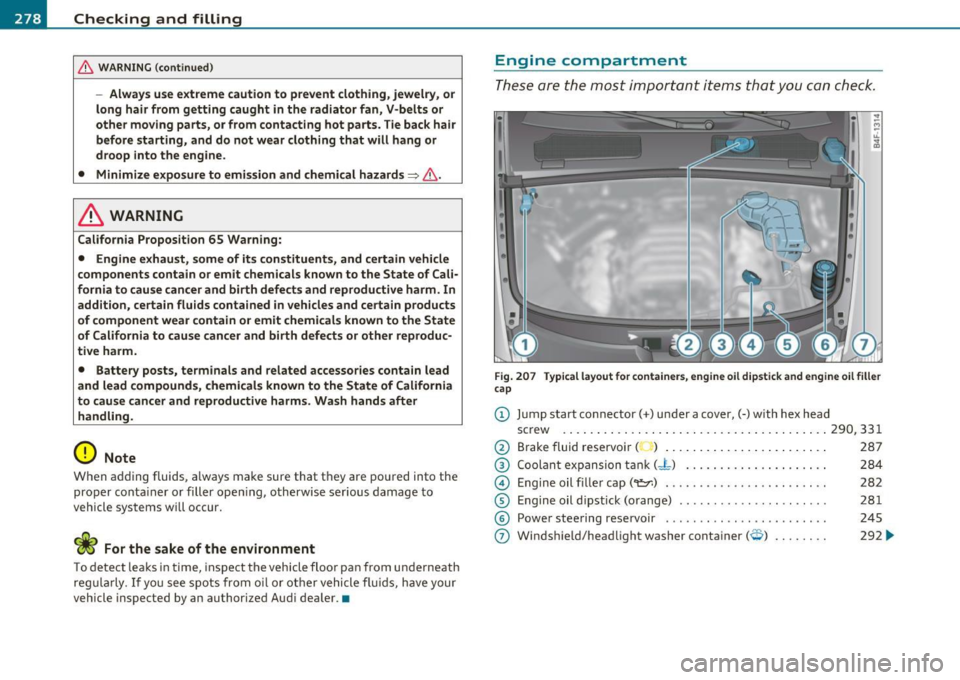
These are th e most importa nt it ems that you can ch eck .
Fig. 207 Typic al layout for container s, engine oil dip st ic k an d eng ine o il fill er
cap
©
@
®
©
®
J u mp start co nnector( +) u nder a cover,(-) w ith hex head
screw . .... . .. .... .. .. .. . ...... ......... . .. .. 290, 331
B rake fluid reservoi r ( ) . . . . . . . . . . . . . . . . . . . . . . . . 287
C oolant expa nsion tank
(J -) . . . . . . . . . . . . . . . . . . . . . 284
E ngin e oil fi ller cap
('1::r. ) . .... ....... ...... .... . .
Engine oil dipstick (o range) .................. ... .
© Power steering reservoir .................... ... . 282
2 8 1
2 4 5
292 _,.
(j) Winds hiel d/head light washer conta iner ( O ) ....... .
Page 304 of 368
IIIIL-_T.:..:..: ir:....:e~ s=---= a~ n:..:..: d:......: w..:....:.. h:....:e~ e= ls=--------------------------------------------------
Yo ur sa fety and that of your passengers also depends o n mak ing s ure
t h at loa d limits are no t ex ceede d. Vehicle lo ad incl udes eve rybody
and everyth ing in and on the vehicle. These load limits are tech nica lly
referred to as the ve hicle 's
Gross Vehicle Weight Rating ("G VW R").
T he "G VWR" includes the we igh t of the b asic ve hicl e, all fa ctory
installe d accesso ries, a fu ll tank of fue l, o il, coo lant and other fluids
p lu s m aximu m lo ad. Th e maxi mum lo ad include s th e num ber of
passengers that the vehicle is intended to carry ("seating capacity")
w ith a n assu med we ight of 150 l bs (6 8 kg) for e ach p assenger at a
designated seating position and the tota l weight of any luggage in
t he vehicle . If you tow a trai le r, t he weight o f the t railer hitch and t he
tongue we ig ht of the loaded trailer must be included as pa rt of the
veh icle load .
T he
Gross Axle Weight Rating ("GAWR") is the m aximum load tha t
can be applied at each of the vehicle's two ax les.
Th e Gross Vehi cle We ight Ratin g a nd the Gross Axle Weigh t Ra ting
are listed o n the safety compliance sticker label located on the
dr ive r's side B-pillar. You r A udi has 5 sea ting positions, 2 in the fron t
and 3 in the rear fo r tota l seati ng ca pac ity of 5 . Eac h seat ing position
has a safety belt ~
page 18 5, "Safety belts".
T he fa ct t hat t here is an upper lim it to your ve hicle's G ross Veh icle
We ight Rating means that t he total weight of whatever is being
c arried in t he ve hicle (includi ng the wei ght of a tra ile r hit ch an d the
tongue weig ht of the loaded tra iler) is limited. The more passengers
i n th e ve hicl e or p assenge rs who are heavier th an the stan dard
we igh ts assumed mean that less we igh t can be ca rried as luggage.
The tire pressure label on yo ur A udi a lso lists the max imum combined
w eight of all of th e occ upants and luggag e or o ther cargo that th e
vehicle ca n car ry. Fo r the location o f the labe l~
page 297, fig . 216.
& WARNING
Overloading a vehicle can cause loss of vehicle control , a crash or
other accident, serious personal injury, and even death.
& WARNING (co ntinued )
• Carrying more weight than your vehicle was de signed to carry
will prevent the vehicle from handling properly and increase the risk of the loss of vehicle control.
• The brakes on a vehicle that has been overloaded may not be
able to stop the vehicle within a safe di stance.
• Tires on a vehicle that has been overloaded can fail suddenly,
including a blowout and sudden deflation, causing loss of control
and a crash .
• Always make sure that the total load being transported -
including the weight of a trailer hitch and the tongue weight of a
loaded trailer -does not make the vehicle heavier than the
vehicle's Gros s Vehicle Weight Rating. •
Determining correct load limit
Use the example below to calculate the
total weight of the passengers and luggage or other things that you plan to transport so
that you can make sure that your vehicle
will not be overloaded. .-.
Page 348 of 368
___ C_ o_n_ s _ u_m_ e_ r_ I_ n_ f_o _r_ m_ a_ t_io _ n _____________________________________________ _
& WARNING (conti nu ed )
• The engine compartment of any motor veh icle is a potentially
hazardous area . Never reach into th e area around or touch the
radiator fa n. It is temperature controlled and can switch on
s uddenly -even when the engine is off and the ignition key has
been remo ved. The radiator fan switches on autom atically when
the coolant rea ches a certain temperature and will continue to run
until the coolant tempe rature drops.
• Always remove the ignition key before anyone gets under the
vehicle.
• Always support your vehicle with safety stands if it i s neces sary
to work unde rne ath the vehicle. The jac k supplied with the vehicle
is not adequate for thi s purpose and could collap se cau sing
serious personal injury.
• If you must work underneath the vehicle w ith the wheels on
the ground , always ma ke sure the vehicle is on level ground , th at
the whe els are alway s securely blocked and that the engine cannot
be started .
• Always make sure the transmi ssion selector l ever (automatic
tran smission) is in "P" (Park position ) and the par k brake is firmly
applied.
W For the sake of the environment
• Changing the engine settings will adversely affect e miss io n levels.
Th is is detrimenta l to the environment and increases fuel consump
ti on.
• Always observe enviro nmental regulations when disposing of old
eng ine o il, use d brake fl uid, dirt y engine coo lant, s pent ba tt er ies or
worn out t ires.
• Undep loyed a irbag modules and pretens ioners migh t be classified
as Perchlorate Mater ia l -spec ial handling may apply, see
www.dts c.ca .g ov/h azar douswas te/pe rchlo ra te . When the veh icle or
parts of the rest raint system including a irbag modu les sa fety belts
w ith pretens ioners are sc rapped, all applicable laws and regulat io ns must be observed
. Your authorized Aud i dealer is familiar with these
re qui remen ts and we recomme nd that you have your dealer perfo rm
this serv ice for you .•
Additional accessories,
modifications and parts
replacement
Additional accessories and parts
replacement
A lway s con sul t an autho rized Audi dealer before
purchasi ng a ccess ories.
Your vehicle incorporates the latest safety design feat ures ens uring a
hig h stand ard of active and passive s afe ty.
T hi s safety co uld be compromised by no n-app roved changes to the
vehicle. Fo r this reason, if parts have to be replace d, p lease observe
the following points when installing addit ional accessories :
Approved Audi accessories and genuine Aud i parts are available from
a u thor ized Aud i deal ers.
T hese dea lers a lso have the necessary fac ilities, tools and tra ined
speci alists to inst all the parts and ac cessor ies p ro p er ly.
& WARNING
Using the wrong spar e parts or u sing non-approved ac ce ss ories
can cause damage to the vehicle and serious personal injury .
• Use only acces sories expressly approved by Audi and genuine
Audi spare parts
• The se parts and acces sorie s have been specially designed to be
used on your vehicle . _,.
Page 353 of 368

Alphabetical index -________________ f!:VII
Anti-Slip Regulation System (ASR)
How the system works ....... .. .. . 242
Anti-theft systems Anti-theft alarm system ....... ... .. 49
Electronic immobilizer ............. 40
Ashtray Front .............. ...... .. .. .. .. 91
Rea r ........ .... .. .. ... ......... 91
ASR How the Anti-Slip Regulation System works . ...... .. ... .. .. ......... 242
Asterisk What does it mean when something is
marked with an asterisk? ........... S
Audi Service Repair Manuals and Literature
344
AUTO mode AC climate controls ...... .... .. .. .. 99
Auto Safety Hotline .... .. .. .. ....... 183
Auto-Check Control .. ........ .... ... .. 24
Automatic belt retractor ............. 189
Automatic car wash
See Washing ....... .. .... .. .. .. . 259
Automatic Shift Lock (ASL) ..... .. 148, 155
Automatic transmission 6-speed automatic transmission ... . 146
Automatic Shift Lock (ASL) .... 148, 155 Driving ............ .. .. .. .. .... . 146
Dynamic shift program ... .. .. .. .. . 149
Emergency release for selector lever . 152
Emergency release for selector lever
(mu ltitron ic®) .............. .... 159
Fail-safe mode .............. 151, 158
Controls and equip
ment Safety first
Ignition key safety lock
.... ... .. .. . 109
Kick -down . ........ .. .. .. ....... 149
Manual shift program .. ... ... ..... 150
multitronic ® ....... ...... .. .. ... 152
Selector lever .... .. .. .. .. .. . 147, 154
Shift buttons . ........... ... 151, 158
Steering wheel with tiptron ic® . 151, 158
Average speed .. ... .... .. .. .. .... .... 34
Avoid damaging the vehicle ........... 250
B
Battery ... ..... .................... 288
Battery location ins.ide the luggage
compartment . ........ ......... 289
Charging ................ .... .. .. 290
Important warnings when wo rk ing on the
battery . .. .. ..... ....... ... .. .. 289
Jump starting ..... ...... ..... .. .. 331
Low ..... .. ... ..... .. ....... .... 247
Replacing the battery .. .. ......... 292
State of charge .... ... ........... 247
Voltage ................. .. .. .. .. . 31
Winter operation ...... .. .. .. ..... 288
Working on the battery .... ... .. .. . 289
Before driving .. ... ... ... .. .. .. .. .. . 175
Blended gasoline ................... 271
Body cavity seal ing . ...... .. ......... 264
Booster seats . .. .. ........ ......... 225
Brake assistant ...... ............... 245
Brake booster . ........ ... ... .. .. ... 244 Brake fluid
Changing the brake fluid ....... .... 287
Checking the brake fluid level ....... 287
Reservoir . .... .. .. .... ...... ... . 287
What is the correct brake fluid level? . 287
What should I do if the brake fluid warning
light comes on? . ................ 287
Brake light Defective ... .. ................... 21
Brake system . .. .. ... ... ... ..... .. .. 287
Anti-lock brake system ............. 17
Brake fluid ........ ............. . 287
Brake fluid spec ificat ions for refil l and
replacement . .... ....... ... ... . 287
Brake pads .. .. .. .. ...... .. .. .. .. 250
Electromechanical parking brake ... . 113
General informat ion ..... ...... .. . 243
How does moisture or road salt affect the
brakes? ... .................. .. 243
Malfunction ...................... 26
Warning/indicator lights ... .. .. .. .. 18
Worn brake pads symbol ........... 31
Break -in period ... .. .. .............. 249
Brake pads . ... ................ .. 250
Tires ... .... .................... 249
Bulbs ............ .... .. .. .. .. .. ... 329
Bumper cover Caution when parking near a parking barri-er or curb . ................... .. 114
C
California Proposition 65 Warning ..... 278
Battery specific .... .............. 290
Vehicle operation Vehicle care Do-it-yourself service Technical data
Page 354 of 368

-Alphabetical inde x lffi'f ___,__ ______________ _
Capacities .... ..................... 341
Car -Systems
Ambience lighting ... .............. 64
Lighting profiles . ................. 64
Car care .. .. .. ..................... 2S8
Interior ..... ............. .... .. 265
Plastic and vinyl .. .. .. .. ......... 262
Weatherstrips ................ ... 263
Care of exterior .. .... .. .. ..... ... ... 258
Cargo area
See Loading the luggage compartment ..
181
Cargo net .. .. ...... .... .. .. .. ..... . 85
Catalytic converter .................. 250
CD changer ............ .... .. .... ... 94
Center armrest adjusting .. .... .. .. .... .......... 82
Storage compartment ... .......... 82
Centra l locking
Emergency locking ............ .... 45
Cert ification .... ...... .... ......... 347
Changing a flat tire .. .. .. .. ......... 318
Changing a wheel ........... ...... .. 318
Changing engine oil .. .. ... ....... .. . 283
Chassis Undercoating . ................. .. 264
See also Adaptive Air Suspension . .. 166
CHECK button . .. .. ........ .......... 11
Checking Engine coolant level . ........... .. 284
Checking tire pressure ............ ... 300
Child restra int system anchors . ... .... 230 Child restraints
Danger of us ing child restraints in the front
seat . ... ............... .. ... .. 197
Where can I get additional information
about child restraints and their use? .. .
237
Child safety ....... ...... ... . .. .. .. . 217
Convert ible locking retractor .... .. . 227
Guidance fixtures for lower anchorages
233
Important safety instructions for using
child safety seats ......... ... .. . 220
Important things to know when driving with children ............ .. .. .. . 217
Installing a child restraint using the LATCH
system .................. ..... 234
Mounting and releasing the anchorage
hook .............. .... ....... 234
Tether anchors ...... ... .. .. .... . 235
Tether straps .............. ... .. . 23S
Child safety lock rear doors (power) ........ .. .. .. .. 47
Child safety seats ............ .. ..... 222
Booster seats .... .. .. .. .. .. .. .. . 225
Convertible child seats .......... .. 223
Convertible lock ing retractor ....... 227
Danger of us ing child restraints in the front
seat .. .... .. ........... .. .. .. . 197
How do I properly install a child safety seat in my vehicle? ........... .. .. .. . 220
In fant seats .............. .. .... . 222
Insta lling ...... .... .. .. .. ....... 227
LATCH system ....... ..... ....... 234
Safety instructions . ... .... ....... 220 Child seats
Lower anchorages . ...... ........ . 232
Cigarette lighter ................... .. 92
Cleaning Alcantara (synthetic suede) .. .. .. .. 268
Engine compartment .......... ... 269
Exhaust tail pipes . .. .. .. ......... 264
Fabrics and fabric coverings . ....... 265
Instrument pane l ... ............. 266
Interior ............. .... ..... .. 265
Leather ....... ... ... ... ..... ... 267
MMI control console .............. 265
MMI display .. .... .. ......... .... 265
Plastic and vinyl .. .. ............. 262
Plastic parts ... .. .. .......... ... 266
Safety belts .............. ... .. .. 269
Trim strips ..................... . 261
tr im strips . .. ................. .. 262
Cleaning and protection ....... .. .. .. 258
Climate control . . . . . . . . . . . . . . . . . . . . . 96
Synchronizing . ................. .. 98
Warm and cold ....... ... .. .. .. ... 96
Climate controls Air distr ibut ion ...... ...... ...... 100
Air outlets . .. ....... ...... .. .. .. 101
Air outlets (rear) ................. 102
Air recirculation . ... ............. 100
AUTO (standard setting) ............ 99 Basic settings ............ ... .. .. 104
Center vents . ............... .... lOS
Controls . . . . . . . . . . . . . . . . . . . . . . . . . 98
Defrosting/defogging ............ 100
Description .. .. ... ...... ..... .. .. 96