2010 AUDI S6 airbag
[x] Cancel search: airbagPage 176 of 368
1111....__D_ r_iv _i_ n_, g=-- S_ a _ f_e _,Ly _ ______________________________________________ _
Driving Safely
General notes
Safe driving habits
Please remember -safety first!
Th is chapter contains important information, t ips, instructions and
warnings that you need to read an d observe fo r you r own safe ty, the
safety of you r passengers and others . We have summarized here
w hat you need to know about sa fety belts, airbags, child restra ints as
we ll as child safety . You r safety is for us
priority number 1. Always
observe the information and warnings in this section -for your own
safety as well as t hat of your passengers.
The informat ion in this section applies to all mode l versions of yo ur
veh icle . Some of the fe atures des cribed in this se ctions m ay be st an
dard equ ipment on some models, or may be optional eq uipment on
others. If you a re not sure, ask your a uth o rized Audi dealer.
& WARNING
• Always make sure that you follow the instructions and heed
the WARNINGS in th is Manual. It is in your interest and in the
intere st of your passengers.
• Always keep the complete Owner's Literatu re in your Audi
when you lend or sell your vehicle so that this important informa
tion will always be available to the driver and passengers .
• Always keep the Owner's literature handy so that you can find
it easily if you have questions . •
Safety equipment
The safety features are part of the occupant restraint
s y stem and wor k together to he lp reduce the ris k of injury
in a wide variety of accident situations.
Your sa fety and t he safety o f yo ur passenge rs shou ld no t be left to
chance . Adva nces in technology have made a variety of features avai l
a b le to help re duce the risk of injury in an a cc ident . The fo llow ing is a
list of jus t a few of the safety features in your Audi:
• sophisticated safety belts for driver and a ll passenger seating
p osi tion s,
• safety belt pretensioners,
• safety belt fo rce lim iters for the fro nt sea ts,
• safety belt he igh t adju stmen t sys tems for the fro nt sea ts,
• automatic safety be lt height adjustment for the rear seats,
• front ai rbags,
• side air bags in the front sea ts a nd ou ter rear seats*,
• side curtain airbags,
• special LATCH an chorages fo r ch ild restra in ts,
• head restraints fo r eac h seating position,
• adjustable steering co lumn .
These individual safety feat ures, can work together as a system to
he lp protect you and yo ur passengers in a wide range of accide nts .
T hese feat ures ca nnot work as a system if they are not a lways
c o rre ctly adjusted and co rre ct ly u sed .
Safety is everybody's responsibility! •
Page 178 of 368
-Driving Safely
·"'---=---"'----------------
Proper occupant seating positions
Proper seating position for the driver
The proper driver seating position is important for safe,
relaxed driving.
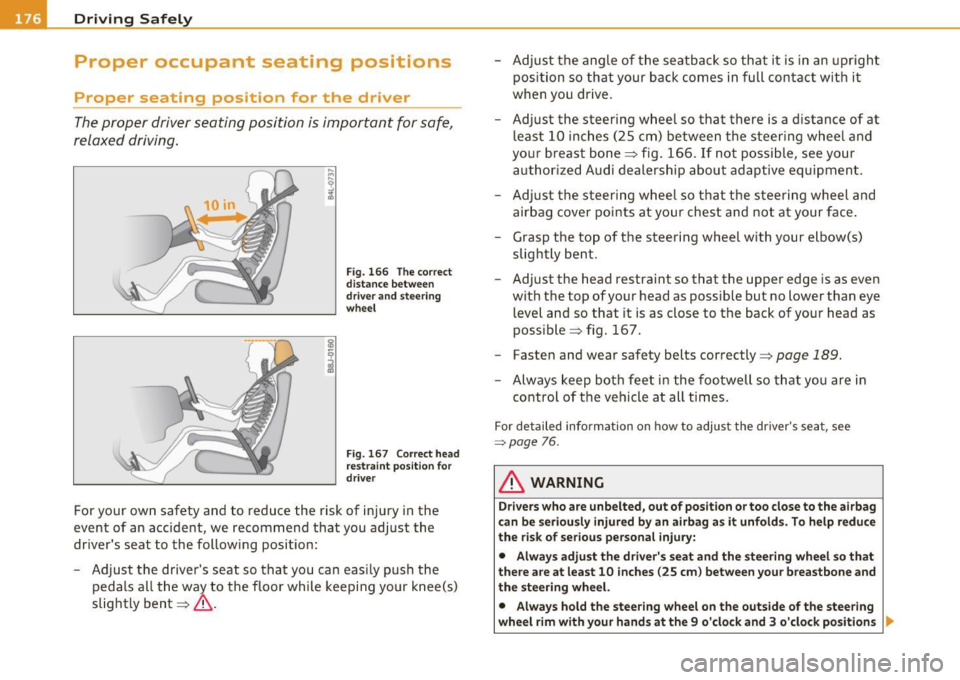
Fig. 166 The correct
distance between
driver and steering
wheel
Fig . 167 Correct head
restraint position for
driver
For your own safety and to reduce the risk of injury in the
event of an accident, we recommend that you adjust the
driver's seat to the following position:
- Adjust the driver's seat so that you can easily push the
pedals all the way to the floor while keeping your knee(s)
slightly bent==>& . -
Adjust the angle of the seatback so that it is in an upright
position so that your back comes in full contact with it
when you drive.
- Adjust the steering wheel so that there is a distance of at least 10 inches (25 cm) between the steering wheel and
your breast bone==> fig. 166. If not possible, see your
authorized Audi dealership about adaptive equipment.
- Adjust the steering wheel so that the steering wheel and airbag cover points at your chest and not at your face.
- Grasp the top of the steering wheel with your elbow(s) slightly bent.
- Adjust the head restraint so that the upper edge is as even
with the top of your head as possible but no lower than eye
level and so that it is as close to the back of your head as
possible ==> fig. 167.
- Fasten and wear safety belts correctly=>
page 189.
-Always keep both feet in the footwell so that you are in
control of the vehicle at all times.
For detailed information on how to adjust the driver's seat, see
=:>page 76 .
& WARNING
Drivers who are unbelted, out of position or too close to the airbag
can be seriously injured by an airbag as it unfolds. To help reduce
the risk of serious personal injury:
• Always adjust the driver's seat and the steering wheel so that
there are at least 10 inches (25 cm) between your breastbone and
the steering wheel.
• Always hold the steering wheel on the outside of the steering
wheel rim with your hands at the 9 o'clock and 3 o'clock positions ..
Page 179 of 368
Driving Safely ---------------------"~'----
& WARNING (continued)
to help reduce the risk of personal injury if the driver's airbag
inflates.
• Never hold the steering wheel at the 12 o 'clock position or with
your hands at other positions inside the steering wheel rim or on
the steering wheel hub. Holding the steering wheel the wrong way can cause serious injuries to the hands, arms and head if the
driver's airbag deploys.
• Pointing the steering wheel toward your face decreases the
ability of the supplemental driver's airbag to protect you in a colli·
sion .
• Always sit in an upright position and never lean against or
place any part of your body too close to the area where the airbags
are located.
• Before driving, always adjust the front seats and head
restraints properly and make sure that all passengers are properly
restrained.
• Never adjust the seats while the vehicle is moving. Your seat
may move unexpectedly and you could lose control of the vehicle .
• Never drive with the backrest reclined or tilted far back! The
farther the backrests are tilted back, the greater the risk of injury due to incorrect positioning of the safety belt and improper
seating position.
• Children must always ride in child safety seats =>
page 217.
Special precautions apply when installing a child safety seat on
the front passenger seat =>
page 195. •
Controls and equip
ment Safety first Vehicle operation
Proper seating position for the front
passenger
The
proper front passenger seating position is important
for safe, relaxed driving.
For your own safety and to reduce the risk of injury in the
event of an accident, we recommend that you adjust the seat
for the front passenger to the following position:
- Adjust the angle of the seatback so that it is in an upright
position and your back comes in full contact with it when
ever the vehicle is moving.
- Adjust the head restraint so that the upper edge is as even
with the top of your head as possible but not lower than
eye level and so that it is as close to the back of your head
as possible=>
page 179.
- Keep both feet flat on the floor in front of the front
passenger seat.
- Fasten and wear safety belts correctly=>
page 189.
For detailed information on how to adjust the front passenger's seat,
see=>
page 75 .
& WARNING
Front seat passengers who are unbelted, out of position or too
close to the airbag can be seriously injured or killed by the airbag
as it unfolds. To help reduce the risk of serious personal injury:
• Passengers must always sit in an upright position and never
lean against or place any part of their body too close to the area
where the airbags are located.
• Passengers who are unbelted, out of position or too close to
the airbag can be seriously injured by an airbag as it unfolds with
great force in the blink of an eye. .,_
Vehicle care Do-it-yourself service Technical data
Page 180 of 368
• ....__D_ r_iv _i_ n_, g=-- S_ a _ f_e _,Ly _ ______________________________________________ _
& WARNING (continued)
• Always make sure that there are at least 10 inches (25 cm)
between the front passenger's breastbone and the instrument
panel.
• Each passenger must always sit on a seat of their own and
properly fasten and wear the safety belt belonging to that seat.
• Before driving, always adjust the front passenger seat and
head restraint properly.
• Always keep your feet on the floor
in front of the seat. Never
rest them on the seat, instrument panel, out of the window, etc.
The airbag system and safety belt will not be able to protect you properly and can even increase the risk of injury in a crash.
• Never drive with the backrest reclined or tilted far back! The
farther the backrests are tilted back, the greater the risk of injury
due to incorrect positioning of the safety belt and improper
seating position.
• Children must always ride in child safety seats=>
page 217.
Special precautions apply when installing a child safety seat on
the front passenger seat=>
page 195. •
Proper seating positions for passengers in
rear seats
Rear seat passengers must sit upright with both feet on
the floor consistent with their physical size and be prop
erly restrained whenever the vehicle is in use.
To reduce the risk of injury caused by an incorrect seating position in the event of a sudden braking maneuver or an
accident, your passengers on the rear bench seat must
always observe the following :
- Make sure that the seatback is securely latched in the
upright position =>
page 83.
-Adjust the head restraint so that the upper edge is as even
with the top of your head as possible but no lower than eye
level =>
page 179.
-Keep both feet flat in the footwell in front of the rear seat.
- Fasten and wear safety belts properly=>
page 189.
-Make sure that children are always properly restra ined in a
child restraint that is appropriate for their size and age
=>
page 217.
& WARNING
Passengers who are improperly seated on the rear seat can be seri·
ously injured in a crash.
• Each passenger must always sit on a seat of their own and
properly fasten and wear the safety belt belonging to that seat.
• Safety belts only offer maximum protection when the seatback
is securely latched in the upright position and the safety belts are
properly positioned on the body. By not sitting upright, a rear seat
passenger increases the risk of personal injury from improperly
positioned safety belts!
• Always adjust the head restraint properly so that it can give
maximum protection. •
Page 181 of 368

______________________________________________ D_ ri_v _ i_n _,,g ,c.._ S_a_ f_ e_ l..:: y __ _
Proper adjustment of head restraints
Correctly adjusted head restraints are an important part
of your vehicle's occupant restraint system and can help to reduce the risk of injuries in accident situations.
Fig . 168 Correctly
adjusted head
restraint viewed from
the side
The head restraints must be correctly adjusted to achieve the
best protection.
- Adjust the front head restraint so that the upper edge of
the restraint is level with the top of your head, but no
lower than eye level and so it is as close to the back of your
head as possible =>
page 179, fig. 168.
- The rear head restraints must be raised fully upward when
passengers ride in the rear seats.
Adjusting head restraints => page 81.
& WARNING
Driving without head restraints or with head restraints that are
not properly adjusted increases the risk of serious or fatal neck
injury dramatically. To help reduce the risk of injury:
• Always drive with the head restraints in place and properly
adjusted.
Controls and equip ment Safety first Vehicle operation
& WARNING (continued)
•
Every person in the vehicle must have a properly adjusted head
restraint.
• Always make sure each person in the vehicle properly adjusts
their head restraint. Each head restraint must be adjusted
according to occupants' size so that the upper edge is as even with
the top of the person's head, but no lower than eye level and so it
is as close to the back of to the head as possible.
• Never attempt to adjust head restraint while driving. If you
have driven off and must adjust the driver headrest for any reason,
first stop the vehicle safely before attempting to adjust the head
restraint.
• Children must always be properly restrained in a child restraint
that is appropriate for their age and size=>
page 217. •
Examples of improper seating positions
The occupant restraint system can only reduce the risk of
injury if vehicle occupants are properly seated.
Improper seating positions can cause serious injury or death.
Safety belts can only work when they are properly positioned
on the body . Improper seating positions reduce the effective
ness of safety belts and will even increase the risk of injury
and death by moving the safety belt to critical areas of the body. Improper seating positions also increase the risk of
serious injury and death when an airbag deploys and strikes
an occupant who is not in the proper seating position. A
driver is responsible for the safety of all vehicle occupants
and especially for children. Therefore:
- Never allow anyone to assume an incorrect seating posi-
tion when the vehicle is being used=>& . _,,,
Vehicle care Do-it-yourself service Technical data
Page 189 of 368
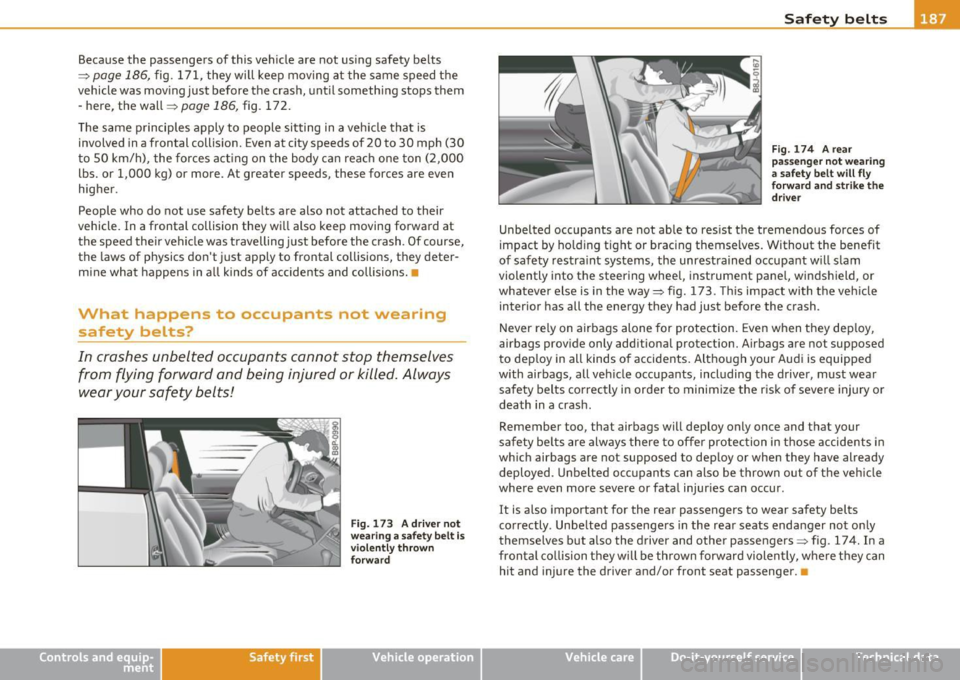
Because the passengers of this vehicle are not using safety belts
=> page 186, fig. 171 , they wi ll keep moving at the same speed the
vehicle was mov ing just before the crash, until someth ing stops them
- here, the wall =>
page 186, fig. 172.
Th e same principles apply to people sitting in a veh icle that is
involved in a frontal collis ion. Even at city speeds of 20 to 30 mph (30
to SO km/h), the forces acting on the body can reach one ton (2,000
lbs. or 1,000 kg) or more. At greater speeds, these forces are even
higher .
People who do not use safety be lts are also not attached to their
vehicle. In a frontal collision they wi ll also keep moving forward at
the speed their vehicle was t ravelling just before the c rash . Of course,
the laws of physics don't just apply to frontal collisions, they deter
mine what happens in all kinds of accidents and collisions.•
What happens to occupants not wearing
safety belts?
In crashes unbelted occupants cannot stop themselves
from flying forward and being injured or killed. Always
wear your safety belts!
Safety first
Fig. 173 A driver not
wearing a safety belt is
violently thrown
forward
Vehicle OP-eration
Safety belts
Fig. 174 A rear
passenger not wearing
a safety belt will fly
forward and strike the
driver
Unbelted occupants are not able to resist the tremendous forces of
impact by holding tight or bracing themselves. Without the benefit
of safety restraint systems, the unrestra ined occupa nt w ill sla m
violently into the steering wheel, instrument panel, winds hield, or
whateve r else is in the way=> fig. 173. This impact with the veh icle
interior has all the energy they had just before the crash.
Never rely on airbags alone for protection. Even when they deploy,
airbags prov ide only additional protection. Airbags are not supposed
to dep loy in all kinds of accidents. Alt hough your Audi is equipped
with airbags, all veh icle occupants, including the driver, must wear
safety belts correctly in order to minimize the risk of severe injury or
death in a crash .
Remember too, that airbags will deploy only once and that your
safety belts are always there to offer protection in those accide nts i n
which airbags are not supposed to deploy or when they have already
deployed. Unbelted occupants can also be thrown out of the vehicle
where even more severe or fatal injur ies can occur .
It is also important for the rear passengers to wear safety belts
correctly. Unbelted passengers in the rear seats endanger not on ly
themse lves but a lso the driver and other passengers=> fig . 174. In a
frontal collision th ey w ill be thrown forward violently, where they can
hit and injure the driver and/or front seat passenger. •
Vehicle care Do-it-yourselt service iTechnical data
Page 190 of 368
__ _:::S:.::a :..:f...:e :.:t::1y ~ b:..:e:.: l:.: t :.:s :._ ____________________________________________ _
Safety belts protect
People think it's possible to use the hands to brace the
body in a minor collision . It's simply n ot true!
F ig. 175 Driver is
correct ly re str ain ed in
a s udden b rakin g
m ane uver
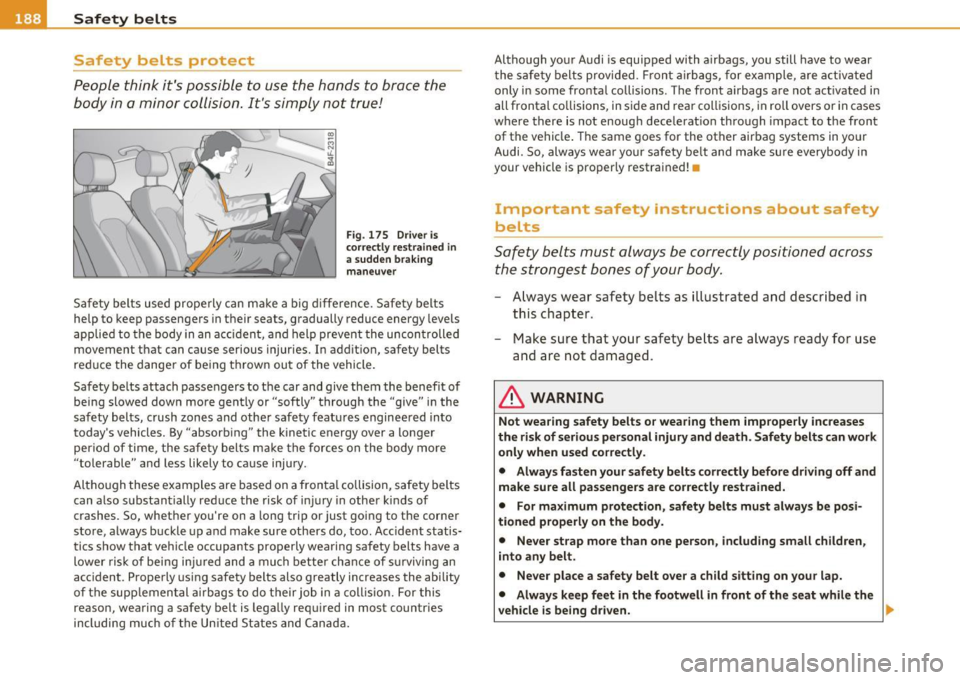
Safe ty belts used properly can make a big d ifference. Safe ty belts
help to keep passengers in their seats, gradually reduce energy levels
applied to the body in an accident, an d help prevent the uncon trolled
movement that can cause serious injuries. In add it ion, safety belts
red uce the danger of be ing t hrown ou t of the vehicle .
Safety be lts attach passengers to the car and give them the benefit of
being slowed down more gently or "softly" through the "give" in the
safety belts, crush zones and othe r saf ety features engine ered into
today's vehicles. By "absorb ing" the kinetic energy over a longer
per iod of time , the safety belts m ake the forces on the body more
"tolerable" and less likely to cause injury.
Altho ugh these examples are based on a fronta l collision, safety belts
can also s ubstant ially red uce the risk of injury in other ki nds of
crashes. So, whether you're on a long trip or just going to the corner
sto re, always buckle up and make sure others do, too. Acc ident statis
tics show that vehicle occupants properly wear ing safety belts have a
lower ris k of bei ng inj ured and a mu ch better cha nce of s urviv ing an
acc ident . Properly using safety belts also greatly increases the ability
of the supp lemen tal air bags to do the ir job in a coll is ion. For this
reason, wearing a safety bel t is lega lly requ ired in most coun tries
including muc h of the Un ited States and Canada. Altho
ugh your Audi is equ ipped with a irbags, you still have to wear
t he safe ty belts provided. Fron t air bags, for ex ample, are a ctiv ate d
only in some frontal collisions . T he front a irbags are not act ivated in
all frontal co llisions, in s ide and rear coll isio ns, in roll overs or in cases
where there is not enough decelerat ion thro ugh impact to the front
of the vehicle . The same goes for the other airbag systems in yo ur
Audi. So, always wea r your safety be lt and make su re everybody in
your vehicle is properly restrained!
Important safety Instructions about safety
belts
Safety b elts must always be correctly positioned across
the strongest bones of your body .
-Always wear safety belts as illustrated and described in
this chapter .
- Make sure that your safety belts are always ready for use and are not damaged .
& WARNING
Not wearing safety belts o r wearing them improperly inc reases
the risk of s eriou s personal injury and death . Safety belts can work
only when u sed correctl y.
• Alway s fasten your safety belts correctly bef ore driving off and
make sure all passengers are corre ctly restrained.
• For ma ximum protection , safety belts must alw ays be posi
ti oned properly on the body.
• Never strap more than one person , including small children ,
into any belt .
• Never place a safety belt o ver a ch ild sitting on you r lap .
• Alway s keep feet in the footwell in front of the seat while the
vehicle is being driven.
~
Page 195 of 368

_____________________________________________ S_a _f _e _t _y _b_ e_lt _ s __ _
[I) Tips
• T he shoulder belt part shou ld route approximate ly over the
middle of your shoulder -under no circumstances should it route over
you r neck a nd throat area~
& in "Safety belt position" on page 190.
• With the front seats, the height adjustment of the seat can also
be used to adjust the position of the safety belts. •
Improperly worn safety belts
Incorrectly positioned safety belts can cause severe inju
nes.
Wearing safety belts improperly can cause serious injury or
death. Safety belts can only work when they are correctly
positioned on the body . Improper seating positions reduce
the effectiveness of safety belts and will even increase the
ris k of injury and death by moving the safety belt to critical
areas of the body. Improper seating positions also increase
the risk of serious injury and death when an airbag deploys
and str ikes an occupant who is not in the correct seating posi
tion. A driver is responsible for the safety of all vehicle occu
pants and especially for children. Therefore:
- Never permit anyone to assume an incorrect sitting posi
tion in the vehicle while traveling
~ & .
& WARNING
Impr ope rly w orn safet y belts inc re a se the ris k of se rious pe rsonal
injury and de ath whenever a vehi cle i s be ing u sed .
• Alway s mak e sure th at all vehicle occupants are corre ctl y
r es trained an d stay in a correct seating po sition wh enever the
v eh icle is being used.
Controls and equip ment Safety first Vehicle operation
& WA
RNING (continu ed)
• Alw ays re ad and heed all WARNINGS and o ther imp ort ant
information ~
page 188. •
Safety belt pretensioners
How safety belt pretensioners work
In front, side and rear -end collisions above a particular
severity, safety belts are tensioned automatically.
Th e safety belts are equipped with safety belt p retensioners. The
system is activated by sensors in front, side and rear-end collisions of
great sever ity. This tightens th e be lt and ta kes up belt slack~
& in
"Service and disposal of safety belt pretens ioner". Taking up the slack
helps to reduce forward occ upan t movement during a coll is io n.
0 Note
Never let the bel t remain over a rear seat back that has been folded
forward.
[I) Tips
The safety belt pretensioner can only be act ivated once.
• In minor fronta l, side and rear -end collis ions, in a rollove r and in
acc idents involving very little impact force, the safety belt preten
sioner are not activated .
• When the safety belt pretensioners are activated, a fine dust is
re leased. This is norma l and is not ca used by a fire in the vehicle.
• The relevant safety requirements must be observed when the
vehicle o r components of the system a re scrapped. A q ual ified deal
ersh ip is familiar with these regulat ions and will be pleased to pass on
the information to you .
~
Vehicle care Do-it-yourself service Technical data