2010 AUDI S6 fuel cap
[x] Cancel search: fuel capPage 279 of 368

___________________________________________ C..:...._ h:....:e :....:c:..:. k.::..: i..:.. n .:..:g:!:....:: a....:. n..:.. d~ f:....:. i.:..ll :.:.i:....:n :.:g !....- _,n
Closing the engine hood
- Pull the hood down until the pressure from the struts is
reduced.
- Let the hood
drop down and latch in place. Do not try to
push it shut;
it may fail to engage=:> &.
& WARNING
A hood that is not completely latched could fly up and block your
view while driving.
• When you close the engine hood, check it to make sure the
safety catch has properly engaged. The hood should be flush with
the surrounding vehicle body parts.
• If you notice while driving that the hood is not secured prop
erly, stop at once and close it. •
Working in the engine compartment
Be especially careful whenever you work in the engine
compartment.
Whenever you must perform any work in the engine compartment,
for example checking and filling different fluids, there is a risk of injury, burns and accidents. To prevent personal injury always
observe the following WARNINGS. The engine compartment of any
vehicle is a hazardous area=>& .
& WARNING
To help avoid injury, before you check anything under the hood:
• Turn off the engine.
• Remove the ignition key.
• Apply the parking brake.
Safety first
& WARNING (continued)
• Move selector lever to "P" (Park).
• Always let the engine cool down. Hot components will burn
skin on contact.
• To reduce the risk of being burned, never open the hood if you
see or hear steam or coolant escaping from the engine compart
ment. Wait until no steam or coolant can be seen or heard before
carefully opening the hood.
• Keep children away from the engine compartment.
• Never spill fluids on hot engine components. They can cause a
fire. • Never touch the radiator fan. The auxiliary electric fan is
temperature controlled and can switch on suddenly.
• Never open the coolant reservoir cap when the engine is still
warm. The coolant system is pressurized and hot coolant could
spray out.
• Protect your face, hands and arm from steam or hot engine
coolant by placing a thick rag over the cap when you open the
coolant reservoir.
• If work on the fuel system or the electrical system is necessary:
- Always disconnect the battery.
- Never smoke or work near heaters or open flames. Fluids in
the engine compartment could start a fire.
- Keep an approved fire extinguisher immediately available.
• To avoid electrical shock and personal injury while the engine is
running or being started, never touch:
-Ignition cables
- Other components of the high voltage electronic ignition
system.
• If you must perform a check or repair with the engine running:
- First, fully apply the parking brake, move selector lever to
"P" (Park). .,
Vehicle care Technical data
Page 284 of 368
___ C_h_ e_c_ k_i_n -=g :a,__ a_n_ d_ f_ i_ l _li _n _,g;._ __________________________________________ _
Oil level within range
©
- You must add oil. Afterwards, the oil level should be
within range@.
The oil level needs to be checked at regular intervals. The best times
to do this are whenever you refuel and prior to long trips.
Depending on the way the vehicle is driven and the operating condi
tions, oil consumption can be up to 1 quart per 1.200 miles
(l liter
per 2.000 km). Consumption may be higher within the first 3.000
miles (5.000 km) .•
Adding engine oil 9=::11
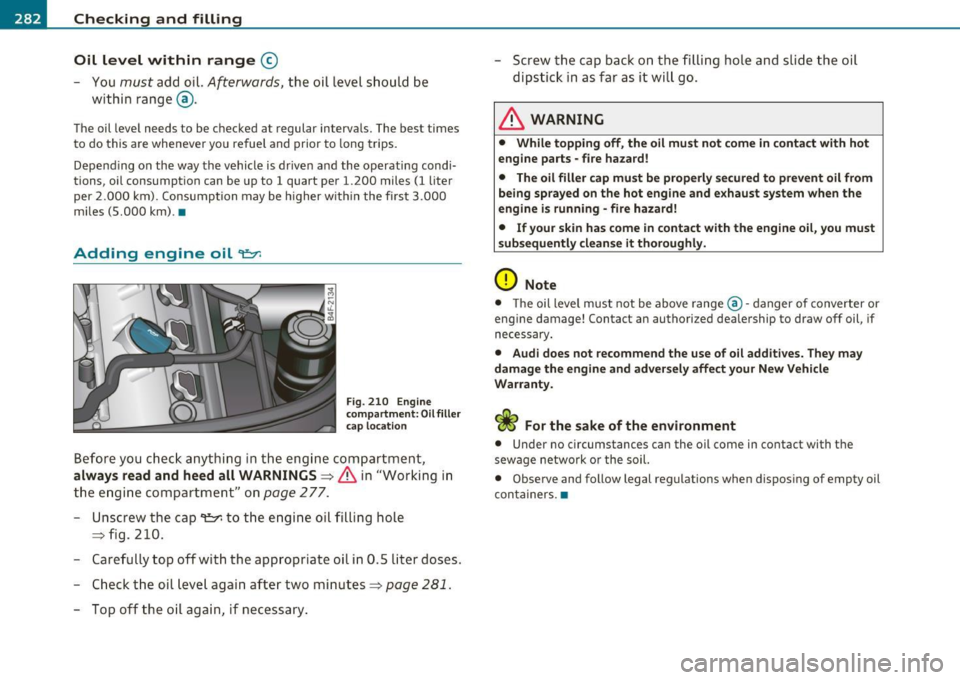
Fig . 210 Engine
compa rtment: Oil filler
cap locatio n
Before you check anything in the engine compartment,
always read and heed all WARNINGS =>
& in "Working in
the engine compartment" on
page 277.
- Unscrew the cap
210 .
-Carefully top off with the appropriate oil in 0.5 liter doses.
- Check the oil level again after two minutes=>
page 281.
-Top off the oil again, if necessary . -
Screw the cap back on the filling hole and slide the oil
dipstick in as far as it will go.
& WARNING
• While topping off, the oil must not come in contact with hot
engine parts -fire hazard!
• The oil filler cap must be properly secured to prevent oil from
being sprayed on the hot engine and ex haust system when the
engine is running -fire hazard!
• If your skin has come in contact with the engine oil, you must
subsequently cleanse it thoroughly.
0 Note
• The oil level must not be above range@- danger of converter or
engine damage! Contact an authorized dealership to draw off oil, if
necessary .
• Audi does not recommend the use of oil additives. They may
damage the engine and adversely affect your New Vehicle
Warranty.
sewage network o r the soil.
• Observe and follow legal regulations when disposing of empty oil
containers. •
Page 312 of 368
llft!l,.___T_ ir_e_ s _ a_ n _ d_ w_ h_e_ e_ ls _______________________________________________ _
Winter tires lose their effectiveness when the tread is worn down to
a d epth o f 0. 157 inch ( 4 mm).
Only drive w it h w inte r tir es under w inte r co nd it io ns. S u mmer t ires
hand le better w hen there is no s now or ice on t he roads a nd the
t em pe ra ture i s above 4 5
°F (7 ° ( ).
If you have a flat tire, see notes on spare wheel~ page 305.
Please always remember that winter tires may have a lower speed
rating than t he t ires or iginally installed on yo ur ve hicle at the time it
was ma nufact ured . Please see~
page 307, "Speed rat ing ( letter
c ode)" fo r a listing of the speed rating le tte r codes a nd t he maximu m
speed at which the tires can be dr ive n.
Th e spee d rat ing le tt er code( ~
page 296) i s on the side w all of the
t ire~
page 305 .
& WARNING
Winter tires have maximum speed limits that may be lower than
your vehicle's maximum speed. Always know the maximum speed
before driving off. Never drive faster than the speed permitted for
your specific winter tires . This will cause damage to the tire s
leading to an accident and serious personal injury to you and your
passengers.
& WARNING
Driving faster than the maximum speed for which the winter tires
on your vehicle were des igned can cause ti re failure includ ing a
blowout and sudden deflation, lo ss of control, crashes and serious
personal injuries . Have worn or damaged tires replaced immedi
ately.
• Winter t ires have maximum speed rat ing that may be lower
than your vehicle's maximum speed .
• Never drive faster than the speed for which the winter or other
tires installed on your vehicle are rated.
& WARNING
Always adjust your driving to the road and traffic conditions.
Never let the good acceleration of the winter tires and all-wheel
drive tempt you into taking extra risks. Always remember :
• When braking , an all-wheel drive vehicle handles in the same
way as a front drive vehicle .
• Drive carefully and reduce your speed on icy and slippery roads,
even winter tires cannot help under black ice conditions.
do not wear as quickly and reduce fuel consum ption .•
Snow chains
Snow chains may be fit te d on ly to the fr ont w heels, and only to
certain t ire sizes . Ask yo ur aut horized Audi dealer on which tire sizes
snow chains can be used .
If you are go ing to use snow c ha ins, then you must insta ll th em on t he
front wheels at least .
Th e sn ow chain s mus t have low-pr ofile li nks and m ust no t be th icker
than 0 .53 inc h (13.5 mm), including the lock.
R emove wheel cente r covers an d trim discs before putti ng snow
chains on your vehicle~
0. For safety reaso ns cove r caps m ust the n
be fitted over the whee l bo lts. These are availab le from a utho rized
Audi dealers.
& WARNING
Using the wrong snow chains for your veh icle or installing them
incorrectly can increase the risk of loss of control leading to
serious personal injury .
~
Page 344 of 368

___ D_ a_t _a _____________________________________________________ _
Applies to vehicles : w ith 3.2 lite r 6 -cylin der engine
265 hp, 3.2 Liter, 6-cylinder engine
Engine dat a
Max imum output SAE net
Max imum torque SAE net
No . of cylinders
Displacement
Stroke
Bore
Comp ression ratio
F uel
Dimen sions (appro x.)
Length
Width Height (unloaded)
Turn ing circle diameter (curb to curb)
Capacities (appro x.)
Fuel t ank
- Total capac ity
- Reserve (of total capacity)
Wind shield and headlight* was her flu id c ontainer
Engin e oil
with filter change hp@rpm
lb-
ft@ rpm
CID (cm
3 )
in (mm)
in (mm) 265 @6500
243 @ 3200-5000
6 cylinder
195 1 (3 197)
3 .65 (92 .8)
3 .37 (85.5)
12 .5: 1
Premium un leaded (91 A KI) Recommended fo r maximum engine performance . Fur
ther details =>
page 271, "Gasoline"
in (mm)
in (mm)
in (mm)
ft (m) 193.5 (4916)
79.2 (2012)
57.4 (1459)
39 .0 (11.9)
gal (liters)
gal (liters)
quarts (lite rs)
quarts ( liters) 21.1 (80
.0)
1. 8-2 .4 (7 -9)
5.1 (4 .8)
6.9 (6.5)
•
Page 345 of 368
____________________________________________________ D_ a_t_ a __ _
App lies to ve hicles : with 4.2 li ter 8 -cy linder engine
3 50 hp, a-cylinder engine
Engine data
Max imum output SAE net
Maximum torque SAE net
No . of cy linders
Displacement
Stroke Bore
Comp ression ra tio
Fuel
Dimensions (approx. )
Length
W idth
He ight (un loaded)
Tu rning circle diameter (curb to curb)
Capacities (app ro x. )
Fuel tank
-Tota l capacity
- Reserve (of total capacity)
Windshield and headlight* washer fluid container
Engine oil
with filter change
Safety first
hp@rpm
lb-ft@ rpm
CID (cm
3
)
in (mm)
in (mm) 350@ 6800
325 @3500
8 cylinder
254 (4163)
3
.65 (92.8)
3 .33 (84 .5)
12.5: 1
Premium unl eaded (91 AKI) Recommended for maximum engine performance . Fur
ther details => page
271, "Gasoline"
in (mm)
i n (mm)
i n (mm)
ft (m) 1
93.5 ( 4916)
79 .2 (2012)
57 .4 (1459)
39.0 (11.9)
gal ( liters)
gal (liters)
quarts (liters)
quarts ( lite rs) 21.1 (80.0)
1.8 -2 .4 ( 7-9)
5 .1 (4 .8)
9.0 (8.5)
•
Do-it,yourself service Technical data
Page 357 of 368
Alphabetical index -________________ fNi'II
Unleaded fuel .... .... ... .. .. . .. . 271
What should I do with an old battery? ...
292
EPC
See E lectronic power control ........ 14
ESP
See Electronic stabilizat ion program (ESP)
14
Event Data Recorder (EDR) ............ 240
Exhaust tail pipes
Cleaning ................ .... .... 264
Expansion tank ..................... 284
Ex terior lighting in the mirror housing ... 61
Eyeglass es compa rtment .............. 9S
F
Fan
Radiator ............... .. .. .. .. . 286
Fastening Booster seats .................... 225
Convertible child safety seats .. ..... 223
Infant seats .............. .... .. . 222
Fastening eyelets .................... 84
Flat tire Changing . .. ........... ...... .. . 318
Floor mats ......................... 180
Fog lights ................. ........ . 60
Folding master key with remote control .. 3 7
Foot pedals .. .. ... ........ .. .. .. .. . 180
For the sake of the environment
Gasoline fumes and the environment 273
Letting your engine warm up ...... . 109
Controls and equip
ment Safety first
Reducing engine noise
by early upshifting
8
Refueling . .. ..... .. .. .. ......... 273
Saving fuel by early upshifting ........ 8
Using the rear window defogger ..... 101
Front airbags Descript ion . ...... .. .. .. .. ....... 199
How they work ................. .. 204
Front ashtray ........................ 91
Front fog lights .. ................. .. . 60
Front seats ... .. ..... ...... ...... .. . 75
Adjusting .. .. .. ........ ......... 177
Chi ld restraints in the front seat . ... 197
Fro nta l collisions and the laws of physics 186
Fuel Additives .... .. .... .. .. ......... 271
Blended gasoline ................. 271
Consumption ............ .... .. .. . 34
Filler neck ....................... 272
Fuel gauge ...... ............. .... 10
Gasoline ..................... ... 271
Gasoline additives ................ 272
Low fuel leve l . . . . . . . . . . . . . . . . . 10, 30
Octane rating . .. ................. 271
Recommendation . ......... .... .. 271
Refuelling ....... .... .. .. ....... 273
Reserve .................. ... .. .. . 10
T ank capacity .................... 341
Unlocking the fuel filler flap by hand . 275
Fuse arrangement ................. .. 325
G
Garage door opener (Homelink ®) .. .. .. 169 Gas d
ischarge lamps .. ... .... ... .... . 329
Gauges Engine coolant temperature .......... 8
Fuel gauge ... ... .. ............... 10
Speedometer ..................... 10
Tachometer . .... .. ... ............. 9
Trip odometer ............ ...... .. 10
General illustration Instrum ents and contro ls ............ 7
Glossary of tire and loading terminology 294
Glove compartment . .. .... .... .. ..... 94
cd changer .. .... .. .... ........... 94
emergency unlocking .............. 94
Valet key function ................. 40
Gross Vehicle Weight Rating (GVWR) ... 339
H
Head restraints ..................... 179
Adjusting ............... ... ... .. 179
Front seats ........ ............... 81
Rear seats .. .. .. .. ............... 81
Headlight washer reservoir ... ........ 292
Headlights ......................... . 58
Adaptive Light .............. ...... 61
Defective . .. .. .. .. ... ............ 21
Front fog lights ................... 60
Headl ight range control defective .. .. 31
Switching off ............ ... .. .. .. 58
Switching on ............ ...... ... 58
Washer system ... ................ 67
Xenon headlights ... ... ... ......... 58
Heated outside mirrors ............... 71
Vehicle operation Vehicle care Do-it-yourself service Technical data
Page 361 of 368

___________________________________________ A_ l::.. p _h _a_ b_ e_t _ic _a_ l_ in_ d _ e_x __ _
R
Radiator fan ................... .... 286
Rain sensor . ................... ... .. 66
Rain sensor defect ive ............... .. 30
Reading lights
Front ................... ... .. .. ..
63
Rear .. ......... ... ... ...... ..... 64
Rear ashtray ........................ 91
Rear fog lights ......... ...... .. .. .. .. 60
Rear lid
Escape handle ..... ..............
316
Open ing and closing .. .. ..... ..... . 46
Valet key function ...... ..... .. .. .. 40
Rear light
Defective .............. .. .... .. ..
21
Rear seat bench .......... .. .. .. .. .. .. 83
Rear view camera Park ing mode
2 ... ... .... .... .... 163
Park ing mode 1 .............. ... . 162
Rear view mirror
Inside rear view mirror . . . . . . . . .
69, 70
Rear window defogger ........ .... .. . 101
Rear window shelf . .. .. ... ....... ..... 80
Rear window sun shade ............... 65
Red symbols ... ... ........ .... .... .. 25
Refuelling . ................... .. .. . 273
Release lever for hood ............... 276
Remote control garage door opener
(Homelink ®) ........... .... ... .
169
Remote control key ................. .. 38
Unlocking and locking ..... ......... 42
Controls and equip
ment Safety first
Remote rear lid release
... .. ...... .. .. 46
Repair manua ls . ... .... ............. 344
Repairs
Airbag system ...................
209
Replacing a fuse . .... ............... 325
Replacing light bulbs . .. .. .. .. ....... 329
Replacing tires and wheels .... ... .. .. . 306
Reporting Safety Defects ........ 183, 184
Reset button .. ...... .. .. .. .......... 10
Residual heat . .. .. ............... ... 98
Retractor .......................... 189
Rims
Cast alloy ...... .... .. ... ... .....
263
Roof rack ... ................ ... .. .. . 87
Loading ................ .. .. .. .. . 88
Mounting locations .... ............ 88
Roof weight ................. ... .. ... 88
s
Safe driving habits ..... .. ..... ... ... 17 4
Safety belt position .... ....... ......
190
Safety belt height adjustment .. .. .. 192
Safety belts worn by pregnant women ...
191
Safety belt pretens ioner
Service and disposal ..............
194
Safety belt pretensioners .. .. .. .. .. ... 193
Safety belt warning light .. ...... . 15,185
Safety belts . .. .. .... ............. .. 189
cleaning . ............... .. .... .. 269
Danger to passengers who do not wear a
safety belt .. ........... ...... ..
187
Fastening . .... ............. .... . 189
height adjustment ........ ... .. ... 192
Improperly worn . .. .............. 193
Not worn . .... ..... ...... ... ... . 187
Safety belt position ............ .. . 190
Safety instructions .. .. .. .. .... .. . 188
Securing child safety seats ...... .. . 227
Special considerations for pregnant
women .... . .... ... . .. .. .. .. .. .
191
Unfastening . .... ... .. .. .. .. .. .. . 192
Warning/indicator light ........... 185
Why YOU MUST wear them ....... .. 185
Worn properly ...... ...... .. .. .. . 188
Safety compliance sticker . .. .. .. .. .... 338
Safety equipment ................ .. . 17 4
Safety features for occupant restraint and protection .... . .. ..............
17 4
Safety guidelines Seat adjustment ... .... ...........
75
Safety instructions
Engine compartment ........ .. ...
277
for side curtain airbags .. ... ..... .. 216
for using child safety seats .. .. .. .. . 220
for using safety belts ...... .... .. . 188
Monitor ing the Advanced Airbag System .
208
Safety lock
Ignition key, automatic transmission
109
Seat adjustment Adjusting the seatback .. ...........
77
Adjusting upper thigh support ....... 78
Driver's seat . ................. .. .. 75
Driver's seat memory ........... ... 79
Front passenger's seat .... .. ....... 76
Vehicle operation Vehicle care Do-it-yourself service Technical data
Page 363 of 368

_____________________________________________ A_ L .... p_ h _ a_b_ e_ t_ ic_a_ l_ in_ d_e _ x __ _
T Tires ..... .... .. .. ...... .. .. ....... 293 TPMS
Service life . .. .. .... .. .. ... ... ...
304 Tire pressure monitoring system . ... 313
Tachometer .. .. ..... ..... .... .. . .. .. . 9 speed rating letter ,code .. ........ . 307 Trailer towing . .. ................. .. 254
Tank flap Tire
manufacturing date . ... .. .. ... 307 Operating instructions . ........... 255
Unlocking the fuel filler flap by hand . 275 Tire specifications ........ .... .. .. 306 Technical requirements ....... 254, 255
T ech nical modifications .... .......... 347 Tr ead depth .. .. ........ ......... 304 Trailer towing tips ......... .. .. .. . 256
Temperature
Climate controls ...... .. .. .. .. .. .. 99 Uniform tire
quality grading ... ..... 308
Winter tires ..................... 309
Transm ission
tiptronic ® .......................
146
Setting for the driver's and front passen-Tires
and vehicle load limits .. . ... ... .. 301 Transport Canada ..... ...... ... . ... . 184
ger's side ....................... 99 Tires and wheels
Tread Wear Indicator (TWI) ........... 304
Tether anchors .............. .... .. . 235
Tether strap ........... .......... .. . 235
Th e first 1,000 miles (1,500 km) and
afterwards ..... ... .. .. .. .. .. .. .
249
Tie-downs ............ .. ... ..... ... 183
Tips for the environment
Saving fuel ............. .. ........ 88 Checking tire pressure
.............
300
Cold tire inflation pressure ......... 297
Dimensions .. .... ............. .. 305
General notes ................... 293
Glossary of tire and loading terminology .
294
New tires and wheels ............ . 305
Replacing .... .... ............... 306
Tr ip computer
Fuel consumption .. ...............
34
Mileage ................. .... .. .. 34
Single-trip memory ................ 35
Total-trip memory ......... .. . ... .. 35
Tr ip odometer .. .. .... ............... 10
What does it mean when dEF appears in
Using the air conditioner only when
necessary ... ...... ........ .....
102
the trip odometer display? .. ....... 10
Snow chains .. ........... .... .. .. 310 Tr unk
Tires and vehicle load limits ... .....
301 tiptronic® ......................... 146
Wheel bolts .. ... ......... .... ... 311
See Rear lid ... .. .. ............... 46
Automatic Shift Lock (ASL) ......... 148
W.
t t· 309 Trunk escape handle ..... .. .. .. .... .. 316 in er ires ....... ....... ...... .
Dr iving ...... ...... .. .. .. .. .. .. . 146
Tires/Wheels
Dynamic shift program ... ......... 149
F ·
l f d 151 Low aspect ratio tires ...... .. .. ... 312 a, -sa e mo e ... ............... . Turn
signals ................ ... .. .. ..
62
Warning/indicator lights ....... .. .. 15
Kick-down ........ ... ... ... ... .. 149 Tire pressure monitoring system 15, 312
Manual shift program ... ... ... ... . 150 Tools · · · · · · · · · · · · · · · · · · · · · · · · · · ---317 u
Selector lever ...... ... ... ... .. ... 147 Torn or frayed safety belts ... ......... 188 Undercoating .. .. .. .. .............. 264
Tire pressure ................ .. .. .. . 300 Touch-up paint ..................... 262 Unfastening safety belts ............. 192
Tir e pressure monitoring system ....... 312 Towing
Unidirectional tires .................. 293
Loss of air pressure ........... 15, 313
Malfunction .............. .. .. ... 313
Resetting tire pressures ........... 314
Front eyelet ................. ... . 334
Rear eyelet ..... ................. 335
T ow truck procedures .. ........... 334
Uniform tire quality grading ......... . 308
Unlocking
Power locking switch ......... .. .. ..
44
Tire service life ..... ... . .... . ... ... . 304 Rear lid/trunk lid ... .... ........... 46
Controls and equip
ment Safety first Vehicle operation
Vehicle care Do-it-yourself service Technical data