2010 AUDI Q7 ABS
[x] Cancel search: ABSPage 310 of 390
![AUDI Q7 2010 Owner´s Manual -Checking and filling
-------=------=---------------------------------------------------
warning/ind icator light will illum inate . Contac t an authorized Aud i
de aler
immediately .
[ i ]](/manual-img/6/40275/w960_40275-309.png "AUDI Q7 2010 Owner´s Manual -Checking and filling
-------=------=---------------------------------------------------
warning/ind icator light will illum inate . Contac t an authorized Aud i
de aler
immediately .
[ i ]")
-Checking and filling
-------=------=---------------------------------------------------
warning/ind icator light will illum inate . Contac t an authorized Aud i
de aler
immediately .
[ i ] Tips
T he b rake fl uid reservoir is located unde rneath t he cover. •
Changing brake fluid
Have the b rake fluid chan ged by an exp eri enc ed t echni
cian.
B ra ke flui d absorbs mois ture fro m th e air . If the w ater con ten t in the
brake fl uid is too high, corros io n in th e brake system may result afte r
a p eriod of time. The boil ing po int of the br ake fl uid will also de cre as e
cons iderab ly and decr ease brak ing performa nce.
Th erefo re, the brake fl uid m ust be changed
every two years. Always
use new br ake fluid w hich conforms to Federal Motor Veh icle Stan
dard "FMVSS 1 16 DOT
4" .
The b rake fl uid reservo ir can be diffi cult to rea ch, there fore, we
recommend that you have the brake fluid c hanged by your author ized
Audi dealer. Your dea ler has the correct tools, the rig ht b rake f luid
and the k now-how to do t his for you .
& WARNING
• Brake fluid is poisonous. It must be stored only in the closed
original container out of the rea ch of children!
• Brake failure can result from old or inappropriate brake fluid.
Observe these precautions:
-Use only brake fluid that meets SAE specification
J 1703 and
conforms to Federal Motor Vehicle Standard 116. Alway s check
with your authorized Audi dealer to make sure you are using
the correct brake fluid. The correct type of brake fluid is also indicated on the brake fluid reservoir .
& WARNING (co ntinued )
-The brake fluid must be new. Heavy use of the brakes can
cause a vapor lock if the brake fluid is left in the system too
long . This can seriously affect the efficiency of the brakes as
well as your safety . This could result in an accident.
0 Note
B rak e fluid will dam age the pai nt of yo u r ve hicl e.
<£> For the sake of the environment
Beca u se of the pr oblem of pro per dispo sal o f b rak e fl uid as we ll a s
the spec ia l too ls req uired and the necessary expertise, we recom
me nd that you h ave t he brake f luid chan ged b y yo ur a uth oriz e d Audi
dea ler. •
Battery
General information
Under normal operat ing co ndit io ns, the battery in your Aud i does not
need any maintenance. With high outs ide temperatures or long daily
dr iv es we re comme nd that yo u have th e ele ct rolyte level checked by
an a uth orized Audi dealer o r qualified wor kshop. The electro lyte leve l
s ho uld a ls o be che cked e ach time the batte ry is ch arge d=>
page 311.
Have the batte ry chec ked when yo u take yo ur vehicle in for serv ice.
Yo u ar e well advised to rep lace a batte ry that is older th an 5 years .
W ith certa in types of airbag deployme nt, the ba ttery is disconnected
from the vehicle e lectrica l system for safety reasons=>
& in "Repair,
c are and dis posa l o f the air bag s" on
page 223. ~
Page 311 of 390

___________________________________________ C..:...._ h:....:e :....:c:..:. k.::..: i..:.. n .:..:g:!:....:: a....:. n..:.. d~ f:....:. i.:..ll :.:.i:....:n :.:g !....- __
Disconnecting the battery terminals
Some vehicle f unct ions (powe r window regula to rs, fo r ex am ple) are
lost if the batt ery t ermina ls are disconnec ted . These func tions hav e
to be re lea rne d after the battery term ina ls a re co nnecte d aga in . To
prev en t th is, t he battery should only b e disconn ecte d from th e
vehicle e lectr ica l system when absol ute ly necessary for repairs .
Vehicles not driven for long periods
If you do not drive your veh icle over a period of seve ra l days o r wee ks,
el ect rical compo nents are g radually cu t back or swi tched off . This
re duces ene rgy consumption an d maintains start in g ca pability ove r a
lo nger pe riod=>
pag e 259.
Take into consideration t hat when you unlock your vehicle, some
c onvenie nce func tions, such a s the m aster key remote function or
power seat ad justment , may not be ava ilab le. T he conven ience func
t ions wi ll be available again when you turn on the ignition and st art
t he engin e.
Winter operation
Dur ing the w inter months, batte ry capac ity tends to decrease as
t empe ra tures drop . This is beca use mo re powe r is also co nsu med
w hile starting, and the headlights, rear w indow defogger, etc ., are
used more often .
Avoid unnecessa ry power consu mptio n, part icularl y in city tra ffic o r
w hen trave ling on ly short distances . Let your author ized A udi deale r
ch eck t he capa city of the vehicle ba ttery before w inter sets in
=>
page 311. A well charged battery will not only prevent start ing
pro blems when the we ather is co ld, but wi ll a lso la st l onge r.
[ i J Tips
If you r ve hicl e is left s tandi ng for seve ral weeks at extremely low
tempe ratures, t he ve hicle battery should be removed and stored
w here it will no t free ze . T his will preven t it fr om being dam age d and
having to be replaced .•
Safety first
Working on the battery
B e es pec ially ca reful when workin g on o r nea r the
batt ery.
The battery is located un de r th e d rive r's se at . B efo re yo u
ch eck a nyth ing under the driv er's sea t,
read and heed all
WARNINGS =>& .
Always heed the safety warnings , when wo rking on the vehicle
battery or the ve hicle elect rical system to p reve nt injury .
The following WARNINGS are very important when
working on the battery:
Always heed the following WARNING SYMBOLS and safety pre
cautions when working on the battery.
@
Always wear eye protection.
Battery acid contains sulfuric acid. Always wear
gloves and eye protection.
No
- sparks
- flames
• smoking .
When a battery is charged, it produces hydrogen
gas which is explosive and could cause personal injury.
Always keep the battery well out of reach of chil
dren.
& WARNING
Whenever working on the battery or on the electrical system ,
there i s the risk of injury, accident and even fire. Read and heed
the following WARNINGS: .,_
Vehicle care Technical data
Page 336 of 390

lffll __ T_ i_ r_e _s_ a_ n_ d _ w _h _e_e_ l_ s _______________________________________________ _
Tire pressure indicator appears
The tire pressure indicator in the instrument cluster
informs you if the ti re pressure is too low or if there is a
system malfunction.
Fig. 2 44 D ispla y:
u nd erinfl ation
warni ng
Fi g. 2 45 Display:
Syst em m alf un ction
Us ing the ABS sensors, the tire pressure monitoring system compares
t he t ire tread c ircumference and vibrat ion characte rist ics o f the indi
vidual tires. If the pressure decreases in one or more tires, this is indi
cated in the ins trument cl uste r wi th a warning symbol
1 and a
message=> fig. 244 . The dr iver message in the display goes o ut after
5 seconds . T he driver message can be disp layed again by p ressing the
[ CHECK ] button. If only one t ire is affected , the display will ind icate
its position . The tire press
ure monitoring must be reset via MMI each time the
pressu res are adju sted (e.g. when sw itching between partial and full
load pressure) or after chang ing or replacing a t ire on your veh icle
=>
page 335. You can find the recommended tire pressures fo r your
vehicle on the label o n the dr iver's door pillar=>
page 318.
Ti re tread circumference and v ibration characterist ics can change and
c ause a tire p ress ure warning if:
• the tire pressure in one or more tires is too low,
• t he ti re has s tructur al damage,
• the t ire pressure was changed, wheels rotated or rep laced but the
T PM S w as no t rese t=>
page 335.
Warning symbols
' ' Loss of press ure in at least one tir e=> .&. Chec k the t ire or t ires
and rep lace or repair if necessary. The indicator light in the instru-
me nt cluster a lso illumina tes=>
page 14. C heck/co rrect t he p res
sures of all four ti res and reset TPMS via MMI.
( T ire Pressure Monitor ing System)
Tire pre ssure! System
malfunction .
If appears afte r sw itch ing the ignition o n or while
dr iv ing =>
page 334, fig. 24 5 and the indicator ligh t in the ins tru
me nt clus ter blinks for approx imately one minu te and then s tays on,
there is a system ma lfunction . See your a uthorized Audi dealer as
soon as poss ible.
& WARNING
• If the tire pressure indicator appear s in the instrument cluster
display, one or more of your tires is significantly under-inflated.
Reduce your speed imm ediately and avoid any hard steering or
brak ing maneuvers . Stop as soon as possible and check the tires
and their pres sures. Inflate the tire pre ssure to the proper pres
s u re as indicated on the vehicle 's tire pressure label=>
page 318.
Driving on a significantly under-inflated tire cau ses the tire to
overheat and can lead to tire failure . Under-inflat ion also is l ikely
to impair the vehicle 's handling and stopping ability .
~
Page 337 of 390

Tires and wheels -________________ fff'II
& WARNING (co ntinued )
• The driver is responsible for maintaining the correct tire pres
sure s. You must check the tire pressures regularly.
• Under certain conditions (such as a sport y driving style , winter
cond ition s or unpaved roads) , the pre ssure monitor indicator may
be delayed.
• Ask your authorized Audi dealer if run-flat t ires may be used on
your vehicle. Your vehicle registration becomes invalid if you use
the se tires when not permitted. Damage to your vehicle or acci
dents could al so result.
[ i ] Tips
• Th e tire pressure monito ring system stops wo rking when there is
an ESP/ABS ma lf u nct ion.
• Using snow cha ins may res ult in a sys tem malfunction.
• The tire press ure mon itor ing system on your Audi was calibrated
u sing t ires wi th the "AO" or "RO" identifi cat ion . W e recommend
using these tires. •
Reset tire pressure monitoring system
If the tire pres sur e is adjuste d, wheels ore ro tated o r
change d, th e TP MS mus t be rese t via MMI .
- Tur n on th e ig nit ion.
- Select : Func tion button [C AR]> Systems* > Tire pressure
monitoring > Store now .
[I) Tips
Before resetti ng the T PMS, the curr ent pr essures of all fo ur tires
must co rrespond to the specif ied values. Adjust the tire pressure and
Safety first
reset the pressure in the t ire p ressure mo nitoring system acco rd in g
t o the loa d you are carry ing ::::>
page 318. •
Vehicle care Technical data
Page 339 of 390

_____________________________________________ W __ h_a _ t_ d_o_ I_ d _ o_ n_o_ w_ ? _ ___.11111
Release the two hook-and-loop fasteners, and remove the two
chocks . To use the chocks, you first have to raise the support plate
=>
page 336, fig . 248 (D and then insert the locking plate with the
two "tabs" into the elongated holes in the base plate @=>& .
& WARNING
• The chock cannot fulfil its function and may lose its stability if
the "tabs" on the support plate are not inserted correctly into the
elo ngated holes in the base plate. If this happens, the vehicle may
start to move while a wheel is being changed.
• Never use the folding chocks if they are damaged or if they
have not been assembled correctly.
& WARNING
Improper use of the vehicle jack can cause serious personal inju
ries.
• Never use the jack supplied with your Audi on another vehicle,
particularly on a heavier one. The jack is only suitable for use on
the vehicle it came with.
• Using a bumper jack to raise the vehicle will damage the
bumper system. The jack may slip, causing injury.
• Never support your vehicle on cinder blocks, bricks or other
objects . These may not be able to support the load and could cause
injury when they fail.
• Never start or run the engine while the vehicle is supported by
the jack.
• If you must work under the vehicle, always use safety stands
specifically designed for this purpose.
• Always make sure the inflatable spare tire and even a flat tire
are secured in place and not loose, otherwise they could fly
forward, causing personal injury to passengers in the vehicle in an
accident or sudden maneuver. •
Vehicle OP-eration
Applies to vehicles : with bass box
Removing bass box
Before the inflatable spare tire can be taken out, the bass
box must be removed.
Fig. 249 Spare wheel
well: Bass box
Removing bass box
-Squeeze the locking tabs=> fig. 249 (D of the connector.
- Disconnect the connector @ and place the lead to one
side.
- Turn the large screw counter-clockwise.
- Carefully remove the bass box.
Installing bass box
-Carefully place the bass box in the wheel. The inscription
"FRONT" on the bass box must face forward.
- Reconnect the connector that was removed.
- Secure the bass box with the large screw. •
Vehicle care Do-it-yourself service iTechnical data
Page 375 of 390

Alphabetical index -________________ fWI
Alternator Auto-Check Control ..... .. .. .... ...... 27 Replacing the battery .. .... .. .. .. . 312
Malfunction ............. ........ . 29 Automatic belt retractor ............. 203 State of charge
.................. 259
Ambience lighting Lighting profiles ................. . 71
Anti -freeze
See Engine coolant system ......... 304
Anti-glare inside day-night mirror ... 77, 78
Anti -lock brake system
How the ABS system works ......... 256
Warning/indicator lights ... .. .... .. 19
Anti-S lip Regulation System (ASR)
How the system works ... .... .. .. . 254
Anti-theft systems
Anti-theft alarm system ........ .. .. 55
Electronic immobilizer ............. 43
Approach/departure angle ............ 266
Ashtray . ............. .. .. .. .. .... . 103
ASR How the Anti-Slip Regulation System works . ..... ... ... .. .. ......... 254
Asterisk What does it mean when something is
marked with an asterisk? ........... 6
Audi braking guard .................. 149
Error messages ............... ... 151
Settings ................ ..... ... 15 1
Status messages ................. 151
Switching on and off .............. 151
Audi Service Repair Manuals and Literature
366
AU TO mode
AC climate contro ls ...... .... .. .. . 112
Auto Safety Hotline .... ... ... ....... 197
Controls and equip
ment Safety first
Automatic car wash
See Washing
.................... 275
Automatic mode Four-zone automatic comfort air
conditioning ........... ...... .. 117
Automatic Sh ift Lock (ASL) ............ 163
Automatic transmission
6-speed automatic transmiss ion .. .. 161
Automatic Shift Lock (ASL) ......... 163
Driving ......................... 161
Dynamic shift program ............ 164
Emergency release for selector lever . 166
Fail-safe mode ................ ... 166
Ignition key safety lock .... ... .. .. . 125
Kick-down . ...... .. .. .. .. ....... 164
Manual shift program .. .. .. .. .. .. . 165
Selector lever ............ ........ 162
Shift buttons .................... 166
Steering wheel with tiptronic ® .... .. 166
Average speed ....................... 3 7
Avoid damaging the vehicle ........... 263
B
Bass box ... .. .. ................. .. 337
Battery . .. .. .. .. .. ........ ......... 308
Battery location .. ... ............. 309
Charging ................ .. ... ... 311
Important warnings when working on the battery . .. .... ....... ..... .. ... 309
Jump start ing ................. ... 352
Low . .. .... .. .. .... ... ...... .... 259 Voltage
............. .... ... ...... 33
Winter operation ............... .. 308
Work ing on the battery ............ 309
Before driving .. .... .. ...... ....... . 189
Blended gasoline . .. .. ...... ....... . 287
Body cavity sealing .................. 280
Booster seats .................... .. 239
Brake ass istant . .. .... .............. 257
Brake booster ..................... . 256
Brake fluid Changing the brake fluid ........... 308
Checking the brake fluid level ....... 307
Reservoir ...................... . 307
What is the correct brake fluid level? . 307
What should I do if the brake fl uid wa rning
light comes on? ... .. .. .. ........ 307
Brake light
Defective .... .................... 24
Brake system ..... .......... ...... .. 307
Anti -lock brake system ............. 19
Brake fluid .. ...... ...... ....... . 307
Brake fluid specificat ions for refill and
replacement ................. .. 308
Brake pads .. .. ................ .. 262
General information ............ .. 255
How does moisture or road salt affect the
brakes? . ...................... 255
Malfunction ........ ...... ...... .. 29
Parking b rake .................... 129
Warning/indicator lights ..... .. .. .. 20
Worn brake pads symbol ........... 34
Vehicle operation Vehicle care Do-it-yourself service Technical data
Page 387 of 390
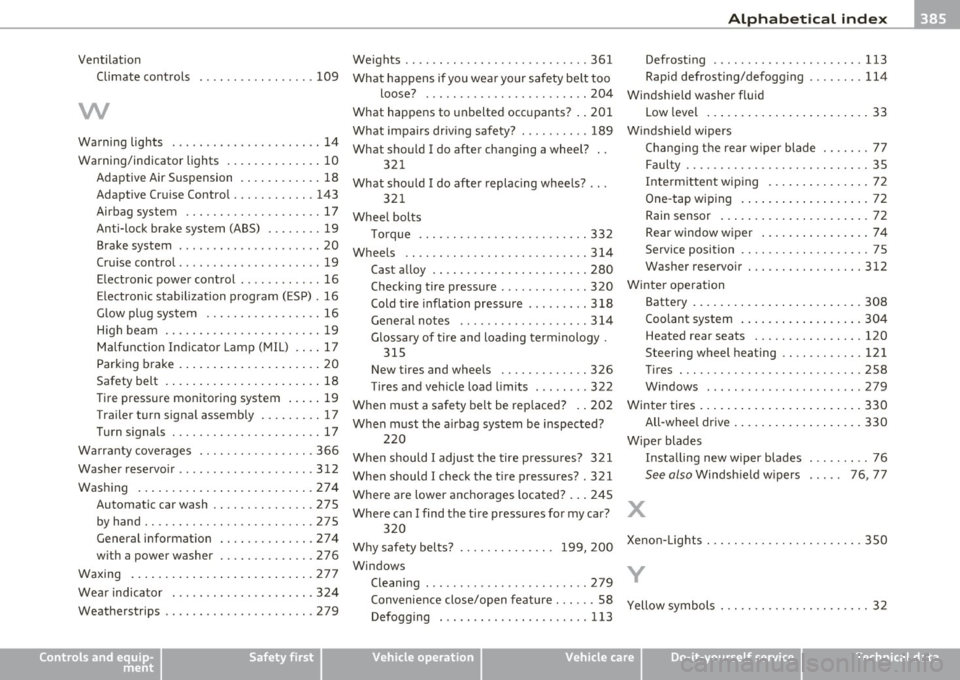
Alphabetical index -___________________________________ ____._ _______ _
Ventilatio n Weights .. .. .. .. .. .... .. .. .... .. ... 361
Climate controls ................. 109 What happens if you wear your safety be lt too
w
Warning lights ............. .... .... . 14
Warning/indicator lights ... ... ... ... .. 10
Adaptive Air Suspension . .. . .... .. .. 18
Adaptive C ru ise Contro l ............ 143
Airbag system .................... 17
An ti-lock brake system (ABS) ........ 19
Brake system ............ ... ...... 20
Cru ise control ............ .... .... . 19
E lectronic power cont rol ... .. .. ... .. 16
E lectro nic stabil ization p rogram ( ESP) . 16
Glow pl ug sys tem ................. 16
H igh beam ....................... 19
Mal fu nction Indicator Lamp ( MIL) .... 17
Park ing brake ..... ....... ... . ... .. 20
Safety belt . ....... .. .. ... .. .. .. .. 18
T ir e pressure monito ring system ... .. 19
Trailer turn signa l assembly ......... 17
Turn signals ............ .. .. .. .. .. 17
Wa rran ty cover ages . ......... .... .. . 3 66
Washer reservo ir ............ ........ 312
Washing . ....... ... .. .. .. .. .. .. .. . 274
Automatic car wash ............... 275
by hand ...... ...... .. .. .. ... ... . 275
General informat ion .............. 274
w ith a power washer .............. 276
Waxing .... ..... ... .. .. .... .. .. .. . 27 7
Wea r indicator . .. .... ...... .... ... . 324
Weatherstrips ...................... 279 loose?
....................... . 204
What happe ns to unbelted occupants? . . 201
W hat impairs driv ing safety? . ........ . 189
What should I do after changing a wheel? ..
32 1
What should I do after replac ing whee ls? ...
32 1
Wheel bolts To rque .... .. ..... ...... ...... .. 332
W heels .. .. .. .. ... ................ 314
Cast alloy ...... .... .... ......... 280
Checking tire pressure ............. 320
Cold tire infla tion pressure ......... 318
General notes ............ .... ... 314
Glossa ry of tire and loading terminology .
315
New tires and whee ls ........... .. 326
Ti res and vehicle load limits ........ 322
W hen m ust a safe ty be lt be rep laced? . . 202
When m ust the a irbag system be inspected?
220
When should I adjus t th e tire press ures? 321
When should I check t he t ire pressures? . 321
Where are lower anchorages loca ted? .. . 24 5
Where can I find the tire pressures for my car? 320
W hy safety belts? ........... .. . 199, 200
Windows Clean ing .... ...... ....... .... .. . 279
Convenience close/open feature . ..... 58
Defogging ......... ... .......... 113 Defrost
ing ... .... ... .... ... ... .. 113
Rapid defrosting/defogg ing ........ 114
Win dshield washer fluid
Low level ... .. .. .. ..... ....... ... 33
W indshield wipers
Changi ng the rear w ipe r blade ....... 77
F aul ty ........................... 3S
I nte rm ittent wi ping .. .. ... .. . ... .. 72
One -tap wip ing . ... .. .. ... .. ... ... 72
Rain sensor ... .. .. ... ... ..... .... 72
Rear window wiper ...... ..... ... .. 74
Service position .. .. ............... 75
Washer reservo ir . .. ............. . 312
Winter ope ration
Battery ... .. ... .... . ..... .. .. .. . 308
Coolant system ...... .. ... .. .. .. . 30 4
Heated rear seats .......... ... .. . 120
Steering wheel heating .. .......... 121
Tires . ......................... . 258
Windows ... .. .................. 279
Winter ti res .... ... .. .. .. .. .. .. .. .. . 33 0
All-whee l drive ....... ... ...... .. . 330
W iper blades
I nsta lling new wiper b lades ....... .. 76
See also Windsh ie ld wipers . . . . . 76 , 7 7
X
Xeno n-Lig hts . .. ...... ...... ....... . 3 50
y
Yellow symbols . .. .. .. ...... ... .. .. .. 32
Controls and equip
ment Safety first Vehicle operation
Vehicle care Do-it-yourself service Technical data