2010 AUDI A5 COUPE instrument cluster
[x] Cancel search: instrument clusterPage 197 of 360

__________________________________________________ A_ i_ r _b _a...; g::- s_ y=--- s_t _e _m __ lffllll
& WA RN ING (co ntinued)
• Th e inflating airb ag will hit th e child safety sea t o r inf ant
ca rrier with g re at f orc e and will sm ash th e child safety sea t a nd
c hild again st t he backre st, c enter armre st, doo r, or roof .
• Alway s in sta ll re arwa rd-f acing child re str aints i n the ba ck seat.
• If you mu st in stall a rearw ard facing child safety seat on the
fro nt pa ssenger seat be cau se of e xceptional cir cumstance s and
the PASSENGER AIR BAG OFF light doe s not come on and stay on ,
imm edi ately in sta ll the re ar- fa cing child safe ty s eat in a rea r
seating p osition and h ave th e airbag system in spected by your
autho riz e d Audi de aler.
& WARNING
If, in e xceptional circum sta n ce s, y ou mu st in stall a forw ard -f aci ng
c hild restraint on the front pa ssenger' s seat:
• Alway s make sure the forw ard -fa cing seat has b een de signed
and cert ified by it s manufa cturer for use on a front seat with a
pa ssenge r fr ont and side airb ag .
• Never put the forward -facing child re straint up again st or very
near the instrum ent p anel .
• Alway s move the p assenger seat into it s rearmo st po sition in
the seat's fore and aft adju stme nt r ange , as far aw ay from the
a irb ag as pos sible , before in stalling the forward -fac ing child
r e stra int . The b ackrest must be adjusted to an upright po sition .
• Make sure that the PASSEN GER AIR BAG OFF light come s on
a nd stay s on all the time whe never the ign it ion i s sw itch ed on . •
Advanced Airbag System components
The front passenger seat in your vehicle has a lot of very important
parts of the Advanced A irbag System in it. These parts inc lude the
weight -sensing mat, sensors, wiring, brackets, and more. The func -
Controls and equip ment Safety first Vehicle operation tion of the system in the front passenger seat is checked by
the elec
tronic contro l unit when the ignition is on . The control unit monitors
the Advanced Airbag System and turns the a irbag indicator light on
when a malfunction in the system components is detected . The
function of the airbag indicator light is described in greater detail below. Because the front passenger seat conta ins important parts
of the Advanced Airbag System, you must take care to prevent it
from being damaged. Damage to the seat may prevent the
Advanced Airbag for the front passenger seat from doing its job in
a crash.
T he front Ad van ced Airbag System consi sts of th e
following:
• Crash sensors in the front of the vehicle that measure vehicle
acce leration/deceleration to provide information to the Advanced
A irbag System about the sever ity of the crash .
• An electronic control unit, with integrated crash sensors for front
and side impac ts. The control unit "decides" whether to fire the
front airbags based on the information received from the crash sensors . The control unit also "decides" whether the safety belt
pretensioners should be activated.
• An Advanced Airbag w ith gas generator and contro l valve for the
driver inside the steering wheel hub.
• An Advanced Airbag with gas generator and contro l valve inside
the instrument panel for the front passenger .
• A weight -sensing mat under the upholstery padding of the front
passenger seat cushion that measures the total weight on the seat .
The information registered is sent continuously to the e lectronic
control unit to regu late dep loyment of the front Advanced Airbag on
the passenger s ide.
• An airbag monito ring system and indicator light in the instru
ment cluster=> page
199.
• A sensor in each front sea t registers t he distance between the
respective seat and the steering wheel or instrument panel. The
information registered is sen t continuously to the electronic control
unit to regulate dep loyment of the front Advanced Airbags. ._
Vehicle care Do-it-yourself service Technical data
Page 209 of 360
Side airbags
Description of side airbags
The airbag system can provide supplemental protecti on
to properly rest rained occupants.
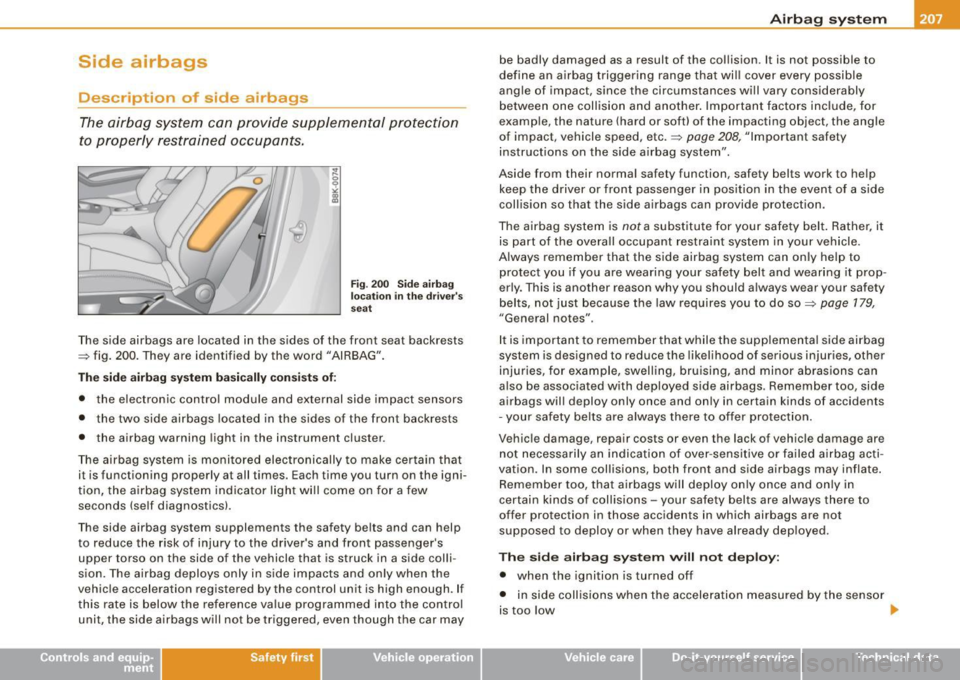
Fi g. 200 Si de a ir b ag
lo ca tio n in th e driv er's
seat
The side airbags are located in the sides of the front seat backrests
=> fig. 200. They are identified by the word "AIRBAG".
The side a irbag sy stem ba sic ally con sis ts of :
• the electronic contro l module and external side impact sensors
• the two side airbags located in the sides of the front backrests
• the airbag warning light in the instrument cluster.
The airbag system is moni tored electronically to make cer tain that
it is functioning properly at all times. Each time you turn on the igni
tion, the airbag system indicator light wi ll come on for a few
seconds (self diagnostics).
T he side airbag system supplements the safety belts and can help
to reduce the risk of injury to the driver's and front passenger's upper torso on the side of the vehicle that is struck in a side colli
sion. The airbag deploys only in side impacts and on ly when the
vehicle acceleration registered by the control unit is high enough. If
t his rate is below the reference va lue programmed into the contro l
unit, the side airbags will not be triggered, even though the car may
Safety first
Airbag sy ste m
be badly damaged as a result of the collision. It is not possible to
define an airbag triggering range tha t wi ll cover every possible
ang le of impact, since the circumstances wi ll vary considerably
between one collision and another. Important factors include, for
example, the nature (hard or soft) of the impacting object, the angle
of impact, vehicle speed, etc.=>
page 208, "Important safety
instructions on the side airbag system".
Aside from their norma l safety function, safety belts work to help
keep the driver or front passenger in posi tion in the event o f a side
collision so that the side airbags can provide protection.
The airbag system is
not a substitute for your safety belt. Rathe r, it
is part of the overall occupant restraint system in your vehicle.
Always remember that the side airbag system can only he lp to
protect you if you are wearing your safety belt and wear ing it prop
erly. This is another reason why you should always wear your safety
belts, not just because the law requires you to do so=>
page 179,
"General notes".
It is important to remember that while the supp lementa l side airbag
system is designed to reduce the likelihood of serious injuries, other
inju ries, for e xample, swell ing, bruising, and minor abras ions can
also be associated with deployed side airbags. Remember too, side
airbags will deploy only once and on ly in certain kinds of accidents
- your safety be lts are a lways there to offer protection.
Vehicle damage, repair costs or even the lack of vehicle damage are not necessarily an indication of ove r-sensitive or fa iled airbag acti
vation. In some collisions, both front and side airbags may inflate.
Remember too, tha t airbags w ill deploy only once and on ly in
certain kinds of collisions -your safety belts are always there to
offer protection in those accidents in which airbags are not
supposed to deploy or when they have already deployed.
The side airbag system will not deploy :
• when the ignition is turned off
• in side collisions when the accele ration measured by the sens or
is too low
~
Vehicle care I I irechnical data
Page 243 of 360

& WARNING (continued)
vehicle. Always drive at speeds which are suited to the road condi
tions -risk of crash. •
Energy management
Starting ability is optimized
Energy management controls the distribution of electrical
energy and thus optimizes the availability of electrical
energy for starting the engine .
If a vehicle with a conventional energy system is not driven for a
long period of time , the battery is discharged by idling current
consumers (e.g . immobilizer) . In certain circumstances it can result
in there being insufficient energy available to start the engine.
Intelligent energy management in your vehicle handles the distribu
tion of electrical energy. Starting ability is markedly improved and
the life of the battery is extended.
Basically, energy management consists of
battery diagnosis, idling
current management
and dynamic energy management .
Battery diagnosis
Battery diagnosis continuously determines the state of the battery.
Sensors determine battery voltage, battery current and battery
temperature. This determines the current state of charge and the
power of the battery.
Idling current management
Idling current management reduces energy consumption while the
vehicle is standing . With the ignition switched off, it controls the
energy supply to the various electrical components. Data from
battery diagnosis is considered.
Controls and equip ment Safety first Vehicle operation
Intelligent technology
Depending
on the battery's state of charge, individual consumers
are gradually turned off to prevent excessive discharge of the
battery and thus maintain starting capability.
Dynamic energy management
While the vehicle is being driven, dynamic energy management
distributes the energy generated according to the needs of the indi
vidual components. It regulates consumption, so that more elec
trical energy is not being used than is being generated and ensures
an optimal state of charge for the battery.
[ i] Tips
• But even energy management cannot negate the limits of
physics. Consider that the power and life of a battery are limited.
• If starting ability is threatened, you are informed by a warning
~ page 242, "Driver notification in the instrument cluster
display". •
What you should know
The highest priority is given to maintaining starting capa
bility.
The battery is severely taxed in short-distance driving, in city traffic
and during the cold time of year. Abundant electrical energy is
required, but only a little is generated. It is also critical if the engine
is not running and electrical components are turned on. In this
instance energy is being consumed but none is being generated.
It is in precisely these situations that you will notice energy manage
ment actively regulating the distribution of energy.
Vehicle stands for an extended period
If you do not drive your vehicle over a period of several days or
weeks, electrical components are gradually cut back or switched off.
This reduces energy consumption and maintains starting capability
over a longer period.
Vehicle care Do-it-yourself service Technical data
Page 244 of 360

llffl __ ln_ t _e_ ll-'"ig ...,_ e_ n_t _t_ e_ c_ h _ n_o _ l_o _,.g= y,_ __________________________________________ _
Take into consideration that when you unlock your vehicle, some
convenience functions, such as the remote key or power seat
adjustment, may not be available. The convenience functions will be
available again when you turn on the ignition and start the engine.
With the engine turned off
If you listen to the radio, for example, with the engine turned off or
use other MMI functions, the battery is being discharged .
If starting capability is jeopardized due to energy consumption, the
following warning appears in the MMI display :
Please start engine, otherwise system will switch off in
3 minutes.
The warning indicates that the system will be turned off automati
cally after 3 minutes. If you wish to continue using the functions,
you have to start the engine .
With the engine running
Although electrical energy is generated when the vehicle is being
driven, the battery can become discharged. This happens mostly
when little energy is being generated and a great deal consumed and the battery's state of charge is not optimal.
To bring the energy balance back into equilibrium, consumers
which require especially large amounts of energy are temporarily
cut back or switched off. Heating systems in particular require a
great deal of energy. If you notice, for example, that the heated
seats* or the heated rear window are not heating, they have been
temporarily cut back or switched off. These systems will be available
again as soon as the energy balance has been restored.
You will also notice that engine idle speed has been increased
slightly . This is normal and not a cause for concern. By increasing
engine idle speed the additional energy required is generated and
the battery is charged.
Driver not ification in the instrument cluster
d isplay
If battery power drops into the range where it can limit the ability of
the engine to start, this is shown in the instrument cluster display
with the following driver message:
'-' Low battery charge: battery will be charged while driving
This notification reminds you that the starting capability of the
engine may be limited. As soon as you start driving again, the
battery will be recharged and the notification will go out.
Driver notification appears and goes out again
If this driver notification appears after the ignition is turned on or
while driving and it goes out again after a while, the battery has
been adequately recharged.
Driver notification appears and does not go out again
If this driver notification appears after the ignition is turned on or
while driving and does not go out again, the battery's state of
charge is not in the optimal range . Starting ability is restricted . Have
the battery checked as soon as possible by an authorized Audi
dealer or qualified workshop. •
Page 252 of 360

___ T_ r _a_ il_e _r_ t_ o_ vv_ in__... g,_ __________________________________________________ _
Observe speed limits. In some areas, speeds for vehicles towing
trailers are lower than for regular vehicles.
Always apply brakes early. When driving downhill, shift into a lower gear to use the engine braking effect to slow the vehicle. Use of the
brakes a lone can cause them to overheat and fail.
Coolant temperature
The coolant temperature gauge=> page 8 must be observed care
ful ly . If the needle moves close to the upper end of the scale, reduce
speed immediately and/or turn off the air conditioner .
If the coolant temperature warning light in the instrument cluster
starts flashing
-F- , pul l off the road, stop and let the engine idle for
about two minutes to prevent heat build-up .
& WARNING
Anyone not properly restrained in a moving vehicle is at a much
greater risk in an accident. Never let anyone ride in your car who
is not properly wearing the restraints provided by Audi . •
Trailer towing tips
Important to know
----------------
Your vehicle handles differently when towing a trailer because of
the additional weight and different weight distribution. Safety,
performance and economy will great ly depend on how careful ly you
load your trailer and operate your rig.
Before you actual ly tow your trailer, pract ice turning, stopping and
backing up in an area away from traffic. Keep practicing unti l you
have become completely familiar with the way your vehicle -trailer
combination behaves and responds . Backing
up is difficult and requires practice . Backing up with a
t rai ler genera lly requires steering action opposite to that when
backing up your vehicle without a trailer .
Maintain a greater distance between your vehicle and the one in
front of you. You will need more room to stop . To compensate for
the trai ler, you wi ll need a larger than norma l turning radius.
When passing, remember that you cannot accelerate as fast as you
normally would because of the added load. Make sure you have
enough room to pass. After passing, al low plenty of room for your
trai ler before changing lanes again .
Avoid jerky starts, sharp turns or rapid lane changes.
[ i ] Tips
• Do not tow a trailer during the break -in period of your vehicle.
• If you tow a trailer, your Audi may require more frequent mainte
nance due to the extra load=>
page 339. •
Parking on a s•ope
Do not pork on a slope with a trailer. If it cannot be
avoided, do so only ofter doing the following:
When parking:
Apply the foot brake.
- Have someone p lace chocks under both the vehicle and
the trailer wheels.
With chocks in place, slow ly release the brakes until the
wheel chocks absorb the load.
- Turn the wheels towards the curb.
- Apply the parking brake.
Page 277 of 360
![AUDI A5 COUPE 2010 Owners Manual Checking and filling -
-----------------=-----==-----...J
0 Note
Driving with an insufficient oil level is likely to cause severe damage
to the engine.
[ i] Tips
• The oil pressu](/manual-img/6/57582/w960_57582-276.png "AUDI A5 COUPE 2010 Owners Manual Checking and filling -
-----------------=-----==-----...J
0 Note
Driving with an insufficient oil level is likely to cause severe damage
to the engine.
[ i] Tips
• The oil pressu")
Checking and filling -
-----------------=-----==-----...J
0 Note
Driving with an insufficient oil level is likely to cause severe damage
to the engine.
[ i] Tips
• The oil pressure warning display~ is not an indicator of the oil
level. Do not rely on it. Instead, check the oil level in your engine at
regular intervals, preferably each time you refuel, and always before
going on a long trip.
• If you have the impression your engine consumes excessive
amounts of oil, we recommend that you consult an authorized Audi
dealer to have the cause of your concern properly diagnosed. Keep
in mind that the accurate measurement of oil consumption requires
great care and may take some time. An authorized Audi dealer has
instructions about how to measure oil consumption accurately. •
Checking the engine oil level
Read oil level
Fig. 223 MMI Display;
Oil level indicator
Select: Function button [CARI> Oil level.
- Park your vehicle so that it is horizontally level. Shut
the engine off when it is at operating temperature.
Wait approx. two minutes. Read the oil level in the MMI* Display=> fig. 223. Add
engine oil if the bar of the oil level indicator is near "Min"
=>
page 275
Depending on the way the vehicle is driven and the operating condi
tions, oil consumption can be up to a 1/2 quart per 600 miles (0.5
liter per 1000 kml. Consumption may be higher within the first 3000
miles (5000 kml.
[ i] Tips
The oil level indicator in the MMI* Display is only an information
display. If the oil level is too low, a minimum oil warning appears in
the instrument cluster. Add oil
=> page 275. If the hood has been
opened, the current oil level is shown in the instrument cluster the
next time the ignition is switched on. •
Adding engine oil ~
Fig. 224 Engine
compartment; Oil filler
cap location
Before you check anything in the engine compartment,
always read and heed all WARNINGS=> & in "Working in
the engine compartment" on
page 271. .,,_
Vehicle care I I irechnical data
Page 309 of 360

________________________________________________ T_ i _r_e _s_ a_n_ d_ w_ h_ e_e _ l_s __ PII
•
those conditions . We suggest you use the recommended snow or
a ll- season tires specified for your vehicle, or their equivalent .
Refer to=>
page 304for more detailed informa tion regarding winter
tires .•
Tire pressure monitoring system
Ap plies to v ehicles : w it h tir e p ressure monit orin g system
General notes ..J
Each tire, including the spare (if provided), should be checked
month ly when cold and inflated to the inflation pressure recom
mended by the vehicle manufacturer on the vehicle placard or tire
inflation pressure label. (If your vehicle has tires of a different size
than the size indicated on the vehicle placard or tire inflation pres
sure label, you should determine the proper tire inflation pressure
for those tires).
As an added safety feature, your vehicle has been equipped with a
tire pressure monitoring system (TPMS) that illuminates a low tire pressure tellta le when one or more o f your tires is significantly
under-inflated . Accordingly, when the low tire pressure te llta le i llu
minates, you should stop and check your tires as soon as poss ible,
and inflate them to the proper pressure. Driving on a significantly
under -inflated tire causes the tire to overheat and can lead to tire
failure. Under-inflation also reduces fue l efficiency and tire tread
life, and may affect the vehicle's handling and stopping ability.
Please note tha t the TPMS is not a substitute for proper tire mainte
nance, and it is the driver's responsibility to maintain correct tire
pressure, even if under -inflation has not reached the level to trigger
il lumination of the TPMS low tire pressure te lltale.
Your vehicle has also been equipped with a TPMS malfunction indi
cator to indicate when the system is not operat ing proper ly. The
TPMS malfunction indicator is combined with the low tire pressure
tel ltale . When the system detects a ma lfunction, the te lltale w ill flash for approximately one minute and then remain continuously
il lum inated . This sequence will continue upon subsequent veh ic le
start-ups as long as the malfunc tion exists .
When the ma lfunction indicator is illuminated, the system may not
be able to detect or signal low tire pressu re as intended . TPMS
malfunctions may occur for a variety of reasons, including the
insta llation of replacement or alternate tires or wheels on the
vehic le that prevent the TPMS from functioning properly . A lways
check the TPMS malfunction tellta le after replacing one or more
tires or wheels on your vehicle to ensure that the replacement or
a lterna te tires and wheels allow the TPMS to continue to function
properly. •
Applies to v ehic les : w it h tire pr ess u re mon itori ng syste m
Tire pressure indicator appears
The tire pressure indicator in the instrument cluster
informs you if the tire pressure is too low or if there is a
system malfunction.
Vehicle care I t •
Fig . 23 4 D ispla y:
u n derin flat ion wa rnin g ....
Page 310 of 360

-~_T_ ir_e_ s_ a_ n_d _ w_ h_ e_e _l_s _________________________________________________ _
Fig. 235 Display:
System malfunction
Usin g the ABS senso rs, the tir e pressure monitor ing system
c o mp ares the tire t read ci rc um fere nc e a nd vibr atio n c harac te ristic s
o f the i ndividual ti res . If t he press ure decr eas es in one or mor e tires,
th is is ind ica te d in the i nstru me nt clust er w ith a wa rning symbol
fl
and a messa ge=> page 3 0 7, fig . 234. The driv er m essage i n th e
dis play goes out after
5 seconds. The driver message can be
d isp lay ed aga in by p ress ing the
!SE T] button. I f only one tir e is
affected, the disp lay wil l indicate its position .
Th e ti re pr essur e mo nitori ng system mu st b e rese t via ra dio or MM I*
each t ime the pressur es are adjusted (e.g. when sw itchi ng b etw een
p a rt ial an d fu ll lo ad pr essu re) or after changi ng or re pl acin g a tire
on your vehic le=>
pa ge 30 9. You can find t he recommended t ire
pressures for your vehic le on the label on driver's side B -pil lar
=>
p ag e 291 .
Tire tread circ umference and vibration characteristics can change
a nd ca use a tire pre ssur e warni ng i f:
• th e t ire pr essure in o ne or mor e tires is too low,
• t he tir e h as structur al d am age,
• the tire pressure was changed, whee ls rotated or replaced but
th e TP MS was not re set =>
page 30 9.
Warning symbols
\.) Loss of pressur e in at le ast one tire => & . C heck the t ire or tire s
and re place or repa ir if necessar y. T he indicato r light
1 in the instrument cluster also
ill uminates=>
page 1 2. C heck/correct th e
p res su res of a ll four tir es and re set TPMS via radio or MMI *.
~ (T ir e Pressure Monito rin g S ystem) Tire pressure! System
malfunction.
I f v a p pears a fter switch ing the i gnition on or w hile drivin g
=> fig. 235 and the indicator light,. in the instrument cluster blinks
f or approx im ately one min ute and then sta y s on , the re is a syste m
malfunct ion . S ee your authorize d Audi dealer as soon as possib le .
& WARNING
• If the tire pressure indicator appears in the instrument cluster
display, one or more of your tires is significantly under -inflated .
Reduce your speed immediately and avoid any hard steering or
braking maneuvers. Stop as soon as possible and check the tires
and their pressures . Inflate the tire pressure to the proper pressure
as indicated on the vehicle's tire pressure label
=> page 291.
Driving on a significantly under -inflated tire causes the tire to over
heat and can lead to tire failure . Under-inflation also is likely to
impair the vehicle's handling and stopping ability .
• The driver is responsible for maintaining the correct tire pres
sures . You must check the tire pressures regularly .
• Under certain conditions (such as a sporty driving style , winter
conditions or unpaved roads ), the pressure monitor indicator may
be delayed.
• Ask your authorized Audi dealer if run -flat tires may be used on
your vehicle. Your vehicle registration becomes invalid if you use
these tires when not permitted . Damage to your vehi cle or acci
dents could also result.
[ i ] Tips
• Th e tir e pr es sur e m oni tori ng syst em stops wor king whe n there
i s an ESP/A BS malfunction.
• U sing s now ch ai ns m ay r esu lt in a s ystem malf u ncti on . .,_