2010 AUDI A5 COUPE brake light
[x] Cancel search: brake lightPage 154 of 360
-Tr
ansmi ssio n
..__ ______________ _
This keeps the transmission from shifting up and down unneces
sari ly on hills. The transmission will shift down to a lower gear when
the driver presses the brake pedal on a downhi ll gradient. This
makes use of the braking effect of the engine without the need to
shift down manually. •
Applies to vehi cles: with aut om ati c transmi ssio n
Manual shift program
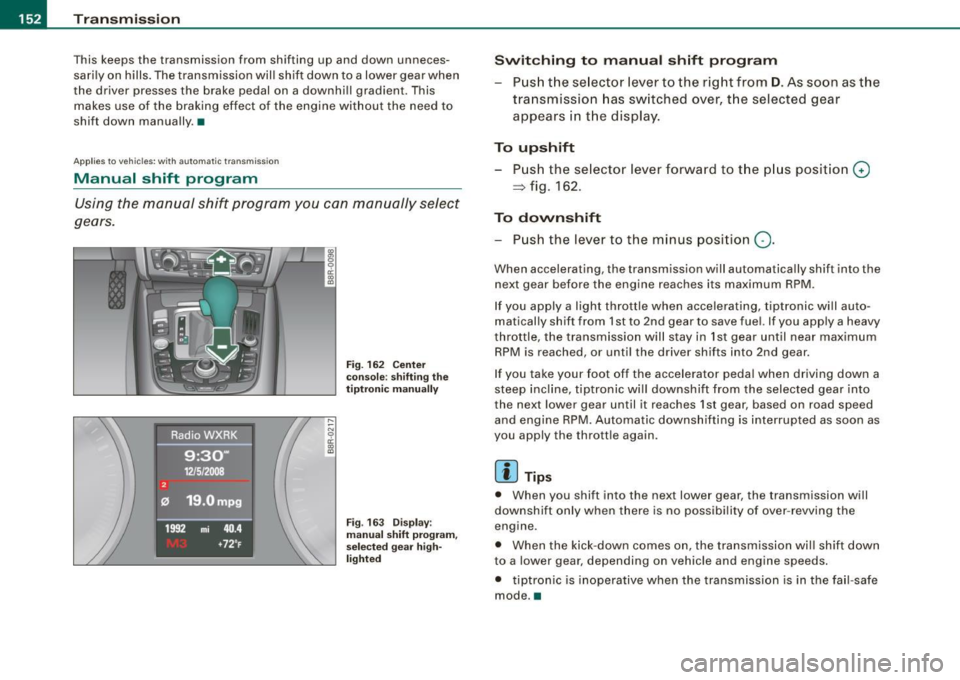
Using the manual shift program you can manually select
gears.
F ig . 162 Ce nter
conso le : sh if ting the
t iptr oni c man ually
Fig . 163 Disp lay:
m anua l shi ft p rogra m ,
selected gear hig h
li g ht ed
Swit chin g to m anu al s hift pr ogr am
Push the se lector lever to the right from D . As soon as the
transmission has switched over, the selected gear
appears in the display .
To upshift
Push the selector lever forward to the p lus position G)
~ fig . 162.
To dovvnshift
- Push the lever to the minus position Q.
When accelerating , the transmission will automatically shift into the
next gear before the engine reaches its maximum RPM .
If you apply a light throttle when accelerating, tiptronic wi ll au to
matically shift from 1st to 2nd gear to save fuel. If you apply a heavy
throttle, the transmission will s tay in 1st gear until near maximum
RPM is reached, or unti l the driver shif ts into 2nd gear.
If you take your foot off the accelerator peda l when driving down a
steep inc line, tiptronic wi ll downshift from the selected gear into
the neX1 lower gear until it reaches 1st gear, based on road speed
and engine RPM. Automatic downshifting is interrupted as soon as
you apply the thrott le again .
[ i ] Tips
• When you shift into the next lower gear, the transmission will
downshift only when there is no possibi lity of over -revving the
engine .
• When the kick-down comes on , the transmission wil l shift down
to a lower gear , depending on vehicle and engine speeds .
• tiptron ic is inoperative when the transmission is in the fa il-safe
mode. •
Page 167 of 360

___________________________________________________ H_ o_m _ e_ L_ i_ n _k_ @_R _ __.1111
Applies to vehicles: with Homelin k® un iversal remote contro l
Programming the Homelink ® transmitter
The transmitter is programmed in two phases. For rolling
code transmitters, a third phase is also necessary.
,,,,, r, o: o "'' '''"
Fig . 177 Overhead
console: HomeLink ®
keypad
Fig . 178 Radiator grille
Phase 1: programming the overhead keypad
1. Make sure your vehicle is within operating range of the
remote controlled garage door opener.
2. Set the parking brake==>
& in "General information" on
page 764.
3. Turn the ignition on. Do not start the engine!
Contro ls and eq uip
ment
4. Press and hold the two outside Homelink® buttons 0
and @for approximately 20 seconds until indicator
light@==> fig. 177 begins to flash. Then release both
buttons. Do not hold the buttons for longer than
30
seconds.
- This procedure only needs to be performed
once . It
erases the factory-set default codes and does not have to
be repeated to program additional remote controls.
5. Press and hold the Homelink® button
0,@ or@ until
the indicator light @starts flashing slowly. Release the
button.
- The system will remain in programming mode for 5
minutes.
Go to the front of the vehicle and proceed with
phase 2.
Phase 2: at the radiator grille
6. Point the
original remote control to the middle of the
radiator grille of your vehicle==> fig. 178.
7. Hold the original remote control at a distance between
0-
5 in. (0-13 cm) (use the shortest distance possible).
8. Press and hold the activation button on the remote control.
- May be different in Canada . If so, press and re -press
(cycle) the activation button on your remote control every
two seconds.
9. The emergency flashers will flash
three times (after
about
15 -60 seconds) when the programming is
successful. Release the button on the remote control.
- To program more devices, repeat steps 4 to 9.
Vehicle care I I irechnical data
Page 237 of 360

The system operates across the entire speed range in combination
with the ABS system. If the Anti -Lock Brake System (ABS) ma lfunc
tions, the ESP wil l also shut down .
How the system works
The Anti -Lock Brake System (ABS), Electronic Differential Lock (EDU
and the Anti -Slip Regulation System (ASR) are integrated in the elec
tronic stabilization program. In addition to the data provided by
th ese functions, the ESP control unit requires additional measure
ment data provided by high performance sensors . The rotational
speed of the vehicle about its vertica l axis, vehicle acceleration in
the fore-and-aft and lateral directions , the brake pressure, and the
steering angle are all measured.
The direction in which the driver wishes to travel is determined with
the aid of the steering angle and vehicle speed and is continua lly
compared with the actual behavior of the vehicle. If the two do not
match, for example, when the vehicle starts hydrop laning on a wet
road, ESP will automatically brake the appropriate whee l to correct
the prob lem.
The vehicle is then stabi lized by the forces acting on the whee l
during braking. If the vehicle is
oversteering (the vehicle turns too
sharply and the rear wheels slide toward th e ou tside of a curve), the
brakes are main ly app lied on the wheel that is on the outside of the
curve . In the case of a vehicle that is
understeering (the vehicle does
not turn sharply enough and pushes out of a curve), the brakes are
applied as needed on the wheel that is on the inside of the curve or
additional ly on the other wheels. An acoustic signal indicates when
ESP brake app lication cuts in=>&.
T he system operates across the entire speed range in combination
with the ABS system =>
page 238. If the Anti-Lock Brake System
(ABS) malfunctions, the ESP will be out of action as well.
Activating
When you turn on the engine, ESP will automatica lly be activated
and will perform a se lf-test. As soon as the test is comp leted, the
system is in norma l operating mode.
Controls and equip
ment Safety first Vehicle operation
Intelligent technology
You
can activate a deactivated ESP or deactivated ESP/ASR if
required by pressing the::::>
page 234, fig. 215 ::::> page 234, fig. 214
button . When they are activated, the message
ESP /ASR on appears
briefly in the display .
Deactivating
The ESP should normally be activated al l the time. If necessary, you
can deactivate Anti -Slip Regu lation (ASR) or the Electronic Stabiliza
tion Program (ESP) by pressing the button=>
page 234, fig. 215.
• Deactivating ASR: Tap the button . In certain exceptional situa
tions (e .g. driving with tire chains), the Anti-Slip Regulation (ASR)
can be deactivated =>
page 236. The message ASR off appears in the
display as we ll.
• Deact ivating ESP/ASR Press the button for more than 3 seconds.
With the ESP/ASR deactivated, the indicator light comes on, see
=>
page 13. The message ESP switched off appears in the disp lay as
we ll.
& WARNING
The Electronic Stabilization Program is nevertheless subject to the
laws of physics . It is particularly important to pay attention to this
fact on wet and slippery roads. It is therefore important that you
always adapt your driving to the condition of the road and traffic
conditions. Do not allow the increased safety provided by the Elec
tronic Stabilization Program system to lull you into accepting
additional safety risks. •
Electronic differential lock (EDL)
---------
The electronic differential lock monitors the rotational
speed of the drive wheels.
General notes
The electronic differential lock (EDU helps the car to start moving,
acc elerate and c limb a gradient on surfaces providing poor or
Vehicle care Do-it-yourself service Technical data
Page 238 of 360

ll}JI Intelligent technology
---""'------------ ....::....:...:~---------------------------
almost no grip. Without EDL, this would be difficult, if not impos
sible.
How the system works
The EDL operates automatically. It monitors the rotational speed of
wheels with the help of the ABS sensors=:,
page 238 . If a noticeable
slip is detected at the wheels (e.g. on slippery ground on one side),
the spinning wheels are braked and power is transferred to the
other wheels. This is done up to a speed of about 60 mph (100 km/h).
Noises from the brake system signal that wheel spin is being
controlled.
Driving off
When driving off, always be sure to keep road conditions in mind as
you accelerate. If one drive wheel spins because it is on a surface
with less grip, apply
plenty of throttle until the car starts to move.
Overheating of brakes
To prevent the disc brake of the braked wheel from overheating if
subjected to excessive loads on this wheel, the EDL cuts out tempo rarily. The vehicle remains operational and behaves in the same way
as a vehicle without EDL.
As soon as the brake has cooled down, EDL switches on again auto
matically.
& WARNING
• When accelerating on slippery surfaces, such as on ice or snow,
always be careful when depressing the accelerator pedal. Even
with the EDL working, the drive wheels can spin and reduce your ability to control your car. Risk of crash!
• The increased safety afforded by EDL does not mean that you
can take safety risks. Always adapt your driving style to the road
conditions and traffic situation.
[ i] Tips
If a fault occurs in the ABS, the EDL is also not functioning . This is
indicated by the ABS warning light=:,
page 15. •
Anti-Slip Regulation System (ASR)
The Anti-Slip Regulation System prevents the driven
wheels from spinning when the car is accelerating.
General notes
The Anti-Slip Regulation System (ASR) is integrated in the electronic
stabilization program (ESP) . When the vehicle starts up and acceler
ates, the wheels are prevented from spinning by adjusting the
engine power to match the amount of grip available from the road
surface.
How the system works
ASR performs automatically , i.e. without the driver's intervention .
With the aid of the ABS sensors=:,
page 238, ASR monitors the
speed of the driven wheels. If the wheels start to spin, engine torque
is reduced automatically until the tires find enough grip to lock onto
the road surface. The system is active across the entire speed range.
The ASR works in conjunction with the ABS. If a malfunction should
occur in the ABS, the ASR will also be out of action.
Activating
The ESP is automatically activated when the engine is started and it
performs a self-test . You can activate a deactivated ASR if required
by pressing the=:,
page 234, fig. 215 button. When it is activated,
the message
ESP/ASR on appears briefly in the display.
Deactivating
You can deactivate the ASR if required by pressing the button (for
less than 3 seconds) =:,
page 234, fig. 215. With the ASR deactivated,
the ESP check light comes on, see=:,
page 13. The message ASR off ._
Page 241 of 360

How the ABS system works
An au tomatic check is made when a speed of about 12 mph (20
km/h) is reached. When this happens, a pumping no ise can be
heard .
I f an individua l wheel begins to ro tate too s low ly in relation to
vehic le speed and tends to lock, the ABS automatical ly reduces
b rake pressure t o preven t tha t whee l from locking.
This automatic adjustment process wil l cause a
slight vibration of
t he brake peda l and some noises to ale rt you tha t veh ic le sp eed
must be adapted to existing road and traffic conditions.
in. WARNING
Although the ABS is very effe ctive , always remember that braking
c apability is limited by tire traction. Always adjust your driving
speed a ccording to the road and traffi c conditions. Do not let the
extra safety afforded by the ABS tempt you into taking extra risks.
The ABS c annot overcome the laws of physics .
[ i J Tips
• I f ABS is not functioning properly, a warning l ight wil l come on .
See
~ page 15.
• I f a fau lt occurs in the ABS, the EDL is also not funct ioning. This
is indicated by the ABS warning light .
Brake assist
Brake assist is designed to achieve the optimum brakin g
effect.
B rake a ssist hel ps to in crease the eff ective b raking powe r an d t hus
to achieve a shorter stopping distance. If the driver presses the
br ake pe dal ve ry q uickl y, br ake a ss is t auto matically boo sts t he
braking force to the maximum lev el, up to the point where the anti
lock b ra ke function (ABS) intervenes to stop the wheels from
Controls and equip
ment Safety first Vehicle operation
Intelligent technology
locking
. You shou ld then keep the brake pedal pressed until the
ve hic le has braked to the required spee d. Brake assist swi tches itse lf
off as soon as you release the brake pedal.
in. WARNING
Please remember that the accident r isk always increases if you
drive too fast , espe cially in corners or on a slippery road , or if you
follow the vehicle ahead of you too closely. Increa sed risk of an
accident cannot be compensated for even by brake as sist , so
always maintain a safe speed .•
Servotronic® -advanced power
steering system
The pow er st eer in g systems uses th e po we r of t he
run nin g eng ine to a llow prec ise s tee ring with lit tle eff ort.
The advanced S ervotronic ® power steering system senses the road
s p eed and electr onically a djusts power assis tance t o provide
comfortab le and safe steering response exactly matched to the
ve hicle speed .
Power steering wi ll n ot work if the eng ine is off. As a result, the
steering whee l wil l be hard to turn.
Th e power s teering flu id leve l is check ed during the sc hed uled
maintenance services .
0 Note
If there is an electronic ma lfunction, servotronic wi ll still function
like a conventi onal power s teer ing sys te m , pr ovi ding a constan t
steering support force that is no longer proportionate to the vehicle
speed. This is mo st noticeable when tu rning t he steering whee l at
low speeds {for examp le when parking), -more effort wi ll be
r equired than usual.
~
Vehicle care Do-it-yourself service Technical data
Page 248 of 360
![AUDI A5 COUPE 2010 Owners Manual ___ D_ r_ iv _i_ n- g"""- a_ n_d_ e_ n _ v_i_r _ o _n_ m_ e_ n_t _____________________________________________ _
[ i ] Tip s
The consumption estimates as published by ENVIRONMENTAL
PROTECT](/manual-img/6/57582/w960_57582-247.png "AUDI A5 COUPE 2010 Owners Manual ___ D_ r_ iv _i_ n- g\"\"\"- a_ n_d_ e_ n _ v_i_r _ o _n_ m_ e_ n_t _____________________________________________ _
[ i ] Tip s
The consumption estimates as published by ENVIRONMENTAL
PROTECT")
___ D_ r_ iv _i_ n-' g"'""'- a_ n_d_ e_ n _ v_i_r _ o _n_ m_ e_ n_t _____________________________________________ _
[ i ] Tip s
The consumption estimates as published by ENVIRONMENTAL
PROTECTION AGENCY (EPA) and Transport Canada may not corre
spond to your actua l consumption on the road, which wi ll vary
depending upon vehic le load and speed, road and weather condi
tions, trip length, etc .•
Drive smoothly and keep a tookout ahead
Vehicles use the most fuel when they are accelerating.
- Avoid unnecessary accelerating and brak ing.
Vehicles use the most fuel when they are accelerating . If you antici
pate what is going to happen next, you will need to brake less and,
thus, accelerate less. Let the vehicle coast whenever possible -for
examp le when you see that the next traffic ligh t is red .
Avoid full thrott e
Driving at moderate speeds saves fuel and improves your
mileage.
- Try and keep we ll below your car's maximum speed.
Acce lerating gently reduces fuel consumption, engine wear, and
does not disturb the environment .
Fuel consumption, exhaust emissions and engine noise increase
disproportionately at high speeds. If you drive at approximate ly
three quarters of top speed, fuel consumption will be reduced by
one half. Never drive faster than the posted speed limit and weather
conditions permit. •
Reducing unnecessary idling
Even when your car is just idling it burns up fuel.
- Shut the engine off when you are not driving the vehicle.
-Do not warm up the vehicle by letting the eng ine run at
idle.
It makes sense to shut off the engine in traffic jams, when waiting
for trains to pass at rai lroad crossings, or at traffic lights that have
long waits on red. Turning the engine off for just 30-40 seconds
saves more fuel than is burned starting the engine again .
It takes a long time for the engine to warm up fully when it is
running at idle. However, wear and noxious emissions are especially
high when the engine is warming up. So you should drive away as
soon as you start the engine and avoid running at high rpms while
the engine is sti ll warm ing up .
0 Note
Do not leave engine idling unattended after starting. If warning
lights should come on to indicate improper operation, they would
go unheeded . Extended id ling a lso produces heat, which could
resu lt in overheating or other damage to the vehicle or other
property .•
Regular maintenance
A badly tuned engine unnecessarily wastes a lot of fuel.
- Have your vehicle serviced at regular intervals.
By having your vehicle regularly serviced by an authorized Audi
dea ler helps to ensure that it runs properly and economically. The
condition of your vehicle not only affects its safety and abi lity to
hold its value, it also affects
f ue l co nsu mpti on.
C hec k your o il e ach tim e y ou fill your ta nk.
Page 250 of 360

-Traile r t ow ing
----- -=---------------------------------
Tr a ii er towing
Driving with a trailer
General information
Your Audi was designed primarily for passenger transpor
tation.
If you plan to tow a trailer, please remember that the additional load
wi ll affect durability , economy and performance.
Trai ler towing not on ly p laces more stress on the vehicle, it a lso ca lls
for more concentration from the driver.
For this reason, always fol low the operating and driving instructions
provided and use common sense. •
Technical requirements
Traile r hit ch
Use a weight -carrying hitch conforming to the gross trailer weight.
The hitch must be suitab le for your vehicle and tra iler and must be
mounted secure ly on the vehicle's chassis at a
technically sound
location . Use only a trailer hitch with a removable ball mount.
Always check with the trai ler hitch manufacturer to make sure that
you are using the correct hitch.
D o not u se a b umper hit ch .
The hitch must be installed in such a way that it does not interfere
w ith the impact-absorbing bumper system . No modifications
should be made to the vehicle exhaust and brake systems . From
time to time, check that all hitch mount ing bolts remain securely
fastened.
When you are not towing a trailer, remove the trailer hitch ball
mount. This prevents the hitch from causing damage should your
vehic le be struck from behind =:> & .
Tra iler br akes
If your trailer is equipped with a braking system, check to be sure
that it conforms to al l regu lations.
T he trailer hydraulic brake system must not be directly connected to
the vehicle's hydraulic brake system=:>& .
Safet y cha ins
Always use safety chai ns between y our vehicle and the trailer .
Traile r lights
Trai ler lights mus t meet all regulations. Be su re to check with your
authori zed Audi dealer for correct wiring, switches, and relays .
Mirrors
If you are unable to see the traffic behind you using the regu lar
outside mirrors, then you
must instal l extended m irrors. It is impor
tant that you
always have to the rear .
& WARNING
• If a trailer ha s el ectri cal brake s please note that the se brak es
are n ot act iva ted by the fa ctory -fitted control unit · ri sk of acc i
dent !
• After remo ving the tr ailer hit ch , d o n ot store it in yo ur vehi cle.
In ca se of sudden b raking , th e hitch could fly forw ard and injure
you or your p assengers . •
Operating instructions
M ax imum tr aile r w eight
A trai ler for your vehicle is limited to a typica l class 1 or class 2
trai ler.
Page 251 of 360

Trailer load d is trib ut ion
Be sure the load in the trailer is held securely in place to prevent it
from shifting forward, backward or sideways.
Ne ver allo w a passen ger to rid e i n a tr ailer => & in "Driving instruc
tions" on
page 249.
En gin e c ool ing syst em
Towing a trailer makes the engine work harder. It is important that
the cooling system 's performance is up to the additiona l load. Make
sure that the cooling system has enough flu id.
Ti re press ure
When towing a trailer, inflate the tires of your vehicle to the cold tire
pressure listed under "Full load" on the labe l located either on the
driver's side B-pillar (visible when the door is open} or inside the fuel
filler flap . Inflate trailer tires to trai ler and tire manufacturers' spec
ifications.
Ligh ts
The headlight settings should be checked with the trailer attached
before driving off . Check to make sure both vehicle and trailer lights
are working properly .
Safe ty c hain s
Be sure trailer safety chains are properly connected from the trailer
to the hitch on the vehicle. Leave enough slack in the chains to
permit turning corners. When you install safety chains, make sure
they will not drag on the road when you are driving.
The chains should cross under the trailer tongue to prevent it from dropping in case of separation from the hitch.
Controls and equip
ment Safety first Vehicle operation
Tr
aile r t owing
Driving instructions
Driving with a trailer always requires extra care and
consideration.
To obtain the best possible handling of veh icle and trailer,
please note t he following :
Do not tow a loaded trailer when your car itself is not
loaded .
- Be especia lly careful when passing other vehicles .
Observe speed l imits .
Do not drive at the maximum permissible speed.
Always apply brakes early.
Monitor the temperature gauge.
W eight distrib utio n
Towing a loaded trailer with an empty car results in a h ighly
unstable distribution of weight . If this cannot be avoided, drive at
very low speeds only to avoid the risk of losing steering control.
A "balanced" rig is easier to operate and control. This means that
t he tow vehicle should be loaded to the extent possible and permis
sible, while keeping the trailer as light as possib le under the circum
stances . Whenever possible, transfer some cargo to the luggage
compartment of the tow vehicle whi le observing tongue load
requirements and vehicle loading considerations.
S pee d
The higher the speed, the more difficu lt it becomes for the d river to
control the rig. Do not drive at the maximum permissible speed.
Reduce your speed even more if load, weather or wind conditions
are unfavorable -particularly when going downhill .
Reduce vehicle speed
i mmed iatel y if the trailer shows the slightest
sign of swaying .
Do not try to st op the swa ying b y accelerating.
Vehicle care Do-it-yourself service Technical data