Page 22 of 94

INSTRUMENT AND CONTROL FUNCTIONS
3-6
1
2
3
4
5
6
7
8
9
If this occurs, try the following.
1. Use the code re-registering key to
start the engine.
TIP
Make sure there are no other immobi-
lizer keys close to the main switch, and
do not keep more than one immobilizer
key on the same key ring! Immobilizer
system keys may cause signal interfer-
ence, which may prevent the engine
from starting.
2. If the engine starts, turn it off, and
try starting the engine with the
standard keys.
3. If one or both of the standard keys
do not start the engine, take the
vehicle, the code re-registering
key and both standard keys to a
Yamaha dealer and have the stan-
dard keys re-registered.
EAU11911
Tachometer unit
The electric tachometer allows the rider
to monitor the engine speed and keep it
within the ideal power range.
When the key is turned to “ON”, the ta-
chometer needle will sweep once
across the r/min range and then return
to zero r/min in order to test the electri-
cal circuit.
NOTICE
ECA10031
Do not operate the engine in the ta-
chometer red zone.
Red zone: 8000 r/min and above
This tachometer unit is equipped with a
clock.
To set the clock:
1. Push both the “SELECT” and “RE-
SET” buttons for at least two sec-
onds.
2. When the hour digits start flashing,
push the “RESET” button to set the
hours.
3. Push the “SELECT” button to
change the minutes.
4. When the minute digits start flash-
ing, push the “RESET” button to
set the minutes.
5. Push the “SELECT” button to start
the clock.
TIP
●
After setting the clock, be sure to
push the “SELECT” button before
turning the key to “OFF”, otherwise
the clock will not be set.
●
When the key is turned to “OFF”,
the clock display will remain on for
48 hours and then go off to prevent
the battery from discharging.
1. Tachometer
2. Tachometer red zone
3. Clock
1
2
3
Page 28 of 94

INSTRUMENT AND CONTROL FUNCTIONS
3-12
1
2
3
4
5
6
7
8
9
EAU12941
Brake pedal
The brake pedal is on the right side of
the motorcycle. To apply the rear
brake, press down on the brake pedal.
EAU26793
ABS (for ABS models)
The Yamaha ABS (Anti-lock Brake
System) features a dual electronic con-
trol system, which acts on the front and
rear brakes independently. The ABS is
monitored by an ECU (Electronic Con-
trol Unit), which will have recourse to
manual braking if a malfunction occurs.
WARNING
EWA10090
●
The ABS performs best on long
braking distances.
●
On certain (rough or gravel)
roads, the braking distance may
be longer with than without the
ABS. Therefore, always keep a
sufficient distance to the vehi-
cle ahead to match the riding
speed.
TIP
●
When the ABS is activated, the
brakes are operated in the usual
way. A pulsating action may be felt
at the brake lever or brake pedal,
but this does not indicate a mal-
function.
●
This ABS has a test mode whichallows the owner to experience the
pulsating at the brake lever or
brake pedal when the ABS is oper-
ating. However, special tools are
required, so please consult your
Yamaha dealer when performing
this test.
NOTICE
ECA16120
Keep any type of magnets (including
magnetic pick-up tools, magnetic
screwdrivers, etc.) away from the
front and rear wheel hubs, otherwise
the magnetic rotors equipped in the
wheel hubs may be damaged, result-
ing in improper performance of the
ABS system.
1. Brake pedal
1
1. Front wheel hub
1
Page 29 of 94
INSTRUMENT AND CONTROL FUNCTIONS
3-13
2
34
5
6
7
8
9
EAU13091
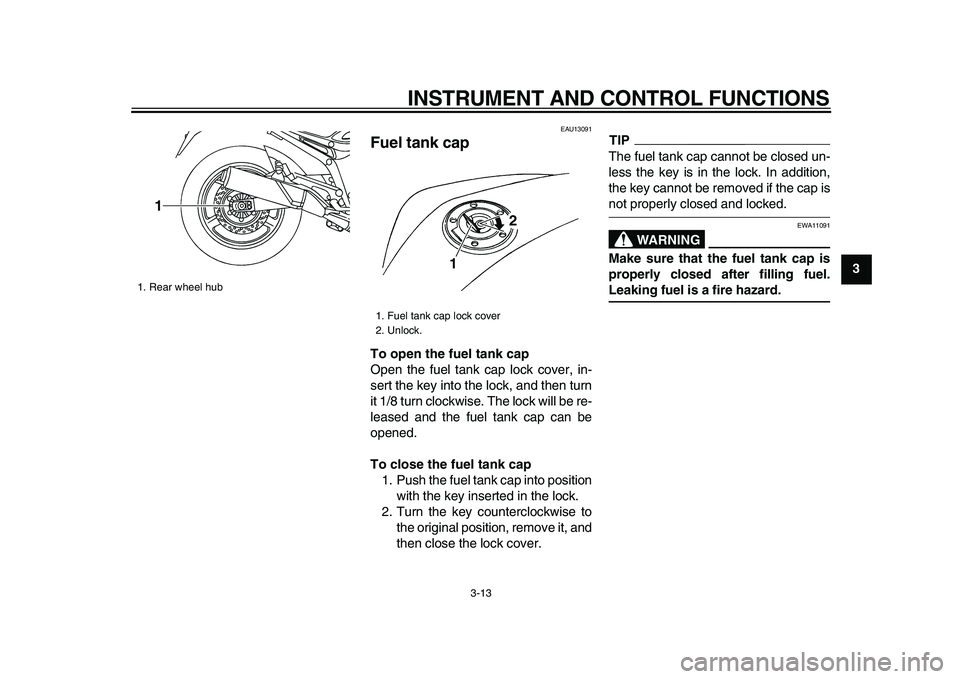
Fuel tank cap
To open the fuel tank cap
Open the fuel tank cap lock cover, in-
sert the key into the lock, and then turn
it 1/8 turn clockwise. The lock will be re-
leased and the fuel tank cap can be
opened.
To close the fuel tank cap
1. Push the fuel tank cap into position
with the key inserted in the lock.
2. Turn the key counterclockwise to
the original position, remove it, and
then close the lock cover.
TIP
The fuel tank cap cannot be closed un-
less the key is in the lock. In addition,
the key cannot be removed if the cap is
not properly closed and locked.
WARNING
EWA11091
Make sure that the fuel tank cap is
properly closed after filling fuel.
Leaking fuel is a fire hazard.
1. Rear wheel hub
1
1. Fuel tank cap lock cover
2. Unlock.
1
2
Page 31 of 94
INSTRUMENT AND CONTROL FUNCTIONS
3-15
2
34
5
6
7
8
9
or premium unleaded fuel. Use of un-
leaded fuel will extend spark plug life
and reduce maintenance costs.
EAU13412
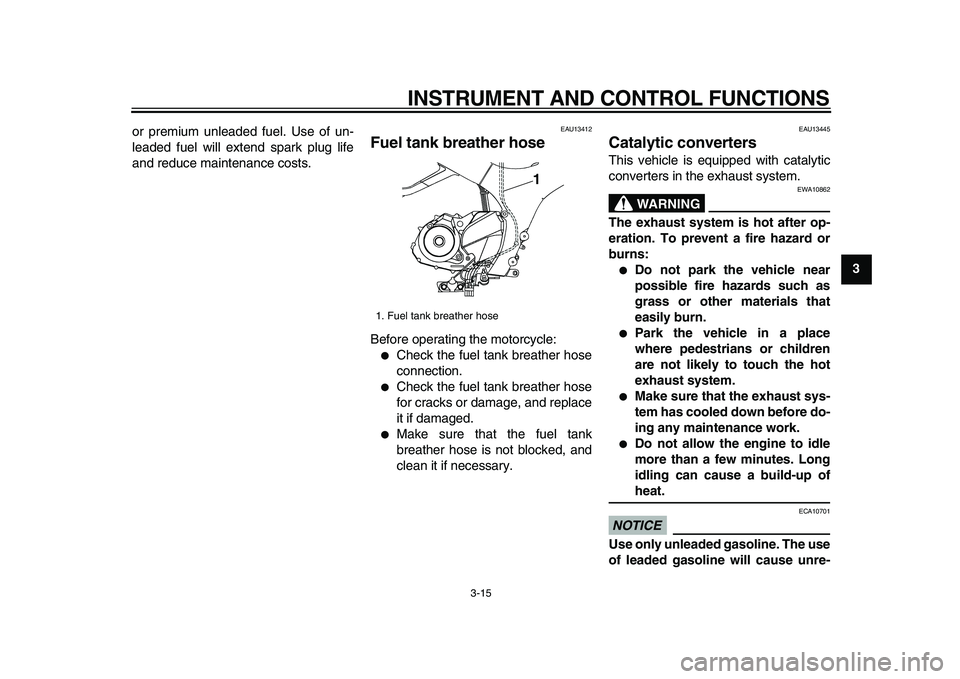
Fuel tank breather hose
Before operating the motorcycle:
●
Check the fuel tank breather hose
connection.
●
Check the fuel tank breather hose
for cracks or damage, and replace
it if damaged.
●
Make sure that the fuel tank
breather hose is not blocked, and
clean it if necessary.
EAU13445
Catalytic converters
This vehicle is equipped with catalytic
converters in the exhaust system.
WARNING
EWA10862
The exhaust system is hot after op-
eration. To prevent a fire hazard or
burns:
●
Do not park the vehicle near
possible fire hazards such as
grass or other materials that
easily burn.
●
Park the vehicle in a place
where pedestrians or children
are not likely to touch the hot
exhaust system.
●
Make sure that the exhaust sys-
tem has cooled down before do-
ing any maintenance work.
●
Do not allow the engine to idle
more than a few minutes. Long
idling can cause a build-up of
heat.
NOTICE
ECA10701
Use only unleaded gasoline. The use
of leaded gasoline will cause unre-
1. Fuel tank breather hose
1
Page 32 of 94
INSTRUMENT AND CONTROL FUNCTIONS
3-16
1
2
3
4
5
6
7
8
9pairable damage to the catalytic
converter.
EAU13861
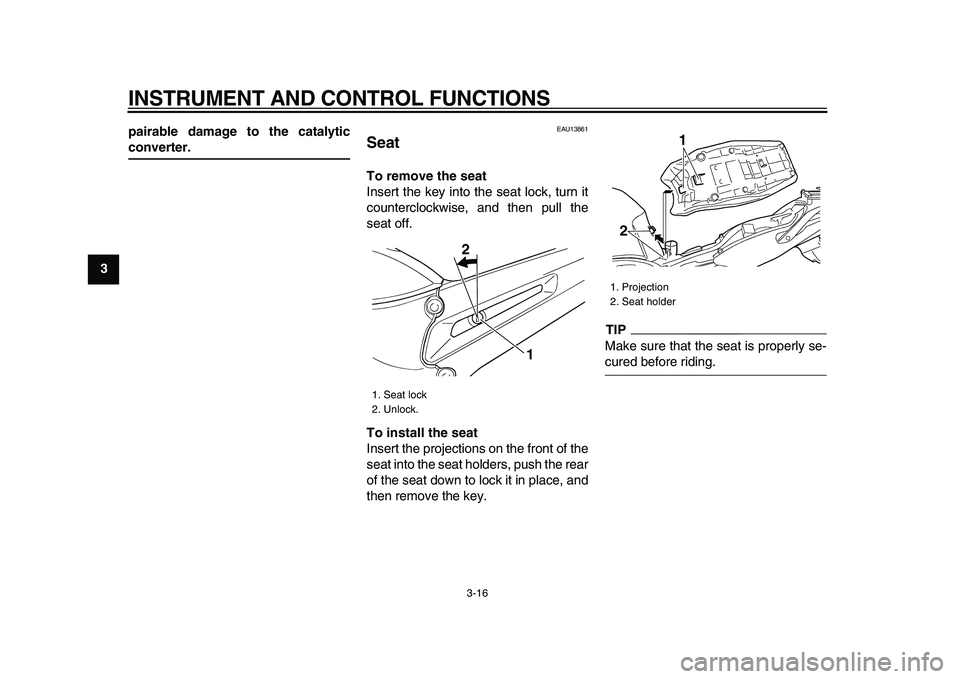
Seat
To remove the seat
Insert the key into the seat lock, turn it
counterclockwise, and then pull the
seat off.
To install the seat
Insert the projections on the front of the
seat into the seat holders, push the rear
of the seat down to lock it in place, and
then remove the key.
TIP
Make sure that the seat is properly se-
cured before riding.
1. Seat lock
2. Unlock.
1
2
1. Projection
2. Seat holder
1
2
Page 33 of 94
INSTRUMENT AND CONTROL FUNCTIONS
3-17
2
34
5
6
7
8
9
EAU14413
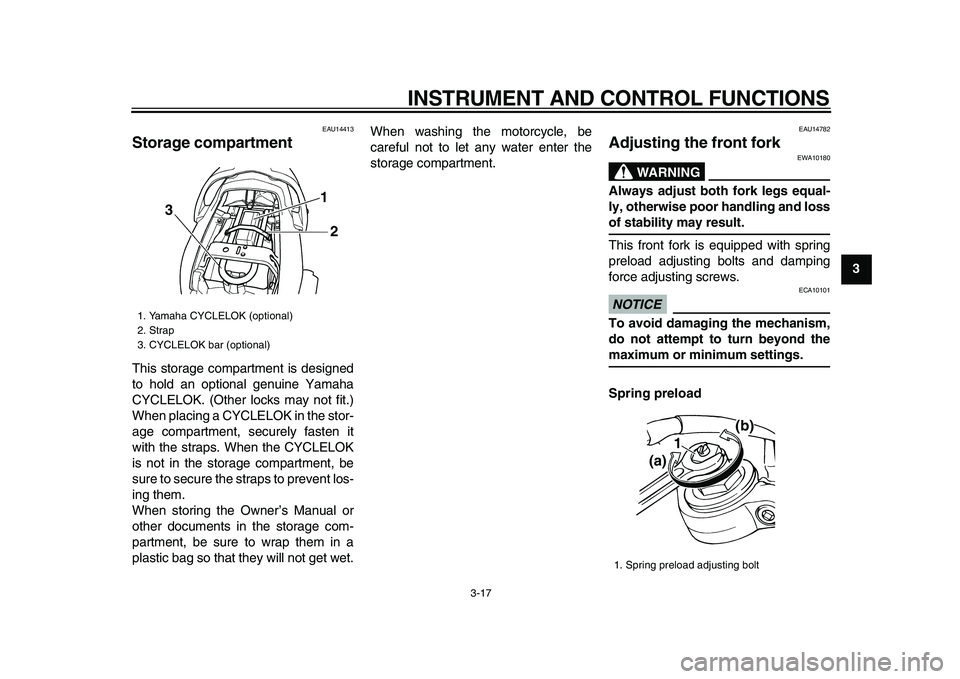
Storage compartment
This storage compartment is designed
to hold an optional genuine Yamaha
CYCLELOK. (Other locks may not fit.)
When placing a CYCLELOK in the stor-
age compartment, securely fasten it
with the straps. When the CYCLELOK
is not in the storage compartment, be
sure to secure the straps to prevent los-
ing them.
When storing the Owner’s Manual or
other documents in the storage com-
partment, be sure to wrap them in a
plastic bag so that they will not get wet.When washing the motorcycle, be
careful not to let any water enter the
storage compartment.
EAU14782
Adjusting the front fork
WARNING
EWA10180
Always adjust both fork legs equal-
ly, otherwise poor handling and loss
of stability may result.
This front fork is equipped with spring
preload adjusting bolts and damping
force adjusting screws.
NOTICE
ECA10101
To avoid damaging the mechanism,
do not attempt to turn beyond the
maximum or minimum settings.
Spring preload
1. Yamaha CYCLELOK (optional)
2. Strap
3. CYCLELOK bar (optional)
3
2 1
1. Spring preload adjusting bolt
1
(a)(b)
Page 63 of 94
PERIODIC MAINTENANCE AND ADJUSTMENT
6-18
2
3
4
5
67
8
9
EAU21960
Cast wheels
To maximize the performance, durabil-
ity, and safe operation of your vehicle,
note the following points regarding the
specified wheels.
●
The wheel rims should be checked
for cracks, bends or warpage be-
fore each ride. If any damage is
found, have a Yamaha dealer re-
place the wheel. Do not attempt
even the smallest repair to the
wheel. A deformed or cracked
wheel must be replaced.
●
The wheel should be balanced
whenever either the tire or wheel
has been changed or replaced. An
unbalanced wheel can result in
poor performance, adverse han-
dling characteristics, and a short-
ened tire life.
●
Ride at moderate speeds after
changing a tire since the tire sur-
face must first be “broken in” for it
to develop its optimal characteris-
tics.
EAU22042
Adjusting the clutch lever free
play
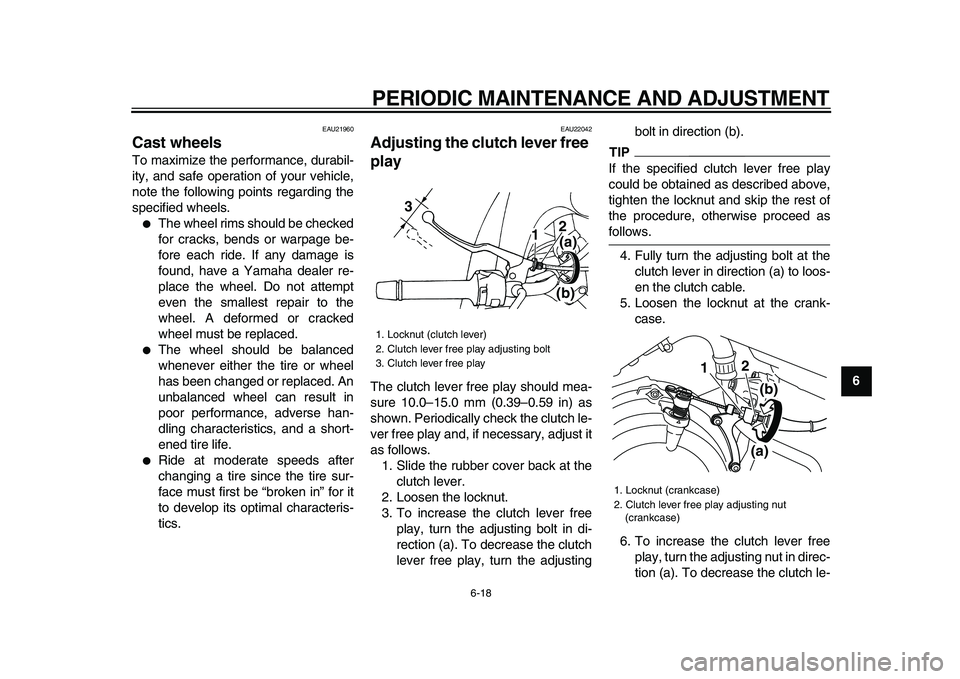
The clutch lever free play should mea-
sure 10.0–15.0 mm (0.39–0.59 in) as
shown. Periodically check the clutch le-
ver free play and, if necessary, adjust it
as follows.
1. Slide the rubber cover back at the
clutch lever.
2. Loosen the locknut.
3. To increase the clutch lever free
play, turn the adjusting bolt in di-
rection (a). To decrease the clutch
lever free play, turn the adjustingbolt in direction (b).
TIP
If the specified clutch lever free play
could be obtained as described above,
tighten the locknut and skip the rest of
the procedure, otherwise proceed as
follows.
4. Fully turn the adjusting bolt at the
clutch lever in direction (a) to loos-
en the clutch cable.
5. Loosen the locknut at the crank-
case.
6. To increase the clutch lever free
play, turn the adjusting nut in direc-
tion (a). To decrease the clutch le-
1. Locknut (clutch lever)
2. Clutch lever free play adjusting bolt
3. Clutch lever free play
12
3
(a)
(b)
1. Locknut (crankcase)
2. Clutch lever free play adjusting nut
(crankcase)
12
(a)(b)
Page 64 of 94
PERIODIC MAINTENANCE AND ADJUSTMENT
6-19
1
2
3
4
5
6
7
8
9
ver free play, turn the adjusting nut
in direction (b).
7. Tighten the locknut at the clutch le-
ver and the crankcase.
8. Slide the rubber cover to its origi-
nal position.
EAU22272
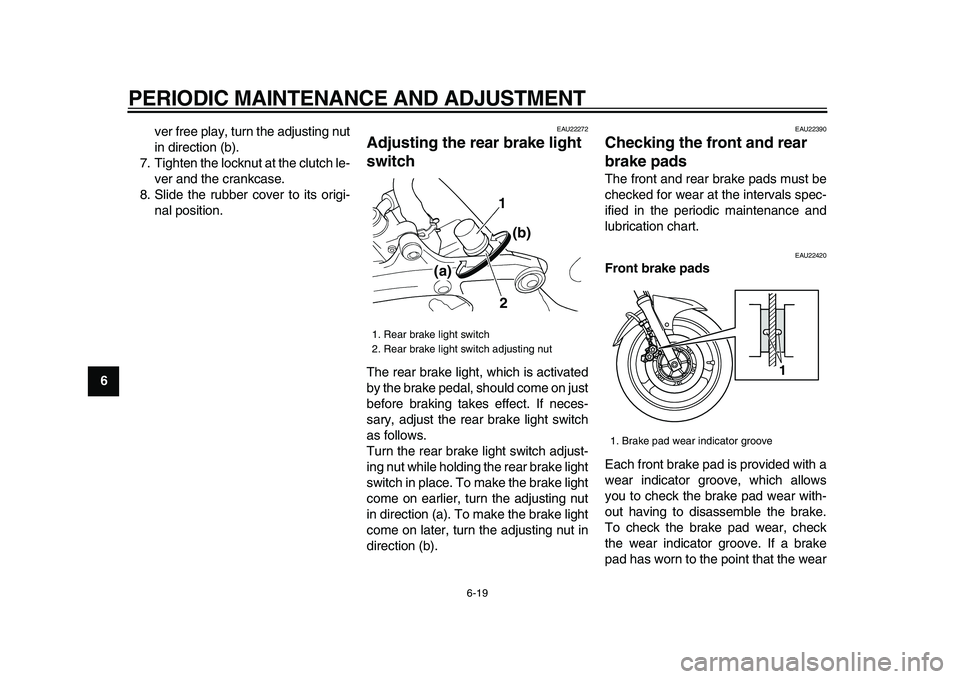
Adjusting the rear brake light
switch
The rear brake light, which is activated
by the brake pedal, should come on just
before braking takes effect. If neces-
sary, adjust the rear brake light switch
as follows.
Turn the rear brake light switch adjust-
ing nut while holding the rear brake light
switch in place. To make the brake light
come on earlier, turn the adjusting nut
in direction (a). To make the brake light
come on later, turn the adjusting nut in
direction (b).
EAU22390
Checking the front and rear
brake pads
The front and rear brake pads must be
checked for wear at the intervals spec-
ified in the periodic maintenance and
lubrication chart.
EAU22420
Front brake pads
Each front brake pad is provided with a
wear indicator groove, which allows
you to check the brake pad wear with-
out having to disassemble the brake.
To check the brake pad wear, check
the wear indicator groove. If a brake
pad has worn to the point that the wear
1. Rear brake light switch
2. Rear brake light switch adjusting nut
1
2 (a)(b)
1. Brake pad wear indicator groove
1