2009 YAMAHA TDM 900 lock
[x] Cancel search: lockPage 66 of 94
PERIODIC MAINTENANCE AND ADJUSTMENT
6-21
1
2
3
4
5
6
7
8
9
Observe these precautions:
●
When checking the fluid level,
make sure that the top of the brake
fluid reservoir is level.
●
Use only the recommended quality
brake fluid, otherwise the rubber
seals may deteriorate, causing
leakage and poor braking perfor-
mance.
●
Refill with the same type of brake
fluid. Mixing fluids may result in a
harmful chemical reaction and
lead to poor braking performance.
●
Be careful that water or dust does
not enter the brake fluid reservoir
when refilling. Water will signifi-
cantly lower the boiling point of the
fluid and may result in vapor lock,
and dirt may clog the ABS hydrau-
lic unit valves.
●
Brake fluid may deteriorate paint-
ed surfaces or plastic parts. Al-
ways clean up spilled fluid
immediately.
●
As the brake pads wear, it is nor-mal for the brake fluid level to grad-
ually go down. However, if the
brake fluid level goes down sud-
denly, have a Yamaha dealer
check the cause.
EAU22731
Changing the brake fluid
Have a Yamaha dealer change the
brake fluid at the intervals specified in
the TIP after the periodic maintenance
and lubrication chart. In addition, have
the oil seals of the master cylinders and
calipers as well as the brake hoses re-
placed at the intervals listed below or
whenever they are damaged or leak-
ing.
●
Oil seals: Replace every two
years.
●
Brake hoses: Replace every four
years.
Recommended brake fluid:
DOT 4
Page 67 of 94
PERIODIC MAINTENANCE AND ADJUSTMENT
6-22
2
3
4
5
67
8
9
EAU22760
Drive chain slack
The drive chain slack should be
checked before each ride and adjusted
if necessary.
EAU22773
To check the drive chain slack
1. Place the motorcycle on the side-
stand.
TIP
When checking and adjusting the drive
chain slack, there should be no weight
on the motorcycle.
2. Shift the transmission into the neu-
tral position.
3. Move the rear wheel by pushing
the motorcycle to locate the tight-
est portion of the drive chain, and
then measure the drive chain slack
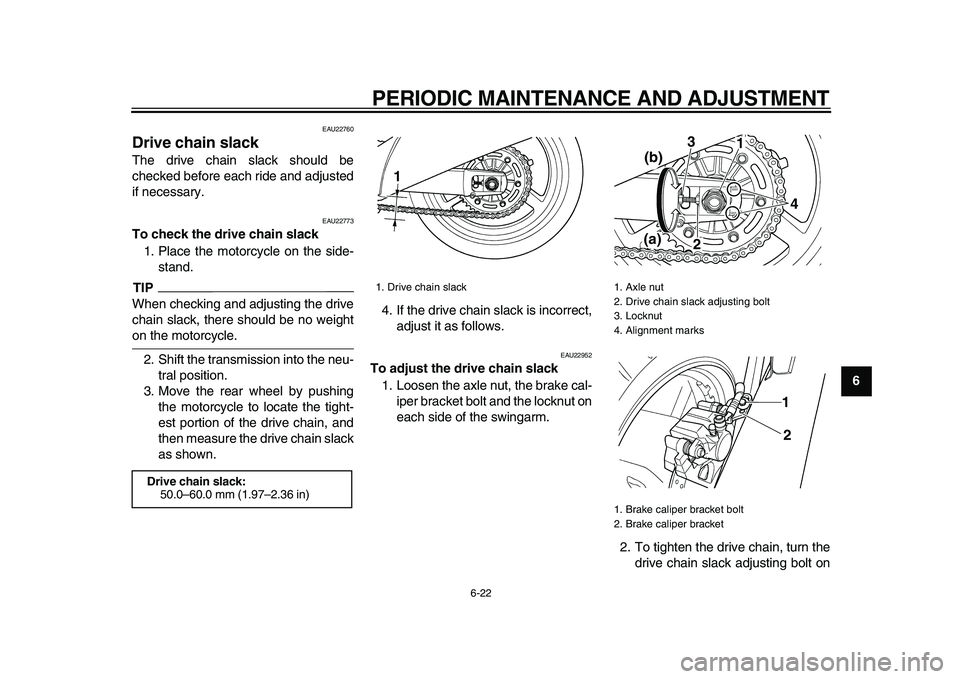
as shown.4. If the drive chain slack is incorrect,
adjust it as follows.
EAU22952
To adjust the drive chain slack
1. Loosen the axle nut, the brake cal-
iper bracket bolt and the locknut on
each side of the swingarm.
2. To tighten the drive chain, turn the
drive chain slack adjusting bolt on
Drive chain slack:
50.0–60.0 mm (1.97–2.36 in)
1. Drive chain slack
1
1. Axle nut
2. Drive chain slack adjusting bolt
3. Locknut
4. Alignment marks
1. Brake caliper bracket bolt
2. Brake caliper bracket
3
4 1
2 (b)
(a)
1
2
Page 68 of 94

PERIODIC MAINTENANCE AND ADJUSTMENT
6-23
1
2
3
4
5
6
7
8
9
each side of the swingarm in direc-
tion (a). To loosen the drive chain,
turn the adjusting bolt on each side
of the swingarm in direction (b),
and then push the rear wheel for-
ward.
NOTICE:
Improper drive
chain slack will overload the en-
gine as well as other vital parts
of the motorcycle and can lead
to chain slippage or breakage.
To prevent this from occurring,
keep the drive chain slack with-
in the specified limits.
[ECA10571]
TIP
Using the alignment marks on each
side of the swingarm, make sure that
both chain pullers are in the same posi-
tion for proper wheel alignment.
3. Tighten the locknuts, and then
tighten the axle nut and the brake
caliper bracket bolt to the specified
torques.
EAU23023
Cleaning and lubricating the
drive chain
The drive chain must be cleaned and
lubricated at the intervals specified in
the periodic maintenance and lubrica-
tion chart, otherwise it will quickly wear
out, especially when riding in dusty or
wet areas. Service the drive chain as
follows.
NOTICE
ECA10581
The drive chain must be lubricated
after washing the motorcycle and
riding in the rain.
1.Clean the drive chain with kero-
sene and a small soft brush.
NOTICE:
To prevent damaging
the O-rings, do not clean the
drive chain with steam cleaners,
high-pressure washers or inap-
propriate solvents.
[ECA11121]
2. Wipe the drive chain dry.
3. Thoroughly lubricate the drive
chain with a special O-ring chain
lubricant.
NOTICE:
Do not use
engine oil or any other lubri-
cants for the drive chain, as theymay contain substances that
could damage the O-rings.
[ECA11111]
Tightening torque:
Axle nut:
150 Nm (15.0 m·kgf, 108.5 ft·lbf)
Brake caliper bracket bolt:
40 Nm (4.0 m·kgf, 29 ft·lbf)
Page 73 of 94

PERIODIC MAINTENANCE AND ADJUSTMENT
6-28
2
3
4
5
67
8
9 To charge the battery
Have a Yamaha dealer charge the bat-
tery as soon as possible if it seems to
have discharged. Keep in mind that the
battery tends to discharge more quickly
if the vehicle is equipped with optional
electrical accessories.
NOTICE
ECA16520
To charge a VRLA (Valve Regulated
Lead Acid) battery, a special (con-
stant-voltage) battery charger is re-
quired. Using a conventional battery
charger will damage the battery. If
you do not have access to a con-
stant-voltage battery charger, have a
Yamaha dealer charge your battery.
To store the battery
1.If the vehicle will not be used for
more than one month, remove
the battery, fully charge it, and
then place it in a cool, dry place.
NOTICE:
When removing the
battery, be sure the key is turned
to “OFF”, then disconnect the
negative lead before discon-
necting the positive lead.
[ECA16302]
2. If the battery will be stored for more
than two months, check it at least
once a month and fully charge it if
necessary.
3. Fully charge the battery before in-
stallation.
4. After installation, make sure that
the battery leads are properly con-
nected to the battery terminals.
NOTICE
ECA16530
Always keep the battery charged.
Storing a discharged battery can
cause permanent battery damage.
EAU38592
Replacing the fuses
For TDM900
1. Backup fuse (for odometer and clock)
2. Radiator fan fuse
3. Turn signal light and hazard fuse
4. Ignition fuse
5. Signaling system fuse
6. Headlight fuse
7. Spare fuse
8. Fuel injection system fuse
9. Main fuse
12 34 5 6 7 97
7
8
Page 74 of 94

PERIODIC MAINTENANCE AND ADJUSTMENT
6-29
1
2
3
4
5
6
7
8
9For TDM900A
The main fuse and the fuse box, which
contains the fuses for the individual cir-
cuits, are located under the seat. (See
page 3-16.)
If a fuse is blown, replace it as follows.
1. Turn the key to “OFF” and turn offthe electrical circuit in question.
2. Remove the blown fuse, and then
install a new fuse of the specified
amperage.
WARNING! Do not
use a fuse of a higher amperage
rating than recommended to
avoid causing extensive dam-
age to the electrical system and
possibly a fire.
[EWA15131]
3. Turn the key to “ON” and turn on
the electrical circuit in question to
check if the device operates.
4. If the fuse immediately blows
again, have a Yamaha dealer
check the electrical system.
1. Backup fuse (for odometer and clock)
2. Radiator fan fuse
3. Turn signal light and hazard fuse
4. Ignition fuse
5. Signaling system fuse
6. Headlight fuse
7. ABS motor fuse
8. ABS motor spare fuse
9. Main fuse
10. Spare fuse
11. Fuel injection system fuse
12. ABS control unit fuse
12 34 5 6 7 8 911 12
10
Specified fuses:
Main fuse:
40.0 A
Headlight fuse:
TDM900 15.0 A
TDM900A 20.0 A
Radiator fan fuse:
20.0 A
Ignition fuse:
10.0 A
Signaling system fuse:
10.0 A
Backup fuse:
TDM900 5.0 A
TDM900A 10.0 A
Fuel injection system fuse:
10.0 A
Turn signal light and hazard fuse:
10.0 A
ABS motor fuse:
TDM900A 30.0 A
ABS control unit fuse:
TDM900A 10.0 A
Page 76 of 94

PERIODIC MAINTENANCE AND ADJUSTMENT
6-31
1
2
3
4
5
6
7
8
9
EAU24081
Replacing the tail/brake light
bulb
1. Remove the seat. (See
page 3-16.)
2. Remove the socket (together with
the bulb) by turning it counter-
clockwise.
3. Remove the burnt out bulb by
pushing it in and turning it counter-
clockwise.
4. Insert a new bulb into the socket,
push it in, and then turn it clock-
wise until it stops.
5. Install the socket (together with the
bulb) by turning it clockwise.
6. Install the seat.
EAU24204
Replacing a turn signal light
bulb
1. Remove the turn signal light lens
by removing the screw.
2. Remove the burnt-out bulb by
pushing it in and turning it counter-
clockwise.3. Insert a new bulb into the socket,
push it in, and then turn it clock-
wise until it stops.
4. Install the lens by installing the
screw.
NOTICE:
Do not over-
tighten the screw, otherwise the
lens may break.
[ECA11191]
1. Socket
1
1. Screw
2. Turn signal light lens
12
1. Turn signal light bulb
1
Page 80 of 94

PERIODIC MAINTENANCE AND ADJUSTMENT
6-35
1
2
3
4
5
6
7
8
9Engine overheating
WARNING
EWA10400
●
Do not remove the radiator cap when the engine and radiator are hot. Scalding hot fluid and steam may be
blown out under pressure, which could cause serious injury. Be sure to wait until the engine has cooled.
●
After removing the radiator cap retaining bolt, place a thick rag, like a towel, over the radiator cap, and then
slowly rotate the cap counterclockwise to the detent to allow any residual pressure to escape. When the hissing
sound has stopped, press down on the cap while turning it counterclockwise, and then remove the cap.
TIP
If coolant is not available, tap water can be temporarily used instead, provided that it is changed to the recommended coolant
as soon as possible.
Wait until the
engine has cooled.
Check the coolant level in the
reservoir and radiator.
The coolant level
is OK.The coolant level is low.
Check the cooling system
for leakage.
Have a Yamaha dealer checkand repair the cooling system.Add coolant. (See TIP.)
Start the engine. If the engine overheats again,
have a
Yamaha dealer check
and repair the cooling system.
There is
leakage.
There is
no leakage.
Page 90 of 94

INDEX
A
ABS (for ABS models) ............................ 3-12
ABS warning light (for ABS models) ......... 3-5
Air filter element, replacing ..................... 6-12
Anti-theft alarm (optional).......................... 3-9
Auxiliary light bulb, replacing .................. 6-32
B
Battery..................................................... 6-27
Brake and clutch levers, checking and
lubricating ............................................. 6-25
Brake and shift pedals, checking and
lubricating ............................................. 6-24
Brake fluid, changing .............................. 6-21
Brake fluid level, checking ...................... 6-20
Brake lever .............................................. 3-11
Brake pedal ............................................. 3-12
C
Cables, checking and lubricating ............ 6-24
Care .......................................................... 7-1
Catalytic converters ................................ 3-15
Clutch lever ............................................. 3-10
Clutch lever free play, adjusting .............. 6-18
Coolant.................................................... 6-11
Coolant temperature gauge ...................... 3-7
Cowlings and panels, removing and
installing.................................................. 6-6
D
Dimmer switch .......................................... 3-9
Drive chain, cleaning and lubricating ...... 6-23
Drive chain slack ..................................... 6-22
E
Engine break-in ......................................... 5-3
Engine idling speed................................. 6-14
Engine oil and oil filter element ................. 6-8
Engine stop switch .................................. 3-10Engine trouble warning light ...................... 3-5
F
Front and rear brake pads, checking ....... 6-19
Front fork, adjusting ................................. 3-17
Front fork, checking ................................. 6-26
Fuel.......................................................... 3-14
Fuel consumption, tips for reducing........... 5-3
Fuel level warning indicator ....................... 3-5
Fuel tank breather hose........................... 3-15
Fuel tank cap ........................................... 3-13
Fuses, replacing ...................................... 6-28
H
Handlebar switches ................................... 3-9
Hazard switch .......................................... 3-10
Headlight bulb, replacing ......................... 6-30
High beam indicator light ........................... 3-4
Horn switch .............................................. 3-10
I
Identification numbers ............................... 9-1
Ignition circuit cut-off system ................... 3-21
Immobilizer system .................................... 3-1
Immobilizer system indicator light.............. 3-5
Indicator and warning lights ....................... 3-4
K
Key identification number .......................... 9-1
L
Luggage strap holders ............................. 3-20
M
Main switch/steering lock........................... 3-2
Matte color, caution ................................... 7-1
Model label ................................................ 9-2
Multi-function display ................................. 3-7
N
Neutral indicator light ................................. 3-4
O
Oil level warning light ................................ 3-4
P
Parking ...................................................... 5-4
Part locations ............................................ 2-1
Pass switch ............................................... 3-9
Periodic maintenance and lubrication
chart ........................................................ 6-2
R
Rear brake light switch, adjusting ........... 6-19
Rear suspension, lubricating ................... 6-25
S
Safety information ..................................... 1-1
Seat ......................................................... 3-16
Shifting ...................................................... 5-2
Shift pedal ............................................... 3-11
Shock absorber assembly, adjusting ...... 3-19
Sidestand ................................................ 3-21
Sidestand, checking and lubricating........ 6-25
Spark plugs, checking ............................... 6-7
Specifications ............................................ 8-1
Starting the engine .................................... 5-1
Start switch .............................................. 3-10
Steering, checking................................... 6-26
Storage...................................................... 7-3
Storage compartment.............................. 3-17
Supporting the motorcycle ...................... 6-32
T
Tachometer unit ........................................ 3-6
Tail/brake light bulb, replacing ................ 6-31
Throttle cable free play, checking ........... 6-15
Throttle grip and cable, checking and
lubricating.............................................. 6-24
Tires ........................................................ 6-15
Tool kit....................................................... 6-1