2009 VOLVO XC60 wheel
[x] Cancel search: wheelPage 223 of 297

05 During your trip
Emergency towing05
221
NOTEDuring towing, ignition mode
II should be
used so that the lighting can be switched on.
CAUTION Vehicles with AWD (All Wheel Drive) with the
front wheels off the ground should not be
towed at speeds above 50 mph (70 km/h) or
for distances longer than 30 miles (50 km).
CAUTION
\b
Please check with state and local
authorities before attempting this type
of towing, as vehicles being towed are
subject to regulations regarding maxi-
mum towing speed, length and type of
towing device, lighting, etc.
\b If the vehicle\fs battery is dead, do not
attempt to start the vehicle by pushing
or pulling it as this will damage the
three-way catalytic converter(s). The
engine must be jump started using an
auxiliary battery (see page 107).
\b If the vehicle is being towed on a flat bed
truck, the towing eyelets must not be
used to pull the vehicle up onto the flat
bed or to secure the vehicle on the flat
bed. Consult the tow truck operator.
Towing vehicles with front wheel drive/
All Wheel Drive
Volvo recommends the use of flat bed equip-
ment.
\b
If wheel lift equipment must be used,
please use extreme caution to help avoid
damage to the vehicle.
In this case, the
vehicle should be towed with the rear
wheels on the ground if at all possible.
\b If it is absolutely necessary to tow the vehi-
cle with the front wheels on the ground,
please refer to the towing information on
page 220.
CAUTION \b
Sling-type equipment applied at the
front will damage radiator and air con-
ditioning lines.
\b It is equally important not to use sling-
type equipment at the rear or apply lift-
ing equipment inside the rear wheels;
serious damage to the rear axle may
result.
\b If the vehicle is being towed on a flat bed
truck, the towing eyelets must not be
used to secure the vehicle on the flat
bed. Consult the tow truck operator.
Page 224 of 297

222 Volvo maintenance
........................................................................\
........ 224
Maintaining your car ........................................................................\
...... 225
Hood and engine compartment ............................................................ 227
Engine oil........................................................................\
....................... 228
Fluids........................................................................\
............................. 230
Replacing bulbs ........................................................................\
............ 232
Wiper blades and washer fluid .............................................................. 240
Battery........................................................................\
........................... 242
Fuses........................................................................\
............................. 245
Wheels and tires........................................................\
............................ 253
Vehicle care ........................................................................\
................... 274
Label information ........................................................................\
.......... 279
Specifications..........................................................\
.............................. 281
Volvo programs ........................................................................\
............. 287
G02092
2
Page 233 of 297

06 Maintenance and specifications
Fluids06
231
The brake fluid should always be between the
MIN and MAX marks on the inside of the res-
ervoir. Check, without removing the cap, that
there is sufficient fluid in the reservoir.
Fluid type: DOT 4+ boiling point >536 °F
(280 °C), P/N 9437433
Replace: The fluid should be replaced accord-
ing to the intervals specified in the Warranty
and Service Records Information booklet.
When driving under extremely hard conditions
(mountain driving, etc), it may be necessary to
replace the fluid more often. Consult a trained
and qualified Volvo service technician.
Always entrust brake fluid changing to a
trained and qualified Volvo service technician.
WARNING
If the fluid level is below the MIN mark in the
reservoir or if a brake-related message is
shown in the information display:
DO NOT
DRIVE. Have the car towed to a trained and
qualified Volvo service technician and have
the brake system inspected.
Filling1. Turn and open the cover.
2. Unscrew the reservoir cap and fill the fluid.
The level must be between the MIN and
MAX marks. Power steering fluid
Check the level frequently. The fluid does not
require changing. The fluid level must be
between the MIN and MAX marks. For capaci-
ties and recommended fluid grade, see
page 285.
WARNING
If a problem should occur in the power
steering system or if the vehicle has no elec-
trical current and must be towed, it is still
possible to steer the vehicle. However, keep
in mind that greater effort will be required to
turn the steering wheel.
CAUTION
Keep the area around the power steering
fluid reservoir clean when checking. G031921
Page 242 of 297

06 Maintenance and specificationsWiper blades and washer fluid 06
240 Wiper blades
The windshield wiper blades are different
lengths. The blade on the driver’s side is longer
than the one on the passenger side.
Service positionThe wiper blades must be in the service (verti-
cal) position for replacement or washing.
1.
Switch off the ignition (ignition mode 0, see
page 79) and keep the remote key in the
ignition slot 1
.
2. Move the right steering wheel lever up and
hold it for at least 1 second. The wipers will
then move to the vertical position on the
windshield. The wipers will return to the normal position
when the vehicle is started.
Replacing the windshield wiper blades
With the wipers in the service position, fold
out the wiper arm from the windshield.
Press the button on the wiper blade attach-
ment and pull the wiper blade straight out,
parallel with the wiper arm.
Slide in the new wiper blade until it clicks
into place.
Check that the blade is securely in place.
CleaningKeeping the windshield and wiper blades clean
helps improve visibility and prolongs the serv-
ice life of the wiper blades. Clean the wiper
blades with a stiff-bristle brush and lukewarm
soap solution or car washing detergent.
1
Does not apply to vehicles with the optional keyless drive. G021763 G021760 G021761 G021762
Page 251 of 297

06 Maintenance and specifications
Fuses06
}}
* Option/accessory, for more information, see Introduction. 249
Under the glove compartment
Fold aside the iupholstery covering the fuse
box.
1. Press the cover\fs lock and fold it up.
2. The fuses are accessible.
Positions
Function A
Rain sensor* 5
SRS system 10
ABS brakes. Electric parking
brake 5 Function A
Accelerator pedal, heated
seats* 7.5
–
ICM display, CD & Radio 15
Steering wheel module 7.5
–
High beam 15 Function A
Moonroof* 20
Backup lights 7.5
–
Front fog light* 15
Windshield washers 15
Adaptive cruise control ACC* 10
– 1011121314123456789
2322212019181716152425262728
G032918
Page 255 of 297
06 Maintenance and specifications
Wheels and tires06
}}
253
Introduction
Your vehicle is equipped with tires according
to the vehicle\fs tire information placard on the
B-pillar (the structural member at the side of
the vehicle, at the rear of the driver\fs door
opening), or on the inside of the fuel filler door
on Canadian models.
CAUTION
Some Volvo models are equipped with an
Ultra High Performance tire and wheel com-
bination designed to provide maximum dry
pavement performance with consideration
for hydroplaning resistance. As such, they
may be more susceptible to road hazard
damage and, depending on driving condi-
tions, may achieve a tread life of less than
20,000 miles (30,000 km). Even if this vehi-
cle is equipped with Volvo’s advanced AWD
or DSTC system, these tires are not
designed for winter driving, and should be
replaced with winter tires when weather
conditions dictate.
The tires have good road holding characteris-
tics and offer good handling on dry and wet
surfaces. It should be noted however that the
tires have been developed to give these fea-
tures on snow/ice-free surfaces.
Certain models are equipped with "all-season"
tires, which provide a somewhat higher degree of road holding on slippery surfaces than tires
without the "all-season" rating. However, for
optimum road holding on icy or snow-covered
roads, we recommend suitable winter tires on
all four wheels.
When replacing tires, be sure that the new tires
are the same size designation, type (radial) and
preferably from the same manufacturer, on all
four wheels. Otherwise there is a risk of altering
the car\fs roadholding and handling characte-
ristics.
New Tires
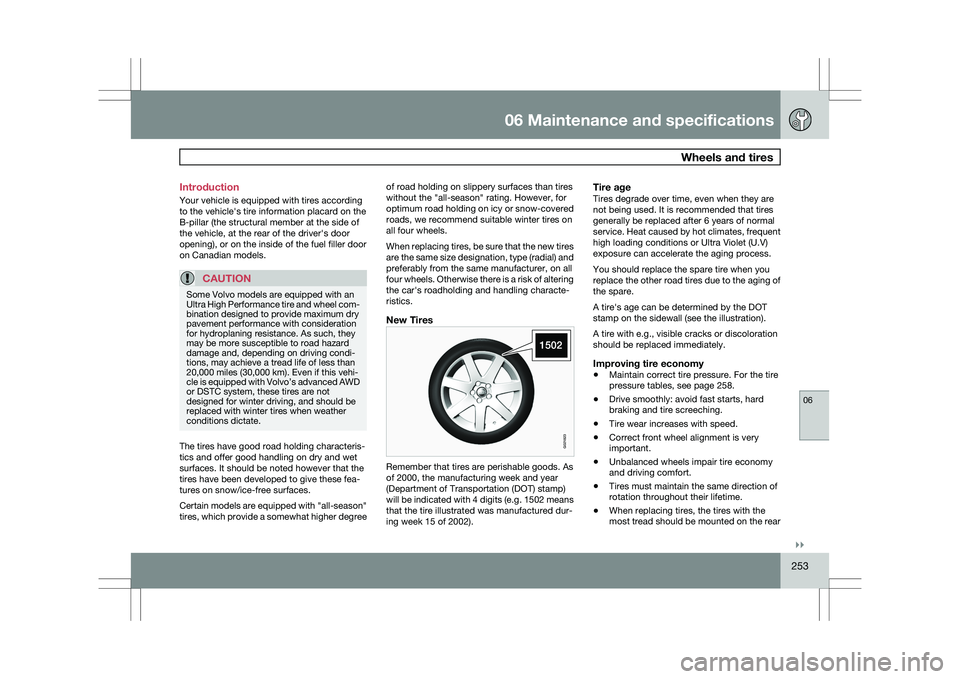
Remember that tires are perishable goods. As
of 2000, the manufacturing week and year
(Department of Transportation (DOT) stamp)
will be indicated with 4 digits (e.g. 1502 means
that the tire illustrated was manufactured dur-
ing week 15 of 2002).
Tire ageTires degrade over time, even when they are
not being used. It is recommended that tires
generally be replaced after 6 years of normal
service. Heat caused by hot climates, frequent
high loading conditions or Ultra Violet (U.V)
exposure can accelerate the aging process.
You should replace the spare tire when you
replace the other road tires due to the aging of
the spare.
A tire\fs age can be determined by the DOT
stamp on the sidewall (see the illustration).
A tire with e.g., visible cracks or discoloration
should be replaced immediately.
Improving tire economy
\b
Maintain correct tire pressure. For the tire
pressure tables, see page 258.
\b Drive smoothly: avoid fast starts, hard
braking and tire screeching.
\b Tire wear increases with speed.
\b Correct front wheel alignment is very
important.
\b Unbalanced wheels impair tire economy
and driving comfort.
\b Tires must maintain the same direction of
rotation throughout their lifetime.
\b When replacing tires, the tires with the
most tread should be mounted on the rear G021823
Page 256 of 297
06 Maintenance and specificationsWheels and tires 06
254 wheels to reduce the chance of oversteer
during hard braking.
\b Hitting curbs or potholes can damage the
tires and/or wheels permanently.
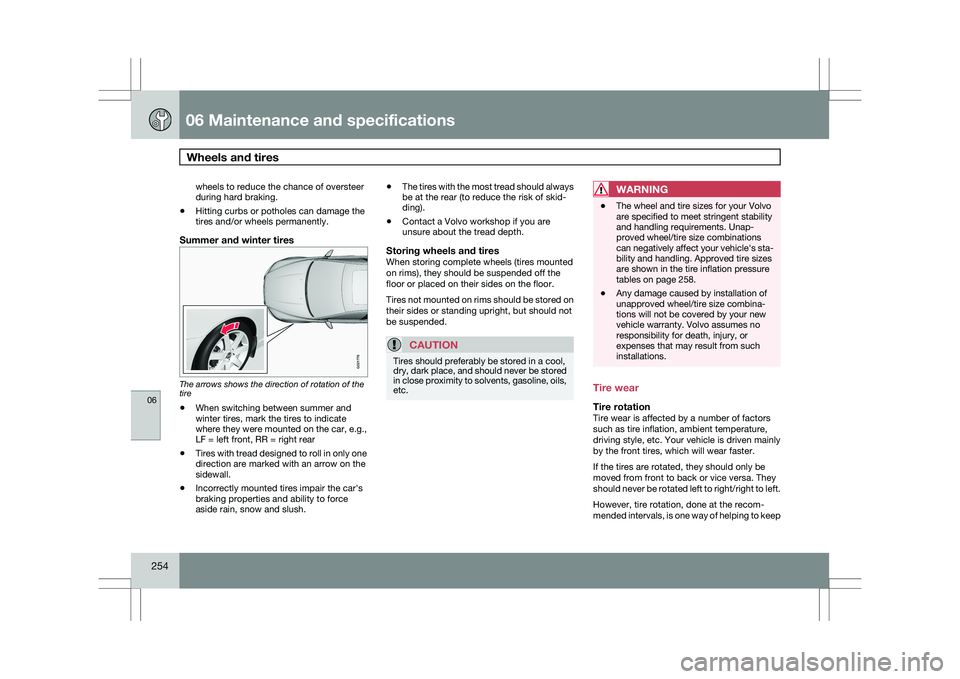
Summer and winter tires The arrows shows the direction of rotation of the
tire
\b
When switching between summer and
winter tires, mark the tires to indicate
where they were mounted on the car, e.g.,
LF = left front, RR = right rear
\b Tires with tread designed to roll in only one
direction are marked with an arrow on the
sidewall.
\b Incorrectly mounted tires impair the car\fs
braking properties and ability to force
aside rain, snow and slush. \b
The tires with the most tread should always
be at the rear (to reduce the risk of skid-
ding).
\b Contact a Volvo workshop if you are
unsure about the tread depth.Storing wheels and tiresWhen storing complete wheels (tires mounted
on rims), they should be suspended off the
floor or placed on their sides on the floor.
Tires not mounted on rims should be stored on
their sides or standing upright, but should not
be suspended.
CAUTION Tires should preferably be stored in a cool,
dry, dark place, and should never be stored
in close proximity to solvents, gasoline, oils,
etc.
WARNING \b
The wheel and tire sizes for your Volvo
are specified to meet stringent stability
and handling requirements. Unap-
proved wheel/tire size combinations
can negatively affect your vehicle\fs sta-
bility and handling. Approved tire sizes
are shown in the tire inflation pressure
tables on page 258.
\b Any damage caused by installation of
unapproved wheel/tire size combina-
tions will not be covered by your new
vehicle warranty. Volvo assumes no
responsibility for death, injury, or
expenses that may result from such
installations. Tire wear
Tire rotationTire wear is affected by a number of factors
such as tire inflation, ambient temperature,
driving style, etc. Your vehicle is driven mainly
by the front tires, which will wear faster.
If the tires are rotated, they should only be
moved from front to back or vice versa. They
should never be rotated left to right/right to left.
However, tire rotation, done at the recom-
mended intervals, is one way of helping to keep G021778
Page 257 of 297
06 Maintenance and specifications
Wheels and tires06
}}
255
tread wear as even as possible and will help
you get maximum mileage from your tires.
Ideally, tire rotation should be done the first
time after approximately 3,000 miles
(5, 000 km) and thereafter at 6,000 mile
(10,000 km) intervals.
Tire rotation should only be performed if front/
rear tire wear is fairly even and tread height is
above 1/16" (1.6 mm).
NOTE
Tire rotation is not included in regularly
scheduled maintenance and is performed
only at customer request, at additional
charge.
Your Volvo retailer can also provide guidance
based on your particular driving circumstan-
ces.
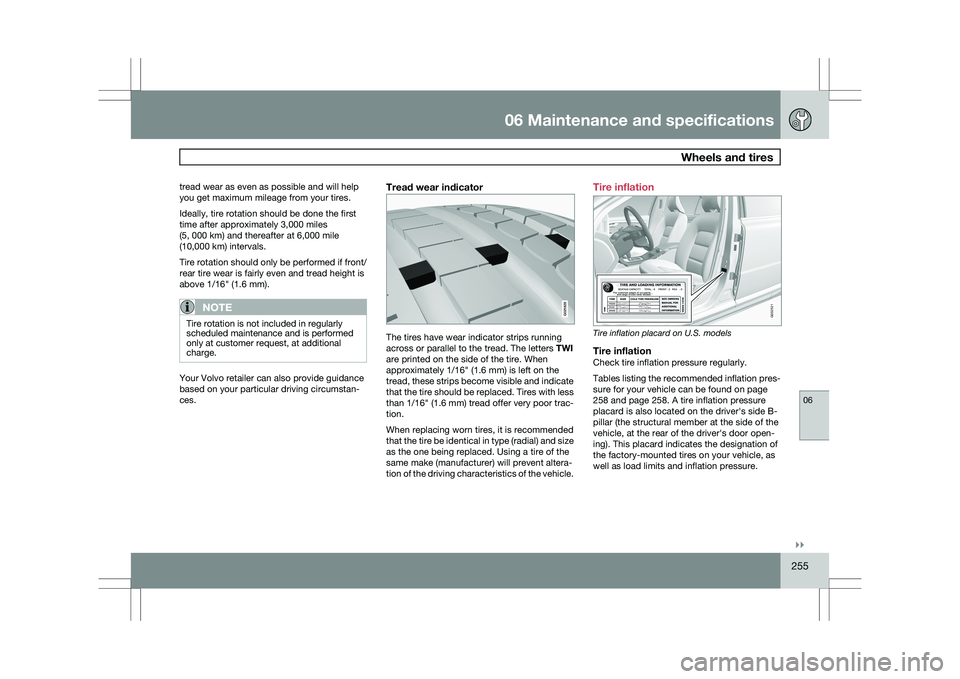
Tread wear indicator The tires have wear indicator strips running
across or parallel to the tread. The letters
TWI
are printed on the side of the tire. When
approximately 1/16" (1.6 mm) is left on the
tread, these strips become visible and indicate
that the tire should be replaced. Tires with less
than 1/16" (1.6 mm) tread offer very poor trac-
tion.
When replacing worn tires, it is recommended
that the tire be identical in type (radial) and size
as the one being replaced. Using a tire of the
same make (manufacturer) will prevent altera-
tion of the driving characteristics of the vehicle. Tire inflation
Tire inflation placard on U.S. models
Tire inflationCheck tire inflation pressure regularly.
Tables listing the recommended inflation pres-
sure for your vehicle can be found on page
258 and page 258. A tire inflation pressure
placard is also located on the driver\fs side B-
pillar (the structural member at the side of the
vehicle, at the rear of the driver\fs door open-
ing). This placard indicates the designation of
the factory-mounted tires on your vehicle, as
well as load limits and inflation pressure. G021829 G032521